![Can a jointed urethral sound break? | The two-cord design also broke [OK Prostate Chip]](/img/a/T0587/eyecatch.svg)
This page is based on entries from "ok-lab's diary" (https://ok-lab.hatenablog.com/), the Japanese development diary written by Mr. Okada, founder of OK Lab, a small company in Japan (Okada Comfortable Life Laboratory). Only the entries about "jointed and two-cord urethral sounds" are summarized here, in order of publication. Past prices and sizes are as written at the time. Current prices come from the official product list (retrieved September 4, 2026). Quotations are translated from Japanese.
Note: This page is a personal reading log by someone with no connection to the maker or the seller. It reflects the source entries as of their publication dates and makes no guarantee of accuracy or safety. The product is not a medical device; talk to a doctor about any health decision. Check the official site for current information. This page contains advertising.
In short
The diary records breakage in both wire-reinforced and two-cord jointed urethral sounds.
Mr. Okada removed reinforcing wires and later added cushioning between joints.
No matching product can be confirmed on the current list.
About this product

The OK Prostate Chip is a small device that is placed in the urethra (the urine passage) so that it acts on the prostate; the maker sells it in several shapes, sizes and materials. It is made and sold by OK Lab (Okada Comfortable Life Laboratory), a small company in Japan, through its own online store, and prices are in Japanese yen (JPY). The maker's development diary, "ok-lab's diary", is written in Japanese. This page is an English summary of it, and every quotation is translated. OK Lab ships internationally, so readers outside Japan can order (see "Buying from outside Japan" below). Product names on this page are plain-English descriptions. The official Japanese product name is shown once in the product table so you can find the same item in the store.
Before you read: key terms
| Term | Plain-English meaning |
|---|---|
| Urethra | The urine passage, and the place where these devices were used in the diary. |
| Jointed urethral sound | A long device with rigid sections and flexible connections, intended by the maker for stimulation inside the urethra. |
| Paired cable | Two cords joined side by side; these form the core of the two-cord design. |
| Epoxy resin | The hard coating used to form the sound's rigid sections. |
| Silicone tube | A flexible sleeve used around reinforcing wires, or as cushioning between joints in the later design. |
| Reinforcing wire | A wire inside the earlier construction, where sliding within a sleeve allowed bending. |
| Blue chip | Another tip named in the pricing discussion, offered as an end-piece. The diary does not explain this. |
| Cartilage | Mr. Okada's comparison for the soft cushioning between resin sections. The diary does not explain this. |
What happens: jointed urethral sound durability
The OK Prostate Chip is a small device placed in the urethra (the urine passage) to act on the prostate. A jointed urethral sound is a longer device with stiff sections and flexible connections, discussed here as a form intended for internal stimulation. Mr. Okada explored this shape because a completely rigid construction had proved inconvenient in his experience. The diary describes a tip connected to a jointed length, with cable continuing behind it.
A jointed urethral sound addressed the maker's complaint about rigidity
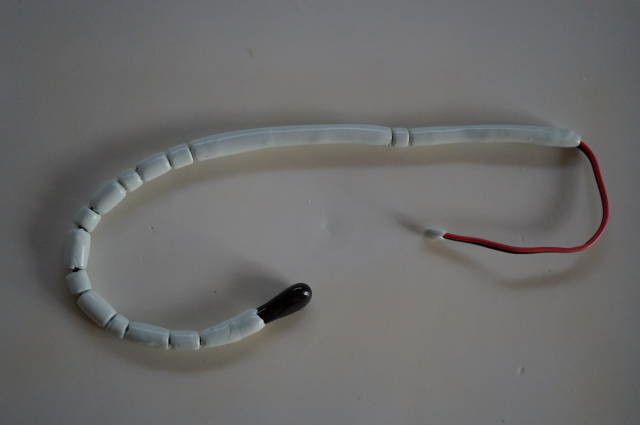
In an entry published in December 2022, Mr. Okada called the previous week's completely unbending wire prototype inconvenient for remaining inside the urethra. His revised sound combined rigid lengths with flexible sections. Its core used paired cable (two cords joined side by side), with a wire-containing tube along each side.
The approximately 2 mm core had epoxy resin (a hard coating) over it, bringing coated sections to approximately 5 mm across. Coated sections stayed rigid; reinforcing wires could slide inside silicone tubes (flexible sleeves) where the structure bent. Mr. Okada favored a smooth ceramic tip because he expected it to pass internal muscle openings more readily.
(Source: ok-lab's diary, published December 2022)
https://ok-lab.hatenablog.com/entry/2022/12/17/122643
The two-cord urethral sound launched after Mr. Okada's personal trial
In an entry published in January 2023, Mr. Okada described his trial of a sound made from cable and epoxy. He concluded that 2 cords were enough for his purposes, without the earlier 4-cord construction. He announced sales because he believed breakage would no longer be a concern.
The closely spaced resin sections allowed limited movement, which was why he described the design as jointed. That confidence was his assessment at launch; a customer report in April 2023 subsequently recorded cable failure. His caution concerned orientation: the new structure bent in only one direction.
(Source: ok-lab's diary, published January 2023)
https://ok-lab.hatenablog.com/entry/2023/01/21/122941
Jointed urethral sound pricing allowed different lengths within a stated limit
In an entry published in January 2023, the jointed section was priced independently of the tip. The resin pattern alternated 10 mm and 5 mm sections, sold as one 15 mm unit for ¥500 (about $3 at ¥156 = $1, rate as of 2026-09-04) excluding tax. A maximum 12 units provided 18 cm of joints at a quoted charge of ¥6,000 (about $38 at ¥156 = $1, rate as of 2026-09-04) excluding tax.
Beyond the joints, up to 10 cm of paired cable was free. One published resin-tip example combined 18 cm of joints with the tip for ¥8,000 (about $51 at ¥156 = $1, rate as of 2026-09-04) excluding tax. The diary also listed a short ceramic-tip example with 12 cm of joints for ¥7,000 (about $45 at ¥156 = $1, rate as of 2026-09-04) excluding tax.
(Source: ok-lab's diary, published January 2023)
https://ok-lab.hatenablog.com/entry/2023/01/21/122941
Eight-hole jointed urethral sounds became available with an additional charge
In an entry published in January 2023, Mr. Okada also announced an 8-hole two-cord version. This had 4 holes at the front and 4 holes at the rear. The published additional charge was ¥1,000 (about $6 at ¥156 = $1, rate as of 2026-09-04) excluding tax for those holes.
He had held back an earlier eight-hole wire-reinforced sound because he lacked confidence in its stability. The newly announced option followed the overall form of the two-cord sound shown in that entry. Mr. Okada offered the two-cord construction as the form he then felt confident enough to sell.
(Source: ok-lab's diary, published January 2023)
https://ok-lab.hatenablog.com/entry/2023/01/21/122941
The maker's answer to jointed urethral sound durability
Mr. Okada changed the internal construction and later introduced cushioning between the resin sections.
Wire failure prompted Mr. Okada's proposed two-cord urethral sound replacement
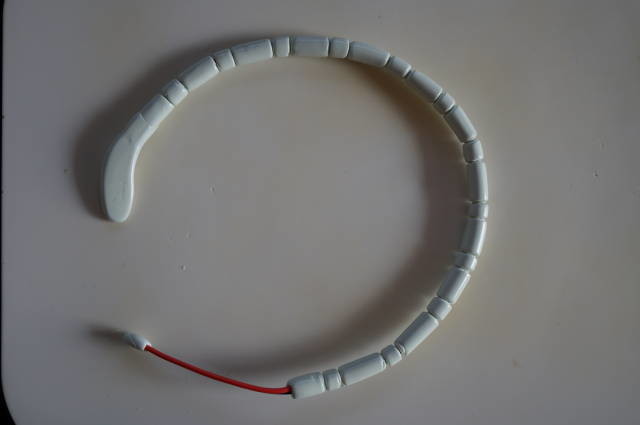
In an entry published in January 2023, a customer sought a replacement after a roughly 6 mm wire-reinforced sound broke after 3 weeks. The break was at the connection to a rigid end section, and the customer wanted that section shortened. Mr. Okada predicted that shortening alone might extend durability from 3 weeks to 6 weeks.
He was reluctant to make that change and instead proposed removing the reinforcing wires from the design. The resulting prototype contained cable and epoxy, and he estimated roughly half a year of durability at that point. His proposed answer was a two-cord build without the long rigid section.
(Source: ok-lab's diary, published January 2023)
https://ok-lab.hatenablog.com/entry/2023/01/21/122941
Mr. Okada favored a flat-ended resin tip for jointed urethral sounds
In an entry published in January 2023, the resin tip with its cable cost ¥2,000 (about $13 at ¥156 = $1, rate as of 2026-09-04) excluding tax. The tip described for this sound was curved, with a flat leading end. Mr. Okada also said the jointed structure could connect to conventional chips.
For ceramic tips or the blue chip (another tip named in the diary), the chosen tip's price was added to the jointed-section charge. No matching product can be confirmed on the current list. Mr. Okada specifically recommended the curved, flat-ended resin tip for this sound because he favored its narrower profile.
(Source: ok-lab's diary, published January 2023)
https://ok-lab.hatenablog.com/entry/2023/01/21/122941
A cushioned jointed urethral sound addressed concern about gaps pinching tissue
In an entry published in February 2023, Mr. Okada described a revised design intended to protect tissue around the gaps between rigid sections. It featured 1 mm silicone tubing in 2 wraps within those gaps. He compared the soft material's role to cartilage (his analogy for cushioning between the hard sections).
The published extra charge was ¥1,000 (about $6 at ¥156 = $1, rate as of 2026-09-04) excluding tax per 10 cm, added to the jointed sound's price. At the maximum jointed length of 18 cm, the additional charge was ¥2,000 (about $13 at ¥156 = $1, rate as of 2026-09-04) excluding tax. Mr. Okada recommended this cushioned version based on his confidence in the revised joint design.
(Source: ok-lab's diary, published February 2023)
https://ok-lab.hatenablog.com/entry/2023/02/11/123054
How jointed urethral sound durability changed over time
| Published | What the diary said then |
|---|---|
| Dec 2022 | An inconvenient rigid prototype prompted a design with flexible sections. |
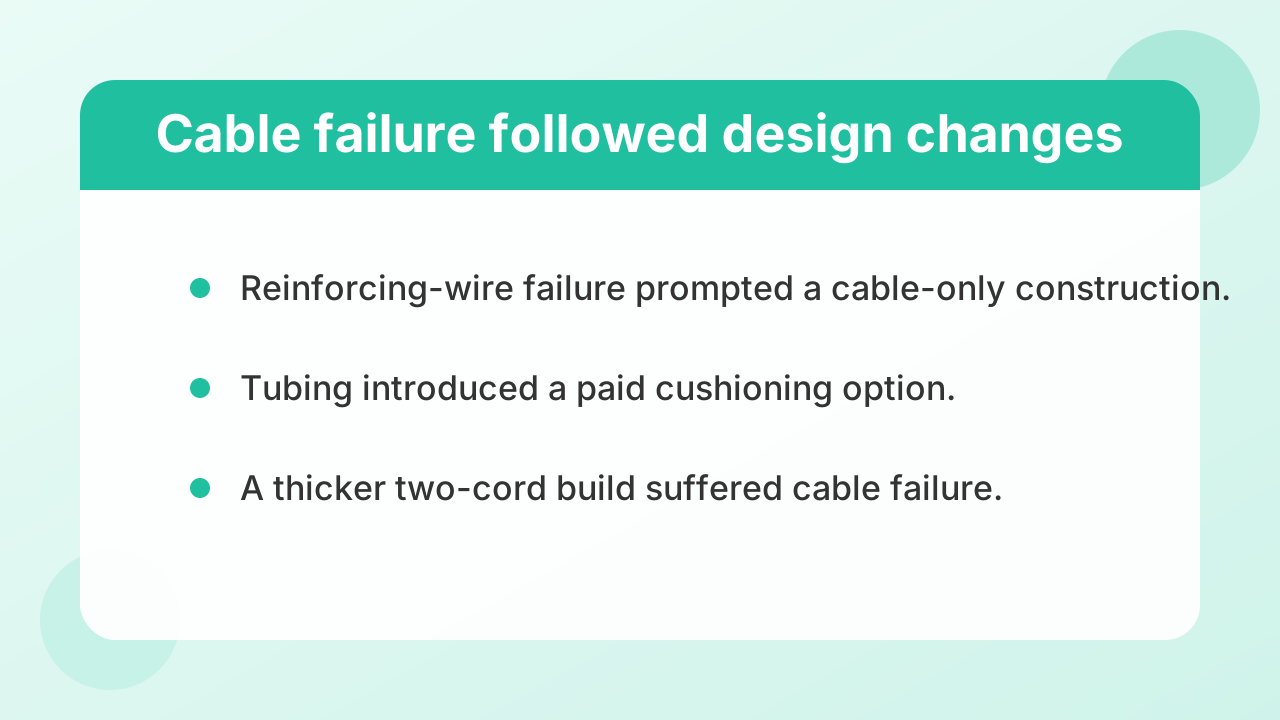
| Jan 2023 | Reinforcing-wire failure prompted a cable-only construction. |
| Jan 2023 | Sales began after Mr. Okada's personal trial. |
| Jan 2023 | An eight-hole version gained its own additional charge. |
| Feb 2023 | Tubing between resin sections introduced a paid cushioning option. |
| Apr 2023 | A thicker two-cord build suffered cable failure despite the earlier durability estimate. |
The diary does not say what the current state is.
OK Prostate Chip products related to jointed urethral sound durability
No current product is directly tied to this topic.
Common worries about jointed urethral sound durability
The customer requests concerned shorter rigid sections, greater thickness, and replacement after breakage.
"Would shorter sections prevent jointed urethral sound breakage?"
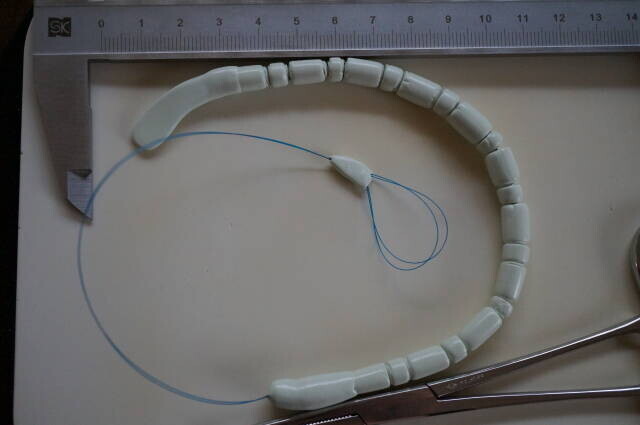
In an entry published in January 2023, the customer behind the wire-reinforced trial proposed shortening the rigid end section. That request specified a change from 5 cm to around 2 cm. The customer thought a longer rigid section put greater force on its connection when bent.
Mr. Okada did not consider shortening a sufficient answer to that customer's durability problem. The diary does not record how a shortened wire-reinforced version performed. His recommendation in that exchange was the cable-only design.
(Source: ok-lab's diary, published January 2023)
https://ok-lab.hatenablog.com/entry/2023/01/21/122941
"Could a two-cord urethral sound be made thicker?"
In an entry published in February 2023, the customer whose request inspired the design had asked for a larger diameter. Mr. Okada made that customer's sound approximately 7–8 mm across; the standard diameter he stated then was 5–6 mm. The diary records initial difficulty with the thicker build, followed by the customer's report of comfortable use.
That customer also reported that the two-cord sound could serve in place of the earlier wire-reinforced design. Later in the same entry, Mr. Okada recommended the version with cushioning between its joints.
(Source: ok-lab's diary, published February 2023)
https://ok-lab.hatenablog.com/entry/2023/02/11/123054
"Can a broken two-cord urethral sound be replaced?"
In an entry published in April 2023, a customer reported breakage after 3 months of daily use. Mr. Okada had expected about 6 months, and located the break roughly 5 cm from the rear. He placed it at the tightest urethral bend, which he described as turning 90° toward the prostate.
He attributed the failure to cable durability and stronger pulling forces because this unusually thick build was harder to bend. The customer requested another sound of the same design. The diary does not record whether the replacement was completed.
(Source: ok-lab's diary, published April 2023)
https://ok-lab.hatenablog.com/entry/2023/04/29/123107
Buying from outside Japan

OK Lab ships internationally to countries covered by Japan Post's EMS courier service. Overseas orders are paid in advance by PayPal. Each order carries a ¥400 (about $3 at ¥156 = $1, rate as of 2026-09-04) handling fee, and EMS shipping is charged on top. These terms come from OK Lab's official sales-terms page (written here as plain text, not a link: ok-lab.net/docs/law), checked on September 7, 2026; confirm them on the official store before you order, because they can change.
Summary of this article
| What you wanted to know | The answer |
|---|---|
| What is the main durability finding? | The diary records failures in both wire-reinforced and two-cord builds. |
| What is the base product? | The OK Prostate Chip is a urethral device made and sold by OK Lab in Japan. |
| What does jointed mean here? | Rigid resin sections have flexible connections between them. |
| Why did the jointed shape appear? | Mr. Okada found the earlier completely rigid prototype inconvenient. |
| What changes did the maker propose? | Removing reinforcing wires, favoring a flat-ended resin tip, and cushioning joint gaps. |
| How did the account change over time? | Early confidence was followed by a customer report of cable failure. |
| Is a matching product confirmed today? | No matching product can be confirmed on the current list. |
| What happened to the replacement request? | The April customer requested the same design; completion is not recorded. |
| How are overseas purchases handled? | PayPal payment in advance, a handling fee, and separate EMS shipping charges. |
Source: ok-lab's diary (Okada Comfortable Life Laboratory). The original entries are in Japanese; quotations on this page are translated. Photos and videos are on the original entries.
This article is a summary of the maker's development diary. The product is not a medical device and no result is guaranteed. If anything feels wrong or worries you, see a doctor. Prices, specifications and cautions change, so confirm the latest information on the official blog and the official site. Questions about ordering and shipping go to the seller.