![What size is an electrode chip? | Thickness depends on the design [OK Prostate Chip]](/img/a/T0593/eyecatch.svg)
This page is based on entries from "ok-lab's diary" (https://ok-lab.hatenablog.com/), the Japanese development diary written by Mr. Okada, founder of OK Lab, a small company in Japan (Okada Comfortable Life Laboratory). Only the entries about "electrode chip shape and size" are summarized here, in order of publication. Past prices and sizes are as written at the time. Current prices come from the official product list (retrieved September 4, 2026). Quotations are translated from Japanese.
Note: This page is a personal reading log by someone with no connection to the maker or the seller. It reflects the source entries as of their publication dates and makes no guarantee of accuracy or safety. The product is not a medical device; talk to a doctor about any health decision. Check the official site for current information. This page contains advertising.
In short
Electrode chip size depends on the wiring, protective material, and arrangement, not width alone.
Mr. Okada proposed custom dimensions and different connections, but some requests could not be met.
The current list includes the comparison resin chip, but does not confirm these custom electrode specifications.
About this product

The OK Prostate Chip is a small device that is placed in the urethra (the urine passage) so that it acts on the prostate; the maker sells it in several shapes, sizes and materials. It is made and sold by OK Lab (Okada Comfortable Life Laboratory), a small company in Japan, through its own online store, and prices are in Japanese yen (JPY). The maker's development diary, "ok-lab's diary", is written in Japanese. This page is an English summary of it, and every quotation is translated. OK Lab ships internationally, so readers outside Japan can order (see "Buying from outside Japan" below). Product names on this page are plain-English descriptions. The official Japanese product name is shown once in the product table so you can find the same item in the store.
Before you read: key terms
| Term | Plain-English meaning |
|---|---|
| Urethra | The urine passage; it is where the urethral electrode chips discussed here are intended to sit. |
| Electrode | An electrical contact, used to deliver the electrical stimulation discussed in the diary. |
| Resin | The base material supporting some aluminum electrodes. The diary does not explain its composition. |
| Sphincter | A closing muscle; Mr. Okada intended it to hold an electrode against tissue. |
| Stacked twin | Two chips joined together as a pair, used to make a stainless steel electrode assembly. |
| End-to-end pair | Two chips linked lengthwise, used to form a longer electrode assembly. |
| Pole | An electrical side of the arrangement; the proposed designs assign chips to one or two poles. |
What happens: electrode chip size
The OK Prostate Chip is a small device placed in the urethra to act on the prostate. The electrode versions described here carry electrical contacts, either around resin bases or on stainless steel chips that serve as the contacts themselves. Wiring and protective material can add bulk, including at the rear end of a chip. Some designs pair chips together, while others connect them lengthwise for electrical stimulation inside the urethra.
Electrode chip size first reflected different locations for muscle contact
In an entry published in March 2019, Mr. Okada described prototypes intended for electrical muscle training. The urethral version was about 40 mm long; the anal version was about 60 mm, including its enlarged ends.
He said sphincters (closing muscles) would hold the electrodes against tissue without adhesive gel or fixing belts. The entry does not record a customer's experience with these prototypes. Mr. Okada proposed these separate shapes around the intended muscle contact at each location.
(Source: ok-lab's diary, published March 2019)
https://ok-lab.hatenablog.com/entry/2019/03/16/165528
Stacked electrode chip size increased when stainless steel pieces were paired
In an entry published in September 2023, Mr. Okada introduced a stacked twin (two chips joined together) made from stainless steel. He expected it to be about 7–8 mm thick and to form a two-pole electrode, with two electrical contacts.
His published price combined the cost of two single-pole versions with a ¥1,000 (about $6 at ¥156 = $1, rate as of 2026-09-04) excluding tax joining charge. Different chip shapes could be paired, subject to whether he could join them. Mr. Okada generally ruled out Zoro (ゾロ) and flat-curved designs, while suggesting ordinary short, semi-long, and long shapes as workable choices.
(Source: ok-lab's diary, published September 2023)
https://ok-lab.hatenablog.com/entry/2023/09/02/122918
Short electrode chip size still included a thicker rear end
An entry published in September 2023 measured a small short stainless steel stacked twin made for a customer. Its leading end was about 6 mm thick and 7 mm wide. Its rear was about 8.5 mm thick and 8 mm wide.
The maker compared it with a small semi-long twin prototype available in the workshop. The diary does not record how the short twin felt in use after delivery. Mr. Okada suggested that someone able to accommodate a single large semi-long chip might find this twin suitable.
(Source: ok-lab's diary, published September 2023)
https://ok-lab.hatenablog.com/entry/2023/09/23/121909
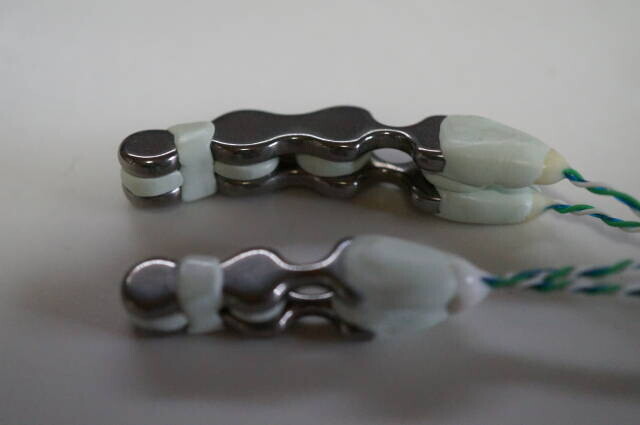
Electrode chip shape changed with cables running alongside both pieces
In an entry published in August 2024, Mr. Okada introduced a lengthwise stainless steel pair (the centipede electrode). Its prototype used small flat-curved chips at both positions, with separate cables bundled together. The tax-exclusive base price included both chips, ¥2,000 (about $13 at ¥156 = $1, rate as of 2026-09-04) × 2 for electrode connections, and ¥1,000 (about $6 at ¥156 = $1, rate as of 2026-09-04) for routing cable alongside the second chip.
Bundling the cables over 20 cm added ¥2,000 (about $13 at ¥156 = $1, rate as of 2026-09-04); optional plug connection and coating between the chips each cost ¥1,000 (about $6 at ¥156 = $1, rate as of 2026-09-04), also excluding tax. He also described an unbundled version with the cable-bundling charge omitted. Mr. Okada offered omission of the coating between chips for people who disliked silicone rubber.
(Source: ok-lab's diary, published August 2024)
https://ok-lab.hatenablog.com/entry/2024/08/03/122758
Long electrode chip size prompted a check before fabrication proceeded
In an entry published in August 2026, a customer requested two aluminum electrode chips, each 49 mm long and about 7 mm wide. Mr. Okada reported making the pair after the customer confirmed those dimensions.
The entry does not record the customer's experience with the completed device. OK Lab had asked for confirmation because staff considered that length outside the company's previous manufacturing experience.
(Source: ok-lab's diary, published August 2026)
https://ok-lab.hatenablog.com/entry/2026/08/08/122906
The maker's answer to electrode chip size
Mr. Okada changed connections and chip arrangements to address size limits, while some requests remained conditional.
Electrode chip size decreased when the joint moved beyond its body
In an entry published in April 2023, a customer wanted a jointed two-wire cable but said thickness above 7 mm would not fit. The joint alone measured about 6 mm; the electrode and protective resin made the chip's rear at least 7 mm thick.
Mr. Okada initially said the request was impossible, then proposed plain wires inside the chip and joints starting farther along the cable. The customer accepted reduced stability, and the finished chip returned to the earlier electrode size.
Mr. Okada reported improving the unstable junction with a rubber cover; the entry does not describe the customer's experience after delivery. He offered this separated joint arrangement as another design choice for customers considering a jointed-cable electrode.
(Source: ok-lab's diary, published April 2023)
https://ok-lab.hatenablog.com/entry/2023/04/01/122841
End-to-end electrode chip size depended partly on the second piece
In an entry published in July 2024, Mr. Okada answered a difficult design request with an end-to-end pair (chips linked lengthwise). His prototype combined a small semi-long stainless steel chip with a large short chip, using a 2.5 mm cable cover.
He set the same price as the stacked twin and allowed the two chips to be chosen separately. The cable added about 2 mm to the second chip's thickness; he estimated a small short version at just over 5 mm thick.
He estimated its width at just over 8 mm; the prototype's gap was about 10 mm, with about 4 mm described as possible. Mr. Okada favored a flat second chip because he thought attaching its cable could be difficult on other shapes.
(Source: ok-lab's diary, published July 2024)
https://ok-lab.hatenablog.com/entry/2024/07/27/122927
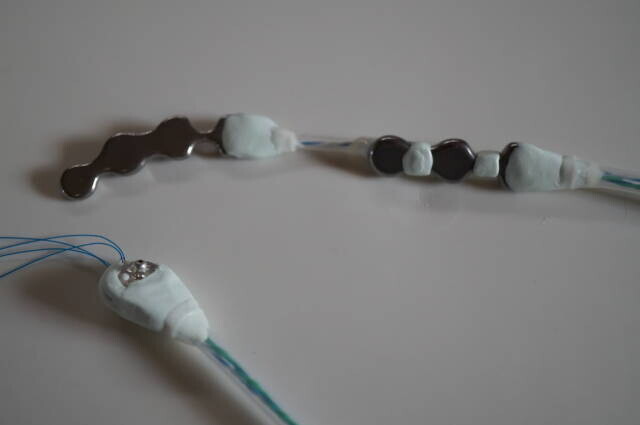
Custom electrode chip size became more flexible with reinforced aluminum pairs
In an entry published in August 2024, Mr. Okada recalled an early two-chip electrode whose connecting wire broke relatively quickly. He had judged that approach impractical; the new aluminum design instead used paired wires with nylon reinforcement.
The announced two-chip, two-pole service allowed requested thicknesses and lengths, including different lengths for the first and second chips. The lowest published price was ¥10,000 (about $64 at ¥156 = $1, rate as of 2026-09-04) excluding tax, covering two short chips and the electrode, cable, and plug work.
Standard short length was 30 mm; 40 mm or more used semi-long pricing, and 50 mm or more used long pricing. Mr. Okada cautioned that he had previously declined thin, long designs because he considered them particularly dangerous for beginners.
(Source: ok-lab's diary, published August 2024)
https://ok-lab.hatenablog.com/entry/2024/08/10/122913
How electrode chip size changed over time
| Published | What the diary said then |
|---|---|
| Mar 2019 | Different prototype lengths were proposed for urethral and anal muscle contact. |
| Jun 2019 | Custom-sized electrodes on resin bases were offered in response to a sizing request. |
| Apr 2023 | Moving the cable joint reduced the electrode body's added bulk. |
| Sep 2023 | Measurements showed the short twin's rear was thicker than its leading end. |
| Jul 2024 | End-to-end stainless steel pairs offered separately chosen chips at the stacked pair's price. |
| Aug 2024 | Parallel-cable construction introduced a different itemized fee structure. |
| Aug 2024 | Reinforced aluminum pairs expanded the available custom shapes and lengths. |
| Oct 2024 | A remake exposed the difference between nominal width and overall electrode size. |
| Mar 2025 | A segmented design was proposed, with links that would not carry current. |
| Aug 2026 | An unusually long, narrow aluminum pair was completed after dimensions were confirmed. |
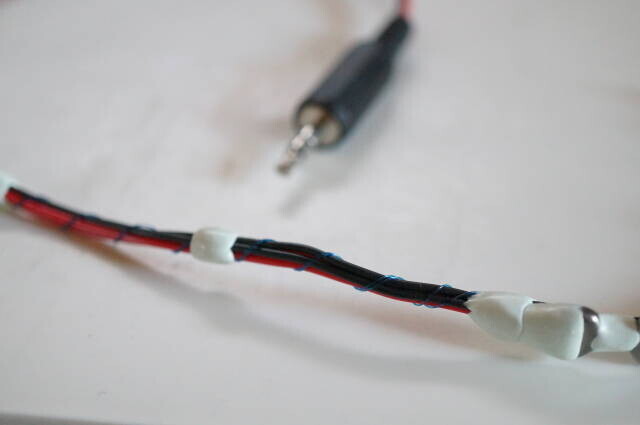
OK Prostate Chip products related to electrode chip size

The current list prices the semi-long resin comparison model at ¥5,500 (about $35 at ¥156 = $1, rate as of 2026-09-04) incl. tax.
Products that appear in these entries
| Product (official name) | Price incl. tax | Relation to this topic |
|---|---|---|
| Semi-long resin chip (OKプロステートチップ セミロングタイプ(生体適合樹脂)) | ¥5,500 (about $35 at ¥156 = $1, rate as of 2026-09-04) | In October 2024, the customer's existing medium size provided the comparison behind a long-electrode remake. |
The semi-long resin chip is listed in OK Lab's own online store.

The supplied product list does not specify sizes or a price for converting this model into an electrode.
(Source: ok-lab's diary, published October 2024)
https://ok-lab.hatenablog.com/entry/2024/10/19/122847
Products the diary mentioned as alternatives
The diary names no alternative.
Custom electrode builds and prototypes
No matching product can be confirmed on the current list.
Common worries about electrode chip size
The questions concern custom dimensions, thickness differences, and the limits of longer designs.
"Can electrode chip size be made to order?"
In an entry published in June 2019, a customer wanted a larger device after finding a standard chip too thin. They also reported needing surgery after a homemade device's glued joint failed, which was why they wanted professional fabrication.
Mr. Okada said he could not decide which type would best match the customer's preferences. For an electrode version, he offered a resin base with electrodes around it, made to the requested size.
The diary does not record whether that custom order was completed or how it felt in use. Mr. Okada invited the customer to provide their preferred electrode dimensions.
(Source: ok-lab's diary, published June 2019)
https://ok-lab.hatenablog.com/entry/2019/06/15/144142
"Does electrode chip size match an ordinary resin model?"
In an entry published in October 2024, a customer's long-electrode request conflicted with their stated limit: a medium semi-long blue resin chip. That chip was 3 mm thick; the electrode was 5–6 mm thick and about 15 mm longer.
After a 9 mm-wide build, staff offered a remake; the customer requested 7.5 mm, then asked about minimum width and thickness. Staff clarified 5.5–6 mm thickness and 7 mm minimum width, with handmade variation sometimes increasing width.
The customer then chose 50 mm length and 7 mm width; the remake was completed, but the diary records no experience using it. OK Lab advised reconsidering, offered cancellation because it had overlooked the stated limit, and said even the narrower remake might not fit.
(Source: ok-lab's diary, published October 2024)
https://ok-lab.hatenablog.com/entry/2024/10/19/122847
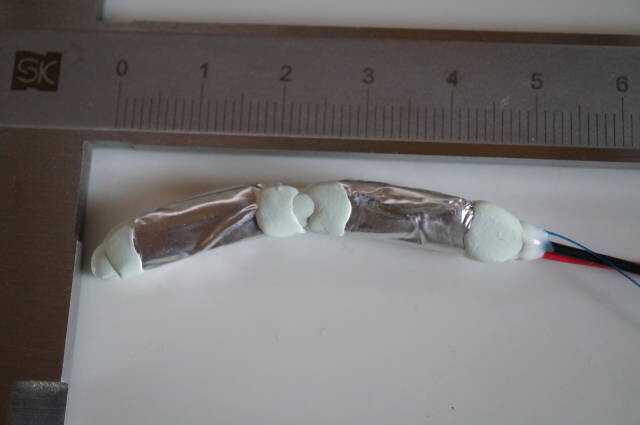
"Can electrode chip size extend to a much longer design?"
In an entry published in March 2025, a customer wanted an electrode about 7 mm across, with 15 cm of internal length. Mr. Okada could not reproduce the requested design or its outside-body contacts, but proposed about five linked chips.
The proposal allowed one pole (electrical side) for all chips, or separate poles for the deeper four and the remaining one. He said the links between chips would not conduct electricity, so the design would not provide an unbroken electrode surface.
Nothing in this entry confirms a finished device, its final width, or an outcome for the customer. Mr. Okada asked for a drawing showing the proposed five-chip arrangement and electrical poles before he would consider making it.
(Source: ok-lab's diary, published March 2025)
https://ok-lab.hatenablog.com/entry/2025/03/15/122925
Buying from outside Japan

OK Lab ships internationally to countries covered by Japan Post's EMS courier service. Overseas orders are paid in advance by PayPal. Each order carries a ¥400 (about $3 at ¥156 = $1, rate as of 2026-09-04) handling fee, and EMS shipping is charged on top. These terms come from OK Lab's official sales-terms page (written here as plain text, not a link: ok-lab.net/docs/law), checked on September 7, 2026; confirm them on the official store before you order, because they can change.
Summary of this article
| What you wanted to know | The answer |
|---|---|
| The short answer about size | Wiring, protective material, and chip arrangement affect the finished dimensions. |
| What the product is | A device made by OK Lab in Japan, with versions intended for the urethra. |
| What the terms mean | Electrodes provide electrical contacts; chips can be stacked or connected lengthwise. |
| Which shapes appeared | The diary describes location-specific prototypes, stacked twins, and longer linked assemblies. |
| How the maker addressed size limits | He proposed relocated joints, different chip combinations, and custom aluminum pairs. |
| What changed over time | Later entries expanded construction choices and documented size limits and manufacturing problems. |
| What is listed today | The comparison resin model is listed; the custom electrode specifications are not confirmed. |
| What customers asked | They asked about custom sizes, thickness differences, and much longer designs. |
| How overseas buying works | The stated terms use PayPal, Japan Post's EMS courier service, and a handling fee. |
Source: ok-lab's diary (Okada Comfortable Life Laboratory). The original entries are in Japanese; quotations on this page are translated. Photos and videos are on the original entries.
This article is a summary of the maker's development diary. The product is not a medical device and no result is guaranteed. If anything feels wrong or worries you, see a doctor. Prices, specifications and cautions change, so confirm the latest information on the official blog and the official site. Questions about ordering and shipping go to the seller.