![Should I pull harder when my chip is stuck? | The maker warns against force [OK Prostate Chip]](/img/a/T0376/eyecatch.svg)
This page is based on entries from "ok-lab's diary" (https://ok-lab.hatenablog.com/), the Japanese development diary written by Mr. Okada, founder of OK Lab, a small company in Japan (Okada Comfortable Life Laboratory). Only the entries about "pulling too hard on the thread" are summarized here, in order of publication. Past prices and sizes are as written at the time. Current prices come from the official product list (retrieved September 4, 2026). Quotations are translated from Japanese.
Note: This page is a personal reading log by someone with no connection to the maker or the seller. It reflects the source entries as of their publication dates and makes no guarantee of accuracy or safety. The product is not a medical device; talk to a doctor about any health decision. Check the official site for current information. This page contains advertising.
In short
- The diary records thread detachment, trapped chips, and injuries associated with forceful pulling.
- Mr. Okada warns against forcing a stuck chip or pulling hard enough to break its thread.
- The short twisted ceramic chip and screw-shaped auxiliary chip remain on the current product list.
If you see blood in your urine, even a small amount or for the first time, do not wait and see. See a urologist right away. If you suddenly cannot urinate, or the device cannot be removed, do not try to fix it yourself. Go to a medical facility, including emergency care, immediately.
About this product

The OK Prostate Chip is a small device that is placed in the urethra (the urine passage) so that it acts on the prostate; the maker sells it in several shapes, sizes and materials. It is made and sold by OK Lab (Okada Comfortable Life Laboratory), a small company in Japan, through its own online store, and prices are in Japanese yen (JPY). The maker's development diary, "ok-lab's diary", is written in Japanese. This page is an English summary of it, and every quotation is translated. OK Lab ships internationally, so readers outside Japan can order (see "Buying from outside Japan" below). Product names on this page are plain-English descriptions. The official Japanese product name is shown once in the product table so you can find the same item in the store.
Before you read: key terms
| Term | Plain-English meaning |
|---|---|
| Urethra | The urine passage; the chip sits inside it to act on the prostate. |
| Retrieval thread | Nylon thread attached to the chip, with an outside portion intended to help with retrieval. |
| Resin coating | Material covering the thread attachment to hold it against the chip. |
| Linked chips | Two chips joined by thread and intended to be retrieved through a shared thread arrangement. |
| Auxiliary chip | An additional chip connected to the main chip; the May 2020 reply discusses its limited usefulness as a stopper. |
| Sphincter stopper | An extra chip intended to reduce movement into the bladder; the maker does not describe it as a guarantee. |
What happens: pulling a stuck chip
The OK Prostate Chip is a small device placed inside the urethra to act on the prostate. Its retrieval thread (the nylon attachment intended to help with retrieval) connects the internal chip to an end outside the body. The entries discuss both the thread's attachment and the direction of force when a chip becomes stuck. Mr. Okada describes situations where extra pulling damaged the attachment or failed to move the chip.
Pulling harder could still break the thicker thread coating
In a February 2018 entry, Mr. Okada described 2 coating failures involving linked chips (two chips joined by thread). He explained that movement inward could load the connecting thread in a direction that peeled its attachment away. The resin coating (material securing the thread against the chip) had exposed thread in one report and lifted with it in another.
He said coatings were becoming gradually thicker on February shipments and offered photo-reviewed replacements for affected January shipments. He excluded another replacement if the replacement's coating also peeled. His warning remained that forceful pulling could break even the thicker resin itself.
(Source: ok-lab's diary, published February 2018)
https://ok-lab.hatenablog.com/entry/20180214/1518601774
A tangled retrieval thread could pull against the wrong chip
In a March 2018 entry, Mr. Okada considered thread tangling in linked chips. He suggested the long thread could catch around the connection, redirecting force toward the first chip's rear. He also said tangling could shorten the exposed thread by at least 6cm.
These were proposed explanations for an unseen arrangement inside the body. His advice opposed forced extraction and treated the thread only as light assistance to movement driven by urine.
(Source: ok-lab's diary, published March 2018)
https://ok-lab.hatenablog.com/entry/20180312/1520844839
Pulling harder detached the thread from an extra-large long chip
An entry published in May 2018 described a customer who thought an extra-large long chip had caught somewhere. Strong pulling detached the thread together with its resin attachment. The chip later emerged reversed by 180 degrees; Mr. Okada concluded that it had turned inside the bladder.
The account records its eventual removal several days later. In his later May discussion of reinforcement, Mr. Okada warned that forcing a trapped chip could seriously injure the bladder or urethra.
(Source: ok-lab's diary, published May 2018)
https://ok-lab.hatenablog.com/entry/20180505/1525509161
(Source: ok-lab's diary, published May 2018)
https://ok-lab.hatenablog.com/entry/20180513/1526181573
A chip removal report included bladder injuries without documented hard pulling
In a January 2019 entry, a customer requested an order change after a semi-long twisted glass chip broke inside their body. They wanted a plain single glass chip because another device reaching the bladder frightened them. The broken tip passed after about 1 week, but a hospital examination found widespread damage to the bladder lining.
Mr. Okada apologized; the account does not say that forceful pulling caused this breakage. The diary does not record whether the requested order change was completed. Mr. Okada advised people concerned about such injuries against using the product.
(Source: ok-lab's diary, published January 2019)
https://ok-lab.hatenablog.com/entry/2019/01/26/152042
A reversed curve changed how the retrieval thread loaded its attachment
In a February 2019 entry, a customer reported satisfaction with a reinforced curved chip sent after repeated breakages. They described using its curve in the opposite orientation. Mr. Okada suggested that this orientation could make removal harder and direct force toward peeling the resin.
He considered that a possible explanation for faster damage, rather than a confirmed diagnosis of those failures. His warning was that pulling at right angles to the thread attachment could peel the resin away.
(Source: ok-lab's diary, published February 2019)
https://ok-lab.hatenablog.com/entry/2019/02/16/171153
Chip stuck after reversal required removal at a hospital
An August 2022 entry described emergency care for a small lobed chip (Zoro S) with an auxiliary chip (an additional connected chip). The customer reported pain and fresh bleeding, despite both threads remaining outside. According to their account, doctors confirmed that the main chip had reversed 180 degrees, making pulling dig it into the urethra.
A hospital procedure removed it after 20 minutes, and the customer subsequently decided to stop using chips. Mr. Okada identified the reversed chip as 37mm long and accepted this case's reversal as confirmed. He supported the customer's decision to seek emergency care promptly.
(Source: ok-lab's diary, published August 2022)
https://ok-lab.hatenablog.com/entry/2022/08/27/123001
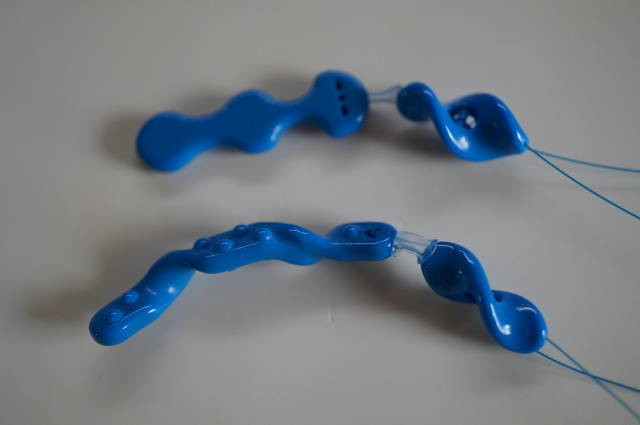
The maker's answer to pulling a stuck chip
Mr. Okada proposed changes to thread attachments while continuing to warn against forceful pulling.
A reinforced retrieval thread brought an additional injury concern
In a May 2018 entry, Mr. Okada announced a planned reinforcement service using instant adhesive together with resin. Its additional charge was ¥1,000 (about $6 at ¥156 = $1, rate as of 2026-09-04) excluding tax, as published that month. He proposed it for customers ordering large or custom long chips and said it would substantially extend delivery time.
However, he also considered thread detachment a possible release under excessive force. His caution was that a stronger attachment could introduce another risk of bladder injury when a chip remained trapped.
(Source: ok-lab's diary, published May 2018)
https://ok-lab.hatenablog.com/entry/20180513/1526181573
Embedded thread anchors did not make forceful pulling acceptable
A separate May 2018 passage recorded 2 reports of thread pulling free when customers tried to widen the space between linked chips. Mr. Okada said he had added a feature to help the embedded thread catch inside the main chip. He explained that stretched nylon becomes thinner and can then slip free more easily.
The change covered the main chip, rather than every attachment. His warning remained that strong pulling could still detach thread from the small end chip.
(Source: ok-lab's diary, published May 2018)
https://ok-lab.hatenablog.com/entry/20180513/1526181573
Retrieval thread tests supported a warning against sudden force
In a May 2018 entry, Mr. Okada published a customer's tests after a thread-detachment incident. The tests measured attachment failure on individual chips.
The tester warned that sudden pulling could apply several kg, and forces above 1kg might tear the urine passage. The tester's warning opposed sudden force and any increase after the thread became taut and stretched. Mr. Okada also expressed concern that the thread could injure the passage under that load.
(Source: ok-lab's diary, published May 2018)
https://ok-lab.hatenablog.com/entry/20180515/1526348315
A second retrieval thread addressed one custom chip's uneven attachment
In a September 2020 entry, a customer sought help after a custom ceramic chip (sea-slug version 4) became stuck and bleeding appeared. Mr. Okada suspected its off-center attachment made the pulling force poorly directed. The customer subsequently reported successful removal the next day.
Mr. Okada then tested a prototype with an independent thread on the opposite side and reported easier removal through that attachment. His original response had been based on general reasoning, before he personally tested this version. His advice included consulting a urologist if the chip could not be removed.
(Source: ok-lab's diary, published September 2020)
https://ok-lab.hatenablog.com/entry/2020/09/05/095734
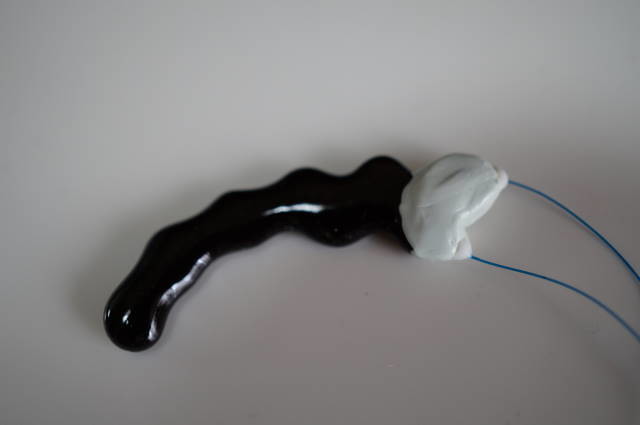
Dryness prompted another warning against pulling a stuck chip
A September 2022 follow-up concerned a different customer from the confirmed reversal case. This customer thought the linked chip heads had become parallel and trapped together, rather than reversed. They had not confirmed that interpretation directly with their doctor.
A later recurrence ended with removal after 3 hours, according to the customer. Mr. Okada accepted their explanation and warned that forcing a chip through a dry, resisting urethra would cause injury.
(Source: ok-lab's diary, published September 2022)
https://ok-lab.hatenablog.com/entry/2022/09/17/123057
If you see blood in your urine, even a small amount or for the first time, do not wait and see. See a urologist right away. If you suddenly cannot urinate, or the device cannot be removed, do not try to fix it yourself. Go to a medical facility, including emergency care, immediately.
How pulling a stuck chip changed over time
| Published | What the diary said then |
|---|---|
| Feb 2018 | Thicker coatings and a limited replacement offer followed reports of peeling. |
| Mar 2018 | Mr. Okada expanded his explanation from chip entanglement to thread tangling. |
| May 2018 | A reversed long chip was reported after its thread detached. |
| May 2018 | Paid adhesive reinforcement was proposed, with a warning about additional injury risks. |
| May 2018 | An embedded thread anchor was added after spacing-adjustment failures. |
| May 2018 | Customer testing prompted warnings about sudden force and thread-related injury. |
| Jan 2019 | A broken glass tip was followed by documented bladder-lining injuries. |
| Feb 2019 | Mr. Okada linked reversed curvature with an unfavorable pull on the coating. |
| Sep 2022 | A separate follow-up supported overlapping chips; Mr. Okada emphasized injury risks from dryness. |
| Mar 2025 | Mr. Okada warned that thread-breaking force would injure the urethra. |
The diary does not say what the current state is.
OK Prostate Chip products related to pulling a stuck chip
The current list includes the short twisted ceramic chip and auxiliary chip involved in the May 2020 incident.
Products that appear in these entries
| Product (official name) | Price incl. tax | Relation to this topic |
|---|---|---|
| Short twisted ceramic chip (OKプロステートチップ 陶器素材ショートタイプ ツイスト) | ¥4,400 (about $28 at ¥156 = $1, rate as of 2026-09-04) | In May 2020, this was the main chip in a customer's report of failed removal. |
| Screw-shaped auxiliary chip (スクリュー型補助チップ追加オプション) | ¥3,300 (about $21 at ¥156 = $1, rate as of 2026-09-04) | In May 2020, this was connected to that customer's main chip when removal failed. |
(Source: ok-lab's diary, published May 2020)
https://ok-lab.hatenablog.com/entry/2020/05/02/131505
Products the diary mentioned as alternatives
The diary names no alternative.
Historical names: custom extra-large long chip; reinforced curved build; older twisted glass chip; Zoro S; sea-slug version 4. No matching product can be confirmed on the current list.
Common worries about pulling a stuck chip
Reader questions concerned missing threads, possible tangles, and the risk of breaking a thread during removal.
"Can long chips work without a retrieval thread?"
In a February 2018 entry, a customer asked about a threadless long chip after trying a short chip without its thread. Mr. Okada's reply distinguished eventual passage from being able to remove a device whenever wanted. He said a long chip could remain in place when the user urgently wanted it out.
A follow-up concerned the short chip becoming temporarily stuck before passing the next morning. The diary does not record a subsequent trial of a threadless long chip. Mr. Okada discouraged use without a retrieval thread.
(Source: ok-lab's diary, published February 2018)
https://ok-lab.hatenablog.com/entry/20180214/1518601774
"Could tangled thread explain my chip getting stuck?"
In a May 2020 entry, a customer sought help after a short twisted ceramic chip and auxiliary chip became stuck. Mr. Okada suspected tangled thread and warned that pulling could tighten it. When it remained stuck the next morning, he changed from expecting spontaneous passage to recommending prompt assessment by a urologist.
Several days later, the customer reported passage, but the chip was lost and could not be inspected. They then asked about products less likely to enter the bladder or become difficult to retrieve. Mr. Okada favored a single chip with a sphincter stopper (an extra chip intended to reduce bladder entry), without guaranteeing prevention.
(Source: ok-lab's diary, published May 2020)
https://ok-lab.hatenablog.com/entry/2020/05/02/131505
"Should pulling a stuck chip ever risk breaking its thread?"
In a March 2025 entry, a customer sought help with a ceramic chip, resin auxiliary chip, and sphincter stopper linked together. The customer reported avoiding extra force because they feared breaking the thread.
Their follow-up reported successful removal before staff replied, and staff acknowledged the outcome. The suspected movement into the bladder was not confirmed in the account. Mr. Okada warned that thread-breaking force would injure the urethra and advised against forcing removal.
(Source: ok-lab's diary, published March 2025)
https://ok-lab.hatenablog.com/entry/2025/03/01/122825
Buying from outside Japan

OK Lab ships internationally to countries covered by Japan Post's EMS courier service. Overseas orders are paid in advance by PayPal. Each order carries a ¥400 (about $3 at ¥156 = $1, rate as of 2026-09-04) handling fee, and EMS shipping is charged on top. These terms come from OK Lab's official sales-terms page (written here as plain text, not a link: ok-lab.net/docs/law), checked on September 7, 2026; confirm them on the official store before you order, because they can change.
Summary of this article
| What you wanted to know | The answer |
|---|---|
| What is the short answer? | The maker warns against forceful pulling. |
| What is this product? | A urethral device made and sold by OK Lab in Japan. |
| What does the thread do? | It provides an attachment intended to help retrieval. |
| What happened in the reports? | Attachments failed; some chips became trapped, reversed, or associated with injuries. |
| What measures did the maker discuss? | Coating changes, embedded anchors, reinforcement, and a second thread on one prototype. |
| What changed over time? | Construction changes were followed by further incidents and cautions. |
| Which current products appear here? | The short twisted ceramic chip and screw-shaped auxiliary chip from the May 2020 case. |
| What did customers ask? | Whether threads were necessary, tangling explained difficulty, or greater force was appropriate. |
| How do overseas orders work? | Advance PayPal payment, a ¥400 (about $3 at ¥156 = $1, rate as of 2026-09-04) handling fee, and additional EMS shipping. |
Source: ok-lab's diary (Okada Comfortable Life Laboratory). The original entries are in Japanese; quotations on this page are translated. Photos and videos are on the original entries.
This article is a summary of the maker's development diary. The product is not a medical device and no result is guaranteed. If anything feels wrong or worries you, see a doctor. Prices, specifications and cautions change, so confirm the latest information on the official blog and the official site. Questions about ordering and shipping go to the seller.