![Can the chip turn inside my urethra? | Rotation and hospital removals have been reported [OK Prostate Chip]](/img/a/T0374/eyecatch.svg)
This page is based on entries from "ok-lab's diary" (https://ok-lab.hatenablog.com/), the Japanese development diary written by Mr. Okada, founder of OK Lab, a small company in Japan (Okada Comfortable Life Laboratory). Only the entries about "chip turning inside the urethra" are summarized here, in order of publication. Past prices and sizes are as written at the time. Current prices come from the official product list (retrieved September 4, 2026). Quotations are translated from Japanese.
Note: This page is a personal reading log by someone with no connection to the maker or the seller. It reflects the source entries as of their publication dates and makes no guarantee of accuracy or safety. The product is not a medical device; talk to a doctor about any health decision. Check the official site for current information. This page contains advertising.
In short
Customers reported chips turning, connected parts overlapping, and devices requiring hospital removal.
Mr. Okada proposed longer chips and different connections, while acknowledging problems with thread and changes in orientation.
The glass single-chip and short resin models remain on the supplied current product list.
If you see blood in your urine, even a small amount or for the first time, do not wait and see. See a urologist right away. If you suddenly cannot urinate, or the device cannot be removed, do not try to fix it yourself. Go to a medical facility, including emergency care, immediately.
About this product
The OK Prostate Chip is a small device that is placed in the urethra (the urine passage) so that it acts on the prostate; the maker sells it in several shapes, sizes and materials. It is made and sold by OK Lab (Okada Comfortable Life Laboratory), a small company in Japan, through its own online store, and prices are in Japanese yen (JPY).
The maker's development diary, "ok-lab's diary", is written in Japanese. This page is an English summary of it, and every quotation is translated.
OK Lab ships internationally, so readers outside Japan can order (see "Buying from outside Japan" below). Product names on this page are plain-English descriptions. The official Japanese product name is shown once in the product table so you can find the same item in the store.
Before you read: key terms
| Term | Plain-English meaning |
|---|---|
| Urethra | The urine passage; the device occupies part of it near the prostate. |
| Bulbar urethra | A wider section of that passage; Mr. Okada discusses it as space where chips can turn. |
| Retrieval thread | Thread attached to the device, intended for removal. |
| Auxiliary chip | An additional retaining part intended to limit movement toward the bladder. |
| Urinary sphincter | A muscle involved in controlling urine flow; the diary discusses chip orientation near it. |
| Endoscope | A camera instrument used by hospital clinicians to inspect the retained device during treatment. |
| Tube holder | A locking part at the urethral opening, intended to secure a connecting tube. |
| Mesh stopper | A perforated retaining part intended to limit movement while allowing urine through. |
| Resilient spacer | Material between connected chips, intended to resist folding. |
What happens: chip turning inside the urethra
The OK Prostate Chip is a small device placed in the urethra (urine passage) to act on the prostate. Here, chip rotation means the device changes direction inside that passage. An attached retrieval thread (thread intended for removal) and auxiliary chip (additional retaining part) can also become involved. The diary describes turning, folding, and tangling near the prostate, followed by hospital reports and designs intended to control movement.
Chip rotation concerns prompted longer designs after a March 2018 hospital report
In an entry published in March 2018, a customer reported that a two-chip device had become tangled near the prostate and required hospital removal. Mr. Okada described this as the first hospital-removal report he had received. He suspected a 180-degree reversal in the bulbar urethra (a wider section of the urine passage), but lacked further details.
The leading chip had previously been about 25-28mm long; he announced a change to 30mm or longer. He did not announce an immediate sales halt, although further similar reports could prompt reconsideration. Mr. Okada cautioned that differences between bodies might still allow a 30mm chip to reverse.
(Source: ok-lab's diary, published March 2018)
https://ok-lab.hatenablog.com/entry/20180310/1520672565
A May 2018 chip reversal left the retrieval thread inaccessible
In an entry published in May 2018, a customer wanted the glass single-chip model's thread length changed from 20cm to 25cm. They reported an apparent half-turn during 6–7 hours of use, after which the thread and its safety part became inaccessible. Neither access to the thread nor urination provided a way to recover the device at that point.
The customer reported eventual removal, but did not identify a confirmed cause. The diary does not record whether the requested thread replacement was completed. Mr. Okada offered the replacement service for ¥1,080 (about $7 at ¥156 = $1, rate as of 2026-09-04), as published in May 2018.
(Source: ok-lab's diary, published May 2018)
https://ok-lab.hatenablog.com/entry/20180505/1525509161
A July 2018 folding incident raised concern about separate chip rotation
In an entry published in July 2018, a customer reported trouble with a separate auxiliary component and a medium-length chip. Mr. Okada had previously expressed reservations about the requested combination, while allowing for a cautious test. The components folded together, and the separate component's thread could not retrieve them.
The customer eventually removed the assembly while it remained folded. Mr. Okada acknowledged the report as evidence that the separate component could rotate and urged caution.
(Source: ok-lab's diary, published July 2018)
https://ok-lab.hatenablog.com/entry/20180707/1530947332
An October 2021 customer linked chip rotation with unsuccessful placement
In an entry published in October 2021, a customer asked about rotation of a short, strongly curved version 4 chip. They described sideways turns of 90 degrees and reversed orientations of 180 degrees, with later attempts at placement unsuccessful. Mr. Okada associated rotation with the chip's short length and strong curve.
He did not regard rotation alone as the explanation for unsuccessful placement. The diary does not record whether the customer's later attempts succeeded. His answer emphasized alignment with the urethral curve immediately before the urinary sphincter (muscle controlling urine flow).
(Source: ok-lab's diary, published October 2021)
https://ok-lab.hatenablog.com/entry/2021/10/02/125825
August 2022 chip rotation concerns included an overlap case requiring hospital care
In an entry published in August 2022, a customer reported that a short resin M chip and auxiliary chip became stuck together. Hospital clinicians removed them on day 5; the customer reported an insured treatment charge of about ¥8,000 (about $51 at ¥156 = $1, rate as of 2026-09-04). Mr. Okada associated unusually little exposed thread with possible internal tangling and emphasized awareness of the device's position and shape.
In a follow-up published in September 2022, the same customer described seeing the chips' heads almost parallel on the hospital camera. Their account supported overlapping parts without confirmed reversal; they had not directly checked this interpretation with the doctor. Mr. Okada's September reply emphasized moisture and cautioned against force when the passage was dry.
(Source: ok-lab's diary, published August 2022)
https://ok-lab.hatenablog.com/entry/2022/08/20/122920
(Source: ok-lab's diary, published September 2022)
https://ok-lab.hatenablog.com/entry/2022/09/17/123057
A separate August 2022 chip reversal required emergency hospital treatment
In a separate entry published in August 2022, a customer reported a retained 37mm S chip (Zoro) with an S auxiliary screw. Pain and bleeding developed even though the retrieval threads remained outside. The customer said a clinician confirmed 180-degree reversal.
Removal using an endoscope (camera instrument for internal inspection) took 20 minutes, and the reported bill was about ¥23,000 (about $147 at ¥156 = $1, rate as of 2026-09-04). The customer subsequently said they would stop using chips. Mr. Okada regarded their prompt decision to seek emergency care as appropriate.
(Source: ok-lab's diary, published August 2022)
https://ok-lab.hatenablog.com/entry/2022/08/27/123001
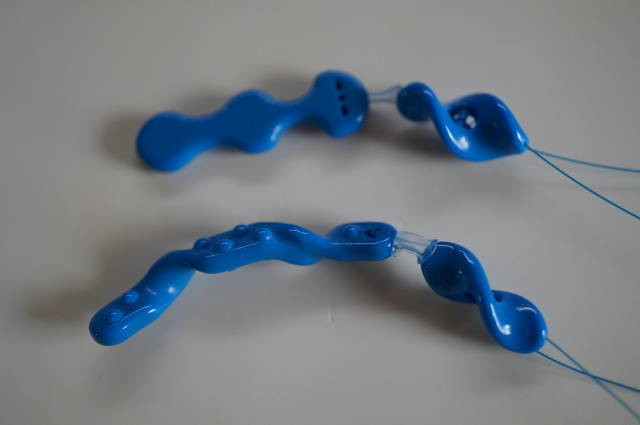
Zero spacing failed to prevent a January 2023 chip stuck incident
In an entry published in January 2023, a customer reported trouble with a long chip and L auxiliary screw connected at 0mm. The assembly became stuck, and attempts at removal caused pain and bleeding. The customer eventually recovered it before a booked hospital visit, then experienced a high fever for about 2 days.
They reported subsequent recovery and asked whether the screw's rounded shape made rotation easier. Mr. Okada suspected that the nearly spherical screw had tilted and trapped thread, but this remained his explanation. His reply proposed connection materials intended to resist thread tangling.
(Source: ok-lab's diary, published January 2023)
https://ok-lab.hatenablog.com/entry/2023/01/07/123115
The maker's answer to chip turning inside the urethra
Mr. Okada's proposed measures changed the chip's length, connection, or support, with different claims for each design.
Locking a connecting tube was proposed to prevent chip rotation in July 2022
In an entry published in July 2022, Mr. Okada said only one combination in his range could theoretically prevent rotation within the prostate. It paired a locking tube holder at the urethral opening (Unicorn Gatekeeper) with a connecting tube secured to the chip. He attributed the claimed resistance to a firm lock between the holder and tube.
He also reported a ceramic two-chip test using a 5mm tube, with little later change in position or angle. Urine leakage was a drawback in that test. OK Lab's staff described the holder as optional, though potentially useful during longer use.
(Source: ok-lab's diary, published July 2022)
https://ok-lab.hatenablog.com/entry/2022/07/30/122933

Mesh stoppers used deliberate sideways positioning after earlier chip rotation accidents
In an entry published in November 2023, Mr. Okada described mesh stoppers (perforated retaining parts allowing urine through). He described them standing almost perpendicular to a 2.5mm tube in the wider passage, while tilting in narrower sections. The size line prints S=12m, M=15m, and L=18mm.
The supplied material does not resolve those inconsistent units. Prices published that month were ¥2,000 (about $13 at ¥156 = $1, rate as of 2026-09-04) excluding tax for fixed stoppers and ¥2,500 (about $16 at ¥156 = $1, rate as of 2026-09-04) excluding tax for removable ones. Mr. Okada favored the permanently fitted version nearest the main chip because he wanted that part to remain attached.
(Source: ok-lab's diary, published November 2023)
https://ok-lab.hatenablog.com/entry/2023/11/25/122934
Mr. Okada credited rigid connections with preventing chip rotation in April 2024
In an entry published in April 2024, Mr. Okada described a pair joined by wire designed to resist folding. He argued that this prevented problems from tangled thread and that the assembly's overall length prevented rotation inside the urethra.
He also acknowledged that the whole assembly, around 10cm long, could enter the bladder under some circumstances. He invited readers with questions about the new design to contact OK Lab's staff.
(Source: ok-lab's diary, published April 2024)
https://ok-lab.hatenablog.com/entry/2024/04/27/122924
If you see blood in your urine, even a small amount or for the first time, do not wait and see. See a urologist right away. If you suddenly cannot urinate, or the device cannot be removed, do not try to fix it yourself. Go to a medical facility, including emergency care, immediately.
How chip turning inside the urethra changed over time
| Published | What the diary said then |
|---|---|
| May 2018 | A separate report described a custom 56mm chip emerging reversed. |
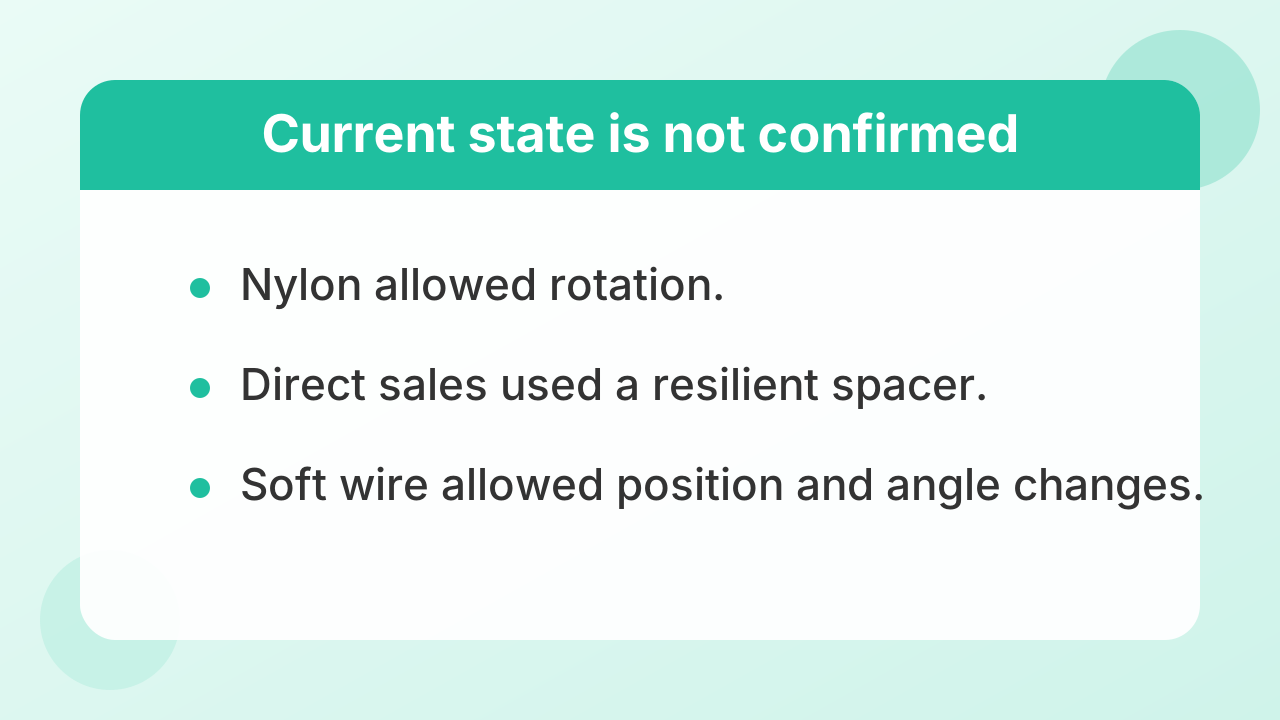
| Oct 2019 | Doubled 0.55mm steel wire made a ceramic prototype almost rigid after nylon allowed rotation. |
| Jun 2021 | A designer opposed shared thread loops because breakage could create turning forces. |
| Aug 2022 | Short and sculpted models supplied through Amazon used 3mm (±1mm) auxiliary spacing. |
| Aug 2022 | A clinician reportedly confirmed 180-degree reversal of a 37mm chip. |
| Sep 2022 | A delayed hospital update became the third reported screw-overlap case. |
| May 2023 | Direct sales used a resilient spacer (material intended to resist folding). |
| Dec 2024 | Mr. Okada expected flexible loops to twist despite a designed 90-degree offset. |
| Jan 2025 | A roughly 2-day prototype test found that soft wire allowed position and angle changes. |
The diary does not say what the current state is.
OK Prostate Chip products related to chip turning inside the urethra
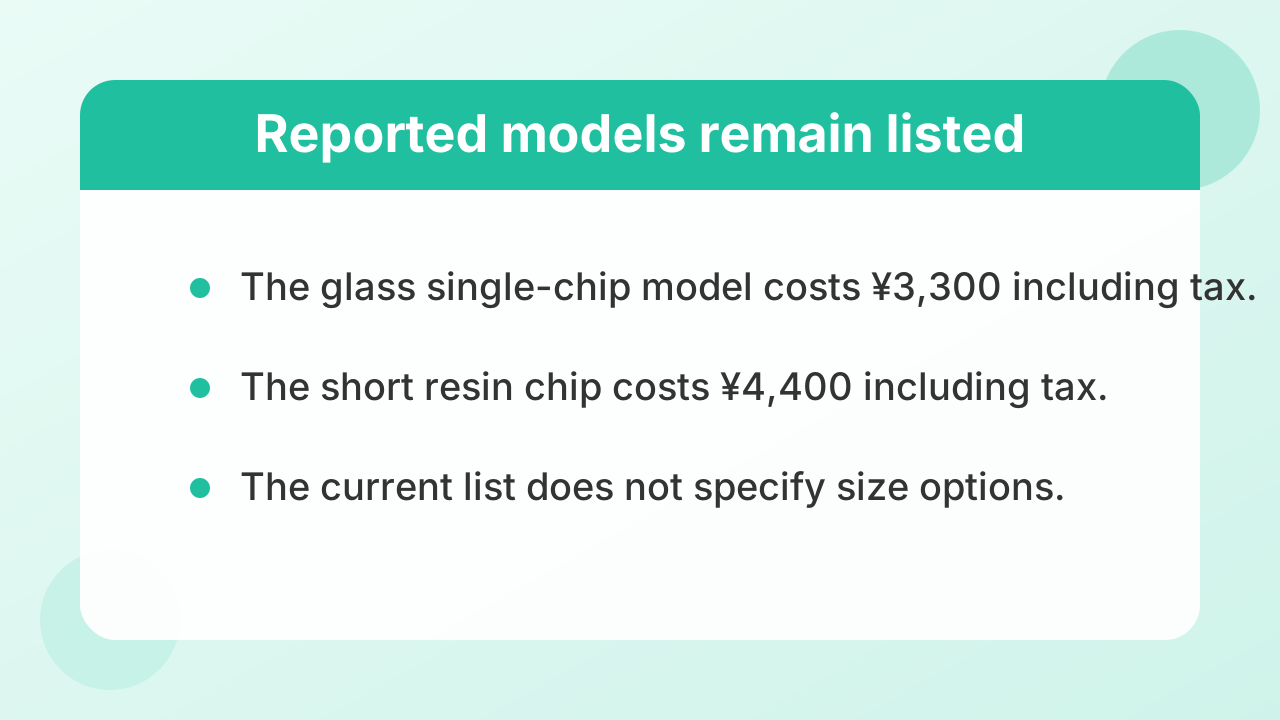
The supplied current list includes products discussed in these reports, but does not specify their present size options.
Products that appear in these entries
| Product (official name) | Price incl. tax | Relation to this topic |
|---|---|---|
| Glass single-chip model (OKプロステートチップ ガラス素材1チップタイプ) | ¥3,300 (about $21 at ¥156 = $1, rate as of 2026-09-04) | The May 2018 customer reported rotation and an inaccessible retrieval thread with this model. |
| Short resin chip (OKプロステートチップ ショートタイプ(生体適合樹脂)) | ¥4,400 (about $28 at ¥156 = $1, rate as of 2026-09-04) | The August 2022 hospital report concerned an M example paired with an auxiliary chip. |
(Source: ok-lab's diary, published May 2018)
https://ok-lab.hatenablog.com/entry/20180505/1525509161
(Source: ok-lab's diary, published August 2022)
https://ok-lab.hatenablog.com/entry/2022/08/20/122920
Products the diary mentioned as alternatives
The diary names no alternative.
Historical configurations include the custom 56mm chip, separate-component assembly, curved version 4, tube-locking assembly, mesh stoppers, and rigid wire-linked prototypes. No matching product can be confirmed on the current list.
Common worries about chip turning inside the urethra
Size and spacing did not yield a universal answer; Mr. Okada also distinguished rotation from other placement difficulties.
"Does chip rotation mean I need a larger size?"
In an entry published in November 2019, a customer asked whether rotation and brief sensations meant their extra-small medium-length chip was too small. Mr. Okada thought its short length and slight curve could explain easy rotation. He considered longer, more curved designs less likely to turn, but did not identify a generally suitable replacement size.
The diary does not record what the customer ultimately chose or how it felt. Mr. Okada said he could not recommend one size for everyone.
(Source: ok-lab's diary, published November 2019)
https://ok-lab.hatenablog.com/entry/2019/11/30/164020
"Does zero spacing prevent chip rotation and tangled thread?"
In an entry published in May 2023, a customer asked whether eliminating the gap or omitting the auxiliary screw would reduce tangling. Mr. Okada replied that nylon remained flexible, including a possible 180-degree bend at 0mm spacing. He did not provide accident statistics establishing a configuration without that risk.
OK Lab's staff described a tradeoff: configurations they considered less prone to tangling could be more prone to entering the bladder. The staff left that choice to the customer.
(Source: ok-lab's diary, published May 2023)
https://ok-lab.hatenablog.com/entry/2023/05/27/122912
"Does chip rotation explain why my chip won't go in?"
In an entry published in April 2025, a first-time buyer asked whether sideways or reversed turns prevented placement of a ribbed medium-length chip. Mr. Okada thought orientation near the curve mattered more than turning earlier in the passage. He also thought the additional stopper could make placement harder.
The material does not record a successful later attempt. Mr. Okada referred the customer's separate concern about possible prostate inflammation to a urologist.
(Source: ok-lab's diary, published April 2025)
https://ok-lab.hatenablog.com/entry/2025/04/26/122909
Buying from outside Japan
OK Lab ships internationally to countries covered by Japan Post's EMS courier service. Overseas orders are paid in advance by PayPal.
Each order carries a ¥400 (about $3 at ¥156 = $1, rate as of 2026-09-04) handling fee, and EMS shipping is charged on top. These terms come from OK Lab's official sales-terms page (written here as plain text, not a link: ok-lab.net/docs/law), checked on September 7, 2026; confirm them on the official store before you order, because they can change.
Summary of this article
| What you wanted to know | The answer |
|---|---|
| In short: can this happen? | Rotation and overlapping parts appear in reports, including hospital cases. |
| About the product | OK Lab in Japan makes this urethral device; prices are in JPY. |
| Key terms | The thread, auxiliary chip, and connecting parts have different retaining or retrieval roles. |
| What happens | Some reports describe confirmed reversal; the short resin case describes overlap without confirmed reversal. |
| The maker's answer | Proposed changes addressed length, connections, and support; the explanations belong to the maker. |
| Changes over time | The diary moved through thread, wire, tube, and flexible-loop designs. |
| Related products | The listed glass single-chip model costs ¥3,300 (about $21 at ¥156 = $1, rate as of 2026-09-04); the short resin model costs ¥4,400, (about $28 at ¥156 = $1, rate as of 2026-09-04) including tax. |
| Common worries | Mr. Okada did not identify one size or thread connection that settled every question. |
| Buying from outside Japan | The supplied terms specify advance PayPal payment, EMS shipping, and a ¥400 (about $3 at ¥156 = $1, rate as of 2026-09-04) handling fee. |
Source: ok-lab's diary (Okada Comfortable Life Laboratory). The original entries are in Japanese; quotations on this page are translated. Photos and videos are on the original entries.
This article is a summary of the maker's development diary. The product is not a medical device and no result is guaranteed. If anything feels wrong or worries you, see a doctor. Prices, specifications and cautions change, so confirm the latest information on the official blog and the official site. Questions about ordering and shipping go to the seller.