![Can a prostate chip irritate my bladder? | The maker cautions against prolonged stimulation [OK Prostate Chip]](/img/a/T0369/eyecatch.svg)
This page is based on entries from "ok-lab's diary" (https://ok-lab.hatenablog.com/), the Japanese development diary written by Mr. Okada.
He founded OK Lab, a small company in Japan (Okada Comfortable Life Laboratory).
Only the entries about "bladder irritation" are summarized here, in order of publication.
Past prices and sizes are as written at the time.
Current prices come from the official product list (retrieved September 4, 2026).
Quotations are translated from Japanese.
Note: This page is a personal reading log by someone with no connection to the maker or the seller. It reflects the source entries as of their publication dates and makes no guarantee of accuracy or safety. The product is not a medical device; talk to a doctor about any health decision. Check the official site for current information. This page contains advertising.
In short
Mr. Okada reported discomfort and changing urinary urges after bladder stimulation.
The maker cautioned against bladder vibration and prolonged exposure to strong stimulation.
The current list includes chips discussed in these entries, while the February 2026 diary still cautioned against prolonged bladder vibration.
About this product
The OK Prostate Chip is a small device that is placed in the urethra (the urine passage) so that it acts on the prostate; the maker sells it in several shapes, sizes and materials. It is made and sold by OK Lab (Okada Comfortable Life Laboratory), a small company in Japan, through its own online store, and prices are in Japanese yen (JPY). The maker's development diary, "ok-lab's diary", is written in Japanese. This page is an English summary of it, and every quotation is translated. OK Lab ships internationally, so readers outside Japan can order (see "Buying from outside Japan" below). Product names on this page are plain-English descriptions. The official Japanese product name is shown once in the product table so you can find the same item in the store.
Before you read: key terms
| Term | Plain-English meaning |
|---|---|
| Prostate | The body part the chip is intended to stimulate; the diary does not explain its bodily function. |
| Urethra | The urine passage, where the device is placed to act on the prostate. |
| Bladder | The organ described as holding urine; some diary prototypes target it for stimulation. |
| Retention | Leaving a device in place over time, discussed here as a way of sustaining stimulation. |
| Bladder loop | A loop intended to occupy the bladder as part of a device providing stimulation. |
| Bougie | The diary does not explain this. |
| Seminal vesicles | Organs beside the bladder targeted by one prototype; the diary does not explain their bodily function. |
| Overactive bladder | Mr. Okada's comparison for urgent toilet trips despite little urine; he uses it to describe his symptoms. |
| Sphincter | A gripping point around the urine passage in the diary's account, relevant to keeping a chip positioned. |
| Screw-shaped support | An auxiliary chip the maker discusses as a way to resist movement toward the bladder. |
What happens: bladder irritation
The OK Prostate Chip is a small device placed in the urethra (the urine passage) to stimulate the prostate. These entries discuss vibration from motorized chips and pressure from chips or loops that extend into the bladder. Some prototypes were intended to transmit movement or pressure between the bladder area and another part of the device. Mr. Okada's reports describe abdominal discomfort, changing urinary urges, and stimulation he found too strong to sustain.
Bladder vibration preceded abdominal discomfort in the maker's August 2019 account
In an entry published in August 2019, Mr. Okada described his plain vibrating chip reaching the bladder unintentionally. He reported about 1 hour of vibration before mild abdominal discomfort prompted him to end the bladder exposure. Over the following few days, he noticed less desire to visit the toilet on waking and believed his bladder held more urine.
He speculated about a massage effect; the diary does not record a medical assessment of that change. In February 2022, Mr. Okada's broader advice was to avoid bladder vibration because certain positions caused unpleasant discomfort.
(Source: ok-lab's diary, published August 2019)
https://ok-lab.hatenablog.com/entry/2019/08/24/125858
(Source: ok-lab's diary, published February 2022)
https://ok-lab.hatenablog.com/entry/2022/02/12/123441
Bladder irritation ended a protruding glass prototype's test after three hours
An entry published in November 2020 describes Mr. Okada's glass-chip prototype joined to a screw-shaped support (an auxiliary chip intended to resist movement). He reported that the assembly stayed positioned particularly well. However, about 10-15mm of its leading tip projected into his bladder, and he ended the test after about 3 hours.
He considered the stimulation too strong for prolonged retention (leaving the device in place over time). No matching product can be confirmed on the current list. Mr. Okada favored a shorter leading chip for longer retention, based on his own experience.
(Source: ok-lab's diary, published November 2020)
https://ok-lab.hatenablog.com/entry/2020/11/21/130647
Strong bladder vibration preceded pain lasting about half a day
An entry published in April 2023 records Mr. Okada's experience involving a bougie (a term the diary does not explain). He described strong vibration while the instrument extended deep into his bladder.
Afterward, he felt intermittent abdominal pain for about half a day. He suspected strain on the bladder and explicitly said he did not recommend the practice.
(Source: ok-lab's diary, published April 2023)
https://ok-lab.hatenablog.com/entry/2023/04/29/123107
Heart symptoms interrupted a prototype test involving strong bladder vibration
In an entry published in May 2024, Mr. Okada described a prototype targeting the seminal vesicles (organs beside the bladder). Its motor was incorporated into the part intended to occupy the bladder. After about 5-10 minutes, he felt an abnormal change in his heart and stopped the vibration.
He attributed this to his existing heart problems; the diary does not record a medical assessment of that episode. No matching product can be confirmed on the current list. Mr. Okada wrote that continued pressure felt too demanding on his heart and that he would avoid using the vibration again.
(Source: ok-lab's diary, published May 2024)
https://ok-lab.hatenablog.com/entry/2024/05/11/122910
The maker blamed bladder irritation for urgent toilet trips during testing
In an entry published in December 2024, Mr. Okada tested his own combined chip-and-loop prototype in response to a custom request. With the assembly 20mm beyond its initial position, about 8cm extended into his bladder. He likened his urgent toilet trips to an overactive bladder (his description of urgency with little urine).
He abandoned the test after about 5 hours, with mild pain lasting about 1 hour afterward. No matching product can be confirmed on the current list. Mr. Okada cautioned that several hours of retention did not mean the requested design would suit continuous use over several days.
(Source: ok-lab's diary, published December 2024)
https://ok-lab.hatenablog.com/entry/2024/12/21/122903
Paired loops produced excessive bladder irritation during the maker's extended test
In an entry published in May 2025, Mr. Okada assessed a paired-loop bladder attachment nicknamed the bladder mouse. He found its stimulation much stronger than an ordinary bladder loop (a loop intended to occupy the bladder). His report also describes the attachment sometimes being pushed toward the prostate when his bladder emptied.
He considered its shape and behavior still unfinished. No matching product can be confirmed on the current list. Mr. Okada therefore limited his own use and did not use it during sleep.
(Source: ok-lab's diary, published May 2025)
https://ok-lab.hatenablog.com/entry/2025/05/10/122936
Flexible joints came with another warning about prolonged bladder vibration
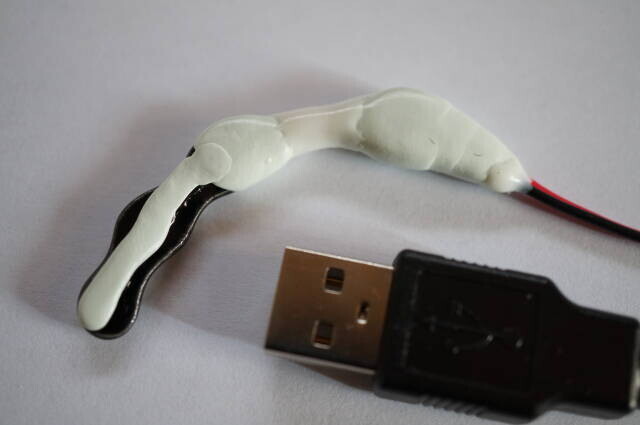
An entry published in February 2026 introduced Mr. Okada's flexible-joint vibrating chip, with a ceramic tip connected to its motor by wire. Construction was offered with 8mm or 10mm motors; he ruled out 6mm motors because he doubted the connection's reliability. He felt that the ceramic tip vibrated more intensely than the motor section.
Published processing surcharges were ¥4,000 (about $26 at ¥156 = $1, rate as of 2026-09-04) excluding tax for short or medium-length ceramic chips and ¥5,000 (about $32 at ¥156 = $1, rate as of 2026-09-04) excluding tax for extended-profile or long ceramic chips. No matching product can be confirmed on the current list. Mr. Okada still cautioned that strong or prolonged bladder vibration might be unhealthy.
(Source: ok-lab's diary, published February 2026)
https://ok-lab.hatenablog.com/entry/2026/02/14/121602
The maker's answer to bladder irritation
Mr. Okada's measures focused on avoiding prolonged vibration and limiting designs he found too stimulating.
Prolonged vibration drew an early caution relevant to bladder irritation
In an entry published in February 2019, Mr. Okada described feeling cold and unable to warm up after almost all-day vibration. The symptoms followed stopping the vibration just before sleep.
He speculated that relying on vibration might suppress the body's normal ability to stay active. His explanation was tentative, and his advice was to avoid long periods of continuous vibration.
(Source: ok-lab's diary, published February 2019)
https://ok-lab.hatenablog.com/entry/2019/02/02/153358
Bladder irritation cautions also included limits for the dual-motor resin chip
In an entry published in February 2019, Mr. Okada assessed a dual-motor extended-profile resin chip. He reported discomfort after about half a day without vibration, which he attributed to dryness associated with the resin. He said he was not selling the resin long type because he considered it problematic.
The dual-motor version cost ¥8,000 (about $51 at ¥156 = $1, rate as of 2026-09-04) excluding tax, with embedded nylon thread adding ¥1,000 (about $6 at ¥156 = $1, rate as of 2026-09-04) excluding tax, as published in February 2019. No matching product can be confirmed on the current list. Mr. Okada restricted this design to short sessions and favored an ordinary single-motor vibrating chip for longer retention.
(Source: ok-lab's diary, published February 2019)
https://ok-lab.hatenablog.com/entry/2019/02/09/152257
Changing bladder irritation led the maker away from continuous retention
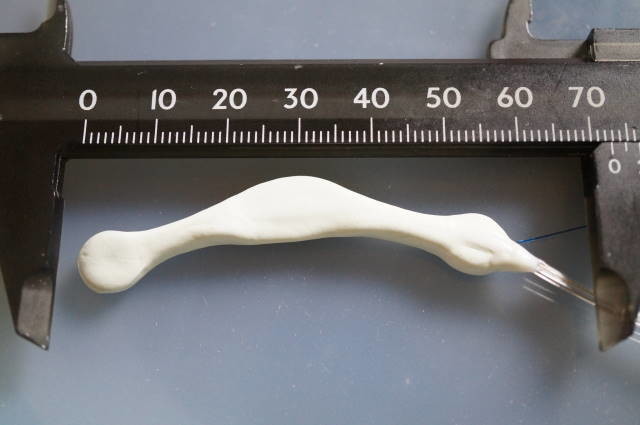
In an entry published in May 2025, Mr. Okada wrote that the paired-loop attachment felt different as his bladder filled and emptied. He said that made choosing its size difficult and questioned its suitability for continuous retention. His next design was a wire device with repeated paired loops, called the urethral centipede.
Published prices, excluding tax, were ¥5,000 (about $32 at ¥156 = $1, rate as of 2026-09-04) for wire up to 30cm, ¥6,000 (about $38 at ¥156 = $1, rate as of 2026-09-04) up to 40cm, and ¥2,000 (about $13 at ¥156 = $1, rate as of 2026-09-04) per loop pair. No matching product can be confirmed on the current list. Mr. Okada's proposal set aside continuous retention, describing stronger stimulation when more of the loops occupied the bladder.
(Source: ok-lab's diary, published May 2025)
https://ok-lab.hatenablog.com/entry/2025/05/17/122914
How bladder irritation changed over time
| Published | What the diary said then |
|---|---|
| Feb 2019 | Feeling cold after prolonged vibration prompted a warning against continuous use. |
| Feb 2019 | The dual-motor resin design was limited to short sessions. |
| Aug 2019 | Accidental bladder vibration preceded discomfort and changes in morning urinary urges. |
| Nov 2020 | A protruding glass tip proved too stimulating despite staying positioned. |
| Feb 2022 | Staff said a power cable did not eliminate the possibility of tangling. |
| Dec 2023 | Support choices remained individual; long chips reaching the bladder could feel excessively stimulating. |
| May 2024 | Mr. Okada stopped a prototype's vibration after experiencing heart symptoms. |
| Dec 2024 | A combined prototype caused urgent toilet trips and lingering discomfort in his test. |
| May 2025 | Paired loops felt too stimulating for Mr. Okada's continuous use. |
| Feb 2026 | A flexible joint brought new construction options alongside continued cautions about prolonged vibration. |
OK Prostate Chip products related to bladder irritation
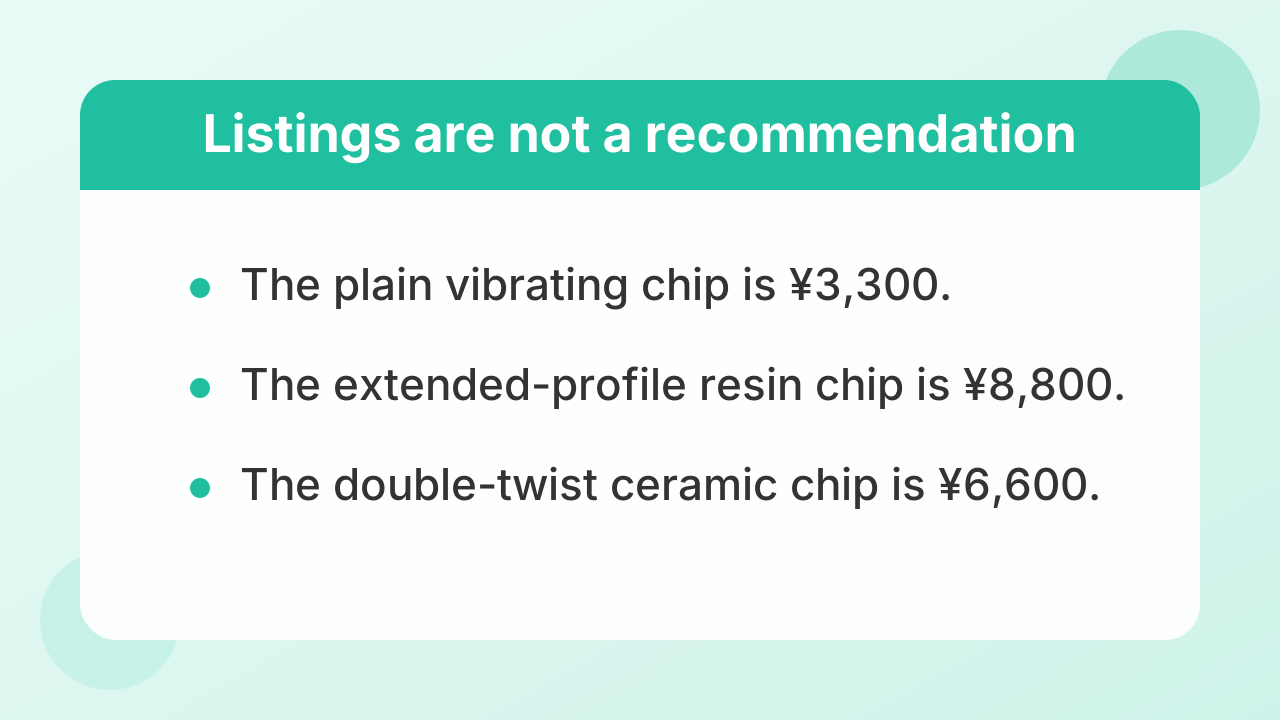
Current listings include products discussed in these accounts, but their appearance here is not a recommendation for bladder irritation.
Products that appear in these entries
| Product (official name) | Price incl. tax | Relation to this topic |
|---|---|---|
| Plain vibrating chip (OKプロステート核振チップ プレーン(胎児チップ)) | ¥3,300 (about $21 at ¥156 = $1, rate as of 2026-09-04) | In February 2022, Mr. Okada described this chip reaching deep into his bladder and cautioned against bladder vibration. |
| Extended-profile resin chip (OKプロステートチップ 覚醒タイプ(生体適合樹脂)) | ¥8,800 (about $56 at ¥156 = $1, rate as of 2026-09-04) | In December 2023, the customer ordered this chip and asked whether extra supports were needed to prevent movement toward the bladder. |
| Double-twist ceramic chip (OKプロステートチップ 陶器素材覚醒タイプ ダブルツイスト(ラブカチップ)) | ¥6,600 (about $42 at ¥156 = $1, rate as of 2026-09-04) | In December 2023, the customer's order also included this chip, prompting the same question about support and inward movement. |
(Source: ok-lab's diary, published February 2022)
https://ok-lab.hatenablog.com/entry/2022/02/12/123441
(Source: ok-lab's diary, published December 2023)
https://ok-lab.hatenablog.com/entry/2023/12/23/122035
Products the diary mentioned as alternatives
The diary names no alternative.
Common worries about bladder irritation
The customer exchanges raise separate questions about pressure, inward movement, and support; the replies do not promise a universal solution.
"Would a smoother tip reduce bladder irritation?"
In an entry published in November 2020, a customer requested a plainer leading tip for a custom two-part design. The customer wanted bladder-wall pressure transmitted to the second chip while limiting strain on the bladder. They expected use within 30 minutes, reasoning that the intended effect would disappear as the bladder expanded.
Mr. Okada revised the tip, but the diary does not record how the customer's finished device felt in use. No matching product can be confirmed on the current list. Mr. Okada favored the plainer shape because he believed it reduced the design's burden on the bladder.
(Source: ok-lab's diary, published November 2020)
https://ok-lab.hatenablog.com/entry/2020/11/21/130647
"Does an electrical cable prevent bladder irritation from inward movement?"
In an entry published in February 2022, a customer asked whether a vibrating chip's electrical cable removed the risks of entering the bladder. The customer reasoned that the cable and its external connector would prevent complete inward loss. They also reported slow urination and movement of the chip when trying to increase the flow.
Staff replied that excessive cable inside the bladder could still become tangled. The diary does not record whether the customer's urinary difficulty improved. Staff said a stopper could help prevent unintended inward movement, while rejecting the idea that tangling was impossible.
(Source: ok-lab's diary, published February 2022)
https://ok-lab.hatenablog.com/entry/2022/02/12/123441
"Would extra supports prevent bladder irritation with longer chips?"
In an entry published in December 2023, a customer asked about supports after ordering extended-profile resin and double-twist ceramic chips. Staff offered wider spacing and a refund; the customer clarified that discomfort occurred during movement, rather than while the earlier chip stayed positioned. Production was paused; the diary does not record whether the order was completed.
Mr. Okada said long chips reaching his bladder felt too stimulating for prolonged retention. He described a sphincter (a gripping point around the urine passage) as relevant to whether supports held their position. Mr. Okada considered screw-shaped supports or sphincter stoppers reasonable options, although he said neither worked for everyone.
(Source: ok-lab's diary, published December 2023)
https://ok-lab.hatenablog.com/entry/2023/12/23/122035
Buying from outside Japan
OK Lab ships internationally to countries covered by Japan Post's EMS courier service. Overseas orders are paid in advance by PayPal. Each order carries a ¥400 (about $3 at ¥156 = $1, rate as of 2026-09-04) handling fee, and EMS shipping is charged on top. These terms come from OK Lab's official sales-terms page (written here as plain text, not a link: ok-lab.net/docs/law), checked on September 7, 2026; confirm them on the official store before you order, because they can change.
Summary of this article
| What you wanted to know | The answer |
|---|---|
| In short | The maker reported discomfort and cautioned against prolonged bladder stimulation. |
| About this product | A Japanese-made urethral device sold by OK Lab, with prices in yen. |
| Key terms | Motor vibration and pressure from a chip or loop both feature in these accounts. |
| What happens | Reports include abdominal discomfort, urgent toilet trips, and excessive stimulation. |
| The maker's answer | His advice repeatedly favored limiting exposure to stimulation he found excessive. |
| Changes over time | New designs continued to appear, alongside cautions extending into February 2026. |
| Related products | The current list includes the plain vibrating chip and chips from the December 2023 consultation. |
| Common worries | The diary gives no universal answer about comfort, supports, or inward movement. |
| Buying from outside Japan | Orders use advance PayPal payment, with handling and EMS shipping charged separately. |
Source: ok-lab's diary (Okada Comfortable Life Laboratory). The original entries are in Japanese; quotations on this page are translated. Photos and videos are on the original entries.
This article is a summary of the maker's development diary. The product is not a medical device and no result is guaranteed. If anything feels wrong or worries you, see a doctor. Prices, specifications and cautions change, so confirm the latest information on the official blog and the official site. Questions about ordering and shipping go to the seller.