![Could this put too much pressure on my prostate? | The diary records pain and design changes [OK Prostate Chip]](/img/a/T0370/eyecatch.svg)
This page is based on entries from "ok-lab's diary" (https://ok-lab.hatenablog.com/), the Japanese development diary written by Mr. Okada, founder of OK Lab, a small company in Japan (Okada Comfortable Life Laboratory). Only the entries about "avoiding excessive strain on the prostate" are summarized here, in order of publication. Past prices and sizes are as written at the time. Current prices come from the official product list (retrieved September 4, 2026). Quotations are translated from Japanese.
Note: This page is a personal reading log by someone with no connection to the maker or the seller. It reflects the source entries as of their publication dates and makes no guarantee of accuracy or safety. The product is not a medical device; talk to a doctor about any health decision. Check the official site for current information. This page contains advertising.
In short
The diary reports pain and bleeding during tests Mr. Okada associated with excessive or sustained prostate pressure.
Mr. Okada's responses included gentler curves, thinner connections, and warnings about prolonged pressure.
The single-chip and semi-long glass models remain on the supplied current product list.
If you see blood in your urine, even a small amount or for the first time, do not wait and see. See a urologist right away. If you suddenly cannot urinate, or the device cannot be removed, do not try to fix it yourself. Go to a medical facility, including emergency care, immediately.
About this product
The OK Prostate Chip is a small device that is placed in the urethra (the urine passage) so that it acts on the prostate; the maker sells it in several shapes, sizes and materials. It is made and sold by OK Lab (Okada Comfortable Life Laboratory), a small company in Japan, through its own online store, and prices are in Japanese yen (JPY). The maker's development diary, "ok-lab's diary", is written in Japanese. This page is an English summary of it, and every quotation is translated. OK Lab ships internationally, so readers outside Japan can order (see "Buying from outside Japan" below). Product names on this page are plain-English descriptions. The official Japanese product name is shown once in the product table so you can find the same item in the store.
Before you read: key terms
| Term | Plain-English meaning |
|---|---|
| Urethra | The urine passage, where the chip is placed to act on the prostate. |
| Prostate pressure | Force exerted on the prostate by a chip or connected device, intended here to produce stimulation. |
| Stent | A device intended to hold a passage open; the October 2017 discussion concerns helping urine flow. |
| Acute prostatitis | Prostate inflammation; this term identifies the diagnosis reported by the June 2018 customer. |
| Urethral sound | A slender device for the urine passage; these entries discuss versions intended to provide stimulation. |
| Heart failure | A medical term Mr. Okada used to identify his reported illness. The diary does not explain this. |
| External anchor | A fixture outside the penis, intended to hold a connected internal device in position. |
| Jointed chip | Linked chip sections with a flexible connection, intended to let the device bend. |
What happens: too much prostate pressure
The OK Prostate Chip is a small device placed in the urethra (the urine passage) to stimulate the prostate. This topic concerns pressure from the chip and connections that hold it in position. The diary describes pressure near the prostate from sharp bends, stiff wire, and fixtures that resist movement for prolonged periods. Mr. Okada's later designs sought stimulation with less force, particularly when pressure also came from the anal side.
Mr. Okada objected to prostate pressure that stayed constant
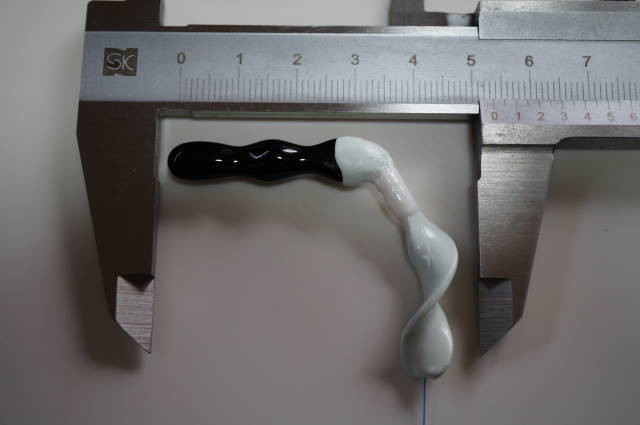
In an entry published in October 2017, Mr. Okada discussed a stent (a device intended to hold a passage open). He contrasted medical stent designs with his early microchip concept, including differences in flexibility and how urine passed the device.
He considered keeping the prostate expanded continuously under the same pressure intolerable. Mr. Okada argued that a person needed control over whether the device remained in place.
(Source: ok-lab's diary, published October 2017)
https://ok-lab.hatenablog.com/entry/20171018/1508291723
An overnight case raised concerns about unnoticed prostate pressure
In an entry published in June 2018, a customer described overnight use of the single-chip glass model to increase sensation. The customer reported Menturm ointment on the chip and nighttime use lasting 6–7 hours, including sleep. A clinician diagnosed acute prostatitis (prostate inflammation) 16 days later.
The customer suspected prolonged use without urination and limited awareness of excessive stimulation; the entry did not establish a cause. Mr. Okada published a medically knowledgeable reader's warning that ointments substantially increase infection risk. The published advice was against combining ointments with the chip.
(Source: ok-lab's diary, published June 2018)
https://ok-lab.hatenablog.com/entry/20180609/1528523953
Bleeding made Mr. Okada suspect damage from excessive prostate pressure
In an entry published in November 2019, Mr. Okada reported bleeding during a test involving a sharply curved linked chip. He said the bleeding had stopped by the next urination. He suspected pressure damage to the prostate rather than a cut; this was his explanation, not a recorded diagnosis.
He subsequently reported no discomfort. Mr. Okada's stated precaution was to avoid larger chips for a while.
(Source: ok-lab's diary, published November 2019)
https://ok-lab.hatenablog.com/entry/2019/11/16/154802
Mr. Okada reported lingering discomfort after prostate pressure from an angled connection
An entry published in November 2020 describes Mr. Okada's test of a short chip with an angled connection. He reported that its bend of 90 degrees strongly pushed the prostate apart, with discomfort lasting about 1 day afterward. He suspected excessive stimulation.
His revised prototype used an angle of 45–60 degrees; the entry covered only about 3 hours of testing. Mr. Okada favored the gentler angle, while leaving longer-term test results for a later report.
(Source: ok-lab's diary, published November 2020)
https://ok-lab.hatenablog.com/entry/2020/11/28/121505
Mr. Okada reported unintended prostate pressure during rigid sound testing
In an entry published in June 2023, Mr. Okada described testing a rigid curved urethral sound (a device for the urine passage). He wrote that roughly half the rigid sound had entered the prostate, producing more stimulation than intended.
He reported heart failure (his description of the illness) and described recovering after the sound was removed. The diary does not record medical confirmation of his explanation linking excessive stimulation to that illness. He emphasized how tightly the rigid sound gripped, describing removal as difficult and alarming.
(Source: ok-lab's diary, published June 2023)
https://ok-lab.hatenablog.com/entry/2023/06/03/121955
Mr. Okada linked firm fixation to continuous prostate pressure
In an entry published in July 2025, Mr. Okada described a test lasting about 3 days. His 10 cm wire extension connected to a shape-memory external anchor (a wire fixture outside the penis that holds position). He reported removing the assembly after symptoms he described as resembling heart failure.
He believed firm fixation kept pressure on the prostate continuously, leaving no respite. He contrasted this with an unanchored arrangement, which he thought still moved slightly with the body. Mr. Okada cautioned that such firm fixation might be too demanding for someone with poor health like his.
(Source: ok-lab's diary, published July 2025)
https://ok-lab.hatenablog.com/entry/2025/07/05/122905
Mr. Okada warned that harm from prostate pressure could go unnoticed
In an entry published in April 2026, Mr. Okada discussed excessive testing of a device that moved back and forth and rotated. He described symptoms resembling heart failure and questioned whether the urethra could tolerate such demanding activity.
He warned that serious prostate damage might go unnoticed because the area cannot be seen. These were his concerns about his testing, rather than a documented injury assessment. Mr. Okada urged careful judgment about adopting such devices.
(Source: ok-lab's diary, published April 2026)
https://ok-lab.hatenablog.com/entry/2026/04/04/122916
The maker's answer to too much prostate pressure
Mr. Okada changed curves and connections to reduce pressure, while acknowledging limits in his testing.
Advice about prostate pressure led to gentler curves and paused sales
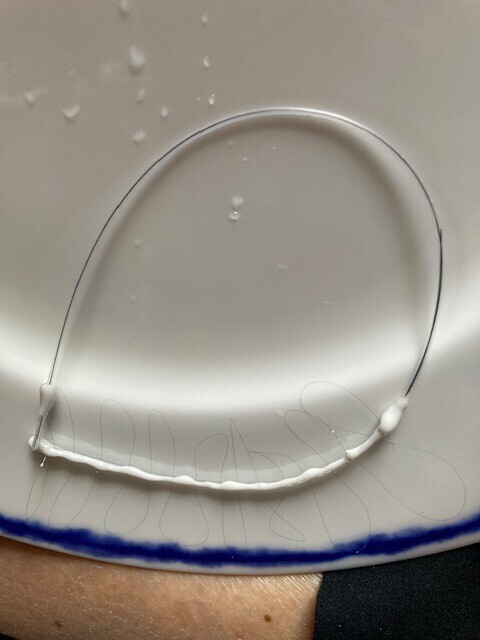
In an entry published in November 2019, Mr. Okada sought advice from someone he described as a urethral specialist. The specialist reportedly considered the prostate delicate and objected to excessive curvature. Mr. Okada initially questioned this because he thought the urethra could bend without difficulty.
He reduced the linked chip's curve and introduced 2 spacing choices: close together and slightly farther apart. Because testing remained incomplete, regular sales were put on hold, with custom orders only for the time being. Mr. Okada adopted the specialist's advice to favor gentler curves rather than force the prostate into a pronounced bend.
(Source: ok-lab's diary, published November 2019)
https://ok-lab.hatenablog.com/entry/2019/11/02/132358
Mr. Okada reported less prostate pressure with more flexible joints
In an entry published in February 2026, Mr. Okada described revising a jointed chip (linked sections with a flexible connection). Customers had reported difficulty handling the existing, stiffer version. His more flexible prototype had roughly 15 mm between chips, about 5 mm of bending rubber, and a resting angle around 45 degrees.
He reported substantially less stimulation because the rubber no longer pressed the prostate through its spring force. Mr. Okada suggested this could limit excessive pressure when combined with pressure from the anal side; that was his assessment.
(Source: ok-lab's diary, published February 2026)
https://ok-lab.hatenablog.com/entry/2026/02/07/122919
Mr. Okada proposed a micro sound for opposing prostate pressure
In an entry published in May 2026, Mr. Okada described a micro prostate sound with a 1 mm diameter. Its wing-like elements measured 40 mm across when spread. He claimed that this design produced stimulation without putting pressure on the urethra.
He contrasted it with a solid chip, which he said could burden the prostate while pressure also came from the anal side. Mr. Okada considered combined use reassuring because he believed the micro sound offered almost no opposing force from the urethral side.
(Source: ok-lab's diary, published May 2026)
https://ok-lab.hatenablog.com/entry/2026/05/23/122904
If you see blood in your urine, even a small amount or for the first time, do not wait and see. See a urologist right away. If you suddenly cannot urinate, or the device cannot be removed, do not try to fix it yourself. Go to a medical facility, including emergency care, immediately.
How too much prostate pressure changed over time
| Published | What the diary said then |
|---|---|
| Oct 2017 | Mr. Okada objected to sustained, unchanging pressure from prostate stents. |
| Jun 2018 | A customer's illness prompted an added warning against ointments. |
| Nov 2019 | Gentler curves and revised spacing accompanied a pause in regular linked-chip sales. |
| Nov 2020 | Lingering discomfort prompted a less sharply angled prototype. |
| Feb 2021 | Wire testing led Mr. Okada to discourage thicker connections for all-day use. |
| Jun 2023 | A rigid sound entered farther than intended and became difficult to remove. |
| Jul 2025 | Firm anchoring raised concerns about pressure that never eased. |
| Feb 2026 | A more flexible connection reduced stimulation and spring-driven pressure, according to Mr. Okada. |
| Apr 2026 | Mr. Okada warned that internal damage might escape notice. |
| May 2026 | Mr. Okada presented a micro sound as offering almost no opposing force. |
OK Prostate Chip products related to too much prostate pressure
The glass models named in customer reports remain on the supplied current product list.
Products that appear in these entries
| Product (official name) | Price incl. tax | Relation to this topic |
|---|---|---|
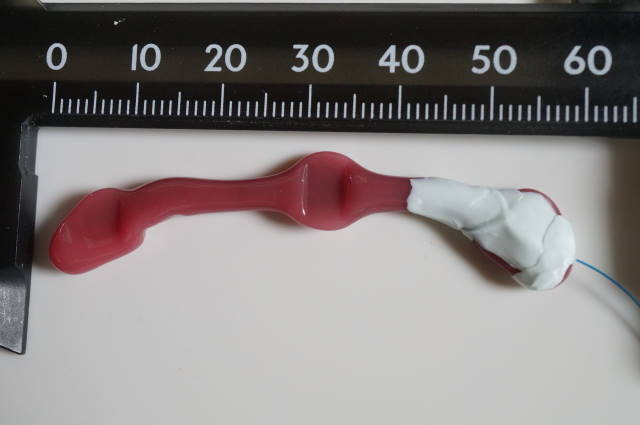
| Single-chip glass model (OKプロステートチップ ガラス素材1チップタイプ) | ¥3,300 (about $21 at ¥156 = $1, rate as of 2026-09-04) | A June 2018 customer reported this model in the overnight-use case followed by a prostatitis diagnosis. |
| Semi-long glass chip (OKプロステートチップ ガラス素材セミロングタイプ) | ¥4,400 (about $28 at ¥156 = $1, rate as of 2026-09-04) | An October 2019 customer reported surface flaking and pain after using this model with a stopper. |
(Source: ok-lab's diary, published June 2018)
https://ok-lab.hatenablog.com/entry/20180609/1528523953
(Source: ok-lab's diary, published October 2019)
https://ok-lab.hatenablog.com/entry/2019/10/12/125944
Products the diary mentioned as alternatives
The diary names no alternative.
Other designs discussed here include the early microchip, linked prototypes, wire-equipped assemblies, urethral sounds, and the test device. No matching product can be confirmed on the current list.
Common worries about too much prostate pressure
The customer exchanges leave some pressure complaints unresolved, even when Mr. Okada answers related questions.
"Could a thicker chip reduce prostate pressure after use?"
In an entry published in October 2019, a glass semi-long chip customer asked about repair after roughly 4 uses. The surface had flaked and felt rough; the customer also described 2–3 days of pain after each use. Asked about greater thickness, Mr. Okada gave 3–4 mm for glass or ceramic, plus roughly 1 mm at the thread attachment.
He considered limited repair possible, depending on the damage. The diary does not record whether repair occurred or pain resolved. Mr. Okada advised against continued use if cracking appeared widespread.
(Source: ok-lab's diary, published October 2019)
https://ok-lab.hatenablog.com/entry/2019/10/12/125944
"Would thicker wire increase prostate pressure during longer use?"
In an entry published in February 2021, a customer asked whether a ceramic chip connection could use 0.6 mm wire. Mr. Okada lacked that thickness, so his reply drew on a 0.7 mm test. He reported sudden prostate pain after about 4 hours, despite initially enjoying the stronger stimulation.
He considered 0.7 mm potentially suitable for brief use; that was his personal judgment. The diary does not record the customer's eventual configuration or experience. For all-day use, Mr. Okada advised against wire 0.5 mm or thicker.
(Source: ok-lab's diary, published February 2021)
https://ok-lab.hatenablog.com/entry/2021/02/06/125245
"Can another setup reduce prostate pressure and painful urination?"
In an entry published in July 2025, a semi-long M customer wanted longer use but reported painful urination and excessive strain. Mr. Okada suggested chip size, inflammation of the urethral lining, or damage to that lining during insertion as possible explanations.
For movement concerns, he discussed a flexible wire connection and an external anchor. The diary does not record whether the customer obtained that arrangement or experienced improvement. Mr. Okada recommended the anchor for position control, but gave no answer about reducing prostate strain or choosing another chip.
(Source: ok-lab's diary, published July 2025)
https://ok-lab.hatenablog.com/entry/2025/07/26/122909
Buying from outside Japan
OK Lab ships internationally to countries covered by Japan Post's EMS courier service. Overseas orders are paid in advance by PayPal. Each order carries a ¥400 (about $3 at ¥156 = $1, rate as of 2026-09-04) handling fee, and EMS shipping is charged on top. These terms come from OK Lab's official sales-terms page (written here as plain text, not a link: ok-lab.net/docs/law), checked on September 7, 2026; confirm them on the official store before you order, because they can change.
Summary of this article
| What you wanted to know | The answer |
|---|---|
| What is the short answer? | The diary links sustained pressure with adverse experiences and records attempts to reduce that pressure. |
| What is this product? | A urethral device made by OK Lab in Japan, with prices in Japanese yen. |
| What do the terms mean? | The key terms distinguish pressure, internal devices, flexible connections, and external fixation. |
| What happened in the reports? | Accounts included pain, bleeding, difficult removal, and illness Mr. Okada associated with excessive stimulation. |
| What did the maker change? | Curves became gentler, connections more flexible, and later designs aimed for less opposing force. |
| How did the concern develop? | Entries from October 2017 through May 2026 moved from objections to fixed pressure toward alternative designs. |
| Which current products appear? | The single-chip glass model is ¥3,300 (about $21 at ¥156 = $1, rate as of 2026-09-04); the semi-long glass chip is ¥4,400, (about $28 at ¥156 = $1, rate as of 2026-09-04) both including tax. |
| Were customer questions answered? | Some received partial replies; the July 2025 pressure and chip-selection questions remained unanswered. |
| How do overseas orders work? | Advance PayPal payment, a ¥400 (about $3 at ¥156 = $1, rate as of 2026-09-04) handling fee, and additional EMS shipping apply under the stated terms. |
Source: ok-lab's diary (Okada Comfortable Life Laboratory). The original entries are in Japanese; quotations on this page are translated. Photos and videos are on the original entries.
This article is a summary of the maker's development diary. The product is not a medical device and no result is guaranteed. If anything feels wrong or worries you, see a doctor. Prices, specifications and cautions change, so confirm the latest information on the official blog and the official site. Questions about ordering and shipping go to the seller.