![Why does my chip keep slipping out? | The diary reports limits to retention [OK Prostate Chip]](/img/a/T0375/eyecatch.svg)
This page is based on entries from "ok-lab's diary" (https://ok-lab.hatenablog.com/), the Japanese development diary written by Mr. Okada, founder of OK Lab, a small company in Japan (Okada Comfortable Life Laboratory). Only the entries about “chip slipping out during movement or penis shrinkage” are summarized here, in order of publication. Past prices and sizes are as written at the time. Current prices come from the official product list (retrieved September 4, 2026). Quotations are translated from Japanese.
Note: This page is a personal reading log by someone with no connection to the maker or the seller. It reflects the source entries as of their publication dates and makes no guarantee of accuracy or safety. The product is not a medical device; talk to a doctor about any health decision. Check the official site for current information. This page contains advertising.
In short
The diary records chips shifting with movement and connecting parts emerging when the penis shrinks.
Mr. Okada proposed different restraints and advised against long or bulky chips during exercise.
The current list includes a long chip; the later custom retention designs lack confirmed matches.
If you see blood in your urine, even a small amount or for the first time, do not wait and see. See a urologist right away.
If you suddenly cannot urinate, or the device cannot be removed, do not try to fix it yourself. Go to a medical facility, including emergency care, immediately.
About this product

The OK Prostate Chip is a small device that is placed in the urethra (the urine passage) so that it acts on the prostate; the maker sells it in several shapes, sizes and materials. It is made and sold by OK Lab (Okada Comfortable Life Laboratory), a small company in Japan, through its own online store, and prices are in Japanese yen (JPY). The maker's development diary, "ok-lab's diary", is written in Japanese. This page is an English summary of it, and every quotation is translated. OK Lab ships internationally, so readers outside Japan can order (see "Buying from outside Japan" below). Product names on this page are plain-English descriptions. The official Japanese product name is shown once in the product table so you can find the same item in the store.
Before you read: key terms
| Term | Plain-English meaning |
|---|---|
| Urethra | The urine passage; the device occupies this passage to act on the prostate. |
| Sphincter | A closing muscle around the urine passage; Mr. Okada discusses its role in retaining a chip. |
| Sphincter stopper | An attachment intended to limit a chip’s movement toward the bladder. |
| Bulbar urethra | The urethral region identified as a displaced chip’s destination. Its bodily function? The diary does not explain this. |
| Nitinol | Shape-memory wire used for connecting parts and retaining loops. |
| Screw support | A screw-shaped auxiliary chip intended to help an assembly stay positioned. |
| Resin | The material surrounding and securing the metal spring in the stainless chip discussed below. |
What happens: chip slipping out
The OK Prostate Chip is a small device placed in the urethra to act on the prostate. These entries describe chips moving from their intended position and connecting parts emerging when the penis shrinks. Proposed restraints sit near a sphincter (a closing muscle around the urine passage) or the urethral opening. Other designs change the connecting part’s flexibility, which Mr. Okada investigated as a way to accommodate changing length.
A stopper did not prevent bleeding during exercise with a prostate chip
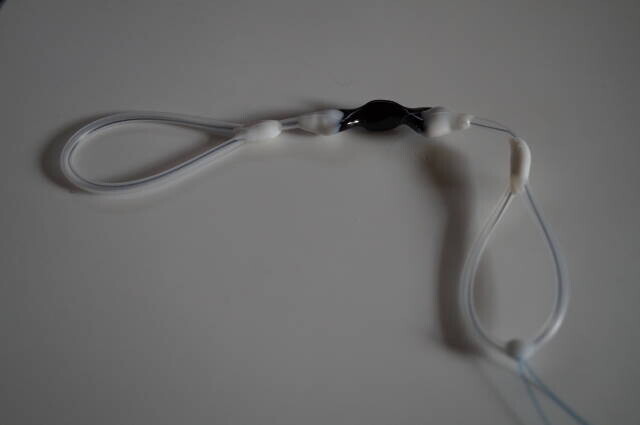
A customer report published in July 2021 compared sea-slug-shaped models, versions 3.1 and 4, during vigorous exercise. Both had a sphincter stopper (an attachment intended to limit movement toward the bladder). The customer reported no bleeding with version 3.1, but bleeding at every urination with the bumpy version 4.
The customer could not determine whether the bumps or an unsuitable shape caused the bleeding. They had stopped using the device and concluded that vigorous exercise with a chip in place was best avoided. Mr. Okada’s reply also cautioned that even smaller chips were unsuitable for prolonged exercise.
(Source: ok-lab's diary, published July 2021)
https://ok-lab.hatenablog.com/entry/2021/07/03/125851
Bare wire was abandoned after a prototype started slipping out painfully
In an entry published in October 2024, Mr. Okada described a short nitinol (shape-memory wire) prototype that moved outward with his body movements. He reported pain when its end loop partly emerged from the urethral opening. Suspecting that thin wire pressed into the lining, he abandoned bare 0.3 mm wire as a thread replacement.
For the official design announced then, he selected fully silicone-covered wire and changed the tube from 1 mm to 2 mm. He cited strength and cushioning concerns, while also noting that the larger tube could accommodate supporting attachments. Mr. Okada acknowledged that he did not know whether using the wire’s springiness to expand the prostate region was safe.
(Source: ok-lab's diary, published October 2024)
https://ok-lab.hatenablog.com/entry/2024/10/19/122847
A ceramic chip kept slipping out slightly despite retaining loops
In an entry published in January 2025, Mr. Okada compared a ceramic-chip prototype with a same-size version containing only wire loops. He had tested the ceramic version for about 2 days, compared with roughly 3 weeks for the wire-only version. He reported more movement with the ceramic chip, particularly during urination and exercise, and suspected its weight and slipperiness.
Retaining loops at both ends, including a 90-degree bend at the bulbar-urethra end, prevented complete escape in his test. Nevertheless, he reported outward movement of about 1 cm, alongside changing sensations as the chip contacted different places. Mr. Okada’s comparison favored the wire-only design for steadier retention.
(Source: ok-lab's diary, published January 2025)
https://ok-lab.hatenablog.com/entry/2025/01/04/122911
Petal loops reduced slipping out, but additional length still mattered
In an entry published in April 2025, Mr. Okada described a petal-shaped end loop intended to resist emergence from the urethral opening. His 0.2 mm wire extension stayed inside despite being about 3 cm longer than an earlier version that emerged. He attributed this result to sideways petals resisting passage through the narrow opening.
However, a wire 5 cm longer than the shrunken urethral length still emerged in his test. The reported improvement therefore had a length limit even in his own experiments. His sizing advice favored an extension about 3 cm longer than the penis when shrunken.
(Source: ok-lab's diary, published April 2025)
https://ok-lab.hatenablog.com/entry/2025/04/19/122913
Severe shrinkage still caused continuous-wire loops to start slipping out
In an entry published in November 2025, Mr. Okada tested a continuous-wire design whose loops served as retaining stops. The 0.15 mm prototype had separate loop groups near the sphincter and the urethral opening. He reported that unusually strong shrinkage made these groups push against each other, allowing the opening-side loops to escape.
He considered a shorter distance between the stops necessary to prevent that particular failure. This entry described a different wire thickness and construction from the bare-wire design abandoned in October 2024. Mr. Okada advised a finished length shorter than the wearer’s penis because excessive length could cause emergence during shrinkage.
(Source: ok-lab's diary, published November 2025)
https://ok-lab.hatenablog.com/entry/2025/11/15/122921
The maker's answer to chip slipping out
Mr. Okada proposed different measures for movement and shrinkage, while reporting limits for each design.
External cable fixation was proposed for a connecting chip slipping out
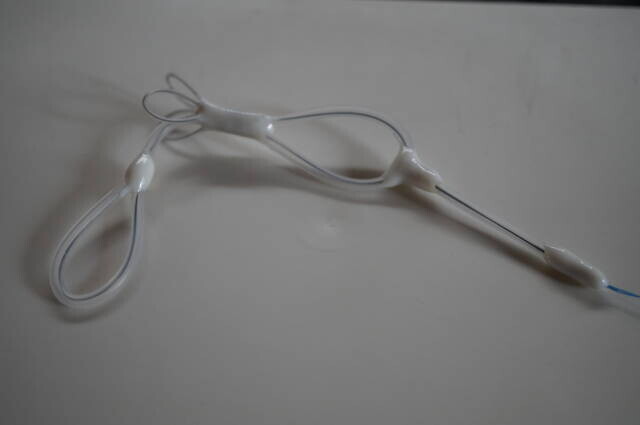
In an entry published in September 2019, Mr. Okada compared a cable-connected chip with an older nylon-thread support arrangement. He considered the cable-connected part easier to retain because cable extended from both sides. However, he also reported that substantial penis shrinkage could make the connecting chip emerge unexpectedly.
His proposed response was external cable fixation using tape, rather than a change to the chip’s shape. The diary does not record a lasting result for that shrinkage measure. Mr. Okada advised choosing tape gentler on skin than the ordinary adhesive tape used in his example.
(Source: ok-lab's diary, published September 2019)
https://ok-lab.hatenablog.com/entry/2019/09/07/135854
Smaller designs were the maker’s preference for chips slipping out during exercise
In his reply published in July 2021, Mr. Okada described a long chip shifting painfully while he sorted belongings. This was his own experience, separate from the customer’s exercise and bleeding report. He thought that continuing to move without noticing the displaced chip might have caused bleeding.
His resulting preference was a simple short chip, avoiding longer or larger designs during exercise. He also considered a short titanium chip with a very narrow sphincter section less likely to shift. Mr. Okada’s advice favored smaller, simpler shapes for this concern.
(Source: ok-lab's diary, published July 2021)
https://ok-lab.hatenablog.com/entry/2021/07/03/125851
Flexible tubing accommodated shrinkage but did not prevent slipping out during urination
In an entry published in December 2023, Mr. Okada described a nylon-thread tail partly covered by 2.5 mm silicone tubing. He reported that this construction could accommodate changes between erect and resting urethral lengths. A 15 cm assembly with 5 screw supports (screw-shaped auxiliary chips) reportedly accommodated a shortened overall length of 10 cm.
He attributed this behavior to tubing that could bend while retaining some resistance to compression. However, he warned that urine pressure could still expel the front support, and his proposed countermeasure involved manual support during urination. After describing the difficulties, Mr. Okada explicitly declined to recommend the multiple-support arrangement for general users.
(Source: ok-lab's diary, published December 2023)
https://ok-lab.hatenablog.com/entry/2023/12/09/123055
Chip slipping out measures included petal stoppers that could reverse under force
A later entry published in April 2025 adapted the petal idea into a stopper near the sphincter. Mr. Okada specified 3 petals made from 0.2 mm wire, attachable to constructions containing shape-memory wire. The published price was ¥1,000 (about $6 at ¥156 = $1, rate as of 2026-09-04) excluding tax per petal, or ¥3,000 (about $19 at ¥156 = $1, rate as of 2026-09-04) excluding tax for the three-petal stopper.
He selected this wire after judging 0.3 mm petals too stimulating around the sphincter for prolonged wear. He considered the thinner version effective during ordinary retention. His warning was that force applied with an instrument could invert the petals and allow the stopper to pass the sphincter.
(Source: ok-lab's diary, published April 2025)
https://ok-lab.hatenablog.com/entry/2025/04/26/122909
Large bladder loops kept slipping out with changes in posture
In an entry published in June 2025, Mr. Okada revisited a prototype with an unusually large bladder loop. He reported some outward movement during urination and also while leaning forward in a cross-legged position. He suspected that the latter posture compressed the bladder, although this was his interpretation.
His account therefore included movement even when he was not urinating. For stable retention, Mr. Okada advised against bladder loops measuring 50 mm or more.
(Source: ok-lab's diary, published June 2025)
https://ok-lab.hatenablog.com/entry/2025/06/14/122936
If you see blood in your urine, even a small amount or for the first time, do not wait and see. See a urologist right away.
If you suddenly cannot urinate, or the device cannot be removed, do not try to fix it yourself. Go to a medical facility, including emergency care, immediately.
How chip slipping out changed over time
| Published | What the diary said then |
|---|---|
| Jul 2018 | Mr. Okada suggested a twisted neck might resist return better; this remained tentative. |
| Nov 2018 | Mr. Okada reported exercise displaced his urethral chip while an anal chip remained supported. |
| Nov 2019 | A customer reported weaker sensation after movement shifted the chip outward. |
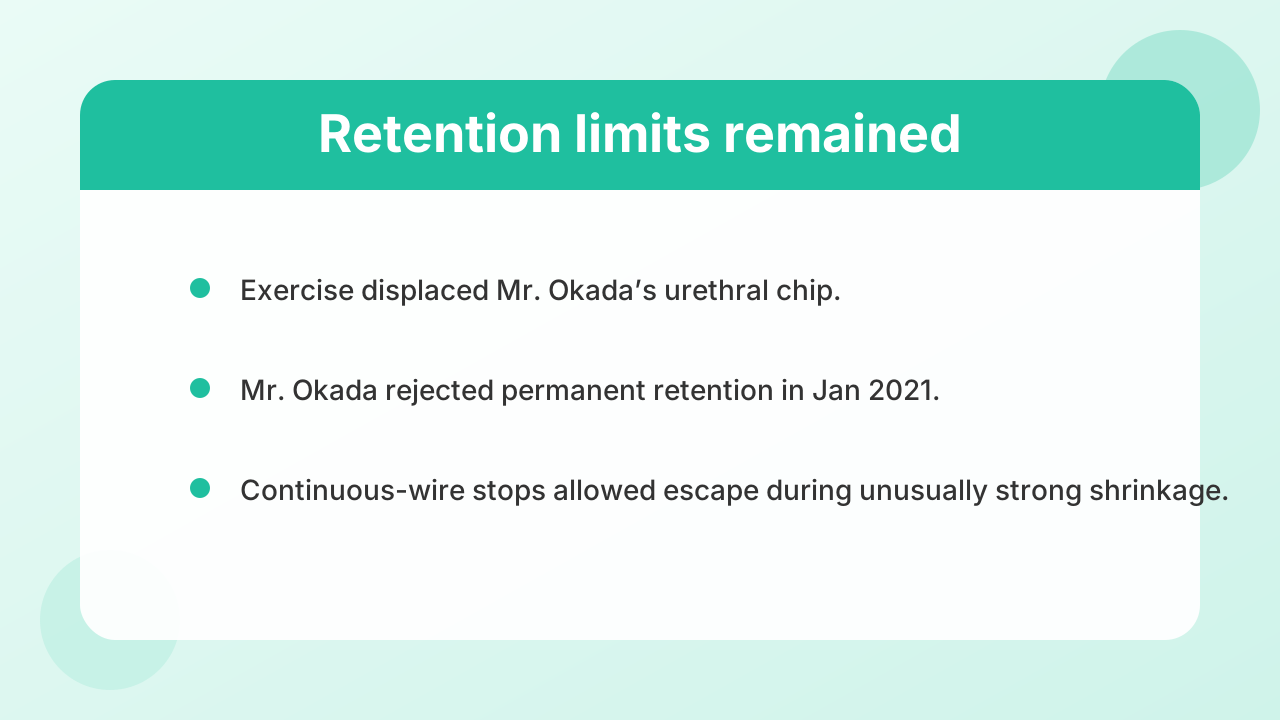
| Jan 2021 | Mr. Okada rejected permanent retention as a realistic expectation. |
| Dec 2023 | Tail: up to 15 cm, ¥2,000 (about $13 at ¥156 = $1, rate as of 2026-09-04) excluding tax; 16–25 cm, ¥3,000 (about $19 at ¥156 = $1, rate as of 2026-09-04) excluding tax. |
| Oct 2024 | The announced covered-wire design replaced 1 mm tubing with 2 mm tubing. |
| Apr 2025 | Two additional petals cost ¥1,000 (about $6 at ¥156 = $1, rate as of 2026-09-04) each, totaling ¥2,000 (about $13 at ¥156 = $1, rate as of 2026-09-04) excluding tax. |
| Nov 2025 | Continuous-wire stops still allowed outward escape during unusually strong shrinkage. |
OK Prostate Chip products related to chip slipping out
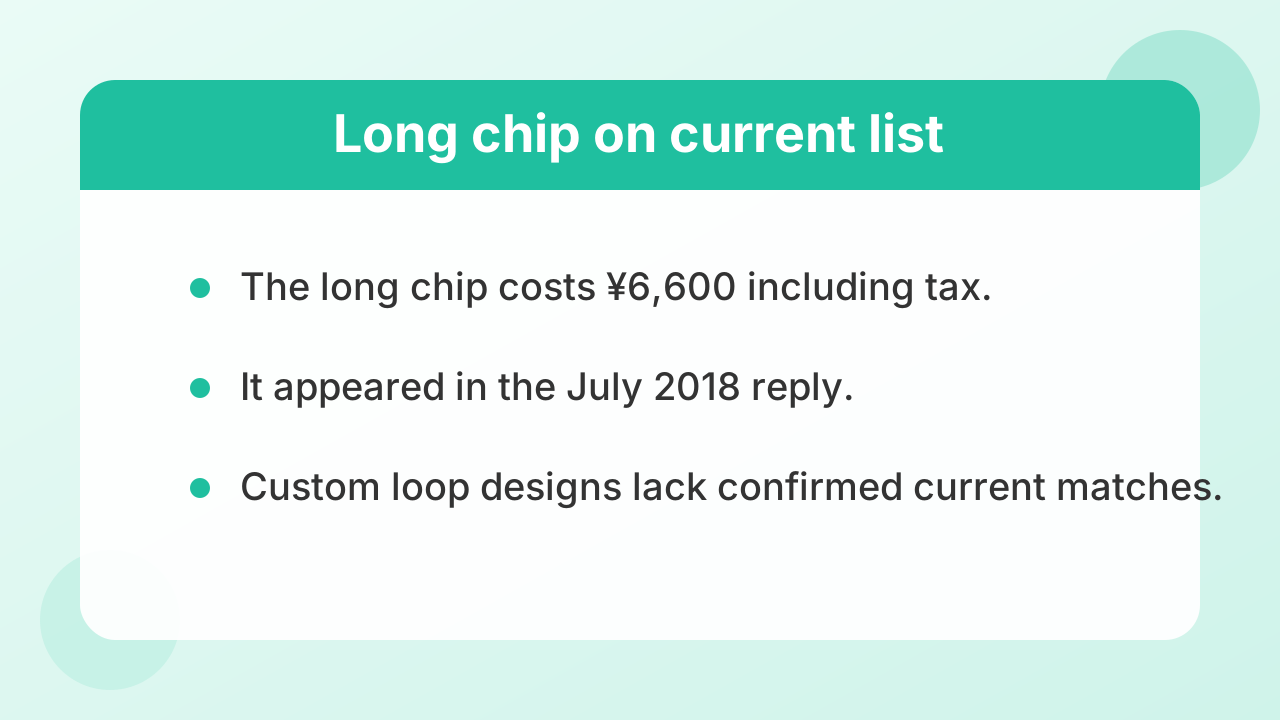
The current list includes the long chip discussed in the July 2018 retention reply.
Products that appear in these entries
No current product appears in these entries.
Products the diary mentioned as alternatives
| Product (official name) | Price incl. tax | Relation to this topic |
|---|---|---|
| Long chip (OKプロステートチップ ロングタイプ) | ¥6,600 (about $42 at ¥156 = $1, rate as of 2026-09-04) | In July 2018, Mr. Okada said stable retention depended on a long chip held between the inner and outer sphincters. |
(Source: ok-lab's diary, published July 2018)
https://ok-lab.hatenablog.com/entry/20180721/1532152353
Historical sea-slug variants, the stainless chip, short titanium chip, nylon-tail assemblies, silicone-covered wire connectors, and custom loop designs:
No matching product can be confirmed on the current list.
Common worries about chip slipping out
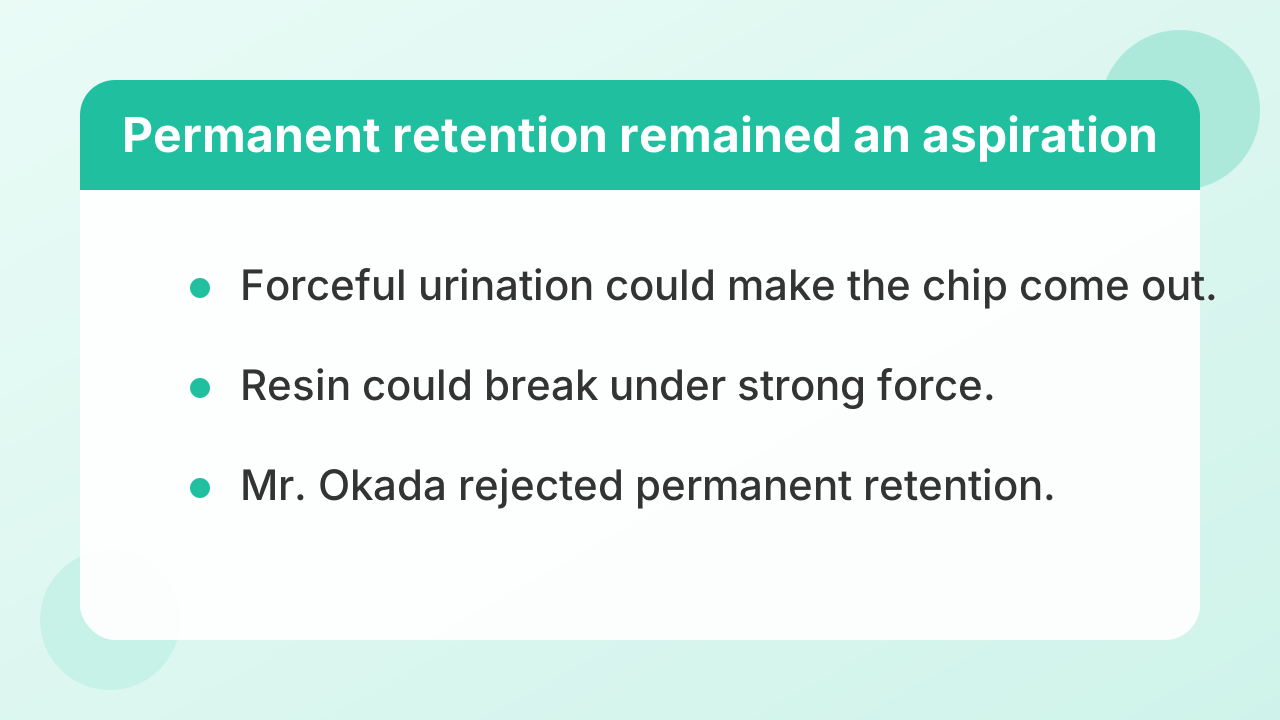
Mr. Okada’s replies distinguished displacement, component failure, and the hope of permanent retention.
"Why is my chip slipping out when I stand?"
In an entry published in July 2018, a customer wanted their short two-chip and semi-long models to remain positioned. Standing, turning over, or tightening the sphincter reportedly returned both to the bulbar urethra (the urethral region identified as their destination). Mr. Okada described an arrangement intended to let the outer sphincter close behind the whole chip, making outward return harder.
The stopper’s intended role was to prevent movement toward the bladder. The diary does not record whether this customer obtained steadier retention. Mr. Okada cautioned that the arrangement remained unanchored in the bladder and could come out during forceful urination.
(Source: ok-lab's diary, published July 2018)
https://ok-lab.hatenablog.com/entry/20180721/1532152353
"Could a chip slipping out mean its metal bond failed?"
A question published in January 2021 concerned whether a stainless spring could separate from its resin (the surrounding material securing the metal). Mr. Okada considered the bond strong and separation unlikely under ordinary handling, but did not call separation impossible.
The message concerned a possible failure, rather than reporting that the customer’s chip had actually separated. Mr. Okada also described a thin-resin prototype that had broken during development. His caution distinguished the bond from the resin itself, which he said could break under strong force.
(Source: ok-lab's diary, published January 2021)
https://ok-lab.hatenablog.com/entry/2021/01/02/123619
"Can long wear stop a chip slipping out permanently?"
Another question in the January 2021 message asked whether prolonged wear could make the chip become fixed within the prostate region. The customer wanted continuous stimulation and worried that such attachment might eventually require hospital removal. Mr. Okada rejected that expectation, saying he believed movement of the prostate and urethra continually changed the contact surface.
He reported that a stainless chip alone could slide out when more secretions were present. Even a bent connection with a screw support could be displaced by abundant secretions or particular body positions, according to his reply. Mr. Okada cautioned that permanent retention remained an aspiration.
(Source: ok-lab's diary, published January 2021)
https://ok-lab.hatenablog.com/entry/2021/01/02/123619
Buying from outside Japan

OK Lab ships internationally to countries covered by Japan Post's EMS courier service. Overseas orders are paid in advance by PayPal. Each order carries a ¥400 (about $3 at ¥156 = $1, rate as of 2026-09-04) handling fee, and EMS shipping is charged on top. These terms come from OK Lab's official sales-terms page (written here as plain text, not a link: ok-lab.net/docs/law), checked on September 7, 2026; confirm them on the official store before you order, because they can change.
Summary of this article
| What you wanted to know | The answer |
|---|---|
| What is the short answer? | The diary reports displacement despite several kinds of retaining attachments. |
| What is this product? | A small urethral device made by OK Lab in Japan to act on the prostate. |
| What do the terms mean? | Stoppers, supports, and loops are different parts intended to influence retention. |
| What happened in the reported cases? | Reports included outward movement, pain, bleeding during exercise, and emergence during shrinkage. |
| What did the maker suggest? | Different designs for different problems, with stated limits involving size, force, movement, and urine pressure. |
| What changed over time? | The diary moved from chip-shape advice to experiments with tubing, covered wire, and retaining loops. |
| What currently listed product is connected? | The long chip costs ¥6,600 (about $42 at ¥156 = $1, rate as of 2026-09-04) including tax and appeared in the July 2018 reply. |
| Does prolonged wear guarantee retention? | Mr. Okada rejected permanent retention as a realistic expectation. |
| How do overseas orders work? | Advance PayPal payment, a ¥400 (about $3 at ¥156 = $1, rate as of 2026-09-04) handling fee, and additional EMS shipping charges. |
| What is the overall conclusion? | The diary records improvements and failures; none of these accounts establishes retention under every condition. |
Source: ok-lab's diary (Okada Comfortable Life Laboratory). The original entries are in Japanese; quotations on this page are translated. Photos and videos are on the original entries.
This article is a summary of the maker's development diary. The product is not a medical device and no result is guaranteed. If anything feels wrong or worries you, see a doctor. Prices, specifications and cautions change, so confirm the latest information on the official blog and the official site. Questions about ordering and shipping go to the seller.