![Can I push the chip farther in? | The maker warns against forcing it [OK Prostate Chip]](/img/a/T0367/eyecatch.svg)
This page is based on entries from "ok-lab's diary" (https://ok-lab.hatenablog.com/), the Japanese development diary written by Mr. Okada, founder of OK Lab, a small company in Japan (Okada Comfortable Life Laboratory). Only the entries about "pushing a prostate chip too far" are summarized here, in order of publication. Past prices and sizes are as written at the time. Current prices come from the official product list (retrieved September 4, 2026). Quotations are translated from Japanese.
Note: This page is a personal reading log by someone with no connection to the maker or the seller. It reflects the source entries as of their publication dates and makes no guarantee of accuracy or safety. The product is not a medical device; talk to a doctor about any health decision. Check the official site for current information. This page contains advertising.
In short
- The diary records bleeding, damaged wires, and devices entering the bladder after excessive pushing.
- Mr. Okada warns against forcing a device beyond its intended position.
- Current listings include related chips and accessories, but later reports show that stoppers did not always prevent bladder entry.
If you see blood in your urine, even a small amount or for the first time, do not wait and see. See a urologist right away. If you suddenly cannot urinate, or the device cannot be removed, do not try to fix it yourself. Go to a medical facility, including emergency care, immediately.
About this product
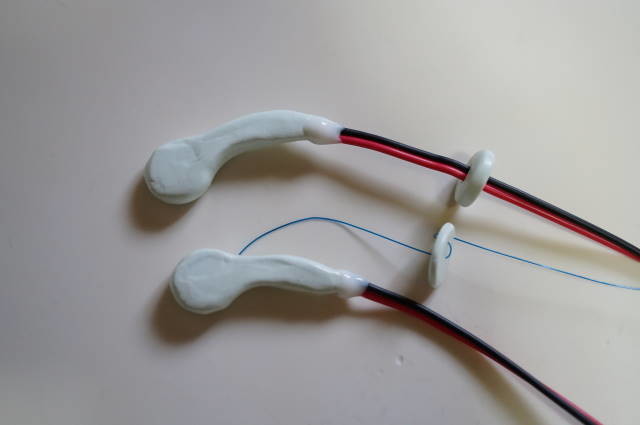
The OK Prostate Chip is a small device that is placed in the urethra (the urine passage) so that it acts on the prostate; the maker sells it in several shapes, sizes and materials. It is made and sold by OK Lab (Okada Comfortable Life Laboratory), a small company in Japan, through its own online store, and prices are in Japanese yen (JPY).
The maker's development diary, "ok-lab's diary", is written in Japanese. This page is an English summary of it, and every quotation is translated.
OK Lab ships internationally, so readers outside Japan can order (see "Buying from outside Japan" below). Product names on this page are plain-English descriptions. The official Japanese product name is shown once in the product table so you can find the same item in the store.
Before you read: key terms
| Term | Plain-English meaning |
|---|---|
| Urethra | The urine passage; the route in which the chip is placed. |
| Sphincter | A muscle controlling a passage; the diary discusses its role in urine flow and chip retention. |
| Retrieval thread | Thread attached to a device to provide a means of retrieving it. |
| Stopper | An additional component intended to limit movement; the diary records failures to prevent inward travel. |
| Chipless device | Wire and silicone tubing without a solid chip; its loops provide the device's shape and support. |
| Shape-memory wire | Flexible structural wire used to form chipless designs; Mr. Okada says force can deform it. |
| Endoscopic operation | Hospital removal using a medical scope; the diary reports this for a device inside the bladder. |
| Cystoscope | A medical instrument used for hospital retrieval of the chipless device from the bladder. |
| CT | An examination included in the May 2025 hospital visit. The diary does not explain this. |
What happens: pushing a prostate chip too far
The OK Prostate Chip is a small urethral device intended to apply pressure around the prostate. Pushing too far is the diary's concern about a device advancing beyond its intended position, sometimes into the bladder. The entries discuss solid chips, connected pairs, and flexible wire designs whose behavior differs under pressure. They also describe stoppers (parts intended to limit movement) and retrieval threads (threads attached for retrieval). These components did not prevent every reported accident.
A bladder-anchoring tester reported bleeding after use during prototype trials
In an entry published in January 2018, a tester reported slight bleeding with a curved, bladder-anchoring prototype. The customer said it had stopped by the next urination. Mr. Okada cautions that incorrect tip alignment can strain the sphincter (a muscle controlling a passage).
(Source: ok-lab's diary, published January 2018)
https://ok-lab.hatenablog.com/entry/20180111/1515662782
Mr. Okada reported his long chip stuck during early testing
In an entry published in January 2018, Mr. Okada describes 2 occasions when a long test chip would not come out. He considered urological care, but ultimately reported retrieval without a hospital visit. He blamed an earlier thread attachment that could detach.
He acknowledged that unexpected breakage remained possible with the changed attachment. He described the long model as restricted to short stays because he believed prolonged placement would damage the sphincter. Mr. Okada advised beginners and intermediate users against buying it.
(Source: ok-lab's diary, published January 2018)
https://ok-lab.hatenablog.com/entry/20180111/1515662782
Forceful pushing preceded bleeding after use with one vibrating chip
An entry published in March 2019 records a customer's experience with a vibrating single-chip model. The customer reported forcing it to about 27 cm, despite having a stopper. Afterwards, they described blood during urination, pain, and a strong feeling that urine remained.
They said the visible bleeding and pain were absent the following morning. Mr. Okada's reply discussed the cable specification, without establishing the cause of those symptoms. The diary does not record a medical diagnosis.
(Source: ok-lab's diary, published March 2019)
https://ok-lab.hatenablog.com/entry/2019/03/23/173222
A customer reported their chip lost inside, followed by injury
In an entry published in January 2020, a customer reviewing a newer ceramic setup described earlier trouble with a linked resin pair. They said they had misjudged the thread length, experienced the device disappearing inward, injured the urethra, and developed a fever. Mr. Okada's reply concerned the newer equipment. The diary does not record how the earlier injury was treated.
(Source: ok-lab's diary, published January 2020)
https://ok-lab.hatenablog.com/entry/2020/01/04/155235
Internal wire extensions unexpectedly drove one chip into the bladder
In an entry published in January 2021, Mr. Okada describes testing a design with doubled-back surplus wire inside the urethra. He reports that penile shrinkage drew the wire inward and drove the entire front chip into the bladder. The arrangement made retrieval difficult, though he ultimately recovered the device. His conclusion was that surplus wire must not be contained inside the urethra.
(Source: ok-lab's diary, published January 2021)
https://ok-lab.hatenablog.com/entry/2021/01/30/122153
Forceful pushing could damage supporting wires behind a blocked chip
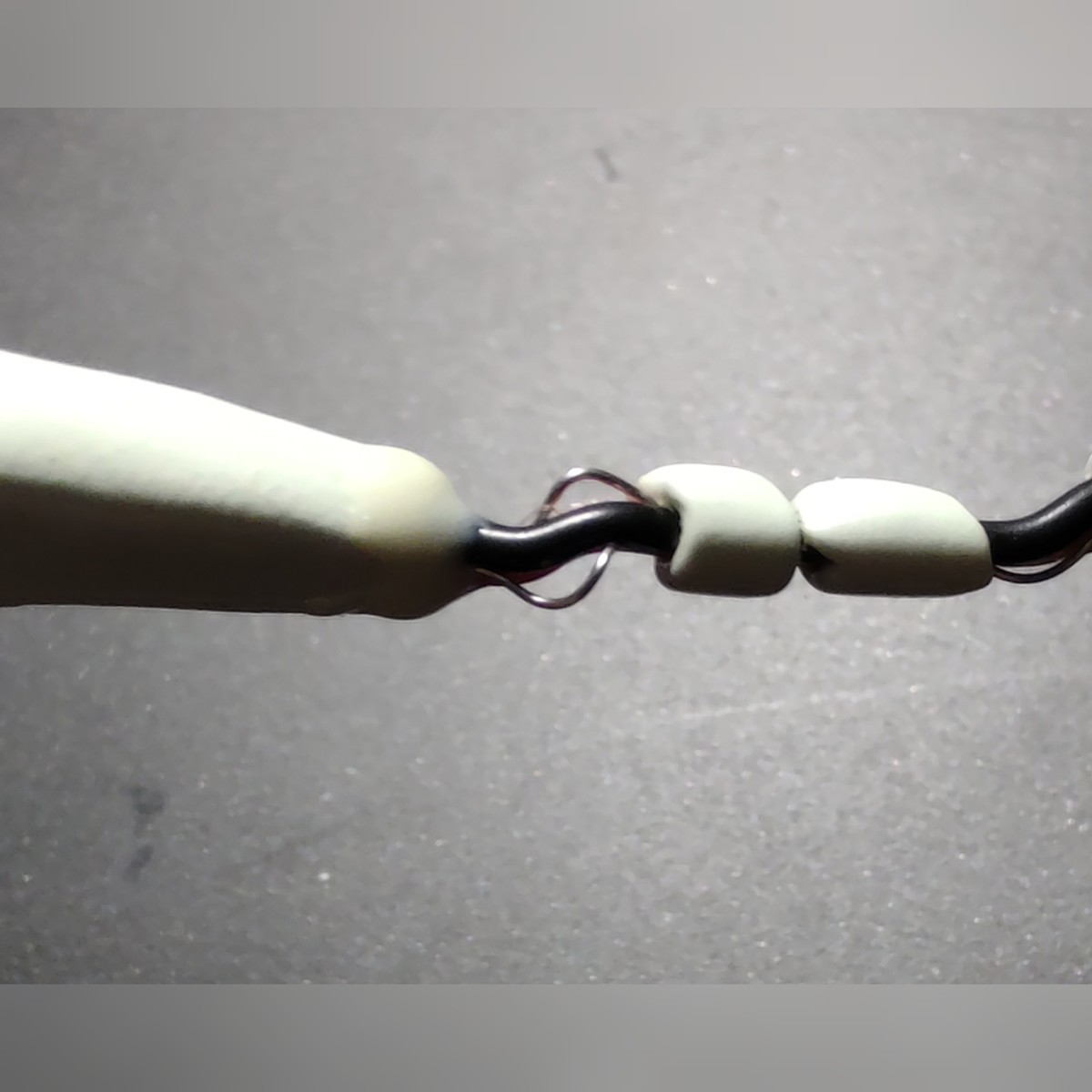
In an entry published in July 2022, a customer reported pain and exposed wire in a 4-wire cable. They had stopped using it and asked about replacement. Mr. Okada suspected forceful pushing against a blocked tip, rather than sphincter pressure alone, could explain the extreme bends.
He warned that repeated bending and straightening could break the wire; six-wire alternatives could also expose wire under extreme use. He offered cable replacement, but the diary does not record whether it was completed. Mr. Okada cautions against forcing a device when the body is resisting it.
(Source: ok-lab's diary, published July 2022)
https://ok-lab.hatenablog.com/entry/2022/07/09/123142
Rigid curved construction left one user with their chip stuck
In an entry published in May 2023, a customer reported that a long, curved chip became impossible to retrieve after half a day. They asked whether its angle explained the difficulty, after eventually retrieving it the following morning. Mr. Okada described an approximately 8 cm rigid assembly: a 6 cm main section and an approximately 2 cm curved addition.
He discussed flexible connections as an alternative. The diary does not record whether the customer tried an alternative. His warning concerned rigid curved devices advancing so far that their return angle could become problematic.
(Source: ok-lab's diary, published May 2023)
https://ok-lab.hatenablog.com/entry/2023/05/06/123024
A stopper failed to prevent whole-device bladder entry in February 2025
In an entry published in February 2025, a customer reported losing sea-slug version 5, its large mesh stopper, and all 35 cm of thread inside. An external stopper had come off, and about 4 urinations failed to recover the thread. Staff supported the doctor's plan for an endoscopic operation (hospital removal using a medical scope).
Staff also offered a custom larger stopper, while acknowledging they could not determine what size would prevent recurrence. The customer later reported successful removal, followed by an injury-related infection, low fever, and fatigue. Mr. Okada warns that a stopper cannot guarantee protection against bladder entry.
(Source: ok-lab's diary, published February 2025)
https://ok-lab.hatenablog.com/entry/2025/02/22/122939
A loop-ended chipless device entered the bladder and required hospital retrieval
An entry published in May 2025 describes failed retrieval of a chipless device (wire and tubing without a solid chip). Mr. Okada initially suggested adjustments, then advised a urology visit after learning the thread had also disappeared. The customer confirmed that both device and thread had entered the bladder.
CT, urine tests, and cystoscope retrieval (using a medical instrument) took about 5 hours, including waiting, and cost ¥34,000 (about $218 at ¥156 = $1, rate as of 2026-09-04). Mr. Okada warns that shape-memory wire (flexible wire forming the device) deforms under strong pushing, allowing the design to advance beyond its intended position.
(Source: ok-lab's diary, published May 2025)
https://ok-lab.hatenablog.com/entry/2025/05/03/122907
The maker's answer to pushing a prostate chip too far
Mr. Okada's recurring warning is that force can defeat the intended limits of a device or its stopper.
Concern about pushing too deep led Mr. Okada to withhold sales
In an entry published in October 2017, Mr. Okada said he had no plans to sell a test product discussed there. He cited possible injuries to the urethra and bladder. He worried that users might lose track of limits and push deeper. Mr. Okada explicitly warned against trying the speculative ideas that followed.
(Source: ok-lab's diary, published October 2017)
https://ok-lab.hatenablog.com/entry/20171022/1508644866
Linked chips brought easier movement alongside warnings about bladder entry
In an entry published in January 2018, Mr. Okada discussed linked chips with a 0–2 mm gap. Their total length was at least 5 cm. He considered them relatively easy to advance, while warning that their length also made bladder entry easy. Mr. Okada advised people with little knowledge of the urethra against this linked configuration.
(Source: ok-lab's diary, published January 2018)
https://ok-lab.hatenablog.com/entry/20180114/1515943724
Tool-assisted pushing raised the maker's concern about whole-chip bladder entry
In an entry published in February 2018, a customer reported successful tool-assisted placement after struggling without equipment. Mr. Okada reproduced the idea with different tubing, without testing that customer's equipment. He warned that tool-assisted pushing made whole-chip bladder entry very likely.
He treated tools as temporary aids until the manual approach was learned. Mr. Okada cautioned against excessive pushing.
(Source: ok-lab's diary, published February 2018)
https://ok-lab.hatenablog.com/entry/20180224/1519457027
Motor-only testing raised concerns about continued pushing after bladder entry
In an entry published in July 2019, Mr. Okada reports a test of a motor-only chip. Once the tip crossed the sphincter, pressure through its cable could keep driving it inward without an apparent limit. He also raised concerns about cable tangling inside the bladder. Mr. Okada wanted stoppers to become mandatory for this motor-and-cable configuration.
(Source: ok-lab's diary, published July 2019)
https://ok-lab.hatenablog.com/entry/2019/07/13/150108
If you see blood in your urine, even a small amount or for the first time, do not wait and see. See a urologist right away. If you suddenly cannot urinate, or the device cannot be removed, do not try to fix it yourself. Go to a medical facility, including emergency care, immediately.
How pushing a prostate chip too far changed over time
| Published | What the diary said then |
|---|---|
| Jan 2018 | Mr. Okada reported delayed irritation during tests of silicone-coated glass. |
| Mar 2019 | A customer stopped forceful pushing after viewing an X-ray video. |
| Mar 2019 | A new silicone-covered cable used a thicker copper core. |
| Jan 2020 | Cable-linked prototypes also incorporated nylon thread because of concerns about cable breakage. |
| Dec 2024 | Testing a guiding aid prompted Mr. Okada to limit its intended reach. |
| Feb 2025 | Hospital charges: ¥25,000 (about $160 at ¥156 = $1, rate as of 2026-09-04) for removal; approximately ¥35,000 (about $224 at ¥156 = $1, rate as of 2026-09-04) including tests and medicines. |
| May 2025 | Mr. Okada advised medical care for trapped cable; no retrieval outcome was reported. |
OK Prostate Chip products related to pushing a prostate chip too far
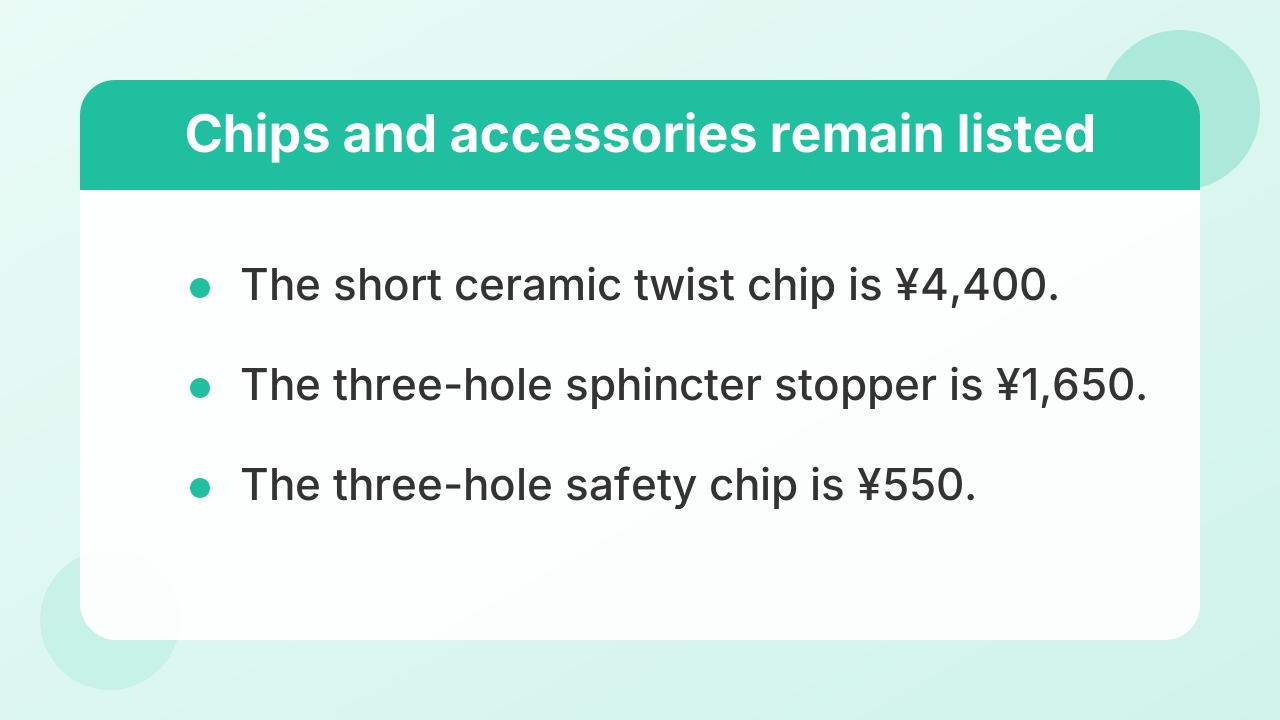
The current list includes the short ceramic twist chip and accessories named in the May 2020 safety discussion.
Products that appear in these entries
| Product (official name) | Price incl. tax | Relation to this topic |
|---|---|---|
| Short ceramic twist chip (OKプロステートチップ 陶器素材ショートタイプ ツイスト) | ¥4,400 (about $28 at ¥156 = $1, rate as of 2026-09-04) | A beginner's May 2020 order prompted questions about preventing bladder entry. |
| Screw-shaped auxiliary chip (スクリュー型補助チップ追加オプション) | ¥3,300 (about $21 at ¥156 = $1, rate as of 2026-09-04) | This accessory was part of the same May 2020 order discussed in the maker's positioning reply. |
| Three-hole sphincter stopper (三穴方式オプションチップ(括約筋ストッパーチップ)) | ¥1,650 (about $11 at ¥156 = $1, rate as of 2026-09-04) | In May 2020, the beginner requested this addition because they feared bladder entry. |
| Three-hole safety chip (三穴方式オプションチップ(セーフティチップ)) | ¥550 (about $4 at ¥156 = $1, rate as of 2026-09-04) | In May 2020, the same customer requested this additional accessory, and staff accepted the change. |
(Source: ok-lab's diary, published May 2020)
https://ok-lab.hatenablog.com/entry/2020/05/09/143600
Products the diary mentioned as alternatives
The diary names no alternative.
Other entries concern historical prototypes, custom assemblies, and older named configurations. No matching product can be confirmed on the current list.
Common worries about pushing a prostate chip too far
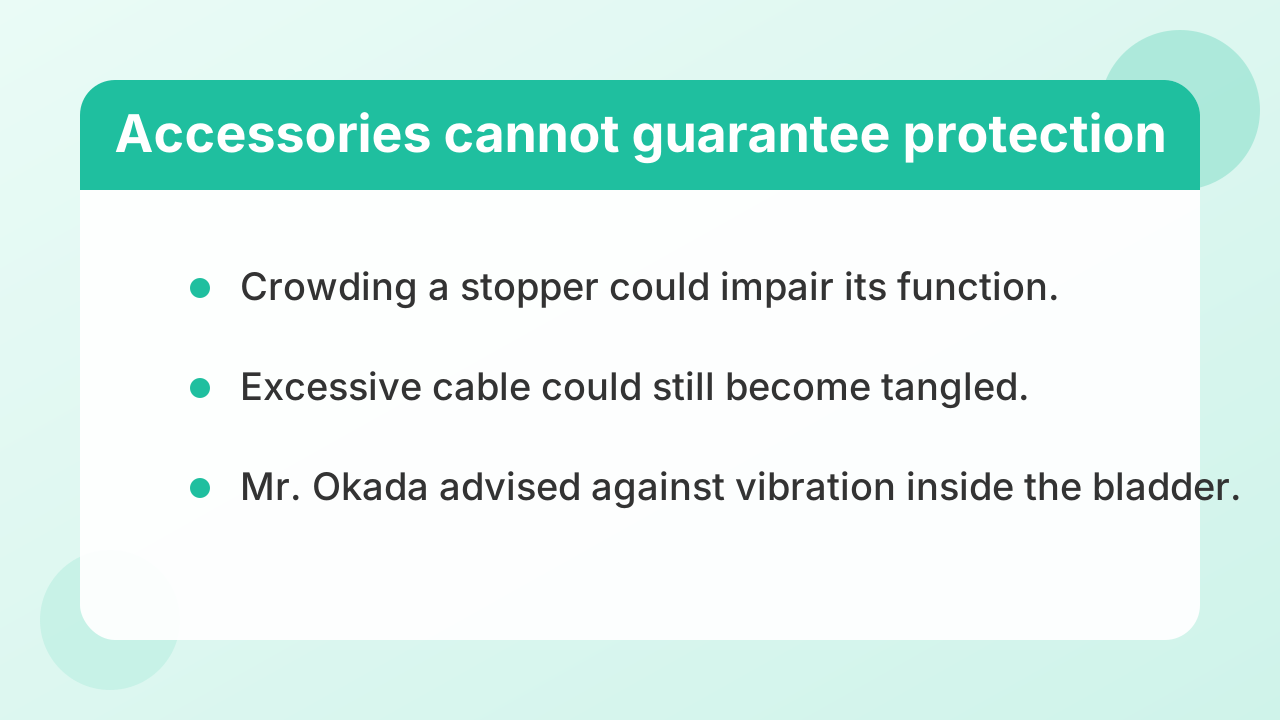
The replies describe limits to accessories and flexible designs, rather than a guarantee against inward movement.
"Can extra stoppers prevent a chip entering the bladder?"
In an entry published in May 2020, a beginner asked to add stoppers after reading about bladder entry involving a similar setup. Staff accepted the additions but warned that crowding a stopper against the auxiliary chip could impair its function.
The diary does not record how this customer's completed setup performed. The maker's reply emphasizes avoiding excessive pushing.
(Source: ok-lab's diary, published May 2020)
https://ok-lab.hatenablog.com/entry/2020/05/09/143600
"Does an electrical cable rule out trouble from bladder entry?"
In an entry published in February 2022, a customer wondered whether an electrical cable and connector made bladder entry easy to recover from. Staff thought the risk was lower than with thread, but warned that excessive cable could still become tangled. Mr. Okada described his own motor-only device advancing deeply with very little resistance.
The diary does not record a later outcome for the questioner's proposed arrangement. Mr. Okada advised against vibration inside the bladder.
(Source: ok-lab's diary, published February 2022)
https://ok-lab.hatenablog.com/entry/2022/02/12/123441
"Will stoppers hold longer chips pushed too far?"
In an entry published in January 2024, a customer asked whether an elongated resin chip could sit entirely beyond the sphincter. They asked whether a stopper would hold it there. Mr. Okada could not answer that from experience. His warning was that prolonged placement of the whole chip beyond the sphincter could make bladder entry especially likely.
(Source: ok-lab's diary, published January 2024)
https://ok-lab.hatenablog.com/entry/2024/01/27/123012
Buying from outside Japan
OK Lab ships internationally to countries covered by Japan Post's EMS courier service. Overseas orders are paid in advance by PayPal. Each order carries a ¥400 (about $3 at ¥156 = $1, rate as of 2026-09-04) handling fee, and EMS shipping is charged on top. These terms come from OK Lab's official sales-terms page (written here as plain text, not a link: ok-lab.net/docs/law), checked on September 7, 2026; confirm them on the official store before you order, because they can change.
Summary of this article
| What you wanted to know | The answer |
|---|---|
| Short answer? | The maker warns against forcing deeper placement. |
| Product and origin? | A urethral device from OK Lab in Japan. |
| Key terms? | Threads assist retrieval; stoppers are intended to limit movement. |
| Reported problems? | Bleeding, damaged wires, difficult retrieval, and bladder entry. |
| Maker's measures? | Warnings about force, depth, tools, and rigid designs. |
| Historical changes? | New cables and guiding aids brought further warnings. |
| Current products? | The May 2020 chip and accessories remain listed. |
| Can stoppers guarantee protection? | Mr. Okada says they cannot. |
| Overseas buying? | Advance PayPal payment, ¥400 (about $3 at ¥156 = $1, rate as of 2026-09-04) handling, plus EMS shipping. |
| Overall lesson? | Later hospital reports reinforced warnings against excessive pushing. |
Source: ok-lab's diary (Okada Comfortable Life Laboratory). The original entries are in Japanese; quotations on this page are translated. Photos and videos are on the original entries.
This article is a summary of the maker's development diary. The product is not a medical device and no result is guaranteed. If anything feels wrong or worries you, see a doctor. Prices, specifications and cautions change, so confirm the latest information on the official blog and the official site. Questions about ordering and shipping go to the seller.