![Can wrong batteries or voltage break my chip? | Yes, motors and controllers can fail [OK Prostate Chip]](/img/a/T0361/eyecatch.svg)
This page is based on entries from "ok-lab's diary" (https://ok-lab.hatenablog.com/), the Japanese development diary written by Mr. Okada, founder of OK Lab, a small company in Japan (Okada Comfortable Life Laboratory). Only the entries about "wrong batteries or voltage" are summarized here, in order of publication. Past prices and sizes are as written at the time. Current prices come from the official product list (retrieved September 4, 2026). Quotations are translated from Japanese.
Note: This page is a personal reading log by someone with no connection to the maker or the seller. It reflects the source entries as of their publication dates and makes no guarantee of accuracy or safety. The product is not a medical device; talk to a doctor about any health decision. Check the official site for current information. This page contains advertising.
In short
- The diary reports overheating, motor failure, and controller damage involving excessive voltage, reversed batteries, or incompatible controllers.
- Mr. Okada warned against 9V and restricted controller choices for the delicate 6 mm motor.
- The medium-length glass vibrating chip remains listed, but the product list does not confirm specific motor sizes.
About this product

The OK Prostate Chip is a small device that is placed in the urethra (the urine passage) so that it acts on the prostate; the maker sells it in several shapes, sizes and materials. It is made and sold by OK Lab (Okada Comfortable Life Laboratory), a small company in Japan, through its own online store, and prices are in Japanese yen (JPY). The maker's development diary, "ok-lab's diary", is written in Japanese. This page is an English summary of it, and every quotation is translated. OK Lab ships internationally, so readers outside Japan can order (see "Buying from outside Japan" below). Product names on this page are plain-English descriptions. The official Japanese product name is shown once in the product table so you can find the same item in the store.
Before you read: key terms
| Term | Plain-English meaning |
|---|---|
| Voltage | The supply specification written with V, used to describe power supplied to the motor. |
| Motor | The part attached to a vibrating chip to generate vibration; the entries discuss several sizes. |
| IC controller | An electronic controller containing a circuit board, used to operate the chip's vibration modes. |
| Polarity | The positive (+) and negative (−) connection direction, relevant to powering the controller or motor. |
| AAA batteries | The battery size specified for the February 2019 electronic controller, used to supply its power. |
| Bluetooth controller | A controller discussed for operating vibrating chips. The diary does not explain this. |
| USB-rechargeable IC controller | A rechargeable electronic controller used to operate chip vibration. |
| Eneloop | The battery brand named by the December 2023 customer, used to power their controller. |
What happens: wrong batteries or voltage
The OK Prostate Chip is a device placed in the urethra, the urine passage, with vibrating versions described in these entries. A motor (the part that produces vibration) is attached to these chips and connected by cable to a controller. An IC controller (an electronic vibration controller) operates that motor. Problems involved reversed connections, unsuitable voltage (the supply level written with V), or batteries too weak for the controller.
A 9V test produced intense heat without reported motor failure
In an entry published in August 2019, a customer described testing a custom three-motor chip at 9V. They had requested closer motor spacing, hoping for stronger vibration, but reported little change from that design difference. The voltage experiment produced intense heat that the customer thought could cause burns during continuous vibration.
The customer also reported roughly five hours of maximum-voltage testing without motor failure or peeling caused by heat. Mr. Okada suspected that some heat injury to the urethra had occurred; the diary does not record a medical assessment. His reply explicitly rejected 9V use.
(Source: ok-lab's diary, published August 2019)
https://ok-lab.hatenablog.com/entry/2019/08/10/125102
An 8 mm motor stopped after 6V testing despite successful bench trials
In an entry published in August 2019, a customer reported that a medium-length glass vibrating chip stopped after earlier 6V testing. They suspected motor failure and asked whether the 8 mm motor lacked the tolerance discussed for larger motors. Mr. Okada replied that most of his voltage testing had actually involved that smaller size.
He reported 10 hours of continuous operation without trouble in his own tests, while acknowledging that individual motors could differ. He offered replacement for an initial defect, but the diary does not record the outcome of this repair request. Mr. Okada cautioned that 6V was outside the motor's rated use and that failure remained possible.
(Source: ok-lab's diary, published August 2019)
https://ok-lab.hatenablog.com/entry/2019/08/24/125858
Wrong polarity could destroy the newly tested 10 mm motor
In an entry published in February 2020, Mr. Okada described a new 10 mm motor being considered for more reliable cable connections. Unlike the earlier motor, it allowed a direct connection to OK Lab's cable. Availability still depended on further heat and water testing.
The prototype survived three hours at 6V, but would not start at 1.5V. Those were results for this particular prototype, whose connection arrangement differed from the earlier motor. Mr. Okada warned that reversing polarity (the positive and negative connection direction) destroyed this motor.
(Source: ok-lab's diary, published February 2020)
https://ok-lab.hatenablog.com/entry/2020/02/01/151232
Motor failure during 3V–6V use did not establish its cause
In an entry published in November 2021, a customer reported that a medium-length glass vibrating chip stopped during use. The customer described an external power supply operating at 3V–6V and believed their own use had damaged the motor. Mr. Okada said he did not know why it had failed.
The customer also requested a different custom three-motor build, which Mr. Okada said would appear in a later custom-order report. The diary does not record whether that order was completed. Mr. Okada cautioned that all the motors became considerably hot above 5V.
(Source: ok-lab's diary, published November 2021)
https://ok-lab.hatenablog.com/entry/2021/11/13/123751
Wrong voltage exposed particular weaknesses in the flat 6 mm motor
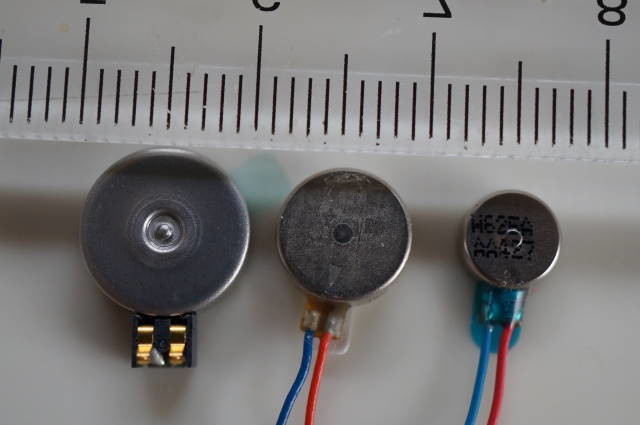
An entry published in January 2022 described a flat 6 mm motor with an operating range of 2.7V–3.3V. Mr. Okada had previously declined a request for this size because he expected too little vibration. He reconsidered its potential for gentler vibration and began testing it.
The motor would not rotate at 2.5V or below; around 5V, it became hot enough to burn within 20 seconds, according to his tests. His testing also found damage when voltage rose again after dropping below the level needed for rotation. Mr. Okada warned that treating this motor like earlier, less delicate models was a mistake.
(Source: ok-lab's diary, published January 2022)
https://ok-lab.hatenablog.com/entry/2022/01/22/123342
The maker's answer to wrong batteries or voltage
The maker warned about connection direction, distinguished repair types, and limited controller choices for the 6 mm motor.
Reversed batteries required greater care when electronic controllers arrived in 2019
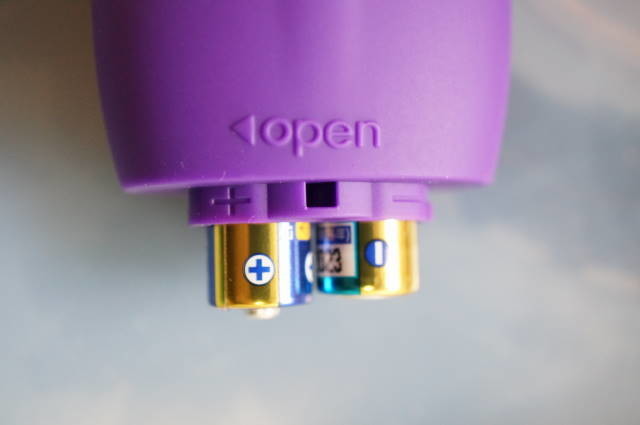
In an entry published in February 2019, Mr. Okada contrasted the IC controller with the older basic vibrator controller. He said the older type would simply run or fail to run when the battery direction was wrong. With the electronic controller, he warned, reversed connections could cause malfunction or heating.
AAA batteries (the battery size specified for this controller) were not included with the original product or with OK Lab's supply. Purchasers had to obtain them separately. Mr. Okada specifically urged customers to avoid mixing up the positive and negative directions.
(Source: ok-lab's diary, published February 2019)
https://ok-lab.hatenablog.com/entry/2019/02/23/142754
Controller repair prices distinguished broken wires from damage caused by reversed batteries
In an entry published in August 2019, a customer reported a controller stopping after one or two uses. The customer identified an internal wiring fault and reported that the controller worked again after repair. Mr. Okada apologized for the poor connection.
The quoted price for a simple broken-wire repair was ¥500 (about $3 at ¥156 = $1, rate as of 2026-09-04) excluding tax, as published in August 2019. Repair of an IC damaged by reversed batteries cost ¥2,000 (about $13 at ¥156 = $1, rate as of 2026-09-04) in that entry. Mr. Okada said such early wiring failures qualified for free repair as an initial defect.
(Source: ok-lab's diary, published August 2019)
https://ok-lab.hatenablog.com/entry/2019/08/17/132641
Wrong controllers destroyed 6 mm motors during January 2022 compatibility tests
The January 2022 entry also tested which controllers could operate the new 6 mm motor. The older basic vibrator controller worked with fresh batteries, but a motor suddenly failed during testing with worn batteries. Every trial with the Bluetooth controller (another vibration controller) destroyed the motor on its first activation, across all tested conditions.
He reported no problems with the standard electronic controller during lengthy tests, including complete battery depletion. Mr. Okada therefore restricted this motor to the standard IC controller or USB-rechargeable IC controller (the rechargeable version).
(Source: ok-lab's diary, published January 2022)
https://ok-lab.hatenablog.com/entry/2022/01/22/123342
How wrong batteries or voltage changed over time
| Published | What the diary said then |
|---|---|
| Feb 2019 | Electronic controls made reversed batteries a malfunction and heating concern. |
| Aug 2019 | The maker rejected a customer's 9V experiment after an intense-heat report. |
| Aug 2019 | Repair pricing distinguished wiring faults from damaged electronics. |
| Aug 2019 | Motor failure prompted an explicit warning about operation outside its rating. |
| Nov 2019 | Another failure prompted discussion of a possible lower voltage limit. |
| Feb 2020 | A newly tested motor was vulnerable to reversed power connections. |
| Nov 2021 | External-power failure remained unexplained; the maker emphasized overheating. |
| Jan 2022 | The smaller motor brought tighter voltage and controller restrictions. |
| Jun 2022 | Advice about multiple motors included a warning against prolonged 6V use. |
| Dec 2023 | A nonworking controller started with alkaline batteries, according to its customer. |
The diary does not say what the current state is.
OK Prostate Chip products related to wrong batteries or voltage
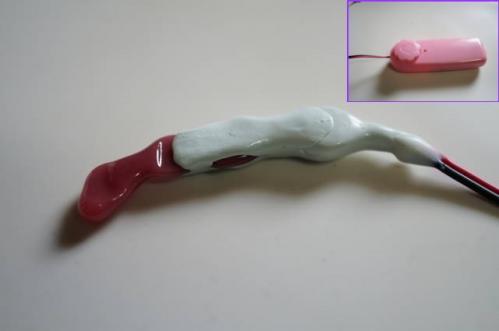
The medium-length glass vibrating chip appears in a failure report and remains on the current product list.
Products that appear in these entries
| Product (official name) | Price incl. tax | Relation to this topic |
|---|---|---|
| Medium-length glass vibrating chip (OKプロステート核振チップ ガラス素材セミロングタイプ) | ¥6,600 (about $42 at ¥156 = $1, rate as of 2026-09-04) | November 2021: a customer reported motor failure during use with an external power supply. |
The medium-length glass vibrating chip is listed in OK Lab's own online store.
(Source: ok-lab's diary, published November 2021)
https://ok-lab.hatenablog.com/entry/2021/11/13/123751
Products the diary mentioned as alternatives
The diary names no alternative.
The entries also describe controller versions, custom three-motor chips, a directly connected 10 mm prototype, and a flat 6 mm test build. No matching product can be confirmed on the current list.
Common worries about wrong batteries or voltage
Reader questions concerned voltage limits, brief stoppages, stronger vibration, and a controller that would not start.
"Does successful 6V testing mean my motor can tolerate it?"
In an entry published in November 2019, a customer asked what voltage the motor could tolerate after changing controllers. Mr. Okada gave its rated voltage as 3V, while reporting that his own continuous tests had reached 6V.
Separately, he described one report of failure after 10 minutes at 6V; that was not identified as the questioner's motor. Mr. Okada said he had replaced that failed motor as an initial defect. He warned that further similar failures could lead him to set a 4.5V maximum.
(Source: ok-lab's diary, published November 2019)
https://ok-lab.hatenablog.com/entry/2019/11/02/132358
"Could reversed batteries explain my chip stopping after two minutes?"
An entry published in March 2020 described a customer whose chip stopped after about two minutes, with its power light also going out. Fresh batteries did not resolve it, but the device ran again the next day; the pattern happened on two consecutive days. Mr. Okada mentioned reversed batteries as one possible explanation based on his own experience, without confirming the cause.
He accepted the case as an initial defect and offered free motor replacement. The customer's follow-up said it was working that morning; the diary does not record whether replacement eventually occurred. Mr. Okada offered immediate return if repeated stoppages made it unusable.
(Source: ok-lab's diary, published March 2020)
https://ok-lab.hatenablog.com/entry/2020/03/21/143802
"Can higher voltage address weak vibration from multiple motors?"
In an entry published in June 2022, a customer wanted prices and dimensions for a custom chip with multiple motors. The customer had found earlier vibrating chips insufficiently stimulating and was considering a different build. Mr. Okada said multiple motors vibrated much more at 4.5V or above than at 3V.
He expected further test results and pricing information in a later entry. The diary does not record whether this order was completed. Mr. Okada specifically warned that 6V was dangerous for prolonged use.
(Source: ok-lab's diary, published June 2022)
https://ok-lab.hatenablog.com/entry/2022/06/04/123036
"Can Eneloop batteries explain why my controller won't start?"
In an entry published in December 2023, a customer reported that a controller would not operate. OK Lab's staff listed weak batteries and earlier reverse connection as possible causes. They warned that even one reversed-battery startup could damage the IC, leaving it unable to operate after correct battery placement.
The customer replied that it worked with alkaline batteries, attributing the earlier failure to insufficient voltage from Eneloop batteries (the battery brand named). The diary advises returning the controller for inspection if neither suggested cause explains the problem.
(Source: ok-lab's diary, published December 2023)
https://ok-lab.hatenablog.com/entry/2023/12/30/122243
Buying from outside Japan

OK Lab ships internationally to countries covered by Japan Post's EMS courier service. Overseas orders are paid in advance by PayPal. Each order carries a ¥400 (about $3 at ¥156 = $1, rate as of 2026-09-04) handling fee, and EMS shipping is charged on top. These terms come from OK Lab's official sales-terms page (written here as plain text, not a link: ok-lab.net/docs/law), checked on September 7, 2026; confirm them on the official store before you order, because they can change.
Summary of this article
| What you wanted to know | The answer |
|---|---|
| What is the short answer? | The diary records damage from unsuitable power and controllers, alongside a battery-related failure that was resolved. |
| What is the product? | A Japanese urethral device, with vibrating versions made by OK Lab. |
| Which terms matter? | Motor, controller, polarity, and battery names distinguish the parts involved. |
| What happened in the cases? | Reports ranged from overheating and motor failure to a cause Mr. Okada could not identify. |
| What did the maker propose? | Attention to connection direction, fault-specific repairs, and restricted controller choices for the smaller motor. |
| What changed over time? | Later entries added motor-specific restrictions and another warning about reversed batteries. |
| Which products are currently listed? | The medium-length glass vibrating chip costs ¥6,600 (about $42 at ¥156 = $1, rate as of 2026-09-04) including tax. |
| What did readers ask? | Questions covered voltage tolerance, intermittent stops, weak vibration, and failure to start. |
| How do overseas orders work? | Advance PayPal payment, a ¥400 (about $3 at ¥156 = $1, rate as of 2026-09-04) handling fee, and additional EMS shipping charges. |
Source: ok-lab's diary (Okada Comfortable Life Laboratory). The original entries are in Japanese; quotations on this page are translated. Photos and videos are on the original entries.
This article is a summary of the maker's development diary. The product is not a medical device and no result is guaranteed. If anything feels wrong or worries you, see a doctor. Prices, specifications and cautions change, so confirm the latest information on the official blog and the official site. Questions about ordering and shipping go to the seller.