![My chip is coming apart | Loose joints can expose wire [OK Prostate Chip]](/img/a/T0358/eyecatch.svg)
This page is based on entries from "ok-lab's diary" (https://ok-lab.hatenablog.com/), the Japanese development diary written by Mr. Okada, founder of OK Lab, a small company in Japan (Okada Comfortable Life Laboratory). Only the entries about "connections coming apart" are summarized here, in order of publication. Past prices and sizes are as written at the time. Current prices come from the official product list (retrieved September 4, 2026). Quotations are translated from Japanese.
Note: This page is a personal reading log by someone with no connection to the maker or the seller. It reflects the source entries as of their publication dates and makes no guarantee of accuracy or safety. The product is not a medical device; talk to a doctor about any health decision. Check the official site for current information. This page contains advertising.
In short
Loose connections have exposed wires, accompanied bleeding, and prompted repairs or refunds.
The maker revised joints, offered repairs, and temporarily stopped sales of some affected designs.
The latest entry distinguishes detached rubber cushioning from an intact nylon connection.
If you see blood in your urine, even a small amount or for the first time, do not wait and see. See a urologist right away.
If you suddenly cannot urinate, or the device cannot be removed, do not try to fix it yourself. Go to a medical facility, including emergency care, immediately.
About this product

The OK Prostate Chip is a small device that is placed in the urethra (the urine passage) so that it acts on the prostate; the maker sells it in several shapes, sizes and materials. It is made and sold by OK Lab (Okada Comfortable Life Laboratory), a small company in Japan, through its own online store, and prices are in Japanese yen (JPY).
The maker's development diary, "ok-lab's diary", is written in Japanese. This page is an English summary of it, and every quotation is translated.
OK Lab ships internationally, so readers outside Japan can order (see "Buying from outside Japan" below). Product names on this page are plain-English descriptions. The official Japanese product name is shown once in the product table so you can find the same item in the store.
Before you read: key terms
| Term | Plain-English meaning |
|---|---|
| Urethra | The urine passage; it is where these chips are placed. |
| Joint | A fastening between device parts, intended to keep them connected. |
| Stopper | A part intended to help hold the device in place. |
| Resin | Material used to secure or cover connections. |
| Epoxy | A hard-setting resin used to secure or protect joints. |
| Nylon thread | A line linking parts; some designs retain this connection when a covering detaches. |
| Figure-8 loop | A shaped wire loop forming part of a stopper attachment. |
| Nitinol | Shape-memory wire used to provide flexibility inside later joints. |
What happens: loose chip connections
The OK Prostate Chip is a small device placed in the urethra, where the maker intends it to act on the prostate. A joint (a fastening between parts) may link chips, attach a motor, or secure a stopper that helps hold the device in place. In these entries, some connections carry wire or thread, while rubber and resin cover or cushion the joined area. The failures include separated fastenings and detached coverings on parts positioned along the device.
A homemade joint coming apart led to reported bladder surgery
In an entry published in May 2019, a customer reported surgery after a homemade device's glued joint separated inside the bladder. They sought a more suitable product after a subsequently purchased glass chip also broke. Mr. Okada apologized for the glass failure and described plans to expand ceramic custom orders.
The diary does not record whether a replacement was ordered. Mr. Okada asked the customer to wait for the planned ceramic system.
(Source: ok-lab's diary, published May 2019)
https://ok-lab.hatenablog.com/entry/2019/05/04/162111
A loose cable stopper prototype remained unready for sale
In an entry published in January 2022, Mr. Okada said the attachable U-turn cable stopper came off too easily. This was the version intended for attachment to parallel cables after assembly. Mr. Okada judged that prototype insufficiently developed for sale.
(Source: ok-lab's diary, published January 2022)
https://ok-lab.hatenablog.com/entry/2022/01/29/123455
Wire coming out prompted refunds and temporarily halted product sales
In an entry published in October 2022, a customer rejected repair after a wire support came apart. Mr. Okada suspected its wire end had not been embedded deeply enough in resin. The customer wanted a stainless-steel replacement, but OK Lab declined a change of product type and offered a refund.
Following early failures, the entry temporarily stopped sales of both the wire support and the 6-wire device. Mr. Okada also offered refunds to buyers who objected to those products' risks.
(Source: ok-lab's diary, published October 2022)
https://ok-lab.hatenablog.com/entry/2022/10/01/122944
A cracked rubber joint weakened the linked version 5 + 4 chip
In an entry published in October 2022, a customer reported a crack in the custom version 5 + 4 chip's rubber connection. It appeared after several attempts at insertion, and the customer asked whether further use was appropriate.
Staff said the crack weakened the connection and increased the risk of eventual breakage. They offered repair with a gentler connection angle; the diary does not record the repair's outcome.
(Source: ok-lab's diary, published October 2022)
https://ok-lab.hatenablog.com/entry/2022/10/29/122854
Loose retainer pins appeared after about 8 or 9 uses
In an entry published in December 2024, a customer said a retainer pin came out after about 8 or 9 uses. The opposite pin was also slightly loose. An attempted adhesive repair failed during boiling.
Mr. Okada said adhesive alone might not secure the pins against strong force. He proposed U-shaped pins for future builds.
(Source: ok-lab's diary, published December 2024)
https://ok-lab.hatenablog.com/entry/2024/12/07/122832
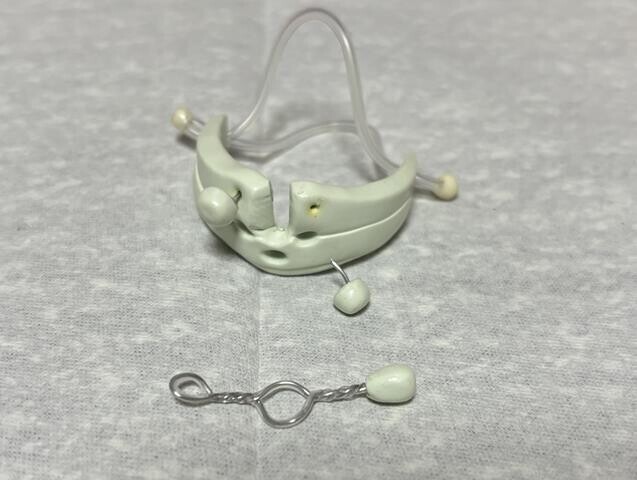
Loose petal loops prompted repairs after early failure and injury
In an entry published in August 2025, a customer reported the petal-loop stopper's base bond failing after about 2 weeks. Staff offered repair, and a later message confirmed receipt of the repaired item. The same customer also reported both loops in the second pair detaching from their remaining multi-loop device.
An exposed inner wire reportedly caught the lining and cut it. The customer planned to return that damaged device; the diary does not record its repair outcome. Mr. Okada proposed thicker rubber protection in his initial repair response.
(Source: ok-lab's diary, published August 2025)
https://ok-lab.hatenablog.com/entry/2025/08/30/122943
A broken chip connector accompanied bleeding after about 3 uses
In an entry published in September 2025, a customer's custom version 4 chip with raised bumps broke at its connection after about 3 uses. The customer reported bleeding and shared the failure to inform future builds.
Staff offered to reattach the flexible extension; the diary does not record whether this happened. Staff cautioned that this attachment was not designed to withstand pushing force.
(Source: ok-lab's diary, published September 2025)
https://ok-lab.hatenablog.com/entry/2025/09/27/123018
A loose figure-8 loop accompanied the customer's first bleeding report
An entry published in November 2025 described bleeding associated with wire protruding from a 0.15mm figure-8 loop (wire shaped like an 8). Mr. Okada initially proposed a refund because remaking the rear stopper could repeat the problem. The same entry later announced changes for every figure-8 loop then on order.
The integrated stopper also received a revised connection to the ceramic body. The diary does not record whether the customer accepted the refund. Mr. Okada asked customers to report further slipping.
(Source: ok-lab's diary, published November 2025)
https://ok-lab.hatenablog.com/entry/2025/11/29/122908
Wire coming out prompted larger joints across all future shipments
A December 2025 entry reported bleeding after wire protruded from a sheathed wire-only device made about half a year earlier. Mr. Okada identified a displaced 0.4mm double-wire loop, although he could not tell which loop position was involved. Earlier protection against slipping had been dropped at those positions because it enlarged the surrounding resin.
He announced protection at every joint on all future shipments, accepting considerably larger white resin sections. He offered a refund or remake, which the customer declined.
(Source: ok-lab's diary, published December 2025)
https://ok-lab.hatenablog.com/entry/2025/12/27/122915
The maker's answer to loose chip connections
The diary records stronger fastenings, repair offers, refunds, and limits on which designs the maker would sell.
The maker described motor connections as resistant to coming apart
In an entry published in June 2022, a customer asked whether a motor could detach from its chip. Staff described a mechanical connection resistant to separation, saying even workshop disassembly required destroying the joint.
Mr. Okada reported strong adhesion in a test, but said glass and epoxy (hard-setting resin) did not bond perfectly. He retained an additional anchoring feature as a precaution.
(Source: ok-lab's diary, published June 2022)
https://ok-lab.hatenablog.com/entry/2022/06/11/123420
A cracked joint meant stopping use of the balancing chip
In an entry published in June 2024, a customer asked whether the balancing chip's narrow section might break. Mr. Okada instead identified its connection to the flexible wire as the likely weakest point. He said soft material cushioned the wire, but the surrounding epoxy could crack under excessive force.
He based this assessment on experience and feel. Mr. Okada advised stopping use if epoxy cracks appeared.
(Source: ok-lab's diary, published June 2024)
https://ok-lab.hatenablog.com/entry/2024/06/15/123132
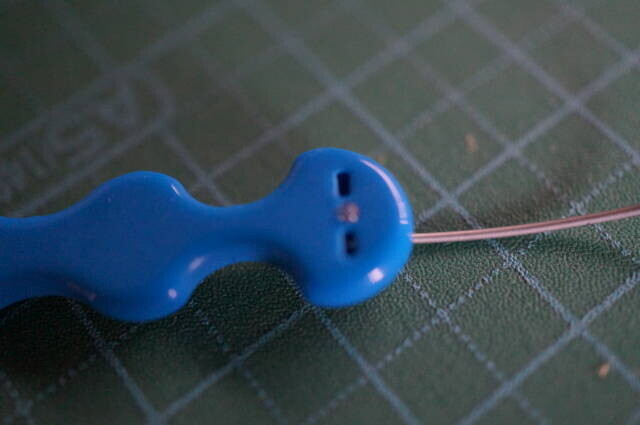
Loose chip joints prompted a switch from cord to nitinol
In an entry published in January 2026, Mr. Okada said older version 5 joints were limited to about 45 degrees after breakage reports. He reported no further trouble at that angle.
He then described a new nitinol (shape-memory wire) core in place of cord. He made reinforcement intended to resist breakage standard, with an option to decline it.
(Source: ok-lab's diary, published January 2026)
https://ok-lab.hatenablog.com/entry/2026/01/31/122917
If you see blood in your urine, even a small amount or for the first time, do not wait and see. See a urologist right away.
If you suddenly cannot urinate, or the device cannot be removed, do not try to fix it yourself. Go to a medical facility, including emergency care, immediately.
How loose chip connections changed over time
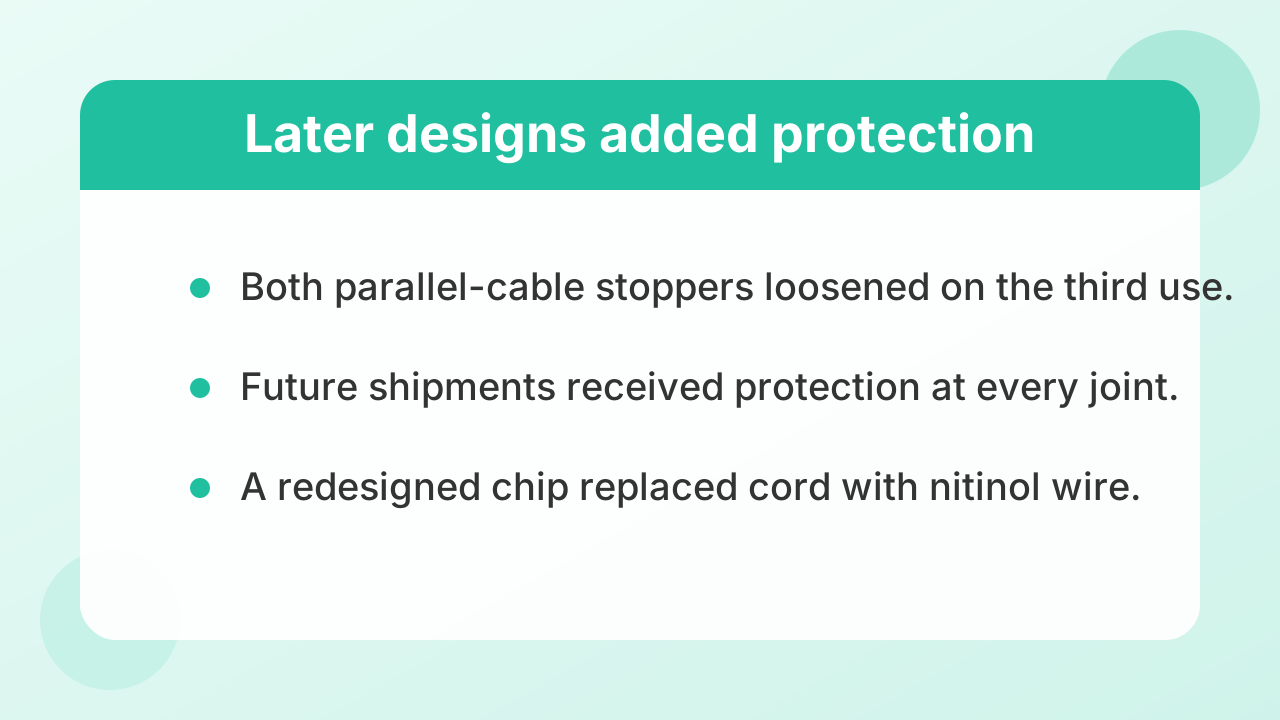
| Published | What the diary said then |
|---|---|
| May 2019 | A customer reported surgery after a homemade adhesive joint failed inside the bladder. |
| Aug 2021 | Both parallel-cable stoppers loosened on the third use. |
| Jan 2022 | The attachable U-turn stopper remained too easy to detach for sale. |
| Oct 2022 | Early failures prompted a temporary sales stop for two wire-based designs. |
| Jun 2024 | Mr. Okada identified cracked epoxy as a reason to stop using the balancing chip. |
| Dec 2024 | A loose-pin report prompted plans for U-shaped retaining pins. |
| Nov 2025 | All figure-8 loops then on order received measures against slipping. |
| Dec 2025 | Protection against slipping was extended to every joint on future shipments. |
| Jan 2026 | A redesigned linked chip replaced its cord core with nitinol wire. |
| Jun 2026 | Staff distinguished rubber cushioning loss from failure of the nylon connection. |
OK Prostate Chip products related to loose chip connections
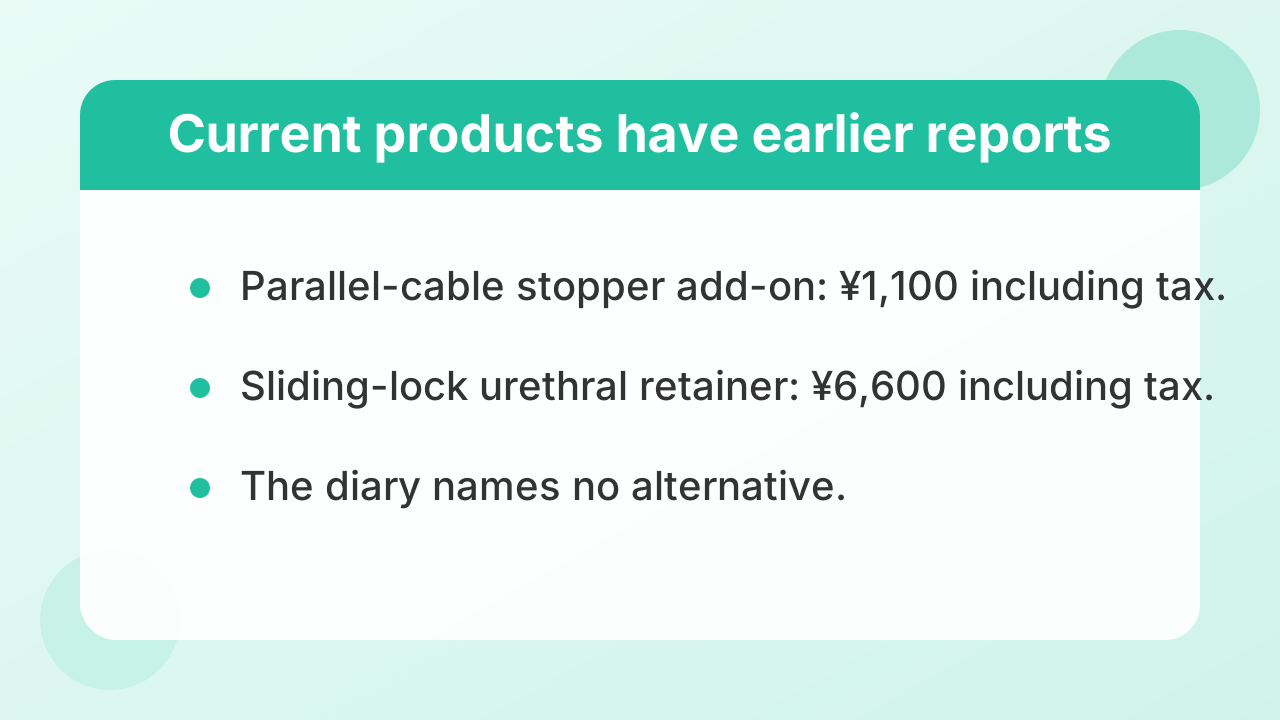
The current list includes cable stoppers and a sliding-lock retainer involved in earlier reports.
Products that appear in these entries
| Product (official name) | Price incl. tax | Relation to this topic |
|---|---|---|
| Parallel-cable stopper add-on (平行ケーブル用ストッパー追加(オプション)) | ¥1,100 (about $7 at ¥156 = $1, rate as of 2026-09-04) | An August 2021 customer reported both cable stoppers loosening on the third use. |
| Sliding-lock urethral retainer (スライドロック式尿道ゲートキーパー) | ¥6,600 (about $42 at ¥156 = $1, rate as of 2026-09-04) | A December 2023 customer reported that the sliding retainer's lock had detached. |
(Source: ok-lab's diary, published August 2021)
https://ok-lab.hatenablog.com/entry/2021/08/21/125838
(Source: ok-lab's diary, published December 2023)
https://ok-lab.hatenablog.com/entry/2023/12/30/122243
Products the diary mentioned as alternatives
The diary names no alternative.
The wire support and 6-wire device were temporarily withdrawn from sale in October 2022. The diary does not say what the current state is.
Historical custom builds, prototypes, and diary nicknames: No matching product can be confirmed on the current list.
Common worries about loose chip connections
The replies depend on which component failed and how the connection was built.
"Could a metal connector prevent my chip joint coming apart?"
In an entry published in January 2021, a customer said a rebuilt custom version 2 chip's rubber-to-screw bond had almost separated. They asked whether a stainless-steel connector could link the screw section, proposing a cable connection if that was impossible.
The customer suspected stress but did not know the cause. The diary does not record a maker's reply or whether either proposed replacement was built.
(Source: ok-lab's diary, published January 2021)
https://ok-lab.hatenablog.com/entry/2021/01/30/122153
"Can a loose retainer lock be repaired with glue?"
In an entry published in December 2023, a customer asked about adhesive repair after their sliding-lock urethral retainer's lock detached. Staff suggested an adhesive repair, but the diary does not record whether it worked. They offered further help if the customer had questions.
(Source: ok-lab's diary, published December 2023)
https://ok-lab.hatenablog.com/entry/2023/12/30/122243
"Does rubber peeling off mean the chip connection has failed?"
In an entry published in June 2026, a customer asked whether a detachable apple-shaped stopper was still usable after rubber separated from its joint. The chip remained connected to its nylon thread (the line joining the parts). Staff said the rubber provided cushioning and believed its loss did not reduce strength while that thread remained intact.
Mr. Okada explained that thicker rubber reduced movement, while thinner rubber peeled more easily. The diary does not record later performance. Staff cautioned against anything sharp contacting the nylon thread.
(Source: ok-lab's diary, published June 2026)
https://ok-lab.hatenablog.com/entry/2026/06/13/122909
Buying from outside Japan

OK Lab ships internationally to countries covered by Japan Post's EMS courier service. Overseas orders are paid in advance by PayPal. Each order carries a ¥400 (about $3 at ¥156 = $1, rate as of 2026-09-04) handling fee, and EMS shipping is charged on top. These terms come from OK Lab's official sales-terms page (written here as plain text, not a link: ok-lab.net/docs/law), checked on September 7, 2026; confirm them on the official store before you order, because they can change.
Summary of this article
| What you wanted to know | The answer |
|---|---|
| What is the main concern? | Loose connections have exposed wires and accompanied bleeding. |
| What is the product? | A urethral device made by OK Lab in Japan. |
| What do the terms describe? | Fastenings, coverings, and lines connecting device parts. |
| What failures were reported? | Adhesive separation, loose pins, cracked rubber, and escaped wire. |
| What did the maker offer? | Repairs, refunds, stronger joints, and temporary sales stops. |
| What changed over time? | Later designs added protection against slipping and changed some connection materials. |
| What is currently listed? | Cable stopper add-on: ¥1,100 (about $7 at ¥156 = $1, rate as of 2026-09-04); sliding-lock retainer: ¥6,600, (about $42 at ¥156 = $1, rate as of 2026-09-04) including tax. |
| What about peeled rubber? | Staff distinguished cushioning damage from an intact nylon connection. |
| How does overseas buying work? | PayPal advance payment, ¥400 (about $3 at ¥156 = $1, rate as of 2026-09-04) handling, plus Japan Post EMS shipping. |
Source: ok-lab's diary (Okada Comfortable Life Laboratory). The original entries are in Japanese; quotations on this page are translated. Photos and videos are on the original entries.
This article is a summary of the maker's development diary. The product is not a medical device and no result is guaranteed. If anything feels wrong or worries you, see a doctor. Prices, specifications and cautions change, so confirm the latest information on the official blog and the official site. Questions about ordering and shipping go to the seller.