![Is the rubber coating coming apart? | The damaged part matters [OK Prostate Chip]](/img/a/T0359/eyecatch.svg)
This page is based on entries from "ok-lab's diary" (https://ok-lab.hatenablog.com/), the Japanese development diary written by Mr. Okada, founder of OK Lab, a small company in Japan (Okada Comfortable Life Laboratory). Only the entries about rubber, coating, and tube deterioration are summarized here, in order of publication. Past prices and sizes are as written at the time. Current prices come from the official product list (retrieved September 4, 2026). Quotations are translated from Japanese.
Note: This page is a personal reading log by someone with no connection to the maker or the seller. It reflects the source entries as of their publication dates and makes no guarantee of accuracy or safety. The product is not a medical device; talk to a doctor about any health decision. Check the official site for current information. This page contains advertising.
In short
- Peeling cable insulation, cracked rubber joints, and damaged tubes have different consequences in the diary.
- Mr. Okada warns against using cables with exposed wires and treats failing structural rubber joints as worn out.
- Current listings confirm some discussed chip components, but do not establish availability of the historical custom assemblies.
If you see blood in your urine, even a small amount or for the first time, do not wait and see. See a urologist right away. If you suddenly cannot urinate, or the device cannot be removed, do not try to fix it yourself. Go to a medical facility, including emergency care, immediately.
About this product
The OK Prostate Chip is a small device that is placed in the urethra (the urine passage) so that it acts on the prostate; the maker sells it in several shapes, sizes and materials. It is made and sold by OK Lab (Okada Comfortable Life Laboratory), a small company in Japan, through its own online store, and prices are in Japanese yen (JPY).
The maker's development diary, "ok-lab's diary", is written in Japanese. This page is an English summary of it, and every quotation is translated. OK Lab ships internationally, so readers outside Japan can order (see "Buying from outside Japan" below).
Product names on this page are plain-English descriptions. The official Japanese product name is shown once in the product table so you can find the same item in the store.
Before you read: key terms
| Term | Plain-English meaning |
|---|---|
| Urethra | The urine passage, where the diary describes the device acting on the prostate. |
| Cable insulation | A covering that keeps electrical wires covered at the chip connection. |
| Metal fatigue; corrosion | Named as causes of wire failure. The diary does not explain this. |
| Silicone rubber | Flexible material used to cushion thread attachments or form bendable connections between chips. |
| Nylon thread | A nylon strand joining parts; in the stopper case, it carries the connection's strength. |
| Silicone tube | A hollow, flexible part used to cover wire or connect components. |
| Auxiliary chip | An additional chip paired with the main chip to form a connected assembly. |
| Epoxy resin | A material that hardens, used for chip bodies and fixed connections. |
| Shape-memory wire; nitinol | A shaped metal support for flexible connections, called nitinol in the January 2026 prototype. |
What happens: rubber coating damage
The OK Prostate Chip is a small device placed in the urethra so that it acts on the prostate. These entries describe silicone rubber (a flexible coating and connecting material), cable coverings, and hollow tubes on different versions of the device. Some rubber cushions nylon thread (the strand linking parts), while other rubber forms a bendable joint between chips. Tubes can cover wire, and the damaged part may be inside the urethra or around a bladder-loop section.
Peeling cable insulation preceded a broken wire and retained chip
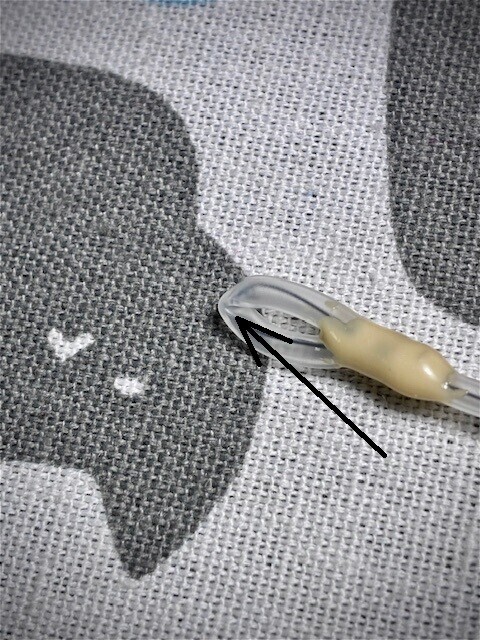
In an entry published in April 2020, a customer reported peeling cable insulation (the covering around electrical wires) after about 5 uses. Copper was visible where the cable met a ceramic chip, and the customer asked whether it might break. Mr. Okada advised against use and offered reinforcement upon return; a November 2020 entry confirms both repairs peeled again.
The November report says the wire broke during use, leaving the chip in the bladder, where an initial medical retrieval attempt failed. An update the following day, November 15, 2020, says the customer subsequently got it out without medical assistance. Mr. Okada warns that exposed wires will break through metal fatigue or corrosion (unexplained in the diary), and advises against use.
(Source: ok-lab's diary, published April 2020)
https://ok-lab.hatenablog.com/entry/2020/04/11/151453
(Source: ok-lab's diary, published November 2020)
https://ok-lab.hatenablog.com/entry/2020/11/14/131426
Cracked rubber joints prompted a shorter connection and paid repair
An entry published in December 2020 describes rubber cracking after about 10 uses, each lasting around 1 hour. When the customer requested better durability, Mr. Okada suspected a weak bond between rubber sections that had hardened at different times. His proposed replacement joint limited the gap to 3 mm, with the rubber formed as one piece.
The diary does not record whether the repair was completed. Published prices were ¥1,100 (about $7 at ¥156 = $1, rate as of 2026-09-04) for repair with a roughly 3 mm gap, or ¥5,500 (about $35 at ¥156 = $1, rate as of 2026-09-04) for more extensive rebuilding. Mr. Okada offered paid repair, with the choice depending on the condition of the returned part.
(Source: ok-lab's diary, published December 2020)
https://ok-lab.hatenablog.com/entry/2020/12/19/132929
Rubber coating peeled from both ends of a spring prototype
An entry published in April 2021 describes a customer's trial of a spring-supported rubber connection. Rubber separated from the main chip on first use, then from the auxiliary chip (an additional connected chip) after a repair.
The customer also reported no failure with 2 cable-supported samples over repeated uses. Mr. Okada favored cable-supported connections; the spring design had been abandoned because coating was uneven, with the report adding strength concerns.
(Source: ok-lab's diary, published April 2021)
https://ok-lab.hatenablog.com/entry/2021/04/03/130518
Rubber joint lifespan was limited despite very few uses
In an entry published in June 2022, a customer sought repairs for a rubber-linked pair (Sea Slug version 5). The customer recalled only 7 uses, but said the connecting rubber had lost too much springiness to remain usable.
Mr. Okada accepted 2 years or less as that model's lifespan, and said repair required nearly as much work as rebuilding. He said future buyers would need to acknowledge that lifespan before their orders were accepted.
(Source: ok-lab's diary, published June 2022)
https://ok-lab.hatenablog.com/entry/2022/06/18/123201
Thin silicone tube concerns put a screw design on hold
In an entry published in October 2022, Mr. Okada paused sales of a spring-action screw-shaped design. Its 1 mm outer-diameter silicone tube (a hollow, flexible tube) had an intended 0.5 mm opening, but actual openings varied. Some samples gripped the 2 internal threads too tightly, preventing the intended sliding and spring action.
He also doubted durability under repeated 500% stretching, despite having no stretching failure himself. No restart date was given. Mr. Okada said he would wait for a reliable tube supply before proceeding.
(Source: ok-lab's diary, published October 2022)
https://ok-lab.hatenablog.com/entry/2022/10/08/122859
Silicone tube damage let water into a bladder-loop model
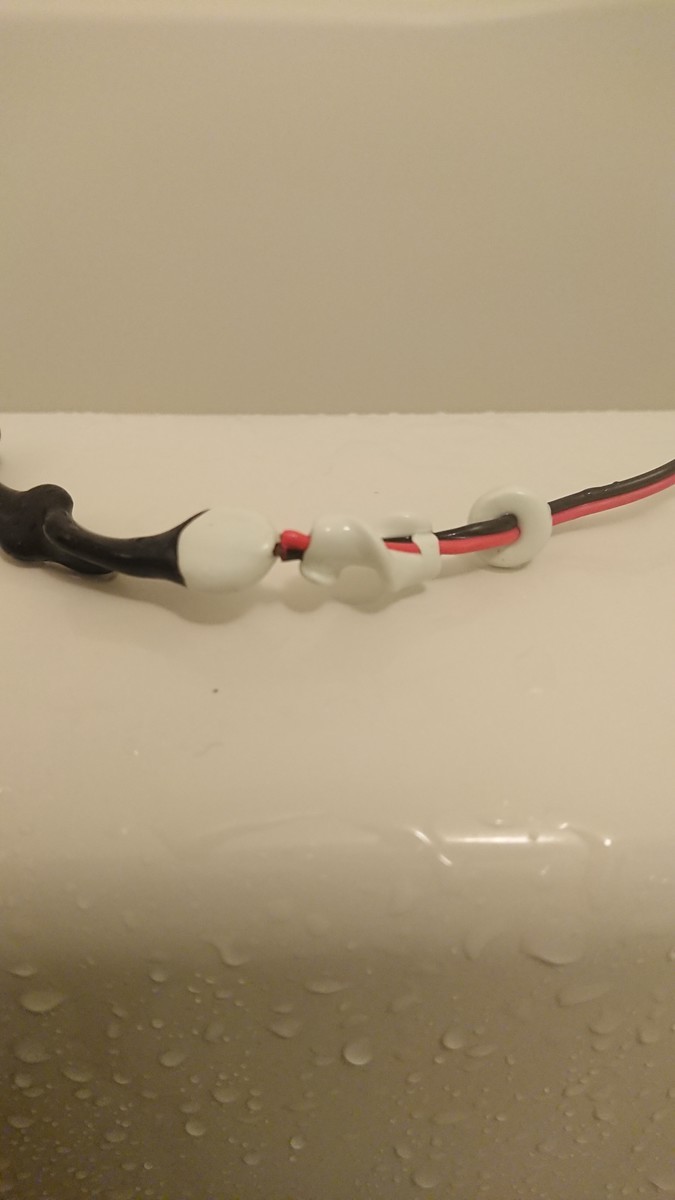
In an entry published in June 2025, a customer reported water entering a wire-based bladder-loop model after about 2 months. A small hole had developed inside the tube's persistent bend, and the customer wanted a replacement with a larger loop. The customer supplied a photograph and suggested cleaning damage or leftover soap might have contributed.
Mr. Okada did not establish either cause; he thought the silicone tube had worn out before the wire. The diary does not record whether the replacement was ordered. OK Lab's response requested a photograph of the damaged area for reference.
(Source: ok-lab's diary, published June 2025)
https://ok-lab.hatenablog.com/entry/2025/06/14/122936
The maker's answer to rubber coating damage
The diary's responses depend on whether the damaged material covers a wire, forms a joint, or provides cushioning.
Rubber coating prices depended on length, with no peeling repairs
In an entry published in October 2020, Mr. Okada priced rubber extensions around thread attachments by their length. The work was free through 2 mm; 3–10 mm cost ¥500 (about $3 at ¥156 = $1, rate as of 2026-09-04) excluding tax. Each additional 10 mm added ¥500 (about $3 at ¥156 = $1, rate as of 2026-09-04) excluding tax, with 11–20 mm listed at ¥1,000 (about $6 at ¥156 = $1, rate as of 2026-09-04) excluding tax.
He cautioned that silicone rubber might last less well than ceramic or epoxy resin (a material that hardens into chip bodies and connections). The underlying nylon thread would remain if this optional covering peeled, according to Mr. Okada. Mr. Okada advised buyers that peeling of this coating was outside his repair service.
(Source: ok-lab's diary, published October 2020)
https://ok-lab.hatenablog.com/entry/2020/10/31/121353
Wire coating durability was unknown when length-based prices were published
In an entry published in February 2021, Mr. Okada described rubber coating on the wire section located inside the urethra. He found his trial comfortable, but said durability was unknown and extreme bends might damage the coating.
Published charges were ¥500 (about $3 at ¥156 = $1, rate as of 2026-09-04) excluding tax through 10 cm, or ¥1,000 (about $6 at ¥156 = $1, rate as of 2026-09-04) excluding tax for 11–20 cm. Mr. Okada stated that uneven coating was unavoidable, while complete wire coverage was a minimum requirement.
(Source: ok-lab's diary, published February 2021)
https://ok-lab.hatenablog.com/entry/2021/02/13/121440
Shape-memory wire offered an alternative to rubber joints that cracked
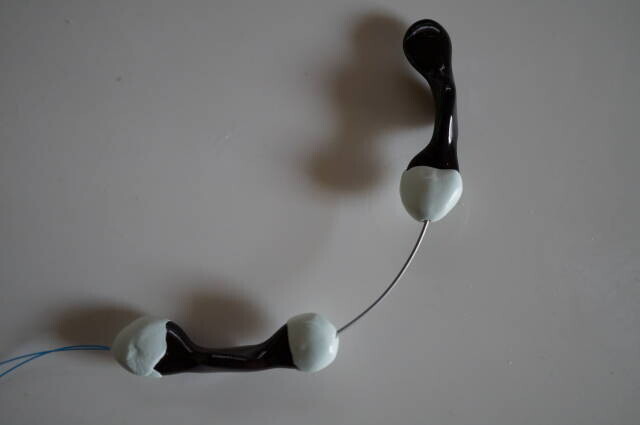
In an entry published in April 2024, Mr. Okada presented a two-chip connection made from shape-memory wire (a shaped metal connector). He said earlier rubber joints could crack when bent and straightened through 90 degrees, whereas the wire could form a U-turn.
The connection cost ¥3,000 (about $19 at ¥156 = $1, rate as of 2026-09-04) excluding tax, with ¥1,000 (about $6 at ¥156 = $1, rate as of 2026-09-04) excluding tax for a tube cover; both chip prices were separate. Mr. Okada suggested this connection for compatible combinations, with second chips restricted to specified ceramic designs.
(Source: ok-lab's diary, published April 2024)
https://ok-lab.hatenablog.com/entry/2024/04/20/122856
Unstable rubber connections gave way to a wire-supported prototype
In an entry published in January 2026, a customer requested an older rubber-connected design with a screw-shaped auxiliary chip. OK Lab replied that the soft nylon support made peeling and angle control problematic, so that specification had effectively been discontinued. Staff offered plain coating without a specified angle, while suggesting added wire could support a similar shape.
Mr. Okada then made a prototype using nitinol (shape-memory metal wire) alongside the thread, priced at ¥3,000 (about $19 at ¥156 = $1, rate as of 2026-09-04) excluding tax extra. The diary does not record what the customer ultimately ordered. OK Lab asked the customer to reconsider the requested specification in light of its reply.
(Source: ok-lab's diary, published January 2026)
https://ok-lab.hatenablog.com/entry/2026/01/24/122909
If you see blood in your urine, even a small amount or for the first time, do not wait and see. See a urologist right away. If you suddenly cannot urinate, or the device cannot be removed, do not try to fix it yourself. Go to a medical facility, including emergency care, immediately.
How rubber coating damage changed over time
| Published | What the diary said then |
|---|---|
| Jul 2018 | A customer reported slight stopper yellowing without deterioration after nearly a month. |
| Apr 2020 | Future cable coverings would be bonded to prevent slipping at the chip connection. |
| Aug 2020 | Rubber end-cover work was generally restricted to unused chips because surface contamination could weaken adhesion. |
| Jun 2022 | Four emptied parallel cables supported a reinforced joint intended to limit excessive bending. |
| Dec 2023 | Recent two-chip rubber connections used gentler angles following breakage reports. |
| Jan 2026 | Four cushioned joints across about 20 mm became standard to spread bending loads. |
OK Prostate Chip products related to rubber coating damage
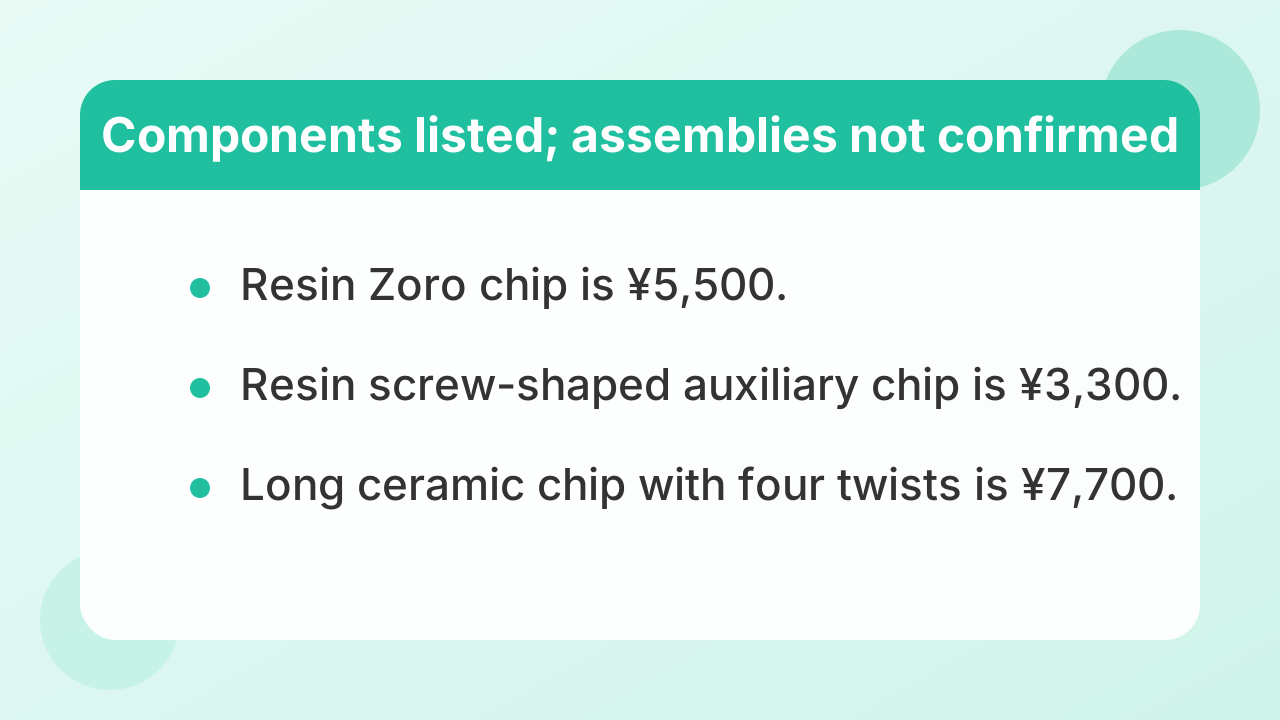
The current list includes the components discussed in the resin-coating enquiry, without confirming the historical custom assemblies.
Products that appear in these entries
| Product (official name) | Price incl. tax | Relation to this topic |
|---|---|---|
| Resin Zoro chip (OKプロステートチップ 凶悪ゾロ(生体適合樹脂)) | ¥5,500 (about $35 at ¥156 = $1, rate as of 2026-09-04) | In September 2021, a customer requested coating between this chip and an auxiliary chip; OK Lab refused. |
| Resin screw-shaped auxiliary chip (スクリュー型補助チップ追加オプション(生体適合樹脂)) | ¥3,300 (about $21 at ¥156 = $1, rate as of 2026-09-04) | In September 2021, its tied thread attachment prevented coating from extending onto this side of a proposed connection. |
| Long ceramic chip with four twists (OKプロステートチップ 陶器素材ロングタイプ 4点ツイスト) | ¥7,700 (about $49 at ¥156 = $1, rate as of 2026-09-04) | In September 2021, a customer asked about pairing this chip with the resin auxiliary chip and adding rubber coating. |
The resin Zoro chip is listed in OK Lab's own online store.
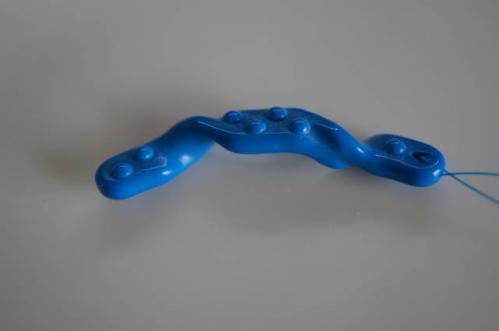
(Source: ok-lab's diary, published September 2021)
https://ok-lab.hatenablog.com/entry/2021/09/04/125843
Products the diary mentioned as alternatives
The diary names no alternative.
Historical custom assemblies discussed here include the cable-connected chip, spring prototype, rubber-linked pairs, wire-linked prototypes, bladder-loop device, and detachable apple-shaped stopper. No matching product can be confirmed on the current list.
Common worries about rubber coating damage
The replies distinguish a coating that cannot bond reliably, a failing structural joint, and a peeling cushion.
"Can rubber coating cover the thread between resin chips?"
In an entry published in September 2021, a customer requested rubber coating between a resin Zoro chip and its auxiliary chip. OK Lab refused: the thread was tied to the resin, and staff expected movement to strain the rubber until it peeled. The customer then asked about a long ceramic chip with four twists joined to a resin screw-shaped auxiliary chip.
Staff allowed coating on the ceramic side, stopping a few millimeters before the resin auxiliary chip. The diary does not record whether an order followed. Mr. Okada's final answer ruled out coating the resin-side thread attachment.
(Source: ok-lab's diary, published September 2021)
https://ok-lab.hatenablog.com/entry/2021/09/04/125843
"Does cracked rubber mean the connection has reached its lifespan?"
In an entry published in October 2022, a customer asked whether a cracked joint on a custom two-chip combination remained usable. The crack appeared after several unsuccessful fitting attempts; no successful use was reported. OK Lab called cracking a warning of future breakage and treated rubber deterioration as the product's end of life.
Staff also said the damaged joint would lose its connecting effect. The diary does not record the repair outcome. OK Lab offered repair with a straighter connection angle to reduce the load it believed had weakened the rubber.
(Source: ok-lab's diary, published October 2022)
https://ok-lab.hatenablog.com/entry/2022/10/29/122854

"Is peeling rubber on the detachable stopper structurally important?"
An entry published in June 2026 describes a customer whose detachable apple-shaped stopper's rubber connection had come loose, while the thread remained attached. The customer asked whether use should stop. OK Lab explained that this later-added coating cushioned the nylon thread and could peel under strong force.
According to the reply, the thread carried the strength, so peeling returned this particular design to its earlier exposed-thread state. The diary does not record subsequent use. OK Lab cautioned that the nylon thread must not be damaged.
(Source: ok-lab's diary, published June 2026)
https://ok-lab.hatenablog.com/entry/2026/06/13/122909
Buying from outside Japan
OK Lab ships internationally to countries covered by Japan Post's EMS courier service. Overseas orders are paid in advance by PayPal. Each order carries a ¥400 (about $3 at ¥156 = $1, rate as of 2026-09-04) handling fee, and EMS shipping is charged on top. These terms come from OK Lab's official sales-terms page (written here as plain text, not a link: ok-lab.net/docs/law), checked on September 7, 2026; confirm them on the official store before you order, because they can change.
Summary of this article
| What you wanted to know | The answer |
|---|---|
| What is the short answer? | The damaged part determines the maker's response. |
| What is this product? | A urethral device made by OK Lab in Japan, priced in JPY. |
| What do the terms mean? | Insulation covers wires; rubber can cushion or connect parts. |
| What happened? | Wires became exposed, joints failed, and a tube developed a hole. |
| What did the maker propose? | Repairs, coating restrictions, revised connections, and a sales suspension. |
| What changed over time? | Supports, connection angles, and joint construction changed. |
| Which current products appear? | Components from the resin-coating enquiry, listed above with current prices. |
| What did customers ask? | About coating compatibility, cracks, and peeling cushions. |
| How does overseas buying work? | Advance PayPal payment, a ¥400 (about $3 at ¥156 = $1, rate as of 2026-09-04) handling fee, and additional EMS shipping. |
Source: ok-lab's diary (Okada Comfortable Life Laboratory). The original entries are in Japanese; quotations on this page are translated. Photos and videos are on the original entries.
This article is a summary of the maker's development diary. The product is not a medical device and no result is guaranteed. If anything feels wrong or worries you, see a doctor. Prices, specifications and cautions change, so confirm the latest information on the official blog and the official site. Questions about ordering and shipping go to the seller.