![Is my prostate chip defective? | Repairs, replacements, and refunds depend on the fault [OK Prostate Chip]](/img/a/T0356/eyecatch.svg)
This page is based on entries from "ok-lab's diary" (https://ok-lab.hatenablog.com/), the Japanese development diary written by Mr. Okada, founder of OK Lab, a small company in Japan (Okada Comfortable Life Laboratory). Only the entries about "manufacturing defects, missed inspections, and repairs" are summarized here, in order of publication. Past prices and sizes are as written at the time. Current prices come from the official product list (retrieved September 4, 2026). Quotations are translated from Japanese.
Note: This page is a personal reading log by someone with no connection to the maker or the seller. It reflects the source entries as of their publication dates and makes no guarantee of accuracy or safety. The product is not a medical device; talk to a doctor about any health decision. Check the official site for current information. This page contains advertising.
In short
The diary records loose threads, exposed metal, electrical faults, and chips breaking inside the body.
Mr. Okada offered repairs, replacements, or refunds in individual cases, and stopped selling some designs.
The latest included entry, published in June 2026, still records a cracked chip with an unresolved cause.
If you see blood in your urine, even a small amount or for the first time, do not wait and see. See a urologist right away.
If you suddenly cannot urinate, or the device cannot be removed, do not try to fix it yourself. Go to a medical facility, including emergency care, immediately.
About this product

The OK Prostate Chip is a small device that is placed in the urethra (the urine passage) so that it acts on the prostate; the maker sells it in several shapes, sizes and materials. It is made and sold by OK Lab (Okada Comfortable Life Laboratory), a small company in Japan, through its own online store, and prices are in Japanese yen (JPY). The maker's development diary, "ok-lab's diary", is written in Japanese. This page is an English summary of it, and every quotation is translated. OK Lab ships internationally, so readers outside Japan can order (see "Buying from outside Japan" below). Product names on this page are plain-English descriptions. The official Japanese product name is shown once in the product table so you can find the same item in the store.
Before you read: key terms
| Term | Plain-English meaning |
|---|---|
| Retrieval thread | A thread attached to a chip so it can be withdrawn. |
| Resin | Material used for some chips and coatings; coatings secure threads and cover metal edges. |
| Stopper | An attached part intended to help keep a chip in position. |
| Burr | An unintended sharp projection on a finished part; it serves no intended purpose. |
| Controller | An external electrical box that powers a vibrating chip and controls its operation. |
| 3D printing | Making an object in layers; here, the process used to produce the reported resin chip. |
What happens: prostate chip defects
The OK Prostate Chip is a device placed in the urethra to act on the prostate. Defects discussed here affect the chip, its retrieval thread (the thread used to withdraw it), or attached and external parts. These include a stopper (a part intended to hold the chip in position) and a controller (an external box powering a vibrating chip). The diary describes repairs addressing broken surfaces, exposed metal, loose coatings, and electrical faults.
Peeling chip coatings prompted thicker resin and conditional exchanges
An entry published in February 2018 describes 2 peeling-coating reports involving linked glass chips. One concerned exposed thread; the other described thread lifting together with resin (the coating securing it).
Mr. Okada considered the coating too thin and began making it thicker that month. For affected January shipments, he offered exchange after checking photographs, but excluded another exchange if peeling recurred.
(Source: ok-lab's diary, published February 2018)
https://ok-lab.hatenablog.com/entry/20180214/1518601774
A loose chip thread raised concerns about incomplete drying
In an entry published in May 2018, a customer reported a newly delivered custom chip losing its retrieval thread. Only the thread emerged, with half the resin still attached.
Mr. Okada suspected insufficient drying; the diary does not record whether the remaining chip was recovered. He concluded that unstable workshop temperatures required more drying time.
(Source: ok-lab's diary, published May 2018)
https://ok-lab.hatenablog.com/entry/20180510/1525959878
Sharp stopper defects accompanied bleeding during early sample tests
An entry published in June 2018 records bleeding reports from 2 recipients of stopper samples. In 1 report, a burr (a sharp raised edge) was found on the stopper.
Mr. Okada suspected careless recoating and revised production to improve edge finishing and consistency. He said the reported injury risk needed addressing before formal sale.
(Source: ok-lab's diary, published June 2018)
https://ok-lab.hatenablog.com/entry/20180609/1528523953
Exposed chip metal escaped inspection but was later repaired
An entry published in August 2019 describes a customer questioning a silver projection near a ceramic chip's thread attachment. The customer reported irritation of the urethral lining after trying it. Mr. Okada acknowledged an inspection miss and requested return for repair.
A linked September 2019 follow-up reports no problem during a test after repair. Mr. Okada cautioned that similar inspection misses could happen again.
(Source: ok-lab's diary, published August 2019)
https://ok-lab.hatenablog.com/entry/2019/08/31/131337
(Source: ok-lab's diary, published September 2019)
https://ok-lab.hatenablog.com/entry/2019/09/14/143710
A broken chip prompted an offer of replacement or refund
In an entry published in February 2020, a customer asked why a curved chip broke inside the body. The customer reported removal without injury, and Mr. Okada suspected inadequate strength in that individual item. He offered replacement or a refund, and the customer requested replacement.
(Source: ok-lab's diary, published February 2020)
https://ok-lab.hatenablog.com/entry/2020/02/01/151232
Ceramic chip damage qualified for replacement despite an unknown cause
An entry published in March 2020 describes a ceramic chip chipping inside the body after 2 insertions. The customer said the fragment later passed during urination and asked about buying another chip.
Mr. Okada could not establish the cause but suspected an existing crack. He offered to remake it as an initial defect, with about a week needed.
(Source: ok-lab's diary, published March 2020)
https://ok-lab.hatenablog.com/entry/2020/03/14/141804
A broken chipless assembly led to tighter bend limits
An entry published in December 2024 describes a 120-degree chipless wire assembly breaking after 2 days of wear. Mr. Okada recalled one local bend reaching almost 90 degrees during manufacture. He identified that abnormal bend as a manufacturing error and offered refund or replacement.
The customer chose replacement. Mr. Okada capped planned bends at 90 degrees and advised anxious buyers to await factory-shaped wire.
(Source: ok-lab's diary, published December 2024)
https://ok-lab.hatenablog.com/entry/2024/12/14/122948
Exposed stopper wire prompted a refund and revised attachments
An entry published in November 2025 describes bleeding with a stopper attached directly to a ceramic chip. It was the customer's first bleeding episode with a chip; a protruding wire was later found. Mr. Okada offered a refund because remaking the existing design might repeat the failure.
He subsequently describes revising the rear stopper's attachment to the ceramic body. He asked customers to report any further loosening.
(Source: ok-lab's diary, published November 2025)
https://ok-lab.hatenablog.com/entry/2025/11/29/122908
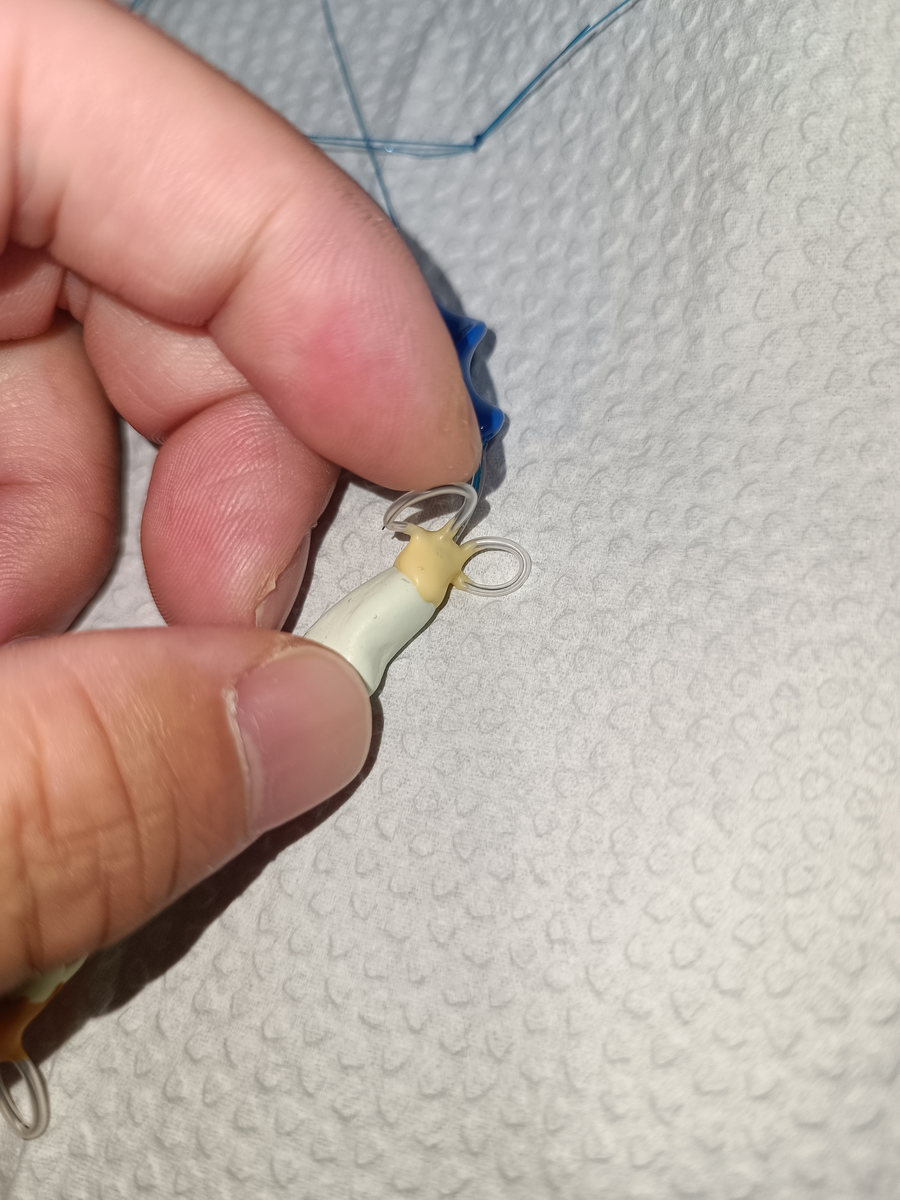
Sharp chip edges prompted replacement after an earlier sizing error
An entry published in January 2026 describes further defects after a chip had already been exchanged for a size error. The customer reported protruding thread and a distinct burr, then asked for more careful inspection. After examining the returned, customer-altered surface, OK Lab offered another new chip.
In a follow-up published that January, Mr. Okada traced damage to finishing work beside an unusually thin edge. OK Lab said future defect reports would receive inspection followed by exchange.
(Source: ok-lab's diary, published January 2026)
https://ok-lab.hatenablog.com/entry/2026/01/24/122909
(Source: ok-lab's diary, published January 2026)
https://ok-lab.hatenablog.com/entry/2026/01/31/122917
Cracked chip layers prompted a refund despite an unresolved cause
An entry published in June 2026 describes cracks across both faces of a resin chip and around its thread holes. They followed layers from 3D printing (building an object in layers). OK Lab accepted it as an initial defect while leaving the cause unresolved.
The M size was out of stock, with no restock date, so staff offered a refund rather than replacement. Staff requested return of the damaged chip for the manufacturer to inspect.
(Source: ok-lab's diary, published June 2026)
https://ok-lab.hatenablog.com/entry/2026/06/27/122906
The maker's answer to prostate chip defects
The diary records case-specific remedies, manufacturing changes, and sales stops rather than one remedy for every defect.
A vibrating chip controller needed checks for faulty electrical connections
The February 2019 entry warns that reversed battery +/− connections could cause erratic operation or heating in an electronic controller. Mr. Okada also linked faulty 20-mode switching to wiring trapped during assembly.
He says affected controllers were reassembled, with adhesive securing parts when necessary. The diary warns against reversing the battery connections.
(Source: ok-lab's diary, published February 2019)
https://ok-lab.hatenablog.com/entry/2019/02/23/142754
A partly covered chip motor was withheld after reported illness
In an entry published in February 2020, Mr. Okada describes nausea and headaches during extended testing of a partly covered motor. Metal on the motor remained exposed during use inside his body.
He suspected a reaction to metal contact; the entry provides no confirmed diagnosis. His response was to rule out selling that motor design.
(Source: ok-lab's diary, published February 2020)
https://ok-lab.hatenablog.com/entry/2020/02/22/145216
Exposed cable wire prompted chip repair offers and stronger bonding
An entry published in April 2020 describes a customer's cable cover slipping after about 5 uses, exposing copper wire. Mr. Okada says he had secured the inner wire but overlooked movement of its cover.
He planned extra bonding for later shipments; the diary does not record this customer's repair outcome. He discouraged continued use in that condition and offered return for reinforcement.
(Source: ok-lab's diary, published April 2020)
https://ok-lab.hatenablog.com/entry/2020/04/11/151453
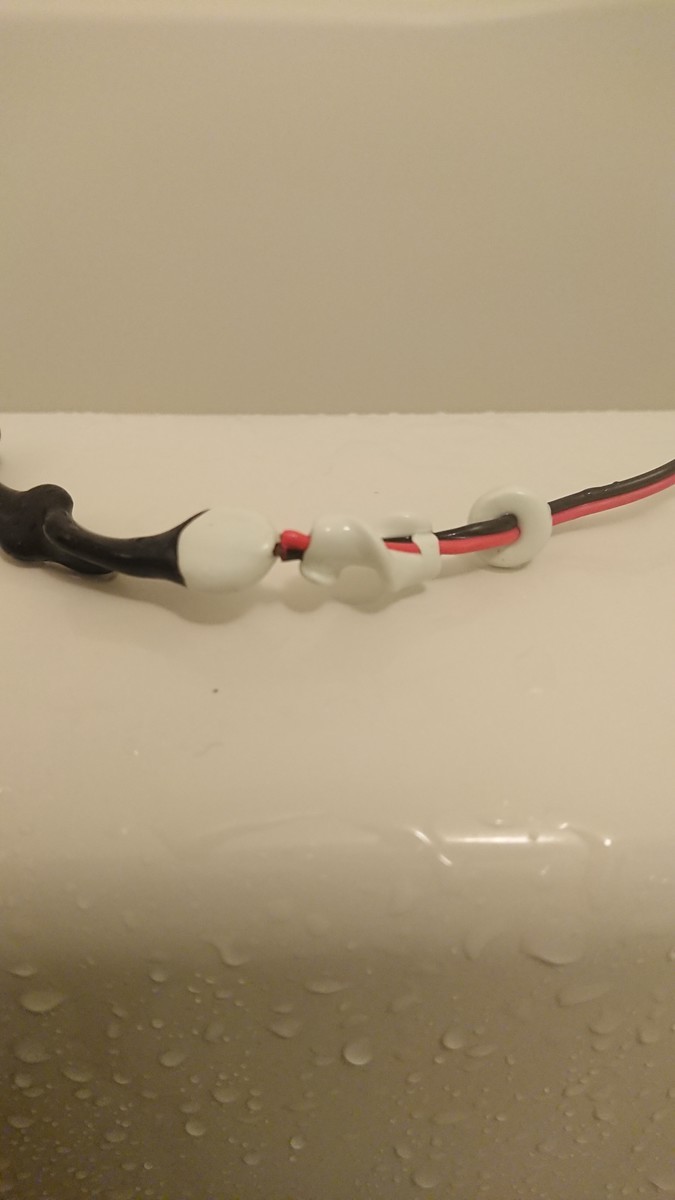
Exposed chip wire led to halted sales and cancelled orders
In an entry published in September 2021, Mr. Okada describes urethral bleeding while testing a resin-coated wire attachment. He attributed it to a tiny bare wire tip protruding through an overly thin coating.
He says touch alone had failed to reveal the projection. He stopped sales and cancelled pending orders until he could establish the attachment's safety.
(Source: ok-lab's diary, published September 2021)
https://ok-lab.hatenablog.com/entry/2021/09/11/125735
Early chip attachment failures led to suspended sales and refunds
In an entry published in October 2022, Mr. Okada announced a temporary sales halt for the 6-wire assembly and wire-loop attachment. He cited failures soon after use began and said he could not assure their safety. A customer with a detached wire-loop end declined free repair and requested a stainless steel chip instead.
Mr. Okada refused an exchange for a different product and offered a refund. He also offered refunds to buyers who objected to these products being sold.
(Source: ok-lab's diary, published October 2022)
https://ok-lab.hatenablog.com/entry/2022/10/01/122944
If you see blood in your urine, even a small amount or for the first time, do not wait and see. See a urologist right away.
If you suddenly cannot urinate, or the device cannot be removed, do not try to fix it yourself. Go to a medical facility, including emergency care, immediately.
How prostate chip defects changed over time
| Published | What the diary said then |
|---|---|
| Apr 2018 | Touching linked chips were remade; Mr. Okada judged the glass design structurally problematic. |
| Mar 2019 | Internal controller resin fixation was strengthened after a contact fault. |
| May 2019 | A missing nylon connection was restored; spacing grew by about 2mm. |
| Dec 2020 | Rubber-linked builds were remade with approximately 2–3mm gaps after layered rubber proved problematic. |
| Mar 2022 | A weak battery-cover latch prompted offers of replacement lids. |
| Sep 2022 | Yellowing was attributed to liquid entering through an improperly sealed tube end. |
| Oct 2024 | Intermittent motor stoppages prompted extended testing and replacement. |
| Apr 2025 | Mr. Okada reported no breaks with supplier-shaped wire, while withholding any guarantee. |
| Nov 2025 | Exposed aluminum edges prompted thicker resin around electrical contact surfaces. |
| Feb 2026 | A custom chip was remade after its integrated stopper was omitted. |
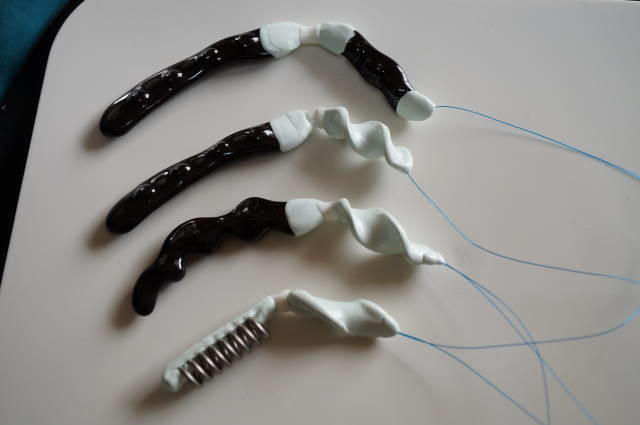
OK Prostate Chip products related to prostate chip defects

The current list includes the plain glass and resin chips involved in the surface-defect complaints below.
Products that appear in these entries
| Product (official name) | Price incl. tax | Relation to this topic |
|---|---|---|
| Single glass chip (OKプロステートチップ ガラス素材1チップタイプ) | ¥3,300 (about $21 at ¥156 = $1, rate as of 2026-09-04) | A May 2019 entry records a central scratch found on arrival and an offer to make a replacement. |
| Single resin chip (OKプロステートチップ 樹脂素材1チップタイプ) | ¥2,200 (about $14 at ¥156 = $1, rate as of 2026-09-04) | An April 2020 entry records a surface-mark complaint that Mr. Okada attributed to resin hardening. |
(Source: ok-lab's diary, published May 2019)
https://ok-lab.hatenablog.com/entry/2019/05/25/144939
(Source: ok-lab's diary, published April 2020)
https://ok-lab.hatenablog.com/entry/2020/04/11/151453
Products the diary mentioned as alternatives
The diary names no alternative.
For the custom glass chip, curved custom chip, early stopper samples, integrated stopper, and old chipless assembly:
No matching product can be confirmed on the current list.
Common worries about prostate chip defects

"Can an unused chip arrive with a manufacturing defect?"
In an entry published in May 2019, a customer asked to exchange a newly arrived single glass chip with a central scratch. Mr. Okada accepted the complaint as an initial defect; the diary does not record delivery of the replacement. His response was to offer a newly made substitute.
(Source: ok-lab's diary, published May 2019)
https://ok-lab.hatenablog.com/entry/2019/05/25/144939
"What can a vibrating chip repair cost?"
An entry published in August 2019 describes a vibrating chip stopping after 1 or 2 uses. The customer reported faulty soldering inside the controller and said repair restored operation. Mr. Okada acknowledged the soldering fault.
He quoted ¥500 (about $3 at ¥156 = $1, rate as of 2026-09-04) excluding tax for a simple broken wire and ¥2,000 (about $13 at ¥156 = $1, rate as of 2026-09-04) for circuit damage caused by reversed batteries. For breaks after only 1 or 2 uses, he offered free repair as an initial defect.
(Source: ok-lab's diary, published August 2019)
https://ok-lab.hatenablog.com/entry/2019/08/17/132641
"Does a surface mark mean my resin chip needs replacing?"
In an entry published in April 2020, a customer requested exchange after noticing a mark on an unopened single resin chip. Mr. Okada described the marks as depressions or wrinkles arising during hardening. He said a remake could have similar irregularities.
The customer accepted that explanation and chose to keep the chip. Mr. Okada's offered remedy was a return and refund if the explanation left the customer uneasy.
(Source: ok-lab's diary, published April 2020)
https://ok-lab.hatenablog.com/entry/2020/04/11/151453
Buying from outside Japan

OK Lab ships internationally to countries covered by Japan Post's EMS courier service. Overseas orders are paid in advance by PayPal. Each order carries a ¥400 (about $3 at ¥156 = $1, rate as of 2026-09-04) handling fee, and EMS shipping is charged on top. These terms come from OK Lab's official sales-terms page (written here as plain text, not a link: ok-lab.net/docs/law), checked on September 7, 2026; confirm them on the official store before you order, because they can change.
Summary of this article
| What you wanted to know | The answer |
|---|---|
| What is the short answer? | The diary records defects and individual repair, replacement, or refund decisions. |
| What is the product? | A small urethral device made and sold by OK Lab in Japan. |
| Which parts matter here? | Chip surfaces, retrieval threads, stoppers, coatings, and electrical components. |
| What has gone wrong? | Reports include peeling, exposed metal, broken chips, and missed finishing defects. |
| How did the maker respond? | Responses included repairs, manufacturing changes, exchanges, refunds, and sales stops. |
| What changed over time? | The diary records revised connections, coatings, parts, and inspection practices. |
| Which listed products appear here? | The single glass chip costs ¥3,300 (about $21 at ¥156 = $1, rate as of 2026-09-04); the single resin chip costs ¥2,200, (about $14 at ¥156 = $1, rate as of 2026-09-04) both including tax. |
| Are repairs always charged? | The August 2019 entry distinguishes paid controller repairs from free initial-defect repairs. |
| How do overseas orders work? | Advance PayPal payment, a ¥400 (about $3 at ¥156 = $1, rate as of 2026-09-04) handling fee, and additional EMS shipping charges. |
| What remains unresolved? | The June 2026 cracked-chip report ends without an established cause. |
Source: ok-lab's diary (Okada Comfortable Life Laboratory). The original entries are in Japanese; quotations on this page are translated. Photos and videos are on the original entries.
This article is a summary of the maker's development diary. The product is not a medical device and no result is guaranteed. If anything feels wrong or worries you, see a doctor. Prices, specifications and cautions change, so confirm the latest information on the official blog and the official site. Questions about ordering and shipping go to the seller.