![What are the OK Prostate Chip lock-on options? | Construction and custom-work charges differ [OK Prostate Chip]](/img/a/T0244/eyecatch.svg)
This page is based on entries from "ok-lab's diary" (https://ok-lab.hatenablog.com/), the Japanese development diary written by Mr. Okada, founder of OK Lab, a small company in Japan (Okada Comfortable Life Laboratory). Only the entries about "lock-on modification types" are summarized here, in order of publication. Past prices and sizes are as written at the time. Current prices come from the official product list (retrieved September 4, 2026). Quotations are translated from Japanese.
Note: This page is a personal reading log by someone with no connection to the maker or the seller. It reflects the source entries as of their publication dates and makes no guarantee of accuracy or safety. The product is not a medical device; talk to a doctor about any health decision. Check the official site for current information. This page contains advertising.
In short
- Lock-on options differ in their wire, cable, and stopper arrangements.
- Mr. Okada describes material limitations, separate construction charges, and custom requests he could accept or had to decline.
- Current listings identify base chips; the entries describe separately priced custom lock-on work.
About this product
The OK Prostate Chip is a small device that is placed in the urethra (the urine passage) so that it acts on the prostate; the maker sells it in several shapes, sizes and materials. It is made and sold by OK Lab (Okada Comfortable Life Laboratory), a small company in Japan, through its own online store, and prices are in Japanese yen (JPY).
The maker's development diary, "ok-lab's diary", is written in Japanese. This page is an English summary of it, and every quotation is translated.
OK Lab ships internationally, so readers outside Japan can order (see "Buying from outside Japan" below). Product names on this page are plain-English descriptions. The official Japanese product name is shown once in the product table so you can find the same item in the store.
Before you read: key terms
| Term | Plain-English meaning |
|---|---|
| Lock-on | An attachment behind the chip, proposed to help position it near the prostate. |
| Shape-memory wire | Wire used for the attachment's curves and loops. Its material behavior is not explained further. |
| Parallel cable | Paired electrical leads that supply power to the vibrating chip's motor. |
| Hybrid lock-on | A wire loop enclosed inside parallel cable, forming a lock-on attachment. |
| Silicone-covered nitinol lock-on | Shape-memory wire enclosed in silicone tubing, forming the curved lock-on attachment. |
| Free-moving lock-on | A named attachment quoted with stoppers. The diary does not explain this. |
| Integrated stopper | A stopping part formed with the chip, requested at its front or rear. Its operation is not explained. |
| Petal stopper | A stopping part with a petal shape, offered as an addition to the assembly. |
| Horn extension | A projecting end included in some custom attachments. Its purpose is not explained. |
| USB connector | An electrical connection for the motor; the April prototype used a version described as compatible with boiling. |
What happens: OK Prostate Chip lock-on options
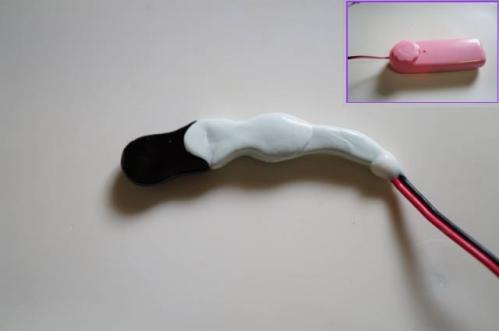
The OK Prostate Chip is a device placed in the urethra (the urine passage), intended to act near the prostate. In these entries, lock-on means an attachment behind the chip, using shaped wire, cable, or a named assembly supplied with stoppers. Customers requested these structures to help position a chip near the prostate, including versions carrying a vibrating motor. The diary describes construction choices and custom quotations, without recording a comparison of how the different arrangements performed in use.
Motor cables needed a separate structure for silicone-covered lock-on
In an entry published in April 2025, a customer wanted a vibrating chip with a curved attachment to help position it. Staff said parallel cable (paired motor power leads) and shape-memory wire were poorly suited to being combined directly. Mr. Okada answered with a prototype that kept their structures largely separate.
The cable and the loop behind the chip were connected at two points, one at each end. Elsewhere, the components could move independently. Mr. Okada presented this separation as his response to the customer's request.
(Source: ok-lab's diary, published April 2025)
https://ok-lab.hatenablog.com/entry/2025/04/26/122909

An August quote priced silicone-covered lock-on separately from added fittings
In an entry published in August 2025, a customer requested a custom bumped chip with a silicone-covered lock-on attachment. The requested specifications included a 50mm loop, a 105° wire angle, and wire 0.4mm thick. The lock-on work was quoted at ¥4,400 (about $28 at ¥156 = $1, rate as of 2026-09-04).
The request also included a petal stopper (a stopping part with a petal shape) and a horn extension (a projecting end). The quote separately listed ¥3,300 (about $21 at ¥156 = $1, rate as of 2026-09-04) for the 50mm extension, ¥3,300 (about $21 at ¥156 = $1, rate as of 2026-09-04) for the stopper, and ¥2,200 (about $14 at ¥156 = $1, rate as of 2026-09-04) for a petal-shaped end. The diary does not record how this configuration felt in use.
(Source: ok-lab's diary, published August 2025)
https://ok-lab.hatenablog.com/entry/2025/08/23/122935
Hybrid lock-on carried a separate charge for the specified length
An entry published in October 2025 quoted a long ceramic four-point twist chip with hybrid lock-on. The attachment specified for that customer measured 4cm, with a separate charge of ¥5,500 (about $35 at ¥156 = $1, rate as of 2026-09-04). A different build in the same entry carried the same hybrid lock-on charge.
The entry does not record how either assembly performed for its customer. These quotations document the requested work and its price at that time.
(Source: ok-lab's diary, published October 2025)
https://ok-lab.hatenablog.com/entry/2025/10/11/123003
An October silicone-covered lock-on quote separated several additional charges
Another quotation published in October 2025 itemized a silicone-covered lock-on assembly for a short ceramic twist chip. The chipless attachment identified as 2-AT, combining silicone-covered lock-on with a horn extension, cost ¥7,700 (about $49 at ¥156 = $1, rate as of 2026-09-04). A doubled wire and a petal-shaped end each added ¥2,200 (about $14 at ¥156 = $1, rate as of 2026-09-04).
Front and rear stoppers, together with reinforcement described by the maker as preventing breakage, were quoted at ¥5,500 (about $35 at ¥156 = $1, rate as of 2026-09-04). Those charges appeared separately from the ceramic chip, quoted at ¥4,400 (about $28 at ¥156 = $1, rate as of 2026-09-04). The quotation does not establish how the completed arrangement performed in use.
(Source: ok-lab's diary, published October 2025)
https://ok-lab.hatenablog.com/entry/2025/10/11/123003
Free-moving lock-on pricing included stoppers for a stainless-steel chip
In an entry published in August 2026, a customer requested free-moving lock-on for a medium semi-long surgical stainless-steel chip. Both stoppers were requested in size S. Unsure about cable dimensions, the customer chose the prototype's existing specifications.
These were 5mm to the first stopper, 20mm to the second, and a following loop approximately 20mm long. Staff explained that the lock-on work cost ¥5,500, (about $35 at ¥156 = $1, rate as of 2026-09-04) including the stoppers. The diary does not record whether those dimensions suited the customer in use.
(Source: ok-lab's diary, published August 2026)
https://ok-lab.hatenablog.com/entry/2026/08/15/122912
The maker's answer to OK Prostate Chip lock-on options
Mr. Okada's responses centered on workable wire structures, space for connections, and separately priced additions.
Lock-on options were limited by what shape-memory wire could accommodate
In April 2025, Mr. Okada described the limited constructions his workshop had successfully made with shape-memory wire. Silicone-covered nitinol lock-on (a shape-memory wire attachment) enclosed the wire in silicone tubing. Hybrid lock-on enclosed a single wire loop inside the parallel cable.
He contrasted these limits with stainless-steel wire, which he thought offered more possibilities through changes in construction. His advice was to expect substantial fabrication limits with shape-memory wire, even when a proposed change seemed straightforward.
(Source: ok-lab's diary, published April 2025)
https://ok-lab.hatenablog.com/entry/2025/04/26/122909
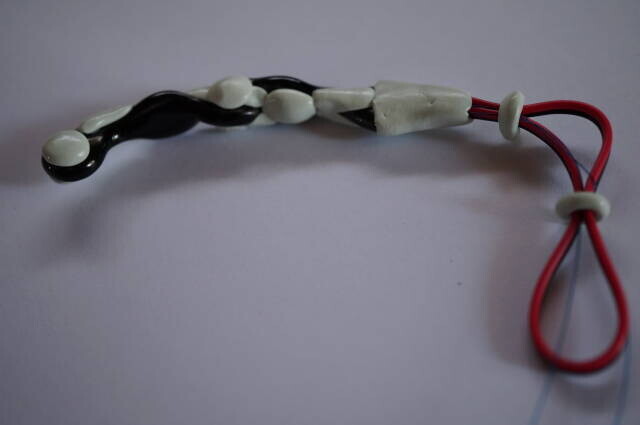
Silicone-covered lock-on required more resin behind the vibrating chip's motor
The prototype described in April 2025 needed a connection hole for its shape-memory wire. Making room for that connection changed the resin section behind the motor. The usual 5-7mm section became approximately 15mm.
Mr. Okada shortened the ceramic portion ahead of the motor by about 10mm to keep the overall length comparable. Including the motor, approximately 25mm at the rear formed the motor connection structure. Mr. Okada advised allowing for a shorter front chip when considering this construction.
(Source: ok-lab's diary, published April 2025)
https://ok-lab.hatenablog.com/entry/2025/04/26/122909
Silicone-covered lock-on prototype pricing separated structural work from optional fittings
In April 2025, Mr. Okada illustrated pricing with a ¥5,000 (about $32 at ¥156 = $1, rate as of 2026-09-04) short ceramic vibrating chip; all prices in this example excluded tax. Additions were ¥1,000 (about $6 at ¥156 = $1, rate as of 2026-09-04) for the adapted chip, ¥4,000 (about $26 at ¥156 = $1, rate as of 2026-09-04) for lock-on work, and ¥1,000 (about $6 at ¥156 = $1, rate as of 2026-09-04) for the two cable connections. His minimum example cost ¥11,000 (about $70 at ¥156 = $1, rate as of 2026-09-04), while the fully equipped prototype cost ¥16,500 (about $106 at ¥156 = $1, rate as of 2026-09-04).
Options added ¥3,000 (about $19 at ¥156 = $1, rate as of 2026-09-04) for the petal stopper and ¥2,000 (about $13 at ¥156 = $1, rate as of 2026-09-04) for a 20cm silicone tube; the prototype's tube measured 4mm. A boil-compatible USB connector (the motor's electrical connection) added ¥500 (about $3 at ¥156 = $1, rate as of 2026-09-04). Mr. Okada specified that connector because he regarded boiling as essential for the silicone-covered lock-on design.
(Source: ok-lab's diary, published April 2025)
https://ok-lab.hatenablog.com/entry/2025/04/26/122909

How OK Prostate Chip lock-on options changed over time
| Published | What the diary said then |
|---|---|
| Apr 2025 | A vibrating prototype separated the motor cable from the shape-memory loop. |
| Apr 2025 | The rear connection section lengthened, while the ceramic section shortened. |
| Aug 2025 | Silicone-covered lock-on work received a separate custom quotation. |
| Oct 2025 | Mr. Okada accepted his first integrated-stopper request for silicone-covered lock-on. |
| Oct 2025 | A hybrid lock-on quotation specified the attachment's length and separate charge. |
| Aug 2026 | Free-moving lock-on pricing included stoppers for a stainless-steel chip. |
| Aug 2026 | A larger custom chip gained additional bumps on its sides and bottom. |
The diary does not say what the current state is.
OK Prostate Chip products related to OK Prostate Chip lock-on options
The current list identifies base chips used in these cases; the historical lock-on quotations describe additional custom work.
Products that appear in these entries
| Product (official name) | Price incl. tax | Relation to this topic |
|---|---|---|
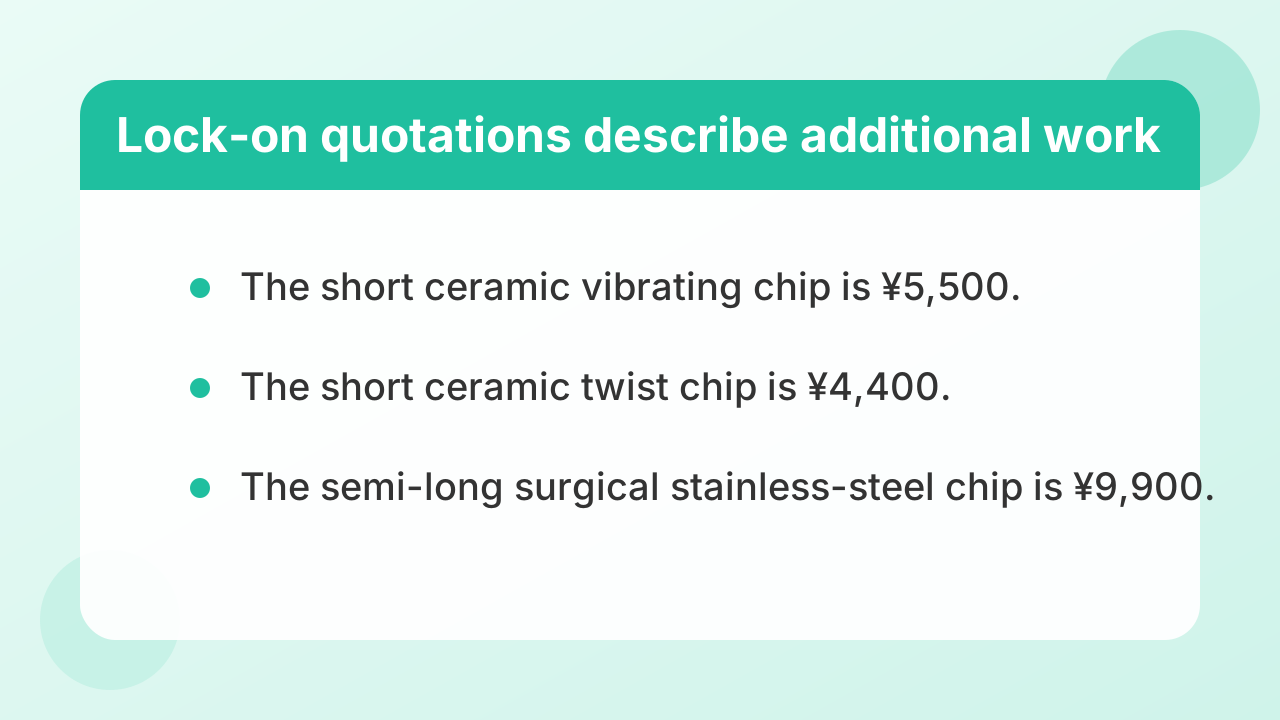
| Short ceramic vibrating chip (OKプロステート核振チップ 陶器素材ショートタイプ) | ¥5,500 (about $35 at ¥156 = $1, rate as of 2026-09-04) | In April 2025, the customer named this base product when requesting a vibrating lock-on assembly. |
| Short ceramic twist chip (OKプロステートチップ 陶器素材ショートタイプ ツイスト) | ¥4,400 (about $28 at ¥156 = $1, rate as of 2026-09-04) | In October 2025, the customer specified this chip for silicone-covered lock-on with integrated stoppers. |
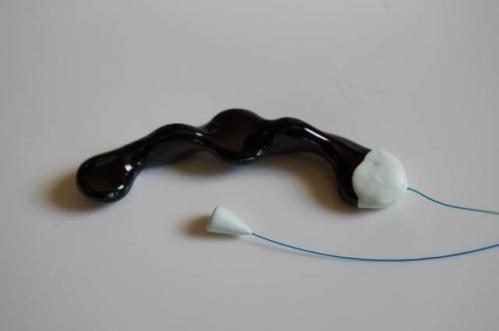
| Long ceramic four-point twist chip (OKプロステートチップ 陶器素材ロングタイプ 4点ツイスト) | ¥7,700 (about $49 at ¥156 = $1, rate as of 2026-09-04) | In October 2025, this chip appeared in a quotation with a separately priced hybrid lock-on attachment. |
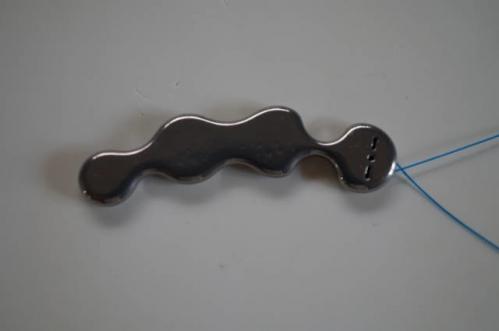
| Semi-long surgical stainless-steel chip (OKプロステートチップ セミロングタイプ(サージカルステンレス)) | ¥9,900 (about $63 at ¥156 = $1, rate as of 2026-09-04) | In August 2026, this chip was requested with free-moving lock-on and stoppers. |
The short ceramic vibrating chip is listed in the company's own online store.
The short ceramic twist chip is listed in the company's own online store.
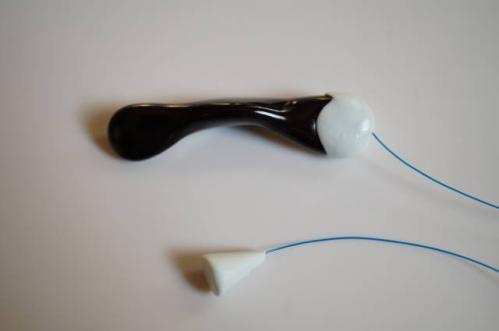
The long ceramic four-point twist chip is listed in the company's own online store.
The semi-long surgical stainless-steel chip is listed in the company's own online store.
(Source: ok-lab's diary, published April 2025)
https://ok-lab.hatenablog.com/entry/2025/04/26/122909
(Source: ok-lab's diary, published October 2025)
https://ok-lab.hatenablog.com/entry/2025/10/11/123003
(Source: ok-lab's diary, published August 2026)
https://ok-lab.hatenablog.com/entry/2026/08/15/122912
Products the diary mentioned as alternatives
The diary names no alternative.
Custom lock-on builds described in this article
No matching product can be confirmed on the current list.
Common worries about OK Prostate Chip lock-on options
Customers asked about mixed wire thicknesses, integrated stoppers, and changes to a larger custom chip.
"Can silicone-covered lock-on use wire with different thicknesses?"
In an entry published in April 2025, a separate customer asked about combining thicker and thinner shape-memory wire in a chipless design. The curve would use 0.4mm wire, while the remaining section would use 0.3mm wire. The requested curve was 15–20mm long, with a 90° angle.
Mr. Okada declined because his workshop could not join those shape-memory wires. The diary records a refusal, with no completed mixed-thickness build. Mr. Okada cautioned that apparently simple changes could exceed his workshop's capabilities with this material.
(Source: ok-lab's diary, published April 2025)
https://ok-lab.hatenablog.com/entry/2025/04/26/122909
"Can silicone-covered lock-on include stoppers built into the chip?"
In an entry published in October 2025, a customer requested silicone-covered lock-on with integrated stoppers for a short ceramic twist chip. An integrated stopper (a stopping part formed with the chip) was requested at both ends. Other specifications included a 50mm loop, 0.4mm doubled wire, and a 150° angle behind the chip.
Mr. Okada said he had never made this combination and was unsure he could do it, but accepted the request. The diary does not record how the requested stoppers performed in use.
(Source: ok-lab's diary, published October 2025)
https://ok-lab.hatenablog.com/entry/2025/10/11/123003
"Can free-moving lock-on support a larger chip with bigger bumps?"
In an entry published in August 2026, staff offered to make a larger shell-style chip with free-moving lock-on. The customer accepted the example, requested larger bumps, and left their placement to Mr. Okada.
Mr. Okada said bumps projecting far beyond the chip were difficult to make. He instead added more bumps, including on the sides and bottom. Staff's offer allowed modest adjustments to bump size and position.
(Source: ok-lab's diary, published August 2026)
https://ok-lab.hatenablog.com/entry/2026/08/22/122905
Buying from outside Japan
OK Lab ships internationally to countries covered by Japan Post's EMS courier service. Overseas orders are paid in advance by PayPal. Each order carries a ¥400 (about $3 at ¥156 = $1, rate as of 2026-09-04) handling fee, and EMS shipping is charged on top. These terms come from OK Lab's official sales-terms page (written here as plain text, not a link: ok-lab.net/docs/law), checked on September 7, 2026; confirm them on the official store before you order, because they can change.
Summary of this article
| What you wanted to know | The answer |
|---|---|
| What is the short answer? | Lock-on constructions and custom-work charges differ. |
| What is the product? | A urethral device made and sold by OK Lab in Japan. |
| What do the names mean? | Hybrid and silicone-covered designs describe different arrangements of wire, tubing, and cable. |
| What happened in the cases? | Customers requested vibrating assemblies, additional fittings, and attachments with specified dimensions. |
| How did the maker respond? | Mr. Okada described workable structures, revised connection space, and itemized charges. |
| What changed over time? | Later entries added integrated-stopper requests and free-moving lock-on quotations. |
| Which products are listed today? | The table identifies named base chips, with prices from the current product list. |
| Which requests raised difficulties? | Mixed wire thicknesses were refused; integrated stoppers were accepted despite uncertainty. |
| How do overseas orders work? | Advance PayPal payment, a handling fee, and additional EMS shipping charges apply. |
| What does the article establish overall? | These entries document custom construction and quotations, without a recorded comparison of performance. |
Source: ok-lab's diary (Okada Comfortable Life Laboratory). The original entries are in Japanese; quotations on this page are translated. Photos and videos are on the original entries.
This article is a summary of the maker's development diary. The product is not a medical device and no result is guaranteed. If anything feels wrong or worries you, see a doctor. Prices, specifications and cautions change, so confirm the latest information on the official blog and the official site. Questions about ordering and shipping go to the seller.