![Worried about the thread slipping inside? | External stoppers are intended to keep it outside [OK Prostate Chip]](/img/a/T0234/eyecatch.svg)
This page is based on entries from "ok-lab's diary" (https://ok-lab.hatenablog.com/), the Japanese development diary written by Mr. Okada, founder of OK Lab, a small company in Japan (Okada Comfortable Life Laboratory). Only the entries about "thread slipping inside" are summarized here, in order of publication. Past prices and sizes are as written at the time. Current prices come from the official product list (retrieved September 4, 2026). Quotations are translated from Japanese.
Note: This page is a personal reading log by someone with no connection to the maker or the seller. It reflects the source entries as of their publication dates and makes no guarantee of accuracy or safety. The product is not a medical device; talk to a doctor about any health decision. Check the official site for current information. This page contains advertising.
In short
An external stopper is intended to keep the retrieval thread outside even if the chip moves into the bladder.
The maker revised designs and advice after problems with detachment, thread kinks, and breakage.
The September 2026 list includes a ¥550 (about $4 at ¥156 = $1, rate as of 2026-09-04) thread stopper and a ¥1,100 (about $7 at ¥156 = $1, rate as of 2026-09-04) three-hole external stopper, including tax.
If you see blood in your urine, even a small amount or for the first time, do not wait and see. See a urologist right away. If you suddenly cannot urinate, or the device cannot be removed, do not try to fix it yourself. Go to a medical facility, including emergency care, immediately.
About this product

The OK Prostate Chip is a small device that is placed in the urethra (the urine passage) so that it acts on the prostate; the maker sells it in several shapes, sizes and materials. It is made and sold by OK Lab (Okada Comfortable Life Laboratory), a small company in Japan, through its own online store, and prices are in Japanese yen (JPY). The maker's development diary, "ok-lab's diary", is written in Japanese. This page is an English summary of it, and every quotation is translated. OK Lab ships internationally, so readers outside Japan can order (see "Buying from outside Japan" below). Product names on this page are plain-English descriptions. The official Japanese product name is shown once in the product table so you can find the same item in the store.
Before you read: key terms
| Term | Plain-English meaning |
|---|---|
| Urethra | The urine passage; the chip and its thread occupy this passage in the diary accounts. |
| Retrieval thread | Thread connected to the main chip, intended to provide a way to recover it. |
| External thread stopper | An accessory on the thread outside the urethra, intended to keep the thread from disappearing inside. |
| Epoxy resin | The material used for the March 2018 replacement stopper; the diary describes it as brittle. |
| Sphincter stopper | An internal accessory designed to limit the main chip's movement toward the bladder. |
| Pulley | A thread guide in the July 2025 prototype, provided for connecting the chip by thread. |
What happens: thread slipping inside
The OK Prostate Chip is a small device placed in the urethra (the urine passage) to act on the prostate. A retrieval thread (the thread connected to the chip for recovery) extends toward the opening. An external thread stopper (an accessory on that thread) sits outside the urethra, near the head of the penis. According to OK Lab's March 2019 reply, its purpose is to keep the thread outside even if the chip enters the bladder.
Thread stopper sales followed reports that chips had slipped inward
In an entry published in March 2018, Mr. Okada acknowledged receiving numerous reports of chips being drawn inward. He wrote that this had not happened to him, so he had initially left customers to find their own solutions. Managing the separate-chip model's two threads changed his view: he decided to sell an accessory that also bundled them together.
The dedicated stopper was priced at ¥500 (about $3 at ¥156 = $1, rate as of 2026-09-04) excluding tax, with sales planned for April 1, alongside the separate-chip model. He said unexpected problems during further testing could delay that launch. Mr. Okada's proposed answer was a dedicated stopper that combined thread management with a stopping function.
(Source: ok-lab's diary, published March 2018)
https://ok-lab.hatenablog.com/entry/20180324/1521875816
Early thread stoppers switched to resin after silicone detached
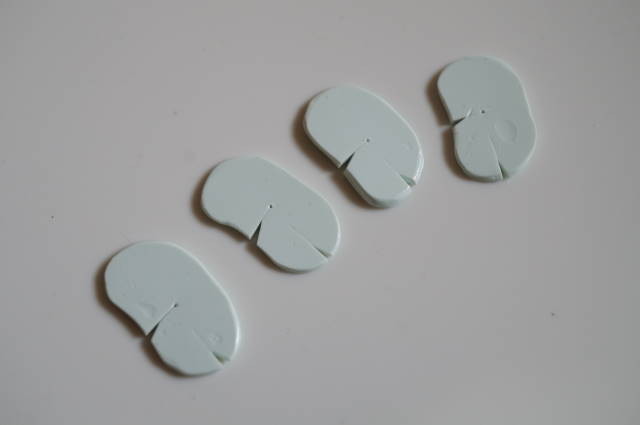
In a later entry published in March 2018, Mr. Okada withdrew the previous stopper explanation because the silicone version was too soft and detached. Its replacement used epoxy resin (the material forming the stopper), with a bean-like shape. The published dimensions were 1mm thick and approximately 10-15mm wide.
The design had two slots, with one reaching a central hole measuring 0.2mm or less in diameter. The other slot stopped short of that hole, providing a separate stopping feature. Mr. Okada directed readers to this revised design in place of his withdrawn silicone-stopper explanation.
(Source: ok-lab's diary, published March 2018)
https://ok-lab.hatenablog.com/entry/20180331/1522485734
Thicker thread stoppers still broke during work in heavy jeans
In an entry published in June 2018, Mr. Okada reported a customer's broken stopper despite an increase in thickness. The customer had been working while wearing thick jeans. Mr. Okada also disclosed that an extremely thin early version had broken during his own use.
He described the resin as brittle and said there was no fundamental solution to that material limitation. The diary does not record whether this customer received a replacement or how any repair performed. Mr. Okada presented his proposed responses as temporary measures, with stronger material another possibility he suggested.
(Source: ok-lab's diary, published June 2018)
https://ok-lab.hatenablog.com/entry/20180602/1527922643
A thread stopper without slots was proposed to reduce breakage
In another entry published in June 2018, Mr. Okada described a third development version with selectable dimensions and thickness. Earlier versions had fixed chip sizes, while the second version had already allowed changes in the distance between chips. The third version allowed both size and spacing to vary.
He wrote that this part could also serve as an ordinary external stopper when located outside the urethra. Because it had no slit, he considered breakage very unlikely, unlike the slotted thread stopper discussed earlier. Mr. Okada nevertheless cautioned that the development did not guarantee prevention of the main chip's movement into the bladder.
(Source: ok-lab's diary, published June 2018)
https://ok-lab.hatenablog.com/entry/20180616/1529136608
A loose retrieval thread prompted Mr. Okada's suggestion of extra protection
In an entry published in July 2025, Mr. Okada described a prototype with a pulley (a guide through which the thread passes). In its single-chip arrangement, he thought the thread might slip out of the guide. This was a concern he identified while discussing the design, rather than a customer's reported accident.
The fixed-guide version was ¥4,000 (about $26 at ¥156 = $1, rate as of 2026-09-04) excluding tax, while the version with a movable guide was ¥5,000 (about $32 at ¥156 = $1, rate as of 2026-09-04) excluding tax. The diary does not identify the exact safety component he had in mind. Mr. Okada suggested that the single-chip arrangement might need an additional safety component to address the loose-thread risk.
(Source: ok-lab's diary, published July 2025)
https://ok-lab.hatenablog.com/entry/2025/07/12/122911
The maker's answer to thread slipping inside
The diary describes revised stopper designs and factory preparation, while withdrawing earlier ideas that caused problems.
Thread stopper advice withdrew twisting because bends could leave lasting kinks
In an entry published in March 2018, Mr. Okada withdrew a proposal to use one component of the separate-chip model as a makeshift stopper. That proposal involved a full turn of the thread, which he said could leave a lasting kink. His later explanation set 90 degrees as the limit beyond which bending could give the thread a persistent shape.
This correction concerned the thread itself, alongside the separate change in stopper material. Mr. Okada warned against the earlier winding approach because the thread might not return to its previous shape.
(Source: ok-lab's diary, published March 2018)
https://ok-lab.hatenablog.com/entry/20180324/1521875816
(Source: ok-lab's diary, published March 2018)
https://ok-lab.hatenablog.com/entry/20180331/1522485734
One sliding thread stopper replaced plans for separate erection positions
In an entry published in March 2018, Mr. Okada also withdrew the proposed arrangement with two stoppers for erect and non-erect positions. His replacement concept used one stopper that could slide as the body changed. He attributed that movement to slight resistance between the thread and the stopper's central hole.
The revised stopper also had a separate stopping function, so its design allowed both movement and restraint. Mr. Okada identified the single sliding stopper as the corrected approach, replacing his earlier two-stopper recommendation.
(Source: ok-lab's diary, published March 2018)
https://ok-lab.hatenablog.com/entry/20180331/1522485734
Factory preparation became another response to broken thread stoppers
In an entry published in June 2018, Mr. Okada offered factory preparation for customers buying a main chip and stopper together. On request, the company could supply them already connected, with the stopper's slit bonded. This was an offered service; the paragraph does not report a customer's result after receiving it.
His other temporary proposals distinguished between a stopper dedicated to one chip and one shared across several chips. Mr. Okada offered the factory-prepared arrangement as an option customers could request with a combined purchase.
(Source: ok-lab's diary, published June 2018)
https://ok-lab.hatenablog.com/entry/20180602/1527922643
If you see blood in your urine, even a small amount or for the first time, do not wait and see. See a urologist right away. If you suddenly cannot urinate, or the device cannot be removed, do not try to fix it yourself. Go to a medical facility, including emergency care, immediately.
How thread slipping inside changed over time
| Published | What the diary said then |
|---|---|
| Mar 2018 | Dedicated stopper sales were planned after reports of inward movement and difficulty managing two threads. |
| Mar 2018 | Resin replaced silicone after the soft prototype detached. |
| Mar 2018 | One sliding stopper replaced the proposed two-stopper arrangement. |
| Jun 2018 | Increased thickness had not eliminated breakage. |
| Jun 2018 | A cut-free development version was proposed for external stopping duties. |
| Mar 2019 | A customer's entire retrieval thread disappeared inside; an external stopper was advised afterward. |
| Feb 2024 | The order list recorded the thread stopper at ¥550 (about $4 at ¥156 = $1, rate as of 2026-09-04) each. |
| Jan 2026 | The order list recorded the three-hole external stopper at ¥1,100 (about $7 at ¥156 = $1, rate as of 2026-09-04) each. |
OK Prostate Chip products related to thread slipping inside
The current list includes external thread stoppers and internal stoppers discussed for the separate concern of bladder movement.
Products that appear in these entries
| Product (official name) | Price incl. tax | Relation to this topic |
|---|---|---|
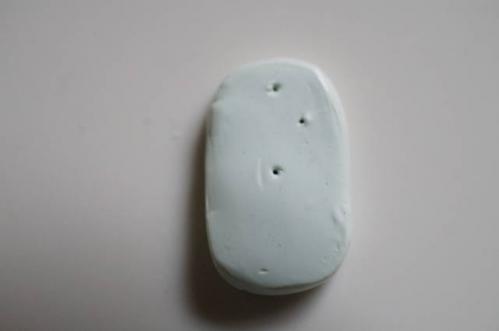
| Thread stopper (OKプロステートチップ用糸飲み込み防止ストッパーチップ) | ¥550 (about $4 at ¥156 = $1, rate as of 2026-09-04) | In February 2024, a customer requested this ¥550 (about $4 at ¥156 = $1, rate as of 2026-09-04) accessory already attached alongside an internal stopper. |
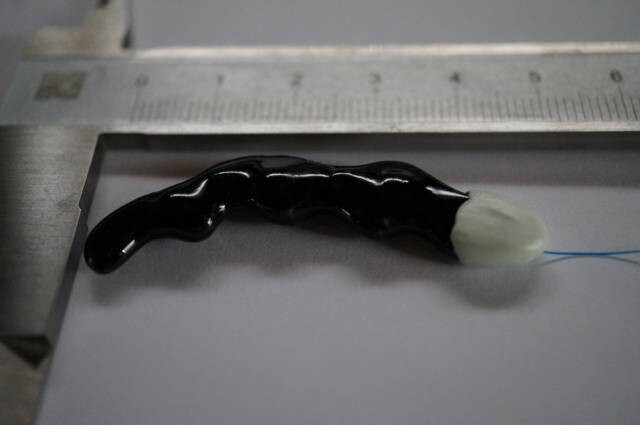
| Three-hole external stopper (三穴方式オプションチップ(亀頭外側ストッパーチップ)) | ¥1,100 (about $7 at ¥156 = $1, rate as of 2026-09-04) | In January 2026, an order listed this external stopper at ¥1,100 (about $7 at ¥156 = $1, rate as of 2026-09-04) each. |
| Six-hole internal stopper (六穴方式オプションチップ(括約筋ストッパーチップ)) | ¥2,200 (about $14 at ¥156 = $1, rate as of 2026-09-04) | In February 2024, a customer asked whether this ordered accessory suited concerns about inward movement. |
The thread stopper is sold through OK Lab's own online store.
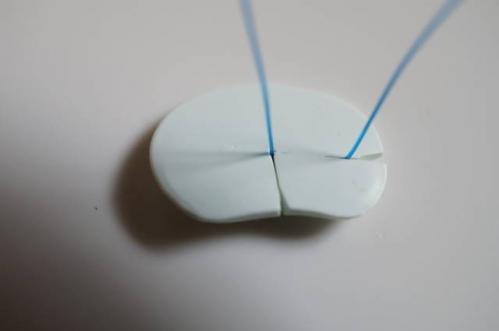
The three-hole external stopper is sold through OK Lab's own online store.
(Source: ok-lab's diary, published February 2024)
https://ok-lab.hatenablog.com/entry/2024/02/10/123023
(Source: ok-lab's diary, published January 2026)
https://ok-lab.hatenablog.com/entry/2026/01/24/122909
Products the diary mentioned as alternatives
| Product (official name) | Price incl. tax | Relation to this topic |
|---|---|---|
| Three-hole internal stopper (三穴方式オプションチップ(括約筋ストッパーチップ)) | ¥1,650 (about $11 at ¥156 = $1, rate as of 2026-09-04) | In March 2019, OK Lab suggested this for limiting bladder movement, rather than merely keeping the thread outside. |
(Source: ok-lab's diary, published March 2019)
https://ok-lab.hatenablog.com/entry/2019/03/23/173222
The historical items are the silicone prototype, June 2018 cut-free design, July 2025 pulley prototype, and March 2024 custom builds. No matching product can be confirmed on the current list.
Common worries about thread slipping inside
The questions distinguish losing the thread, limiting the chip's movement, and requesting a different thread ending.
"Does thread slipping inside mean the chip cannot come out?"
In an entry published in March 2019, a customer reported losing access to the cross-jointed resin chip's entire thread by the second day. Its white end piece was inside the urethra, and the customer asked whether medical help was necessary. Mr. Okada warned that a joint entirely inside the bladder could fold, potentially preventing the chip from coming out during urination.
The customer later reported recovering the chip, then asked how to prevent another incident. No matching product can be confirmed on the current list. OK Lab's sales representative recommended an external stopper to keep the thread outside even if the chip entered the bladder.
(Source: ok-lab's diary, published March 2019)
https://ok-lab.hatenablog.com/entry/2019/03/23/173222
"Will a thread stopper prevent movement into the bladder?"
In an entry published in February 2024, a customer suspected their existing chip repeatedly moved into the bladder and asked about a better position. They had ordered a six-hole internal stopper with a ceramic chip. A sphincter stopper (an internal accessory intended to limit movement toward the bladder) was the option under discussion.
Mr. Okada said that preventing the main chip from moving into the bladder was its intended purpose. The diary does not record how the customer's new arrangement performed. Mr. Okada considered the option relevant to that concern, while warning that differences between people meant it would not necessarily work.
(Source: ok-lab's diary, published February 2024)
https://ok-lab.hatenablog.com/entry/2024/02/10/123023
"Can custom chips include a thread stopper instead of loops?"
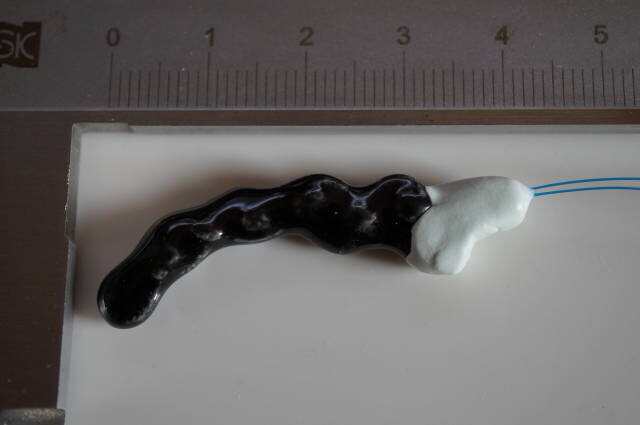
In an entry published in March 2024, a customer replaced a requested loop ending with white resin protection against the thread slipping inside. The request covered custom screw-shaped chips, including a long piece with a narrower body. Mr. Okada reported a finished maximum width slightly above 8mm, after declining the narrower specification.
Further discussions with staff led to the pictured custom pieces. The diary does not record how their thread ends performed in use. Mr. Okada cautioned that 7mm was not feasible at the requested length.
(Source: ok-lab's diary, published March 2024)
https://ok-lab.hatenablog.com/entry/2024/03/30/122958
Buying from outside Japan

OK Lab ships internationally to countries covered by Japan Post's EMS courier service. Overseas orders are paid in advance by PayPal. Each order carries a ¥400 (about $3 at ¥156 = $1, rate as of 2026-09-04) handling fee, and EMS shipping is charged on top. These terms come from OK Lab's official sales-terms page (written here as plain text, not a link: ok-lab.net/docs/law), checked on September 7, 2026; confirm them on the official store before you order, because they can change.
Summary of this article
| What you wanted to know | The answer |
|---|---|
| In short: what is the stopper for? | Its stated purpose is keeping the thread outside when the main chip moves inward. |
| About this product: who makes it? | OK Lab makes the urethral device in Japan and sells it in yen. |
| Key terms: are all stoppers alike? | External thread stoppers and internal sphincter stoppers have different intended jobs. |
| What happens: what problems were reported? | The diary records inward movement, stopper detachment, and breakage. |
| The maker's answer: what changed? | Revised material, corrected thread arrangements, and factory preparation were discussed. |
| Changes over time: what remains historical? | Early specifications and experimental designs belong to their dated entries. |
| Related products: what is listed now? | The September 2026 list includes the external stoppers and internal options shown above. |
| Common worries: is the distinction practical? | Keeping the thread outside does not mean the main chip cannot enter the bladder. |
| Buying from outside Japan: what are the terms? | Advance PayPal payment, a ¥400 (about $3 at ¥156 = $1, rate as of 2026-09-04) handling fee, and additional Japan Post EMS shipping. |
Source: ok-lab's diary (Okada Comfortable Life Laboratory). The original entries are in Japanese; quotations on this page are translated. Photos and videos are on the original entries.
This article is a summary of the maker's development diary. The product is not a medical device and no result is guaranteed. If anything feels wrong or worries you, see a doctor. Prices, specifications and cautions change, so confirm the latest information on the official blog and the official site. Questions about ordering and shipping go to the seller.