![Can the chip slip into my bladder? | A stopper may help, but can fail [OK Prostate Chip]](/img/a/T0230/eyecatch.svg)
This page is based on entries from "ok-lab's diary" (https://ok-lab.hatenablog.com/), the Japanese development diary written by Mr. Okada, founder of OK Lab, a small company in Japan (Okada Comfortable Life Laboratory). Only the entries about "sphincter stoppers intended to prevent movement into the bladder" are summarized here, in order of publication. Past prices and sizes are as written at the time. Current prices come from the official product list (retrieved September 4, 2026). Quotations are translated from Japanese.
Note: This page is a personal reading log by someone with no connection to the maker or the seller. It reflects the source entries as of their publication dates and makes no guarantee of accuracy or safety. The product is not a medical device; talk to a doctor about any health decision. Check the official site for current information. This page contains advertising.
In short
A sphincter stopper is intended to prevent movement into the bladder, but the maker says it may fail.
Mr. Okada revised rough surfaces, connections, and wire stiffness after reports of injury and discomfort.
The current list includes three-hole, six-hole, and eight-hole stoppers; petal designs appear in historical custom quotations.
If you see blood in your urine, even a small amount or for the first time, do not wait and see. See a urologist right away. If you suddenly cannot urinate, or the device cannot be removed, do not try to fix it yourself. Go to a medical facility, including emergency care, immediately.
About this product

The OK Prostate Chip is a small device that is placed in the urethra (the urine passage) so that it acts on the prostate; the maker sells it in several shapes, sizes and materials. It is made and sold by OK Lab (Okada Comfortable Life Laboratory), a small company in Japan, through its own online store, and prices are in Japanese yen (JPY).
The maker's development diary, "ok-lab's diary", is written in Japanese. This page is an English summary of it, and every quotation is translated.
OK Lab ships internationally, so readers outside Japan can order (see "Buying from outside Japan" below). Product names on this page are plain-English descriptions. The official Japanese product name is shown once in the product table so you can find the same item in the store.
Before you read: key terms
| Term | Plain-English meaning |
|---|---|
| Urethra | The urine passage; the maker places the main chip here to act on the prostate. |
| Sphincter | The body structure the stopper is intended to stay in front of. The diary does not explain this. |
| Sphincter stopper | An added part intended to resist the main chip's movement into the bladder. |
| Nylon thread | A strand attached to the device; the February 2019 reply describes it as support for a stopper. |
| Petal stopper | A stopper with projecting wire loops, intended to resist passage beyond the sphincter. |
| Shape-memory wire | Wire inside tubing that forms the petal loops and supports their shape. |
| Heart-shaped stopper | A loop prototype intended to resist outward slipping near the penis tip; inward protection remained a possibility. |
| Electrode | An electrical contact on a chip, used for electrical stimulation in the May 2019 custom request. |
What happens: chip slipping into the bladder
The OK Prostate Chip is a device placed in the urethra (the urine passage) to act on the prostate. A sphincter stopper (an added part intended to resist inward movement) sits near the main chip, in front of the sphincter. The diary names this body structure but does not explain its anatomy. Mr. Okada describes the stopper as a way to resist movement into the bladder, while warning that effectiveness varies between people.
An early sphincter stopper sample caused pain despite reportedly holding position
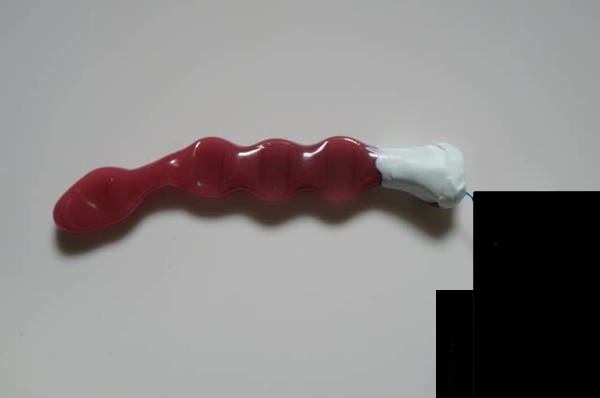
In an entry published in June 2018, a customer tested a stopper-equipped sample intended to resist inward movement. It measured 49 mm long, with a 9 mm prostate-side bulge, 6 mm waist, and 9 mm rear bulge. The customer reported pain and a small amount of bleeding, despite feeling that the stopper held position and resisted inward movement.
The customer also thought the main chip's size might contribute to how firmly it stayed in place. Mr. Okada acknowledged that his own favorable tests had missed possible injury and said he would address it before formal sales.
(Source: ok-lab's diary, published June 2018)
https://ok-lab.hatenablog.com/entry/20180609/1528523953
A three-hole sphincter stopper order exposed roughness on its companion chip
An entry published in May 2020 lists an M three-hole sphincter stopper at ¥1,650 (about $11 at ¥156 = $1, rate as of 2026-09-04), alongside a customer's requested custom ceramic chip. The customer wanted the stopper supplied already attached. During photography, Mr. Okada noticed a surface flaw on the ceramic chip that was difficult to see without magnification.
He reported that the area felt rough when checked. His response was to remake the ceramic chip before supplying the order.
(Source: ok-lab's diary, published May 2020)
https://ok-lab.hatenablog.com/entry/2020/05/16/131332
The rigid U-turn stopper remained on hold because body changes created strain
In an entry published in March 2022, Mr. Okada explained why repeated U-turn stopper prototypes had not reached practical use. He wrote that the fixed shape could unexpectedly strain the urethra during extreme shrinkage. Making the rigid section shorter created another problem: the flexible cable allowed the chip to be pushed outward more easily.
He also described a flexible cable prototype incorporating approximately 0.4-0.5 mm wire, which he had tested for about 5 days. His assessment was that hard, unbending components were probably unsuitable for prolonged placement in that part of the urethra.
(Source: ok-lab's diary, published March 2022)
https://ok-lab.hatenablog.com/entry/2022/03/12/122940
A dedicated cable sphincter stopper became an adjustable factory-fitted proposal
An entry published in August 2023 described an optional stopper for a cable combining nylon thread (a support strand) with fine electrical wires. The dedicated sphincter stopper was priced at ¥2,000 (about $13 at ¥156 = $1, rate as of 2026-09-04) excluding tax. It would be fitted before delivery because of the cable's waterproof connector, although its position remained adjustable.
The proposal covered the maker's vibrating chips and chips with electrical contacts. Mr. Okada said orders would open only after another week of testing without problems.
(Source: ok-lab's diary, published August 2023)
https://ok-lab.hatenablog.com/entry/2023/08/19/123214
The heart-shaped stopper targeted outward slipping while bladder protection remained untested
In an entry published in December 2025, Mr. Okada described a heart-shaped stopper (an internal prototype intended to resist outward slipping). Its 4-layer loop structure was intended for placement near the penis tip. He reported strong retention with little discomfort, but had not established its use as a sphincter stopper.
The best loop size and whether 2 layers could give similar results remained under investigation. Mr. Okada said further testing was needed before he could announce specifications.
(Source: ok-lab's diary, published December 2025)
https://ok-lab.hatenablog.com/entry/2025/12/06/122924
A two-petal sphincter stopper quotation required changes to its custom build
In an entry published in August 2026, a customer requested a wire-and-loop device with a petal sphincter stopper. The quotation priced the 2-petal stopper at ¥2,200 (about $14 at ¥156 = $1, rate as of 2026-09-04). The requested double-wire build used 0.3 mm wire, but its parts interfered at 150°, so the customer accepted 120°.
Mr. Okada later noticed an extension was on the wrong side and said the device would be remade. The diary does not record completion of that remake or how it felt in use. Mr. Okada's design advice was that this combination required the angle change because of the interference.
(Source: ok-lab's diary, published August 2026)
https://ok-lab.hatenablog.com/entry/2026/08/15/122912
The maker's answer to chip slipping into the bladder
Mr. Okada's measures changed the stopper's finish, flexibility, and fit, without establishing protection for every person.
A second sphincter stopper injury report prompted changes to manufacturing
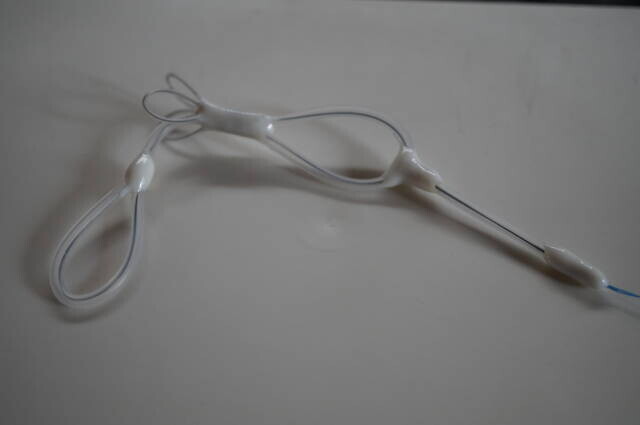
An entry published in June 2018 records a separate tester who initially found the stopper comfortable but later reported bleeding after longer use. The customer found a rough edge on the sample. Mr. Okada attributed it to carelessness when adding another layer of resin.
He described a revised design with rounded edges and a sliding connection, assembled away from the main chip. He said this made quality more consistent and spacing adjustable, while moving the earliest possible release to July 2018. His response was to revise the manufacturing process to address the reported defects.
(Source: ok-lab's diary, published June 2018)
https://ok-lab.hatenablog.com/entry/20180609/1528523953
Softer petal stopper wire was chosen after thicker versions caused excessive stimulation
In an entry published in April 2025, Mr. Okada introduced a stopper formed from 3 petals of 0.2 mm wire. He said it could be connected to designs containing shape-memory wire (wire used to maintain a formed shape) inside tubing. The published prices were ¥1,000 (about $6 at ¥156 = $1, rate as of 2026-09-04) per petal and ¥3,000 (about $19 at ¥156 = $1, rate as of 2026-09-04) for 3 petals, excluding tax.
Mr. Okada reported about 5 days of use without strong stimulation at the sphincter. His tests favored the thinner wire over 0.3 mm wire, which produced stronger stimulation. He judged the thicker version unsuitable for prolonged use because stimulation around the sphincter was too strong.
(Source: ok-lab's diary, published April 2025)
https://ok-lab.hatenablog.com/entry/2025/04/26/122909
Combined petal stoppers could create excessive pressure instead of a secure fit
The entry published in April 2025 also discusses combining sphincter petals with petals intended to prevent outward movement at the penis tip. Mr. Okada wrote that overly long connecting extensions could make the two sets push against each other. He said this could push the outer petals beyond the penis tip and create excessive pressure near the sphincter.
His report described the internal petals as functioning during ordinary placement. However, he warned that force from a pushing instrument could reverse the petals and carry them past the sphincter.
(Source: ok-lab's diary, published April 2025)
https://ok-lab.hatenablog.com/entry/2025/04/26/122909
If you see blood in your urine, even a small amount or for the first time, do not wait and see. See a urologist right away. If you suddenly cannot urinate, or the device cannot be removed, do not try to fix it yourself. Go to a medical facility, including emergency care, immediately.
How chip slipping into the bladder changed over time
| Published | What the diary said then |
|---|---|
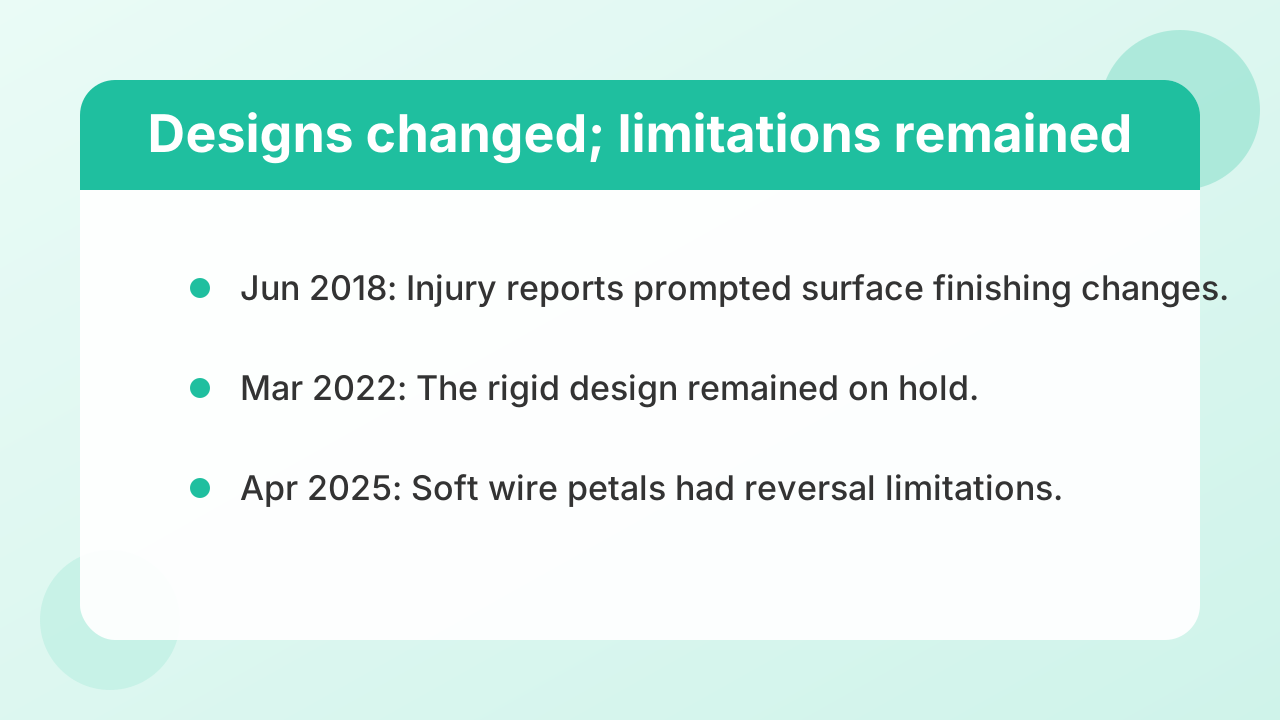
| Jun 2018 | Injury reports prompted changes to surface finishing and the connection. |
| Feb 2019 | Nylon thread was explained as an attachment for the stopper. |
| May 2020 | A three-hole stopper price appeared alongside a companion chip requiring a remake. |
| Mar 2022 | The rigid U-turn design remained on hold because of strain concerns. |
| Aug 2023 | A factory-fitted, adjustable stopper was proposed for the new cable. |
| Feb 2024 | Mr. Okada warned that individual differences could prevent reliable operation. |
| Apr 2025 | Soft wire petals introduced another design, with pressure and reversal limitations. |
| Dec 2025 | A heart-shaped prototype addressed outward slipping; sphincter use remained speculative. |
| Aug 2026 | A two-petal custom quotation included an angle change and required a remake. |
OK Prostate Chip products related to chip slipping into the bladder
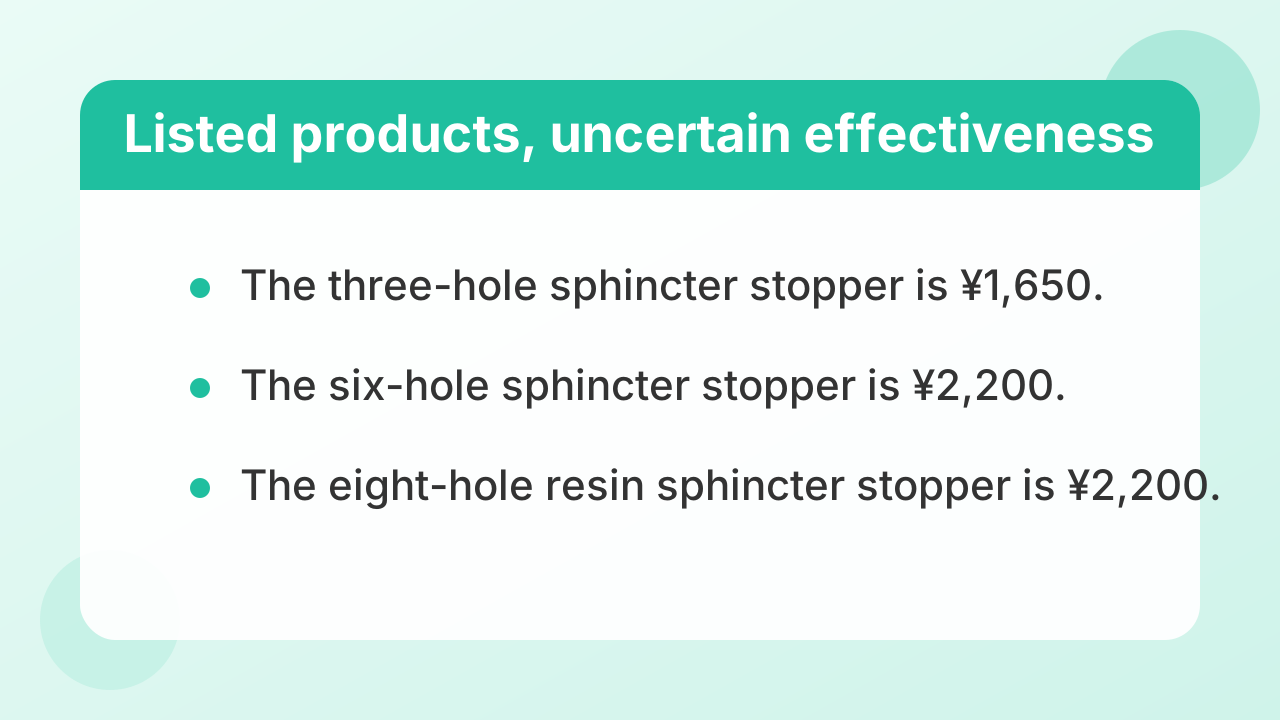
The current list contains three stopper products documented in these cases, but does not establish their effectiveness.
Products that appear in these entries
| Product (official name) | Price incl. tax | Relation to this topic |
|---|---|---|
| Three-hole sphincter stopper (三穴方式オプションチップ(括約筋ストッパーチップ)) | ¥1,650 (about $11 at ¥156 = $1, rate as of 2026-09-04) | In May 2020, this stopper accompanied the custom ceramic chip that Mr. Okada decided to remake. |
| Six-hole sphincter stopper (六穴方式オプションチップ(括約筋ストッパーチップ)) | ¥2,200 (about $14 at ¥156 = $1, rate as of 2026-09-04) | In February 2024, an M stopper was listed at ¥2,200 (about $14 at ¥156 = $1, rate as of 2026-09-04) for a customer asking about suspected inward slipping. |
| Eight-hole resin sphincter stopper (八穴方式括約筋ストッパーチップ(生体適合樹脂)) | ¥2,200 (about $14 at ¥156 = $1, rate as of 2026-09-04) | A separate February 2024 order listed the M stopper at ¥2,200, (about $14 at ¥156 = $1, rate as of 2026-09-04) without a reported use result. |
(Source: ok-lab's diary, published May 2020)
https://ok-lab.hatenablog.com/entry/2020/05/16/131332
(Source: ok-lab's diary, published February 2024)
https://ok-lab.hatenablog.com/entry/2024/02/10/123023
Products the diary mentioned as alternatives
The diary names no alternative.
The diary also describes early samples, custom ceramic and electrical builds, dedicated cable stoppers, petal builds, and U-turn and heart-shaped prototypes. No matching product can be confirmed on the current list.
Common worries about chip slipping into the bladder
The reader exchanges concern inward movement, the thread's purpose, and whether custom combinations can accommodate a stopper.
"Why does a sphincter stopper need nylon thread?"

In an entry published in February 2019, a customer considering added nylon thread asked whether the existing electrical cable was strong enough. Mr. Okada explained that the thread provided an attachment for a sphincter stopper when inward slipping was a concern. He considered the cable probably stronger under tension, while suggesting that the thread's connection to the glass tip might help if resin broke.
The diary does not record whether the customer chose the additional thread. Mr. Okada advised weighing those differences and the added care required, rather than describing the thread as universally necessary.
(Source: ok-lab's diary, published February 2019)
https://ok-lab.hatenablog.com/entry/2019/02/23/142754
"Can custom electrical chips include a sphincter stopper?"
In an entry published in May 2019, a customer requested electrodes (electrical contacts) on a two-part resin arrangement with a sphincter stopper. Mr. Okada said the proposed arrangement was possible under thread-and-cable constraints, and clarified that he had not prohibited the customer's earlier electrical design. The customer withdrew that proposal and requested a linked pair with a stopper, reporting that linked chips could still slip inward.
Mr. Okada described a completed build but retained concerns about the connecting cable's durability. The diary does not record how the finished device felt in use. During the exchange, Mr. Okada asked the customer to weigh closer electrical-contact spacing against strength and durability.
(Source: ok-lab's diary, published May 2019)
https://ok-lab.hatenablog.com/entry/2019/05/11/152432
"Does a sphincter stopper guarantee the chip stays in place?"
In an entry published in February 2024, a customer said their chip repeatedly slid deeper until sensation disappeared. The customer suspected movement into the bladder and asked whether a stopper would hold the chip in the desired place. Mr. Okada replied that preventing inward movement was the stopper's intended purpose.
The diary does not record whether the requested stopper solved this customer's problem. Mr. Okada cautioned that differences between people meant it might not function reliably.
(Source: ok-lab's diary, published February 2024)
https://ok-lab.hatenablog.com/entry/2024/02/10/123023
Buying from outside Japan

OK Lab ships internationally to countries covered by Japan Post's EMS courier service. Overseas orders are paid in advance by PayPal. Each order carries a ¥400 (about $3 at ¥156 = $1, rate as of 2026-09-04) handling fee, and EMS shipping is charged on top. These terms come from OK Lab's official sales-terms page (written here as plain text, not a link: ok-lab.net/docs/law), checked on September 7, 2026; confirm them on the official store before you order, because they can change.
Summary of this article
| What you wanted to know | The answer |
|---|---|
| What is the short answer? | The stopper is intended to resist inward movement, but the maker does not guarantee it works. |
| What is the product? | A urethral device made by OK Lab in Japan, with prices in JPY. |
| What do the terms mean? | Sphincter stoppers address inward movement; the heart-shaped prototype primarily addressed outward slipping. |
| What happened in the cases? | Reports include bleeding, surface defects, uncertain effectiveness, and custom designs needing changes. |
| What did the maker change? | Surface finishing, connections, wire stiffness, and the fit between components. |
| How did development progress? | Early samples were followed by cable-specific, petal, and heart-shaped designs with different limitations. |
| Which related products are listed? | Three-hole, six-hole, and eight-hole stoppers appear on the supplied current list. |
| What did customers ask? | Whether stoppers work, why thread matters, and whether electrical builds can accommodate them. |
| How are overseas purchases handled? | Advance PayPal payment, a handling fee, and separate EMS shipping charges. |
Source: ok-lab's diary (Okada Comfortable Life Laboratory). The original entries are in Japanese; quotations on this page are translated. Photos and videos are on the original entries.
This article is a summary of the maker's development diary. The product is not a medical device and no result is guaranteed. If anything feels wrong or worries you, see a doctor. Prices, specifications and cautions change, so confirm the latest information on the official blog and the official site. Questions about ordering and shipping go to the seller.