![Will a screw-shaped helper chip keep the device in place? | It is not a reliable stopper [OK Prostate Chip]](/img/a/T0236/eyecatch.svg)
This page is based on entries from "ok-lab's diary" (https://ok-lab.hatenablog.com/), the Japanese development diary written by Mr. Okada, founder of OK Lab, a small company in Japan (Okada Comfortable Life Laboratory). Only the entries about "screw-shaped helper chips" are summarized here, in order of publication. Past prices and sizes are as written at the time. Current prices come from the official product list (retrieved September 4, 2026). Quotations are translated from Japanese.
Note: This page is a personal reading log by someone with no connection to the maker or the seller. It reflects the source entries as of their publication dates and makes no guarantee of accuracy or safety. The product is not a medical device; talk to a doctor about any health decision. Check the official site for current information. This page contains advertising.
In short
- Screw-shaped helper chips were developed to help retention, but the maker says they cannot reliably act as stoppers.
- Mr. Okada's answers distinguish fixed attachments, sliding designs, and assemblies with separate stopper functions.
- The current list includes original, biocompatible-resin, and second-generation resin screw-shaped helper options.
If you see blood in your urine, even a small amount or for the first time, do not wait and see. See a urologist right away. If you suddenly cannot urinate, or the device cannot be removed, do not try to fix it yourself. Go to a medical facility, including emergency care, immediately.
About this product

The OK Prostate Chip is a small device that is placed in the urethra (the urine passage) so that it acts on the prostate; the maker sells it in several shapes, sizes and materials. It is made and sold by OK Lab (Okada Comfortable Life Laboratory), a small company in Japan, through its own online store, and prices are in Japanese yen (JPY).
The maker's development diary, "ok-lab's diary", is written in Japanese. This page is an English summary of it, and every quotation is translated. OK Lab ships internationally, so readers outside Japan can order (see "Buying from outside Japan" below).
Product names on this page are plain-English descriptions. The official Japanese product name is shown once in the product table so you can find the same item in the store.
Before you read: key terms
| Term | Plain-English meaning |
|---|---|
| Urethra | The urine passage; it also contains the device in the diary's examples. |
| Screw-shaped helper chip | A twisted part behind the main chip, intended to help it stay in place. |
| Sphincter | A muscle closing the urine passage; parts may sit on either side. |
| Stopper | A part intended to limit movement, distinct from the screw-shaped helper. |
| Silicone-covered tail | Nylon thread inside silicone tubing, used as a connection carrying supplementary parts. |
| Biocompatible resin | The maker's label for these parts' resin; the diary does not explain compatibility testing. |
| Epoxy | The earlier resin, used to embed the thread connection in the helper. |
| Nitinol | Shape-memory wire used to reinforce connections. |
What happens: screw-shaped helper chips
The OK Prostate Chip is a small device placed in the urethra to act on the prostate. A screw-shaped helper chip is a twisted supplementary part connected behind the main chip, on thread or, in later examples, cable or tubing. Mr. Okada describes it as helping retention within the urine passage, including arrangements around the sphincter (the muscle that closes the passage). He distinguishes this supporting role from a stopper's function.
Screw-shaped helper chips launched with fixed spacing and an added purchase requirement
An entry published in November 2019 introduced the screw-shaped helper with a standard length of 15–18 mm and width of 8–9 mm. Its planned price was ¥3,000 (about $19 at ¥156 = $1, rate as of 2026-09-04) excluding tax. The comparison prices, also excluding tax, were ¥2,000 (about $13 at ¥156 = $1, rate as of 2026-09-04) for an ordinary helper and ¥4,000 (about $26 at ¥156 = $1, rate as of 2026-09-04) for an ordinary screw chip.
Buyers could specify the gap, but the attachment did not slide. Mr. Okada specified ordering it with the main product because it could not be attached later.
(Source: ok-lab's diary, published November 2019)
https://ok-lab.hatenablog.com/entry/2019/11/16/154802
Cable-mounted screw-shaped helper chips were harder to insert than thread-mounted versions
In an entry published in December 2019, a customer asked whether a vibrating chip could carry the helper on its cable. Mr. Okada agreed to investigate, then abandoned an initial prototype over strength concerns. After about 3 days of testing, he adopted a directly embedded connection; the diary does not record the customer's experience.
He reported that limited rotation made insertion harder than with the thread-mounted version. The price was ¥3,000 (about $19 at ¥156 = $1, rate as of 2026-09-04) excluding tax, with a minimum gap of 2 mm because 0 mm prevented cable bending. Mr. Okada specified purchasing the attachment with the vibrating chip because later attachment was unavailable.
(Source: ok-lab's diary, published December 2019)
https://ok-lab.hatenablog.com/entry/2019/12/21/150646
Two-thread screw-shaped helper chips gained a different resin option
An entry published in August 2021 announced a launch the following week for helpers made from biocompatible resin (the maker's material designation). These were specifically for two-thread connections. Their length was about 15 mm.
Widths were just under 10 mm for L, 9 mm for M, 8 mm for S, and 7 mm for SS. The published price was ¥3,000 (about $19 at ¥156 = $1, rate as of 2026-09-04) excluding tax. Mr. Okada recommended this material instead of embedded epoxy (the earlier resin) for customers choosing two threads.
(Source: ok-lab's diary, published August 2021)
https://ok-lab.hatenablog.com/entry/2021/08/28/125823
Heavy metal screw-shaped helper chips raised concerns about outward movement
In an entry published in August 2022, a customer asked about stainless-steel supplementary parts. OK Lab initially replied that an earlier silver test had felt too heavy, apparently pulling the main chip outward. Mr. Okada said that concern had previously stopped him pursuing metal helpers.
A new reinforced connection and rear retaining arrangement led him to reconsider stainless-steel production. The diary records no customer-use result. Mr. Okada proposed exploring the revised construction specifically for screw-shaped helpers.
(Source: ok-lab's diary, published August 2022)
https://ok-lab.hatenablog.com/entry/2022/08/27/123001
Sliding screw-shaped helper chips needed a tighter opening after wet slippage
In an entry published in December 2023, Mr. Okada tested a helper on a silicone-covered tail (nylon thread inside silicone tubing). The first version's 2.5 mm central opening allowed unwanted movement when wet with urine. He said a 10 mm gap could become 20 mm.
His initial response involved extra stoppers, but a revised 2 mm opening around 2.5 mm tubing reportedly held its position while remaining adjustable. He described this as OK Lab's first position-adjustable screw helper. Mr. Okada proposed the revised tail attachment for customers wanting to explore different spacing.
(Source: ok-lab's diary, published December 2023)
https://ok-lab.hatenablog.com/entry/2023/12/02/122648
Five screw-shaped helper chips proved difficult and were not generally recommended
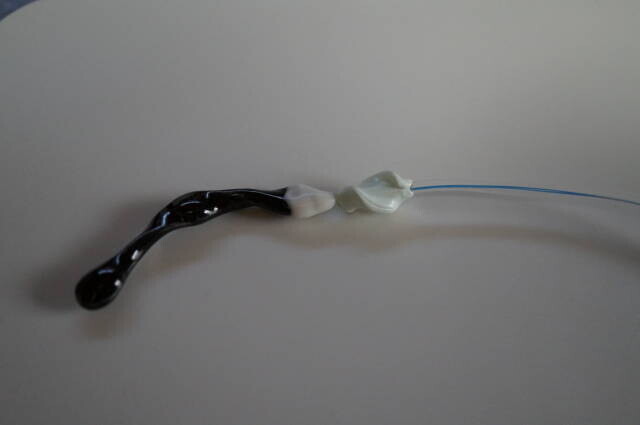
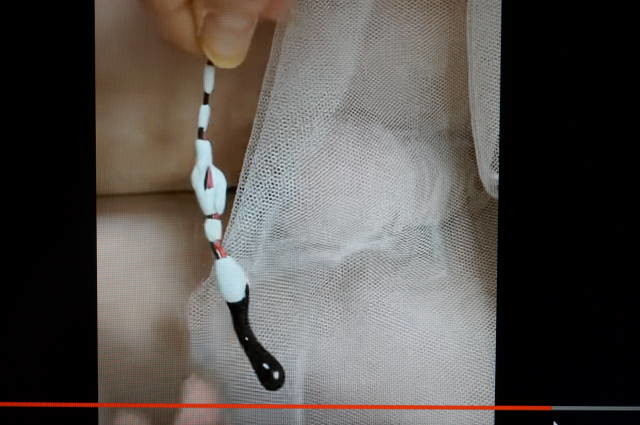
In another entry published in December 2023, Mr. Okada described 5 helpers, each 15 mm long, on a 15 cm tail. He reported that the assembly accommodated shortening to 10 cm. However, he said urine pressure could still expel the helper near the penis head, making hand support necessary during his test.
He also reported difficulty getting all 5 helpers inside, particularly from helper 3 onward. More helpers also cost more. Mr. Okada explicitly declined to recommend the multiple-helper experiment for general users.
(Source: ok-lab's diary, published December 2023)
https://ok-lab.hatenablog.com/entry/2023/12/09/123055
Blue-resin and steel screw-shaped helper chips lost adjustment in one assembly
An entry published in October 2024 discussed screw helpers on a flexible loop-ended assembly. For blue-resin and stainless-steel versions, the tubing could not pass through the screw itself. It therefore stopped on either side.
Mr. Okada said this interrupted waterproofing and allowed water inside the tubing. He described the resulting cleaning limitation as boiling-only. Mr. Okada also cautioned that these assembled versions had no position adjustment.
(Source: ok-lab's diary, published October 2024)
https://ok-lab.hatenablog.com/entry/2024/10/26/122649
The maker's answer to screw-shaped helper chips
Mr. Okada's replies make retention dependent on the particular attachment and stopper arrangement.
Screw-shaped helper chips could slip outward at the penis head
In an entry published in November 2019, Mr. Okada warned that the screw slipped outward when held at the penis head. He distinguished that location from softer tissue farther along the shaft. Mr. Okada cautioned that the holding arrangement for an ordinary helper did not transfer to this screw design.
(Source: ok-lab's diary, published November 2019)
https://ok-lab.hatenablog.com/entry/2019/11/16/154802
Screw-shaped helper chips could not replace a dedicated stopper
In an entry published in March 2020, Mr. Okada said a screw helper could cross the sphincter. In his view, it could pass that boundary both under pressure and when pulled by the main chip. Mr. Okada advised thinking of it as a bendable end bump, without expecting a stopper's function.
(Source: ok-lab's diary, published March 2020)
https://ok-lab.hatenablog.com/entry/2020/03/14/141804
Integrated screw-shaped helper chips required the additional stopper component
An entry published in October 2025 described an integrated main-chip, screw, and stopper assembly reinforced with nitinol (shape-memory wire). The main-chip-to-screw gap was 3–6 mm. It required a blue-resin or stainless-steel screw; white resin was unsuitable for the internal wire.
The stopper cost ¥2,000 (about $13 at ¥156 = $1, rate as of 2026-09-04) excluding tax; joining the main chip and screw was free. Mr. Okada reported improved comfort from eliminating exposed thread and projecting connections near the sphincter. He accepted the combined assembly but declined main-chip-to-screw integration without its stopper.
(Source: ok-lab's diary, published October 2025)
https://ok-lab.hatenablog.com/entry/2025/10/11/123003

If you see blood in your urine, even a small amount or for the first time, do not wait and see. See a urologist right away. If you suddenly cannot urinate, or the device cannot be removed, do not try to fix it yourself. Go to a medical facility, including emergency care, immediately.
How screw-shaped helper chips changed over time
| Published | What the diary said then |
|---|---|
| Dec 2019 | Cable attachment used resin coverage on one side, leaving the opposite side exposed. |
| Mar 2020 | Embedding both cables reportedly strengthened the connection without changing its feel. |
| Aug 2021 | The maker said the new resin helper could remain after thread replacement, unlike embedded epoxy. |
| May 2022 | A four-wire support version appeared at ¥3,000 (about $19 at ¥156 = $1, rate as of 2026-09-04) excluding tax. |
| Dec 2023 | Initial tail pricing covered up to 10 cm at ¥2,000 (about $13 at ¥156 = $1, rate as of 2026-09-04) excluding tax. |
| Dec 2023 | Tail prices, excluding tax: up to 15 cm, ¥2,000 (about $13 at ¥156 = $1, rate as of 2026-09-04); 16–25 cm, ¥3,000 (about $19 at ¥156 = $1, rate as of 2026-09-04). |
| Oct 2024 | A 2 mm tube allowed easier sliding than the 2.5 mm version. |
| Nov 2025 | Mini helpers: about 10 mm long, 7–8 mm wide, ¥1,000 (about $6 at ¥156 = $1, rate as of 2026-09-04) each excluding tax. |
| Jan 2026 | A second-generation SS helper was quoted at ¥3,500 (about $22 at ¥156 = $1, rate as of 2026-09-04); its larger integrated stopper, ¥2,200 (about $14 at ¥156 = $1, rate as of 2026-09-04). |
OK Prostate Chip products related to screw-shaped helper chips
The current list includes screw-helper add-ons; custom assemblies are not separately identified.
Products that appear in these entries
| Product (official name) | Price incl. tax | Relation to this topic |
|---|---|---|
| Original screw-shaped helper add-on (スクリュー型補助チップ追加オプション) | ¥3,300 (about $21 at ¥156 = $1, rate as of 2026-09-04) | November 2019 introduced the fixed-spacing screw helper as an add-on purchased with the main chip. |
| Second-generation resin screw-shaped helper add-on (スクリュー型補助チップ追加オプション(第二世代生体適合樹脂)) | ¥3,500 (about $22 at ¥156 = $1, rate as of 2026-09-04) | January 2026 quoted the second-generation SS component for a custom assembly with an integrated stopper. |
The original screw-shaped helper add-on is listed in OK Lab's own online store.
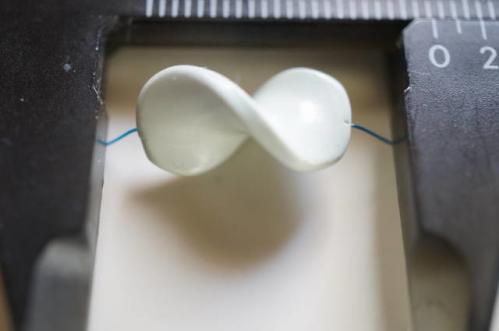
The second-generation resin screw-shaped helper add-on is listed in the same store.

(Source: ok-lab's diary, published November 2019)
https://ok-lab.hatenablog.com/entry/2019/11/16/154802
(Source: ok-lab's diary, published January 2026)
https://ok-lab.hatenablog.com/entry/2026/01/17/122907
Products the diary mentioned as alternatives
| Product (official name) | Price incl. tax | Relation to this topic |
|---|---|---|
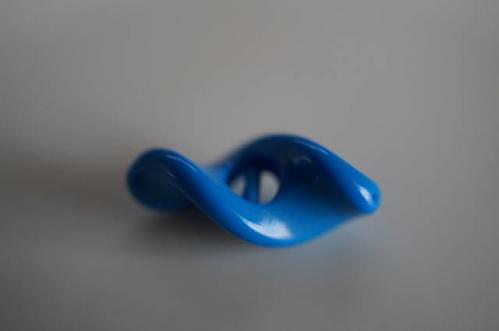
| Biocompatible-resin screw-shaped helper add-on (スクリュー型補助チップ追加オプション(生体適合樹脂)) | ¥3,300 (about $21 at ¥156 = $1, rate as of 2026-09-04) | August 2021 recommended this resin option instead of embedded epoxy for customers specifying two-thread connections. |
The biocompatible-resin screw-shaped helper add-on is listed in the company's own online store.
(Source: ok-lab's diary, published August 2021)
https://ok-lab.hatenablog.com/entry/2021/08/28/125823
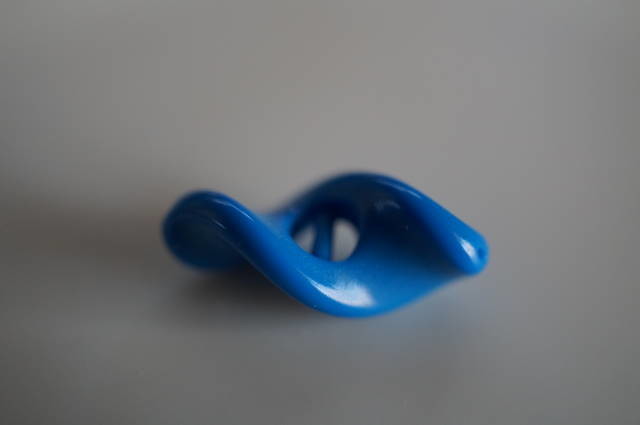
Custom assemblies, metal screws, integrated stoppers, and the movable-joint prototype: No matching product can be confirmed on the current list.
No longer sold: the older curved nylon-core connection, described as effectively discontinued in January 2026.
(Source: ok-lab's diary, published January 2026)
https://ok-lab.hatenablog.com/entry/2026/01/24/122909
Common worries about screw-shaped helper chips
Customers asked about side-by-side movement, smaller sizes, and an older curved construction.
"Could screw-shaped helper chips end up beside the main chip?"
In an entry published in March 2020, a customer described a glass vibrating chip becoming stuck beside its stopper. The parts sometimes could not be removed. The customer asked whether a screw helper on a four-point ceramic chip could behave similarly.
Mr. Okada considered that unlikely unless the urethra was unusually wide. The diary does not record whether the customer changed products or how a replacement performed. Mr. Okada also considered the thicker four-point ceramic design less likely to lie beside another part.
(Source: ok-lab's diary, published March 2020)
https://ok-lab.hatenablog.com/entry/2020/03/14/141804
"Were smaller metal screw-shaped helper chips available?"
In an entry published in March 2024, a customer wanted a smaller metal helper and asked whether tubing between screws could ease insertion. Mr. Okada's final answer identified 3 metal sizes, S, M, and L, with S measuring about 7.8 mm at its widest. He ruled out the smaller blue-resin option for that customer's cleaning requirements.
He could offer tubing over the connecting thread but did not know whether it would improve insertion. The diary does not record a resulting purchase or experience. Mr. Okada favored one longer screw over linked short screws for ease of insertion.
(Source: ok-lab's diary, published March 2024)
https://ok-lab.hatenablog.com/entry/2024/03/02/123027
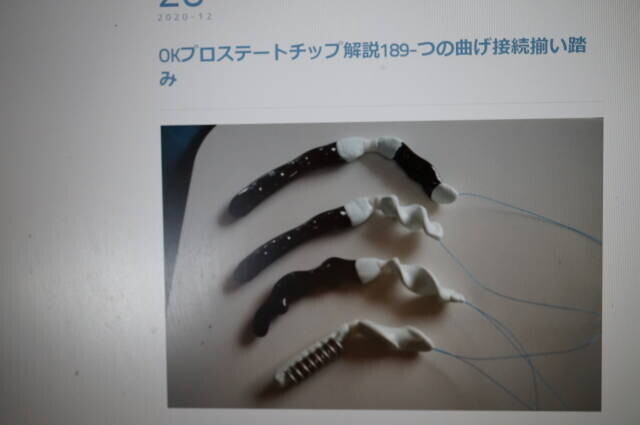
"Is the older curved screw-shaped helper chip still available?"
In an entry published in January 2026, a customer requested an older curved connection. OK Lab replied that it was effectively discontinued: the soft nylon core was unstable, rubber peeled, and angles were difficult to set. A nitinol-reinforced prototype followed, priced at an extra ¥3,000 (about $19 at ¥156 = $1, rate as of 2026-09-04) excluding tax.
The diary does not record whether the customer accepted it. Mr. Okada also offered rubber-covered thread without a specified angle.
(Source: ok-lab's diary, published January 2026)
https://ok-lab.hatenablog.com/entry/2026/01/24/122909
Buying from outside Japan

OK Lab ships internationally to countries covered by Japan Post's EMS courier service. Overseas orders are paid in advance by PayPal. Each order carries a ¥400 (about $3 at ¥156 = $1, rate as of 2026-09-04) handling fee, and EMS shipping is charged on top. These terms come from OK Lab's official sales-terms page (written here as plain text, not a link: ok-lab.net/docs/law), checked on September 7, 2026; confirm them on the official store before you order, because they can change.
Summary of this article
| What you wanted to know | The answer |
|---|---|
| Will it stay in place? | The maker says a screw helper cannot reliably replace a stopper. |
| Who makes the product? | OK Lab, a small company in Japan, sells the urethral device in Japanese yen. |
| What does “helper” mean? | A twisted supplementary part connected behind the main chip. |
| What problems were recorded? | Fixed spacing, difficult insertion, wet slippage, weight concerns, and construction-specific limitations. |
| What did the maker propose? | Attachment material, connection design, and the presence of a separate stopper function. |
| What changed over time? | Cable attachments, different resins, adjustable versions, and integrated assemblies. |
| What products are listed now? | Screw-helper add-ons at ¥3,300 (about $21 at ¥156 = $1, rate as of 2026-09-04) or ¥3,500 (about $22 at ¥156 = $1, rate as of 2026-09-04) including tax. |
| Is the older curved design available? | The January 2026 reply described that specification as effectively discontinued. |
| What are the overseas terms? | Advance PayPal payment, ¥400 (about $3 at ¥156 = $1, rate as of 2026-09-04) handling, and additional EMS shipping. |
Source: ok-lab's diary (Okada Comfortable Life Laboratory). The original entries are in Japanese; quotations on this page are translated. Photos and videos are on the original entries.
This article is a summary of the maker's development diary. The product is not a medical device and no result is guaranteed. If anything feels wrong or worries you, see a doctor. Prices, specifications and cautions change, so confirm the latest information on the official blog and the official site. Questions about ordering and shipping go to the seller.