![Will a small mesh stopper keep my chip in place? | No guaranteed fit [OK Prostate Chip]](/img/a/T0235/eyecatch.svg)
This page is based on entries from "ok-lab's diary" (https://ok-lab.hatenablog.com/), the Japanese development diary written by Mr. Okada, founder of OK Lab, a small company in Japan (Okada Comfortable Life Laboratory). Only the entries about "small stoppers and mesh stoppers" are summarized here, in order of publication. Past prices and sizes are as written at the time. Current prices come from the official product list (retrieved September 4, 2026). Quotations are translated from Japanese.
Note: This page is a personal reading log by someone with no connection to the maker or the seller. It reflects the source entries as of their publication dates and makes no guarantee of accuracy or safety. The product is not a medical device; talk to a doctor about any health decision. Check the official site for current information. This page contains advertising.
In short
- Mesh stoppers are intended to limit movement, but the diary records bleeding and a tradeoff in comfort.
- Mr. Okada changed the design for different connections and acknowledged that position cannot be guaranteed.
- A conventional thread-mounted stopper appears on the current list; the mesh-stopper specifications below are historical.
If you see blood in your urine, even a small amount or for the first time, do not wait and see. See a urologist right away. If you suddenly cannot urinate, or the device cannot be removed, do not try to fix it yourself. Go to a medical facility, including emergency care, immediately.
About this product

The OK Prostate Chip is a small device that is placed in the urethra (the urine passage) so that it acts on the prostate; the maker sells it in several shapes, sizes and materials. It is made and sold by OK Lab (Okada Comfortable Life Laboratory), a small company in Japan, through its own online store, and prices are in Japanese yen (JPY). The maker's development diary, "ok-lab's diary", is written in Japanese. This page is an English summary of it, and every quotation is translated. OK Lab ships internationally, so readers outside Japan can order (see "Buying from outside Japan" below). Product names on this page are plain-English descriptions. The official Japanese product name is shown once in the product table so you can find the same item in the store.
Before you read: key terms
| Term | Plain-English meaning |
|---|---|
| Urethra | The urine passage; the device and stopper occupy parts of it. |
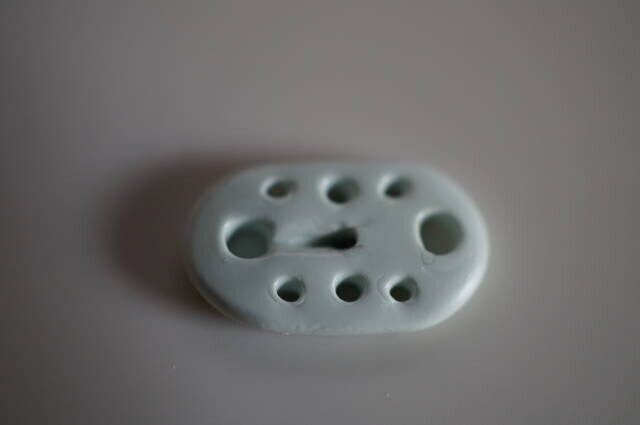
| Mesh stopper | An oval plate with holes, intended to limit device movement while letting urine pass. |
| Bulbar urethra | The wider passage beyond the penile section; the diary places mesh stoppers here to resist movement. |
| Pendulous urethra | The narrower passage within the penis; the outer stopper was intended to limit movement into it. |
| Sphincter | The boundary discussed between the prostate area and bulbar urethra; the stopper is intended to resist crossing it. |
| Covered-thread tail | Nylon thread inside silicone tubing, used to carry connected accessories. |
| Screw-shaped accessory | A twisted plate used as an additional part alongside the main chip in the bulbar urethra. |
| Shape-memory wire | Wire that tends to recover its preset shape, used to connect parts or form loops. |
What happens: mesh stopper fit
The OK Prostate Chip is a small device placed in the urethra to act on the prostate. A mesh stopper is an oval plate with holes, carried on a covered-thread tail (nylon thread inside silicone tubing) or connecting wire. Mr. Okada describes it as a barrier intended to limit movement while allowing urine through the plate. The entries place these stoppers in the bulbar urethra (the wider passage beyond the penile section), near the device's connected parts.
A mesh stopper addressed outward pressure against an upright plate
In an entry published in November 2023, Mr. Okada described a problem with a flat stopper on a 2.5mm tube. He reported that the plate stood almost perpendicular to the tube instead of tilting with urine flow. During his test, urine pressure seemed likely to push the assembly outward.
This differed from the thread-mounted stopper, which he said tilted with the flow. His proposed answer was a perforated plate, allowing urine through even when the stopper remained upright.
(Source: ok-lab's diary, published November 2023)
https://ok-lab.hatenablog.com/entry/2023/11/25/122934
Mesh stoppers initially addressed sliding before the screw opening changed
In an entry published in December 2023, Mr. Okada tested a screw-shaped accessory (a twisted auxiliary plate) on a 2.5mm covered-thread tail. He had expected friction to keep the accessory in position. He reported that the accessory slipped easily when the tube became wet with urine.
His initial answer was an assembly with mesh stoppers on both sides of the screw-shaped part. Later in the same entry, he reported that a smaller 2mm opening provided enough friction on the tube without those extra stoppers. For the revised design, Mr. Okada considered the screw-shaped accessory alone sufficient for the conventional arrangement.
(Source: ok-lab's diary, published December 2023)
https://ok-lab.hatenablog.com/entry/2023/12/02/122648
A wire-mounted mesh stopper resisted crossing after a chip migrated inward
In an entry published in March 2024, Mr. Okada reported inward movement during a test of a roughly 30mm chip connected to springy wire. After several hours, about 15mm had entered the bladder; at around 5 hours, the whole chip was inside it.
He then developed a wire-mounted mesh stopper that stood nearly perpendicular to the wire. He reported no sign of it crossing the sphincter (the boundary discussed between the prostate area and bulbar urethra) during his force test. Mr. Okada favored that barrier over a screw-shaped accessory, which he thought might also cross the boundary.
(Source: ok-lab's diary, published March 2024)
https://ok-lab.hatenablog.com/entry/2024/03/30/122958
A customer reported blood around the mesh stopper during difficult placement
In an entry published in June 2024, a customer described a long resin chip with shape-memory wire (wire that tends to recover its shape). They found a little blood on the stopper and suspected concentrated pressure on that part. Their later report described stable positioning without further bleeding or pain during urination.
Mr. Okada distinguished the narrow entrance from the passage farther along, where he expected the stopper to tilt by itself. He described the stopper's purpose as preventing the rear chip from crossing the sphincter. For this design, he favored the stopper near the rear chip.
(Source: ok-lab's diary, published June 2024)
https://ok-lab.hatenablog.com/entry/2024/06/08/123008
Mesh stopper fit depended on tube thickness in the loop prototype
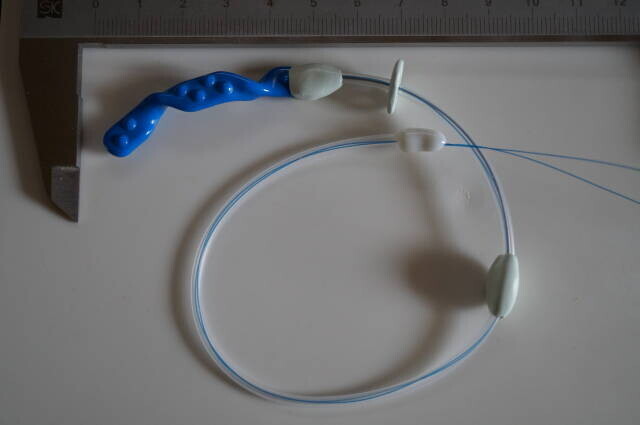
In an entry published in October 2024, a reader proposed a device with loops instead of a solid chip. Concerned about inward movement, they asked about a retrieval thread and stopper. Mr. Okada presented a double-loop prototype carrying sliding accessories.
The screw-shaped accessory and mesh stopper had 2mm openings, with easy movement on 2mm tubing and a tighter fit on 2.5mm tubing. The diary does not record how that reader's proposed device felt in use. Mr. Okada offered the thicker tube for firmer positioning and the thinner tube for easier movement.
(Source: ok-lab's diary, published October 2024)
https://ok-lab.hatenablog.com/entry/2024/10/26/122649
The maker's answer to mesh stopper fit
Mr. Okada matched stopper construction to its connection and intended role, while reporting limits in comfort and fit.
Non-removable mesh stoppers were favored nearest the main chip
In November 2023, Mr. Okada described non-removable and removable mesh-stopper versions. Published prices were ¥2,000 (about $13 at ¥156 = $1, rate as of 2026-09-04) excluding tax for the non-removable type and ¥2,500 (about $16 at ¥156 = $1, rate as of 2026-09-04) excluding tax for the removable type. He reported no snagging from the removable version's opening during his 3-day test.
The non-removable type was fitted before shipment and could not be detached. He suggested removable outer parts for comparing sizes and sharing accessories across compatible covered-thread assemblies. For the stopper closest to the main chip, he recommended the non-removable version because it would not detach.
(Source: ok-lab's diary, published November 2023)
https://ok-lab.hatenablog.com/entry/2023/11/25/122934
Linked mesh stoppers had different jobs at opposite ends
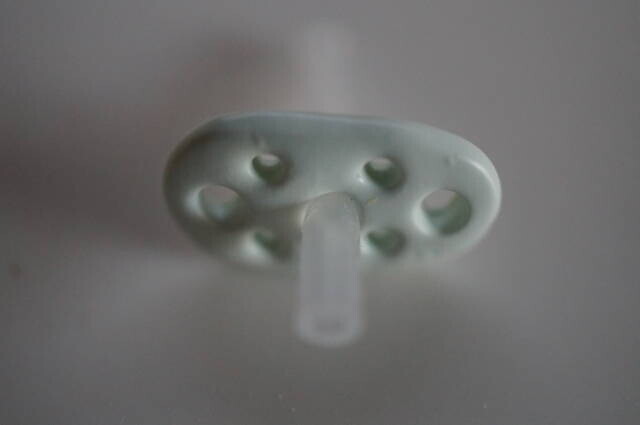
In the November 2023 entry, Mr. Okada gave the innermost and outermost mesh stoppers different jobs. He intended the nearest stopper to resist movement into the bladder. The farthest was intended to prevent entry into the pendulous urethra (the narrower passage within the penis).
In his tests, he considered 3 or 4 stoppers an appropriate number. He reported discomfort when extra stoppers extended into that narrower passage. He therefore favored an assembly contained within the wider bulbar section.
(Source: ok-lab's diary, published November 2023)
https://ok-lab.hatenablog.com/entry/2023/11/25/122934
Only a mesh stopper was offered between chip and loop
In an entry published in November 2024, Mr. Okada introduced a conventional chip connected to a shape-memory wire loop. The wire was enclosed in silicone tubing, replacing the covered-thread tail's nylon core.
He allowed only a mesh stopper in the section between the main chip and the loop. The listed addition cost ¥2,000 (about $13 at ¥156 = $1, rate as of 2026-09-04) excluding tax, with S, M and L sizes.
He said requested dimensions and angles were approximate rather than exact. Mr. Okada also warned against an excessively long loop extending into the narrower penile passage.
(Source: ok-lab's diary, published November 2024)
https://ok-lab.hatenablog.com/entry/2024/11/16/122924
If you see blood in your urine, even a small amount or for the first time, do not wait and see. See a urologist right away. If you suddenly cannot urinate, or the device cannot be removed, do not try to fix it yourself. Go to a medical facility, including emergency care, immediately.
How mesh stopper fit changed over time
| Published | What the diary said then |
|---|---|
| Nov 2023 | Printed width 8-9mm; lengths S=12m, M=15m, L=18mm; tolerance +-1mm; mixed units unexplained. |
| Dec 2023 | A smaller screw opening reduced the need for mesh stoppers to prevent sliding. |
| Mar 2024 | Inward migration prompted a mesh stopper designed for a springy wire connection. |
| Jun 2024 | A custom quote listed the small (S) mesh stopper at ¥2,200 (about $14 at ¥156 = $1, rate as of 2026-09-04). |
| Oct 2024 | Tube thickness determined how readily mesh stoppers could slide on the loop prototype. |
| Nov 2024 | The bladder-loop design allowed only a mesh stopper between its prostate and bulbar loops. |
| Dec 2024 | A size inquiry received approximate dimensions and no guarantee against movement. |
OK Prostate Chip products related to mesh stopper fit
A conventional thread-mounted stopper appears in a customer request about unwanted movement.
Products that appear in these entries
| Product (official name) | Price incl. tax | Relation to this topic |
|---|---|---|
| Six-hole sphincter stopper (六穴方式オプションチップ(括約筋ストッパーチップ)) | ¥2,200 (about $14 at ¥156 = $1, rate as of 2026-09-04) | In June 2024, a customer ordering this stopper requested a larger version after reporting repeated crossing of the sphincter. |
The six-hole sphincter stopper is listed in OK Lab's own online store.
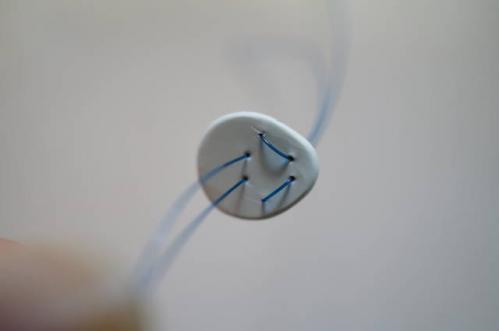
(Source: ok-lab's diary, published June 2024)
https://ok-lab.hatenablog.com/entry/2024/06/08/123008
Products the diary mentioned as alternatives
The diary names no alternative.
Historical mesh stoppers and custom wire assemblies:
No matching product can be confirmed on the current list.
Common worries about mesh stopper fit
"Can a larger sphincter stopper prevent it crossing inward?"
In an entry published in June 2024, a customer requested an enlarged six-hole thread-mounted stopper alongside ceramic chips. They reported that a stopper seemed to cross the sphincter repeatedly.
The request asked for a slightly larger part, but the paragraph contains no reply evaluating that change. The diary does not record whether the larger stopper prevented further movement.
(Source: ok-lab's diary, published June 2024)
https://ok-lab.hatenablog.com/entry/2024/06/08/123008
"Does a small mesh stopper guarantee a stable position?"
In December 2024, a customer asked about stopper sizes and whether a 90-degree loop design needed one. Mr. Okada said widths of 8mm or less could not be made; each size was about 9-10mm wide. Lengths were about 11-12mm for S, 14-15mm for M, and 17-18mm for L.
He gave no guarantee against outward movement or travel toward the bladder, regardless of angle. He thought a mesh stopper could block excessive inward travel, but said it would reduce the loop-based design's gentle feel. Mr. Okada favored preserving that comfort in his own tests and therefore did not use a mesh stopper.
(Source: ok-lab's diary, published December 2024)
https://ok-lab.hatenablog.com/entry/2024/12/14/122948
"Can a bump limit mesh stopper movement along the tail?"
In an entry published in December 2024, a customer wanted a non-removable M mesh stopper on a covered-thread tail. The request specified a 10cm tail and about 7mm between the chip and stopper. They also asked for a raised bump around 15mm to limit any further stopper movement.
OK Lab replied that making a secure bump there would be difficult and require substantial work. The customer accepted the configuration without that bump. The diary does not record whether the finished assembly prevented stopper movement.
(Source: ok-lab's diary, published December 2024)
https://ok-lab.hatenablog.com/entry/2024/12/28/122907
Buying from outside Japan

OK Lab ships internationally to countries covered by Japan Post's EMS courier service. Overseas orders are paid in advance by PayPal. Each order carries a ¥400 (about $3 at ¥156 = $1, rate as of 2026-09-04) handling fee, and EMS shipping is charged on top. These terms come from OK Lab's official sales-terms page (written here as plain text, not a link: ok-lab.net/docs/law), checked on September 7, 2026; confirm them on the official store before you order, because they can change.
Summary of this article
| What you wanted to know | The answer |
|---|---|
| What is the short answer? | Mesh stoppers are intended to limit movement, but fit and comfort are not guaranteed. |
| What is the base product? | A urethral device made and sold by OK Lab in Japan. |
| What do the stopper terms mean? | They distinguish the perforated plate, its connection, and the passages it is intended to occupy. |
| What problems appeared? | Urine pressure, sliding accessories, inward migration, and a customer's bleeding report. |
| What did the maker propose? | Different connections, non-removable or removable parts, and assemblies suited to their intended location. |
| What changed over time? | The diary developed mesh stoppers for covered thread, springy wire, and loop-based designs. |
| Which current product appears? | The six-hole thread-mounted stopper; its listing does not establish availability of historical mesh versions. |
| What remains uncertain? | A size label or loop angle does not guarantee stable positioning. |
| How do overseas purchases work? | Advance PayPal payment, a ¥400 (about $3 at ¥156 = $1, rate as of 2026-09-04) handling fee, and additional EMS shipping charges. |
Source: ok-lab's diary (Okada Comfortable Life Laboratory). The original entries are in Japanese; quotations on this page are translated. Photos and videos are on the original entries.
This article is a summary of the maker's development diary. The product is not a medical device and no result is guaranteed. If anything feels wrong or worries you, see a doctor. Prices, specifications and cautions change, so confirm the latest information on the official blog and the official site. Questions about ordering and shipping go to the seller.