![How can a prostate chip stay in place? | The maker describes stoppers, with limits [OK Prostate Chip]](/img/a/T0238/eyecatch.svg)
This page is based on entries from "ok-lab's diary" (https://ok-lab.hatenablog.com/), the Japanese development diary written by Mr. Okada, founder of OK Lab, a small company in Japan (Okada Comfortable Life Laboratory). Only the entries about "keeping a prostate chip in place" are summarized here, in order of publication. Past prices and sizes are as written at the time. Current prices come from the official product list (retrieved September 4, 2026). Quotations are translated from Japanese.
Note: This page is a personal reading log by someone with no connection to the maker or the seller. It reflects the source entries as of their publication dates and makes no guarantee of accuracy or safety. The product is not a medical device; talk to a doctor about any health decision. Check the official site for current information. This page contains advertising.
In short
Chips can slip inward or outward, and customers reported that a stopper alone did not always hold.
Mr. Okada describes screw supports and stoppers as possible barriers, with results depending on the individual.
The current list includes separate supports; later diary entries describe custom integrated designs.
If you see blood in your urine, even a small amount or for the first time, do not wait and see. See a urologist right away. If you suddenly cannot urinate, or the device cannot be removed, do not try to fix it yourself. Go to a medical facility, including emergency care, immediately.
About this product

The OK Prostate Chip is a small device that is placed in the urethra (the urine passage) so that it acts on the prostate; the maker sells it in several shapes, sizes and materials. It is made and sold by OK Lab (Okada Comfortable Life Laboratory), a small company in Japan, through its own online store, and prices are in Japanese yen (JPY). The maker's development diary, "ok-lab's diary", is written in Japanese. This page is an English summary of it, and every quotation is translated. OK Lab ships internationally, so readers outside Japan can order (see "Buying from outside Japan" below). Product names on this page are plain-English descriptions. The official Japanese product name is shown once in the product table so you can find the same item in the store.
Before you read: key terms
| Term | Plain-English meaning |
|---|---|
| Urethra | The urine passage; it is where the chip is placed. |
| Sphincter | A muscle described as gripping the chip, helping hold it in place. |
| Screw support | A screw-shaped auxiliary chip, discussed as a barrier against unwanted movement. |
| Sphincter stopper | A retaining part intended to resist passage beyond the sphincter. |
| Petal stopper | A stopper formed from wire loops, intended to resist passage past the sphincter. |
| Integrated stopper | A stopper joined to a chip or screw support, intended to help hold the assembly in place. |
| Nitinol wire | The shape-memory wire used inside the integrated assembly to secure its parts. |
What happens: keeping a prostate chip in place
The OK Prostate Chip is a device placed in the urethra so that it acts on the prostate. The diary discusses retaining parts intended to limit movement toward the bladder or out of the intended position. These include a screw support (a screw-shaped auxiliary chip) and a sphincter stopper (a retaining part near the muscle discussed here). Mr. Okada also describes a stopper outside the penis tip as another possible barrier.
Chip slipping out was Mr. Okada's own difficulty in December 2023
In an entry published in December 2023, Mr. Okada described his own problem with chips slipping outward. He suspected his outer sphincter could no longer hold shorter chips in the intended area. He wrote that longer chips reaching the bladder resisted outward movement but felt too intense for extended wear.
He described several developing designs as attempts to find a steadier position while his sphincter felt tired. Mr. Okada cautioned that his personal experience could not reliably answer someone else's opposite problem.
(Source: ok-lab's diary, published December 2023)
https://ok-lab.hatenablog.com/entry/2023/12/23/122035
Petal stoppers had limits despite the maker's favorable wear test
In an entry published in April 2025, Mr. Okada introduced a petal stopper (a retaining part formed from wire loops). He used 3 petals and reported about 5 days of wear without strong sphincter irritation. His tests led him to choose 0.2 mm wire.
He judged 0.3 mm wire more resistant to reversal, but too irritating for prolonged wear. He considered the thinner petals effective during ordinary wear. Mr. Okada warned that forced pressure from an instrument could reverse them and carry the stopper past the sphincter.
(Source: ok-lab's diary, published April 2025)
https://ok-lab.hatenablog.com/entry/2025/04/26/122909
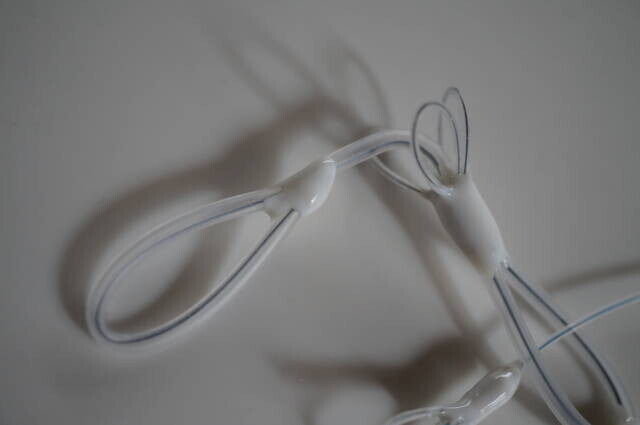
An integrated stopper prototype felt more comfortable to Mr. Okada
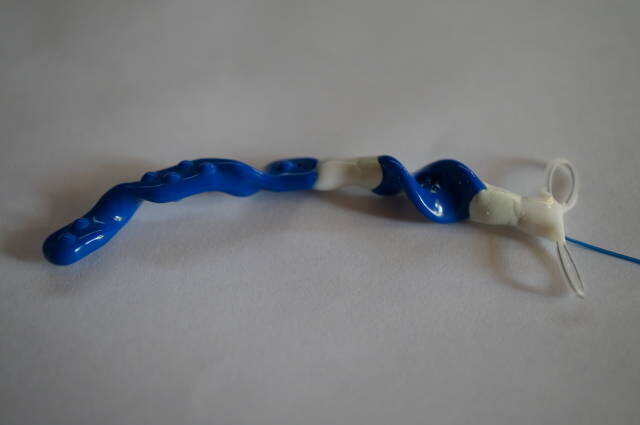
In an entry published in October 2025, Mr. Okada tested an integrated stopper (a stopper joined directly to another component). The prototype joined a long blue resin chip, its screw support, and the new stopper; an existing flat stopper remained. He reported greater comfort because exposed thread and connection bumps were absent near the sphincter.
He wrote that the connections still bent, unlike a single rigid long chip. Mr. Okada asked customers interested in this blue resin build to wait for supplies expected in about 3 weeks.
(Source: ok-lab's diary, published October 2025)
https://ok-lab.hatenablog.com/entry/2025/10/11/123003
An enlarged integrated stopper appeared in the January 2026 quotation
In an entry published in January 2026, a customer requested an enlarged integrated stopper on an SS second-generation resin screw. It belonged to a custom double-twist ceramic assembly that also had a stopper joined to the main chip.
The quote listed ¥2,200 (about $14 at ¥156 = $1, rate as of 2026-09-04) for each stopper and ¥3,500 (about $22 at ¥156 = $1, rate as of 2026-09-04) for the screw. The diary does not record how the larger stopper felt in use.
(Source: ok-lab's diary, published January 2026)
https://ok-lab.hatenablog.com/entry/2026/01/17/122907
The maker's answer to keeping a prostate chip in place
Mr. Okada described several retaining arrangements, while acknowledging that stoppers could still pass the sphincter.
A sphincter stopper or screw was never described as foolproof
In an entry published in December 2023, Mr. Okada considered screw supports and sphincter stoppers useful against inward movement, but imperfect. He cited cases needing hospital removal when discussing screws positioned about 10 cm from the main chip as an extra precaution. He understood that arrangement as an extra barrier away from a position that could not be reliably judged by feel.
He also considered an external stopper a possible option. Mr. Okada said a screw or stopper alone might suffice where neither readily passed the sphincter.
(Source: ok-lab's diary, published December 2023)
https://ok-lab.hatenablog.com/entry/2023/12/23/122035
Petal stoppers brought separate costs and limits when combined with external barriers
In an entry published in April 2025, the petal stopper was priced at ¥1,000 (about $6 at ¥156 = $1, rate as of 2026-09-04) per petal, excluding tax. The published price for 3 petals was ¥3,000, (about $19 at ¥156 = $1, rate as of 2026-09-04) excluding tax.
Mr. Okada described this as difficult work and said he had kept the price lower because he regarded it as safety equipment. He warned that combining internal and external petals could produce excessive pressure when the projecting section was too long.
(Source: ok-lab's diary, published April 2025)
https://ok-lab.hatenablog.com/entry/2025/04/26/122909
Integrated stopper specifications limited which screw materials could be used
In an entry published in October 2025, Mr. Okada corrected the integrated rear stopper price from ¥3,000 (about $19 at ¥156 = $1, rate as of 2026-09-04) to ¥2,000, (about $13 at ¥156 = $1, rate as of 2026-09-04) excluding tax. The extra reinforcement was unnecessary when the stopper was attached only at the chip's rear. For the integrated screw version, a ceramic main chip was possible, but the screw had to be blue resin or stainless steel.
White resin could not accommodate the internal nitinol wire (shape-memory wire used to secure this assembly). The specified gap between the main chip and screw was 3–6 mm. Mr. Okada said he could not accept requests to join only the main chip and screw without an integrated stopper.
(Source: ok-lab's diary, published October 2025)
https://ok-lab.hatenablog.com/entry/2025/10/11/123003

If you see blood in your urine, even a small amount or for the first time, do not wait and see. See a urologist right away. If you suddenly cannot urinate, or the device cannot be removed, do not try to fix it yourself. Go to a medical facility, including emergency care, immediately.
How keeping a prostate chip in place changed over time
| Published | What the diary said then |
|---|---|
| Dec 2023 | Restringing cost ¥550 (about $4 at ¥156 = $1, rate as of 2026-09-04) per connected chip, plus a ¥400 (about $3 at ¥156 = $1, rate as of 2026-09-04) fee. |
| Mar 2025 | Staff required inspection of the returned device before giving a final quotation. |
| Apr 2025 | Petal stoppers could fit assemblies containing shape-memory wire inside tubing. |
| Oct 2025 | Joining the main chip and screw was included at no additional charge. |
| Jan 2026 | Possibly his first order: integrated stopper on the screw immediately behind the main chip. |

The diary does not say what the current state is.
OK Prostate Chip products related to keeping a prostate chip in place
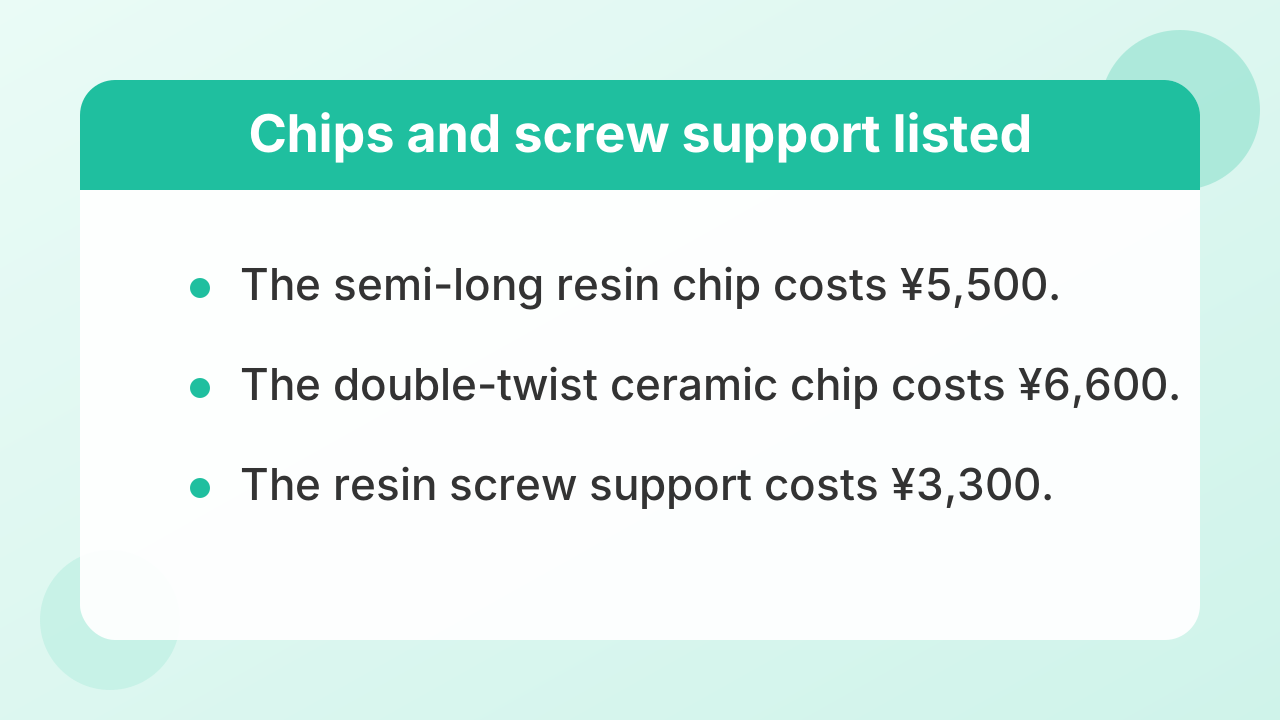
The current list includes chips discussed in these cases and a resin screw support.
Products that appear in these entries
| Product (official name) | Price incl. tax | Relation to this topic |
|---|---|---|
| Semi-long resin chip (OKプロステートチップ セミロングタイプ(生体適合樹脂)) | ¥5,500 (about $35 at ¥156 = $1, rate as of 2026-09-04) | In December 2023, a customer reported this chip slipping into the bladder. |
| Short twisted resin chip (OKプロステートチップ ショートタイプ ツイスト(生体適合樹脂)) | ¥5,500 (about $35 at ¥156 = $1, rate as of 2026-09-04) | In December 2023, this chip with a screw prompted a discussion about size and spacing. |
| Elongated resin chip (OKプロステートチップ 覚醒タイプ(生体適合樹脂)) | ¥8,800 (about $56 at ¥156 = $1, rate as of 2026-09-04) | In December 2023, a customer asked whether their planned purchase needed additional retaining parts. |
| Double-twist ceramic chip (OKプロステートチップ 陶器素材覚醒タイプ ダブルツイスト(ラブカチップ)) | ¥6,600 (about $42 at ¥156 = $1, rate as of 2026-09-04) | In December 2023, a customer asked about additional support because this longer chip lacked an obvious gripping waist. |
The double-twist ceramic chip is sold through OK Lab's own online store.
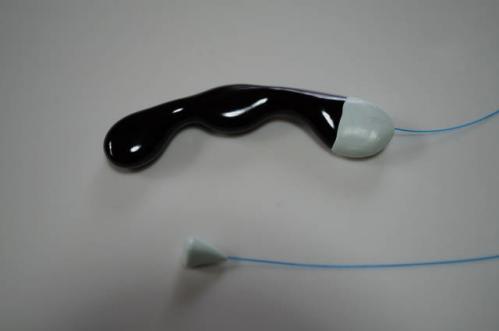
(Source: ok-lab's diary, published December 2023)
https://ok-lab.hatenablog.com/entry/2023/12/23/122035
Products the diary mentioned as alternatives
| Product (official name) | Price incl. tax | Relation to this topic |
|---|---|---|
| Resin screw support (スクリュー型補助チップ追加オプション(生体適合樹脂)) | ¥3,300 (about $21 at ¥156 = $1, rate as of 2026-09-04) | In March 2025, staff accepted this resin addition for a ceramic chip whose existing stopper slipped inward. |
The resin screw support is sold through OK Lab's own online store.
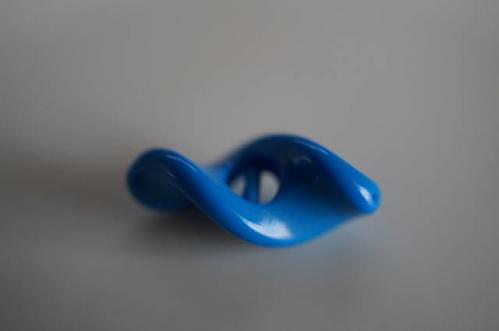
(Source: ok-lab's diary, published March 2025)
https://ok-lab.hatenablog.com/entry/2025/03/22/122906
The diary also describes a sea-slug-shaped ceramic version 4, petal prototypes, and custom integrated stopper assemblies. No matching product can be confirmed on the current list.
Common worries about keeping a prostate chip in place
Customer questions concerned inward slipping, mixed-material supports, and first-time custom orders.
"Can wider spacing help a prostate chip stay in place?"
In an entry published in December 2023, a customer reported their semi-long resin chip sometimes slipped into the bladder unnoticed. They also found their short twisted chip and screw large; staff thought wider spacing might feel milder. Staff reported common gaps of 0 mm–6 mm, most often 4 mm; the customer clarified that discomfort was near the penis tip.
Staff said a long chip's tip would almost certainly enter the bladder if the entire chip passed the sphincter. The diary does not record how their planned elongated resin and double-twist ceramic chips felt in use. Staff advised pausing the new order while considering the existing combination, and offered a refund.
(Source: ok-lab's diary, published December 2023)
https://ok-lab.hatenablog.com/entry/2023/12/23/122035
"Can resin screw supports work with ceramic prostate chips?"
In an entry published in March 2025, a customer reported bleeding with their sea-slug-shaped ceramic chip, version 4. Their sphincter stopper slipped inward and the chip entered the bladder; another chip's screw held, prompting a request for similar support. Staff accepted a resin screw and asked for the distance from the main chip; refitting the existing stopper would cost ¥550 (about $4 at ¥156 = $1, rate as of 2026-09-04).
Staff suspected the rear shape, designed to resist slipping, caused pain and bleeding; they considered the rubber protective. The customer deferred a decision about the rubber covering; the diary does not record the assembly's comfort after the proposed changes. Mr. Okada favored retaining the rubber protection because he believed it reduced irritation from that rear shape.
(Source: ok-lab's diary, published March 2025)
https://ok-lab.hatenablog.com/entry/2025/03/22/122906
"Can a first order include custom chip stoppers?"
In an entry published in December 2025, a first-time buyer asked whether their initial order could be a custom double-stopper assembly. They had read accounts of chips entering the bladder and screws turning sideways, becoming impossible to remove. They thought the double stopper shown in a video looked less likely to let the screw turn sideways.
The accompanying quotation listed an integrated stopper at ¥2,200 (about $14 at ¥156 = $1, rate as of 2026-09-04), an eight-hole stopper at ¥2,300 (about $15 at ¥156 = $1, rate as of 2026-09-04), and a screw support at ¥3,500 (about $22 at ¥156 = $1, rate as of 2026-09-04). The diary does not record whether the requested combination prevented sideways movement during the customer's use.
(Source: ok-lab's diary, published December 2025)
https://ok-lab.hatenablog.com/entry/2025/12/06/122924
Buying from outside Japan

OK Lab ships internationally to countries covered by Japan Post's EMS courier service. Overseas orders are paid in advance by PayPal. Each order carries a ¥400 (about $3 at ¥156 = $1, rate as of 2026-09-04) handling fee, and EMS shipping is charged on top. These terms come from OK Lab's official sales-terms page (written here as plain text, not a link: ok-lab.net/docs/law), checked on September 7, 2026; confirm them on the official store before you order, because they can change.
Summary of this article
| What you wanted to know | The answer |
|---|---|
| What is the short answer? | The maker describes retaining parts, but reports show they can fail. |
| What is this product? | A urethral device made by OK Lab in Japan. |
| What do the terms mean? | Screw supports, sphincter stoppers, petals, and integrated parts are different retaining designs. |
| What did the maker's tests describe? | Outward slipping, petal flexibility, joined components, and later custom variations. |
| What measures did he discuss? | Different barriers, petal additions, and integrated assemblies with material limits. |
| What changed over time? | Repair terms, compatible structures, integrated construction, and the position of retaining parts. |
| What is currently listed? | The tables show current base products and prices in JPY, separate from historical custom quotations. |
| What did customers ask? | Whether spacing, a resin screw, or a custom assembly could address their particular problem. |
| How does overseas buying work? | Advance PayPal payment, a ¥400 (about $3 at ¥156 = $1, rate as of 2026-09-04) handling fee, and additional EMS shipping charges. |
Source: ok-lab's diary (Okada Comfortable Life Laboratory). The original entries are in Japanese; quotations on this page are translated. Photos and videos are on the original entries.
This article is a summary of the maker's development diary. The product is not a medical device and no result is guaranteed. If anything feels wrong or worries you, see a doctor. Prices, specifications and cautions change, so confirm the latest information on the official blog and the official site. Questions about ordering and shipping go to the seller.