![What are prostate chip horns and flexible tails? | Different attachments with recorded risks [OK Prostate Chip]](/img/a/T0243/eyecatch.svg)
This page is based on entries from "ok-lab's diary" (https://ok-lab.hatenablog.com/), the Japanese development diary written by Mr. Okada, founder of OK Lab, a small company in Japan (Okada Comfortable Life Laboratory). Only the entries about "horn attachments and flexible tails" are summarized here, in order of publication. Past prices and sizes are as written at the time. Current prices come from the official product list (retrieved September 4, 2026). Quotations are translated from Japanese.
Note: This page is a personal reading log by someone with no connection to the maker or the seller. It reflects the source entries as of their publication dates and makes no guarantee of accuracy or safety. The product is not a medical device; talk to a doctor about any health decision. Check the official site for current information. This page contains advertising.
In short
- Horn attachments and flexible tails serve different purposes, and the diary records injuries and hospital removal.
- Mr. Okada favored softer tails, revised connections, and external retention for specific problems.
- The current list includes related chip parts, but no matching horn or flexible-tail product is confirmed.
If you see blood in your urine, even a small amount or for the first time, do not wait and see. See a urologist right away.
If you suddenly cannot urinate, or the device cannot be removed, do not try to fix it yourself. Go to a medical facility, including emergency care, immediately.
About this product
The OK Prostate Chip is a small device that is placed in the urethra (the urine passage) so that it acts on the prostate; the maker sells it in several shapes, sizes and materials. It is made and sold by OK Lab (Okada Comfortable Life Laboratory), a small company in Japan, through its own online store, and prices are in Japanese yen (JPY). The maker's development diary, "ok-lab's diary", is written in Japanese. This page is an English summary of it, and every quotation is translated. OK Lab ships internationally, so readers outside Japan can order (see "Buying from outside Japan" below). Product names on this page are plain-English descriptions. The official Japanese product name is shown once in the product table so you can find the same item in the store.
Before you read: key terms
| Term | Plain-English meaning |
|---|---|
| Chip horn | Coated thread or wire attachment intended to support positioning or connect device parts. |
| Flexible tail | Soft tubing containing wire and nylon, intended for retrieval and position control. |
| Chipless device | A wire-loop version of the device, intended to apply pressure around the prostate. |
| Sphincter stopper | A retaining part near the urine-control muscle, intended to limit inward movement. |
| Silicone-covered retainer | A wire loop attached to a solid chip, intended to support its position. |
| Petal loop | A projecting wire loop intended to help hold the device in position. |
| Shape-memory Gatekeeper | An external wire attachment around the penis head, intended to control device movement. |
| Cystoscopy | Examination with a bladder scope; used for hospital removal in the reported case. |
What happens: prostate chip attachments
The OK Prostate Chip is a device placed in the urethra to apply pressure around the prostate. Chip horns (stiffer attachments) began as rubber-coated thread and later included wire, extending behind a chip or connecting it to another part. Flexible tails (softer attachments) contain wire and nylon inside silicone tubing, intended for retrieval and position control. On chipless devices (wire-loop versions), they extend from the rear loop into the urethra within the penis.
Early chip horns covered nylon thread with rubber coating
An entry published in October 2020 announced the horn chip, named for its resemblance to snail antennae. These early chip horns used rubber-coated nylon thread.
Single and double versions covered roughly 10mm of thread extending from the chip. Mr. Okada recommended a coated connection between the main chip and a screw-shaped auxiliary chip.
(Source: ok-lab's diary, published October 2020)
https://ok-lab.hatenablog.com/entry/2020/10/31/121353
A directly fixed chip horn stopper preceded urine leakage
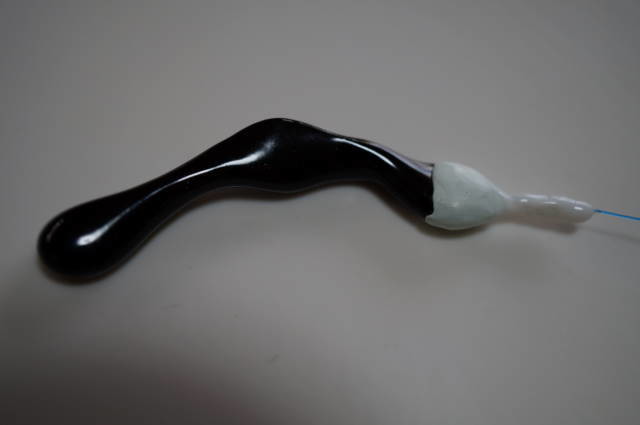
In an entry published in November 2020, Mr. Okada tested a sphincter stopper (a retaining part) fixed directly to a horn. After about 10 hours, he reported slight urine leakage lasting roughly 1 day.
He suspected muscle fatigue or damage. Mr. Okada warned that directly fixing the stopper to the horn could place too much strain on the muscle.
(Source: ok-lab's diary, published November 2020)
https://ok-lab.hatenablog.com/entry/2020/11/07/121125
Chip horn prices depended on connection length and bend
An entry published in November 2020 priced 90° horn connections, spanning 3–5mm, at ¥1,000 (about $6 at ¥156 = $1, rate as of 2026-09-04) excluding tax. Straight connections were free up to 2mm; 3mm or more cost ¥500 (about $3 at ¥156 = $1, rate as of 2026-09-04) excluding tax. Mr. Okada limited bent connections to that span for production and flexibility reasons.
(Source: ok-lab's diary, published November 2020)
https://ok-lab.hatenablog.com/entry/2020/11/21/130647
Wire chip horns brought new options and serious concerns
An entry published in March 2025 described Mr. Okada ending continuous wear with exposed wire because he feared bacterial contamination from clothing contact. During a separate 9cm shaft test, tight underwear pressed the device; he reported an episode he called heart failure during sleep. He favored shorter horns afterward, compatible with chipless devices and silicone-covered retainers (wire loops attached to solid chips).
Published horn prices were ¥3,000 (about $19 at ¥156 = $1, rate as of 2026-09-04) excluding tax up to 20cm, and ¥4,000 (about $26 at ¥156 = $1, rate as of 2026-09-04) excluding tax above 20cm, up to 30cm. The diary does not record a medical diagnosis of the episode. Mr. Okada restricted the externally protruding design to short use.
(Source: ok-lab's diary, published March 2025)
https://ok-lab.hatenablog.com/entry/2025/03/15/122925
Thinner wire made flexible tails possible with different prices
An entry published in April 2025 introduced flexible tails containing 0.2mm wire and nylon thread inside silicone tubing. Mr. Okada described them as more flexible than the earlier 0.3mm horn.
Historical prices up to 10cm were ¥3,000 (about $19 at ¥156 = $1, rate as of 2026-09-04) excluding tax for 2.5mm tubing and ¥4,000 (about $26 at ¥156 = $1, rate as of 2026-09-04) excluding tax for 1mm tubing. The narrower version could not exceed 20cm with the manufacturing method then available. Mr. Okada favored thinner wire where a longer attachment made the earlier horn too springy.
(Source: ok-lab's diary, published April 2025)
https://ok-lab.hatenablog.com/entry/2025/04/12/122910
A loop-ended chip horn device required hospital removal
In an entry published in May 2025, a customer sought help because a loop-ended horn device could not be removed. Mr. Okada initially assumed it remained in its intended position and suggested retrieval troubleshooting. After learning the thread had disappeared too, he advised a urology visit.
The customer reported that external manipulation had pushed the device and its thread into the bladder. Removal by cystoscopy (examination with a bladder scope), tests, and waiting took about 5 hours and cost ¥34,000 (about $218 at ¥156 = $1, rate as of 2026-09-04). Mr. Okada warned that force could move the flexible wire beyond its intended position and cautioned against deeper pushing.
(Source: ok-lab's diary, published May 2025)
https://ok-lab.hatenablog.com/entry/2025/05/03/122907
Breakage reports changed petal-loop construction
In an entry published in August 2025, a customer reported a petal-loop failure after about 2 weeks. Petal loops (projecting wire loops) were intended to help retain the device. While awaiting the repaired item, the same customer reported detached side loops on another device and a cut to the urethral lining.
Mr. Okada blamed permanent bending of the wire, despite its rubber covering. OK Lab offered repairs, then described construction that avoided permanently deforming the wire. Mr. Okada proposed that revised design after considering an end to petal sales.
(Source: ok-lab's diary, published August 2025)
https://ok-lab.hatenablog.com/entry/2025/08/30/122943
A spiral chip horn prototype prompted another serious health report
In an entry published in July 2026, Mr. Okada tested a spiral chipless prototype supported by a horn. It used doubled 0.3mm horn wire to support a 0.15mm spiral.
He reported an episode he called sudden heart failure within minutes, with recovery taking about 1 hour. The diary does not record a medical diagnosis of that episode. Mr. Okada said specifications and sales would wait until further prototypes could be made consistently.
(Source: ok-lab's diary, published July 2026)
https://ok-lab.hatenablog.com/entry/2026/07/04/122918
The maker's answer to prostate chip attachments
Mr. Okada changed attachment stiffness, connection spacing, and external retention in response to particular problems.
Chip horn connections needed room for the stopper to move
An entry published in November 2020 distinguished sphincter stoppers from screw-shaped auxiliary chips. Mr. Okada wrote that a thick coating could restrict the stopper's sideways movement during urination. His revised design advice specified a gap of at least 5mm so the stopper could move sideways.
(Source: ok-lab's diary, published November 2020)
https://ok-lab.hatenablog.com/entry/2020/11/14/131426
A customer request combined firm chip horns with flexible tails
In an entry published in May 2025, a customer wanted a firmer horn on a second threadless chipless device. Mr. Okada first suggested 1mm tubing with 0.2mm wire, considering it safer because its softness prevented the same external pushing. The customer objected that the softer attachment would not help with positioning.
OK Lab made a 5cm firm horn followed by a 5cm flexible tail. The diary does not record how this customer's finished device felt in use. Mr. Okada described the softer final section as a safety tether.
(Source: ok-lab's diary, published May 2025)
https://ok-lab.hatenablog.com/entry/2025/05/03/122907
Flexible tails gained an external attachment for movement control
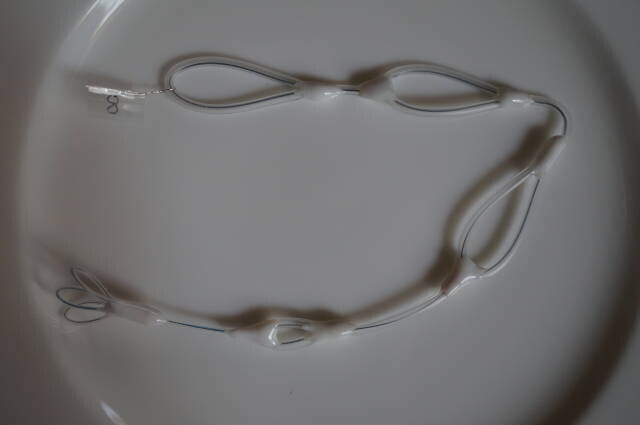
In an entry published in July 2025, a ceramic-chip customer asked about thread failure and movement in both directions. Mr. Okada recommended a flexible tail with a shape-memory Gatekeeper (an external wire retainer). He claimed this combination resisted both inward and outward movement.
A confirmed follow-up published in August 2025 records a completed custom build with wire reinforcement and an adjustable tail. The diary does not report that customer's experience with the completed build. For the requested length, OK Lab proposed 10cm + 20cm, with the 20cm section adjustable.
(Source: ok-lab's diary, published July 2025)
https://ok-lab.hatenablog.com/entry/2025/07/26/122909
(Source: ok-lab's diary, published August 2025)
https://ok-lab.hatenablog.com/entry/2025/08/02/123058
If you see blood in your urine, even a small amount or for the first time, do not wait and see. See a urologist right away.
If you suddenly cannot urinate, or the device cannot be removed, do not try to fix it yourself. Go to a medical facility, including emergency care, immediately.
How prostate chip attachments changed over time
| Published | What the diary said then |
|---|---|
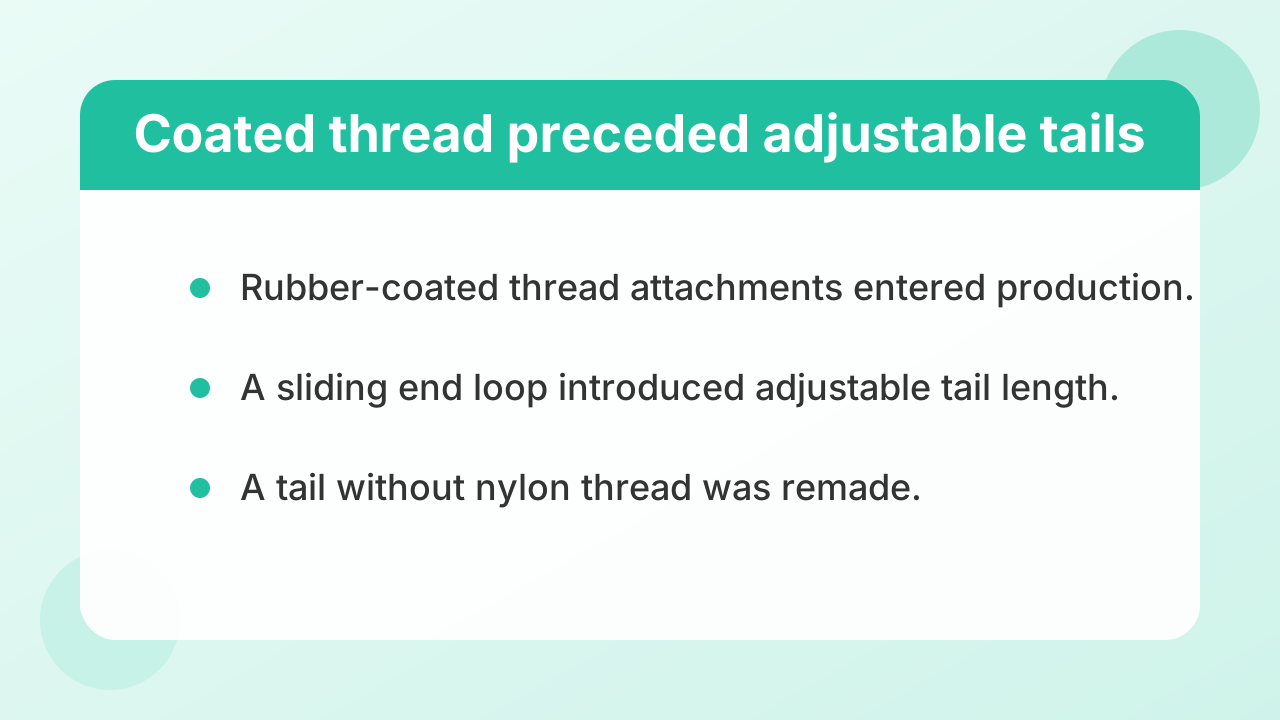
| Oct 2020 | Rubber-coated thread attachments entered production. |
| Feb 2021 | A customer reported steel wire bending and digging into the urethra. |
| Oct 2023 | Two threads emerging separately carried an additional ¥1,100 (about $7 at ¥156 = $1, rate as of 2026-09-04) charge. |
| Jun 2025 | Curved wire devices needed horn extensions beyond a rear section limited to roughly 11cm. |
| Jul 2025 | A sliding end loop introduced adjustable tail length. |
| Sep 2025 | Side loops were first added to a flexible tail at 2cm intervals. |
| May 2026 | A tail made without its nylon thread was identified and remade. |
| Aug 2026 | A 40mm horn build changed from 150° to 120°; incorrect attachment required remaking. |
The diary does not say what the current state is.
OK Prostate Chip products related to prostate chip attachments
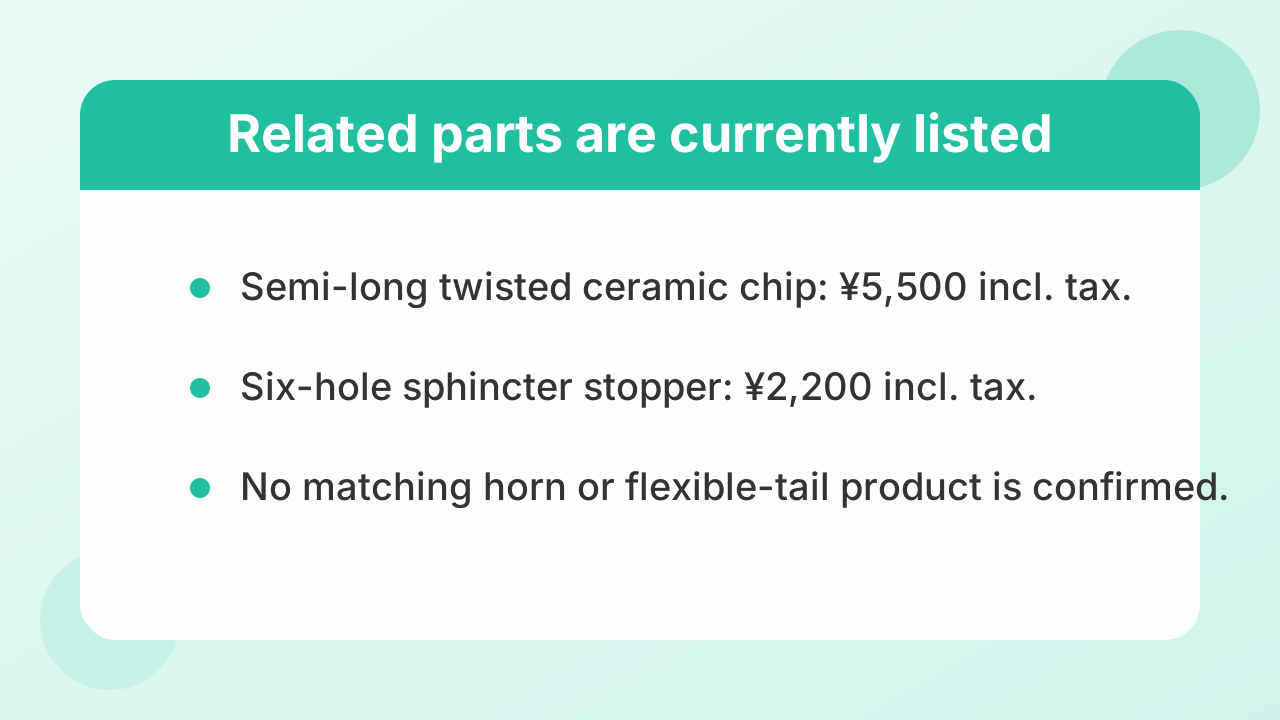
The current list includes parts used in a documented custom horn request.
Products that appear in these entries
| Product (official name) | Price incl. tax | Relation to this topic |
|---|---|---|
| Semi-long twisted ceramic chip (OKプロステートチップ 陶器素材セミロングタイプ コブラツイスト) | ¥5,500 (about $35 at ¥156 = $1, rate as of 2026-09-04) | In November 2020, a customer requested this chip with a coated two-thread horn. |
| Six-hole sphincter stopper (六穴方式オプションチップ(括約筋ストッパーチップ)) | ¥2,200 (about $14 at ¥156 = $1, rate as of 2026-09-04) | In November 2020, the matching horn request specified this stopper separately from the horn. |
(Source: ok-lab's diary, published November 2020)
https://ok-lab.hatenablog.com/entry/2020/11/07/121125
(Source: ok-lab's diary, published November 2020)
https://ok-lab.hatenablog.com/entry/2020/11/28/121505
Products the diary mentioned as alternatives
The diary names no alternative.
Custom horns, flexible tails, wire-loop prototypes, and the shape-memory Gatekeeper:
No matching product can be confirmed on the current list.
Common worries about prostate chip attachments
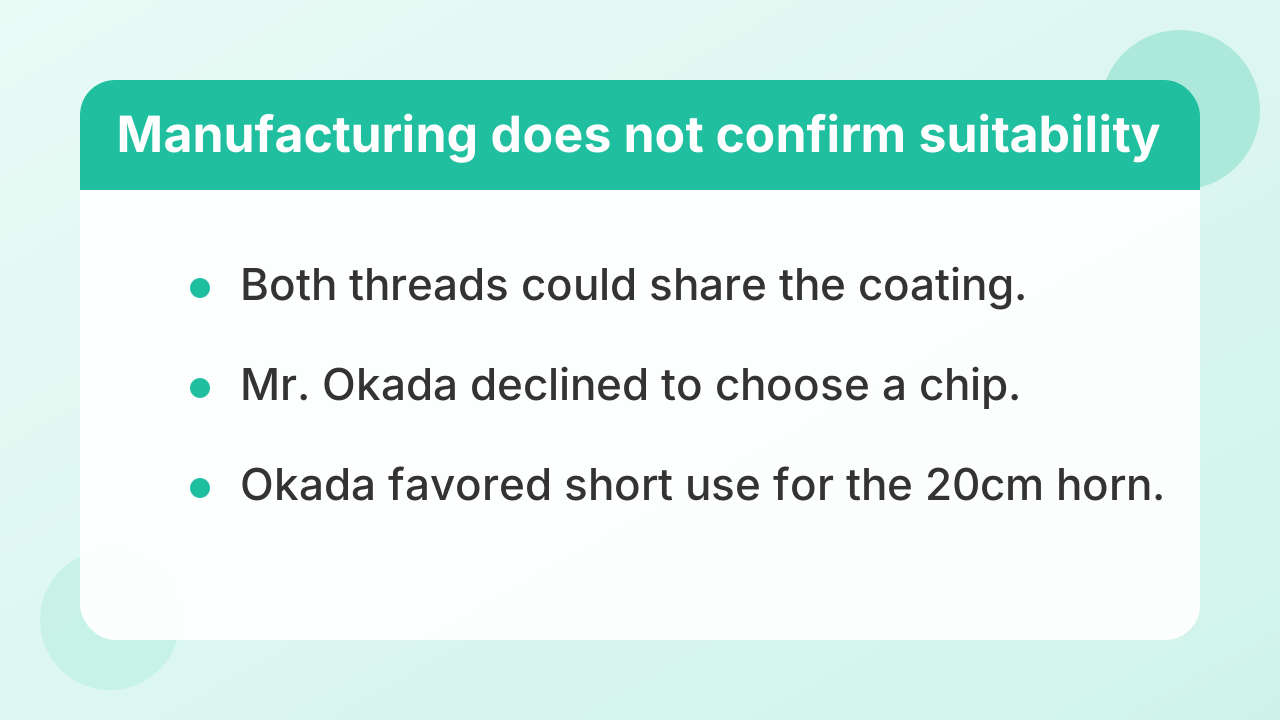
The replies distinguish manufacturing possibilities from suitability for a particular customer.
"Can chip horns cover two retrieval threads?"
In an entry published in November 2020, a customer asked about coating two threads on a twisted ceramic chip. The request specified a 5mm horn and a six-hole stopper 8mm from the chip. Mr. Okada said both threads could share the coating, making the horn slightly wider.
A later November 2020 entry records the matching configuration and a ¥550 (about $4 at ¥156 = $1, rate as of 2026-09-04) horn charge. The diary does not record how the finished item felt in use. Mr. Okada favored the requested arrangement with the stopper separate from the horn.
(Source: ok-lab's diary, published November 2020)
https://ok-lab.hatenablog.com/entry/2020/11/07/121125
(Source: ok-lab's diary, published November 2020)
https://ok-lab.hatenablog.com/entry/2020/11/28/121505
"Can OK Lab choose a chip for my flexible tail?"
An entry published in August 2025 followed up on a July 2025 inquiry from a customer outside Japan. The customer wanted OK Lab to choose a chip material and size, with a tube attachment but no external retainer. Mr. Okada declined to choose because he knew too little about the customer.
He also acknowledged that the external retainer might not fit every penis-head shape. The diary does not record a completed order for this customer. Mr. Okada favored an adjustable flexible tail and suggested describing desired changes to a photographed custom example.
(Source: ok-lab's diary, published July 2025)
https://ok-lab.hatenablog.com/entry/2025/07/26/122909
(Source: ok-lab's diary, published August 2025)
https://ok-lab.hatenablog.com/entry/2025/08/02/123058
"Are longer chip horns suitable for extended wear?"
In an entry published in January 2026, a customer settled on a 20cm horn after considering the length. The published horn charge was ¥3,300 (about $21 at ¥156 = $1, rate as of 2026-09-04). Mr. Okada said its stiffness helped positioning but also placed a greater load on the body. He considered that configuration suited to short use.
(Source: ok-lab's diary, published January 2026)
https://ok-lab.hatenablog.com/entry/2026/01/17/122907
Buying from outside Japan
OK Lab ships internationally to countries covered by Japan Post's EMS courier service. Overseas orders are paid in advance by PayPal. Each order carries a ¥400 (about $3 at ¥156 = $1, rate as of 2026-09-04) handling fee, and EMS shipping is charged on top. These terms come from OK Lab's official sales-terms page (written here as plain text, not a link: ok-lab.net/docs/law), checked on September 7, 2026; confirm them on the official store before you order, because they can change.
Summary of this article
| What you wanted to know | The answer |
|---|---|
| What is the short answer? | Firmer horns and softer tails serve different purposes and have recorded risks. |
| Who makes the device? | OK Lab, a small company in Japan. |
| What do the attachment names mean? | Horns support positioning or connections; flexible tails contain wire and nylon. |
| What problems were reported? | Leakage, bladder migration, wire breakage, and episodes Mr. Okada called heart failure. |
| What did the maker change? | Connection spacing, attachment flexibility, petal construction, and external retention. |
| How did development progress? | Coated thread preceded wire attachments, adjustable tails, and later manufacturing revisions. |
| Which related products are currently listed? | The twisted ceramic chip and six-hole sphincter stopper appear in a documented request. |
| What about a longer horn? | Mr. Okada considered the January 2026 configuration suitable for short use. |
| How are overseas purchases handled? | Advance PayPal payment, a handling fee, and additional EMS shipping. |
Source: ok-lab's diary (Okada Comfortable Life Laboratory). The original entries are in Japanese; quotations on this page are translated. Photos and videos are on the original entries.
This article is a summary of the maker's development diary. The product is not a medical device and no result is guaranteed. If anything feels wrong or worries you, see a doctor. Prices, specifications and cautions change, so confirm the latest information on the official blog and the official site. Questions about ordering and shipping go to the seller.