![What is the prostate chip tail for? | It covers thread, but parts can fail [OK Prostate Chip]](/img/a/T0240/eyecatch.svg)
This page is based on entries from "ok-lab's diary" (https://ok-lab.hatenablog.com/), the Japanese development diary written by Mr. Okada, founder of OK Lab, a small company in Japan (Okada Comfortable Life Laboratory). Only the entries about "the 2.5mm tail tube and its dedicated parts" are summarized here, in order of publication. Past prices and sizes are as written at the time. Current prices come from the official product list (retrieved September 4, 2026). Quotations are translated from Japanese.
Note: This page is a personal reading log by someone with no connection to the maker or the seller. It reflects the source entries as of their publication dates and makes no guarantee of accuracy or safety. The product is not a medical device; talk to a doctor about any health decision. Check the official site for current information. This page contains advertising.
In short
The tail covers nylon thread, but its support parts can slip or crack.
Mr. Okada changed component designs and urged checks for damage without forceful handling.
The current list includes related devices but does not separately identify the dedicated tail parts.
If you see blood in your urine, even a small amount or for the first time, do not wait and see. See a urologist right away. If you suddenly cannot urinate, or the device cannot be removed, do not try to fix it yourself. Go to a medical facility, including emergency care, immediately.
About this product

The OK Prostate Chip is a small device that is placed in the urethra (the urine passage) so that it acts on the prostate; the maker sells it in several shapes, sizes and materials. It is made and sold by OK Lab (Okada Comfortable Life Laboratory), a small company in Japan, through its own online store, and prices are in Japanese yen (JPY).
The maker's development diary, "ok-lab's diary", is written in Japanese. This page is an English summary of it, and every quotation is translated. OK Lab ships internationally, so readers outside Japan can order (see "Buying from outside Japan" below).
Product names on this page are plain-English descriptions. The official Japanese product name is shown once in the product table so you can find the same item in the store.
Before you read: key terms
| Term | Plain-English meaning |
|---|---|
| Tail | Silicone tubing covering thread inside the urethra and carrying supporting parts. |
| Sphincter | A urine-passage closing structure, used as a boundary for stoppers. |
| Bulbar urethra | The wider passage near the sphincter, intended to accommodate stoppers. |
| Penile urethra | The narrower passage carrying urine through the penis. |
| Tail screw support | A twisted resin part supporting the chip's position. |
| Mesh stopper | A perforated plate intended to resist movement while passing urine. |
| Hollow support | A solid auxiliary part intended to preserve urine flow under pressure. |
| Curved support | A bent auxiliary chip supporting a linked arrangement. |
| Petal stopper | Wire loops intended to resist passage beyond the sphincter. |
| Slide-lock clamp | An external retaining device adapted to grip tail tubing. |
What happens: prostate chip tail and parts
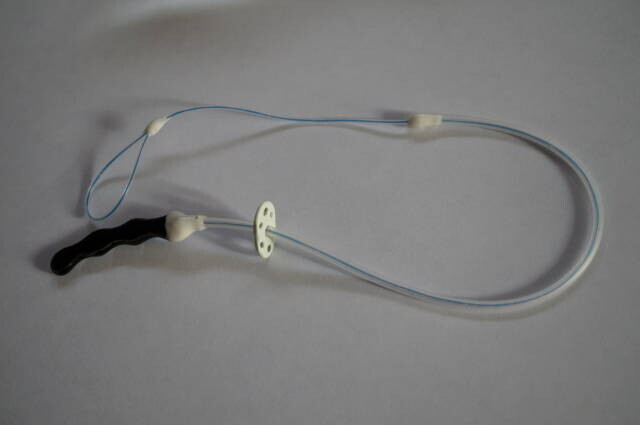
The OK Prostate Chip is a small urethral device intended to act on the prostate. The tail is silicone tubing around nylon thread, attached behind the chip to carry supports and stoppers along the internal connection. In the original design, 2.5mm tubing covered the thread inside the urethra, while plain nylon continued outside the body. Mr. Okada thought uncovered thread could burden the surrounding tissue.
A prostate chip tail followed reported thread strain, with stopper concerns
In a November 2023 entry, Mr. Okada reported strain after about one day testing a thread-connected assembly. The affected area was the sphincter (the urine-passage closing structure). He then made a tail prototype about 15mm long.
His stopper proposal concerned the bulbar urethra (the wider section nearby), where he thought external support could limit displacement during urination. He warned that pressure over a stopper in the penile urethra (the narrower passage within the penis) could stop urine flow. Mr. Okada therefore restricted his proposed stopper location to the wider section.
(Source: ok-lab's diary, published November 2023)
https://ok-lab.hatenablog.com/entry/2023/11/18/122841
A tail screw slipped when wet until its central hole changed
In a December 2023 entry, Mr. Okada described a tail screw support (a twisted resin part) with a 2.5mm internal hole. Urine made the fit too slippery: a 10mm gap from the main chip could become 20mm. He revised the hole to 2mm, creating a tighter fit around the 2.5mm tube.
He reported enough friction to hold the part while retaining adjustability. The support cost ¥3,000 (about $19 at ¥156 = $1, rate as of 2026-09-04) excluding tax as published that month, with the tail priced separately. Mr. Okada presented a single dedicated screw as an option for familiar support.
(Source: ok-lab's diary, published December 2023)
https://ok-lab.hatenablog.com/entry/2023/12/02/122648
Longer tail assemblies still depended on restraint against urine pressure
In a December 2023 entry, Mr. Okada described a 15cm tail carrying five screw supports. He reported that it accommodated shortening to 10cm during his own test. Urine pressure could still push the support near the penile tip outward, leaving the arrangement dependent on manual restraint.
That entry revised tail prices: up to 15cm: ¥2,000 (about $13 at ¥156 = $1, rate as of 2026-09-04) excluding tax; 16–25cm: ¥3,000 (about $19 at ¥156 = $1, rate as of 2026-09-04) excluding tax. He described the many-screw test as a personal report, not a general recommendation. Mr. Okada instead favored a modest change, with one support or stopper.
(Source: ok-lab's diary, published December 2023)
https://ok-lab.hatenablog.com/entry/2023/12/09/123055
A hollow tail support offered urine flow but could slide
In a December 2023 entry, Mr. Okada introduced a hollow support (an auxiliary part with a separate urine channel). It had a 2mm tube hole and a 4mm urine passage. He said external pressure would not collapse that passage.
The smooth exterior could nevertheless slide out of position, and testing was still limited. The approximately 15mm support cost ¥3,000 (about $19 at ¥156 = $1, rate as of 2026-09-04) excluding tax that month. Mr. Okada proposed it instead of a screw where pressure on the latter could restrict urine flow.
(Source: ok-lab's diary, published December 2023)
https://ok-lab.hatenablog.com/entry/2023/12/23/122035
A petal tail stopper could reverse under force and pass the sphincter
In an April 2025 entry, Mr. Okada described a petal stopper (wire loops intended to resist travel past the sphincter). The tail-compatible design used 0.2mm wire. He described three petals, priced at ¥1,000 (about $6 at ¥156 = $1, rate as of 2026-09-04) excluding tax each.
In his tests, they held during ordinary wear, but he warned that forced pressure with an instrument could invert them. That could let the stopper pass the sphincter. Mr. Okada favored thinner wire because stronger petals placed too much strain on the surrounding area in his tests.
(Source: ok-lab's diary, published April 2025)
https://ok-lab.hatenablog.com/entry/2025/04/26/122909
Tail screw detachment left a customer with blood in the urine
In an entry published in June 2025, a customer reported a detached tail screw support after difficulty removing a resin chip. The piece remained inside, with blood in the urine, before passing during urination 2–3 hours later. Another support bought around the same time also had a crack.
Mr. Okada suspected separation at the bond between two resin layers. He said other parts made with that construction might also be affected. He asked owners to check supports before use and avoid strong force.
(Source: ok-lab's diary, published June 2025)
https://ok-lab.hatenablog.com/entry/2025/06/07/122954
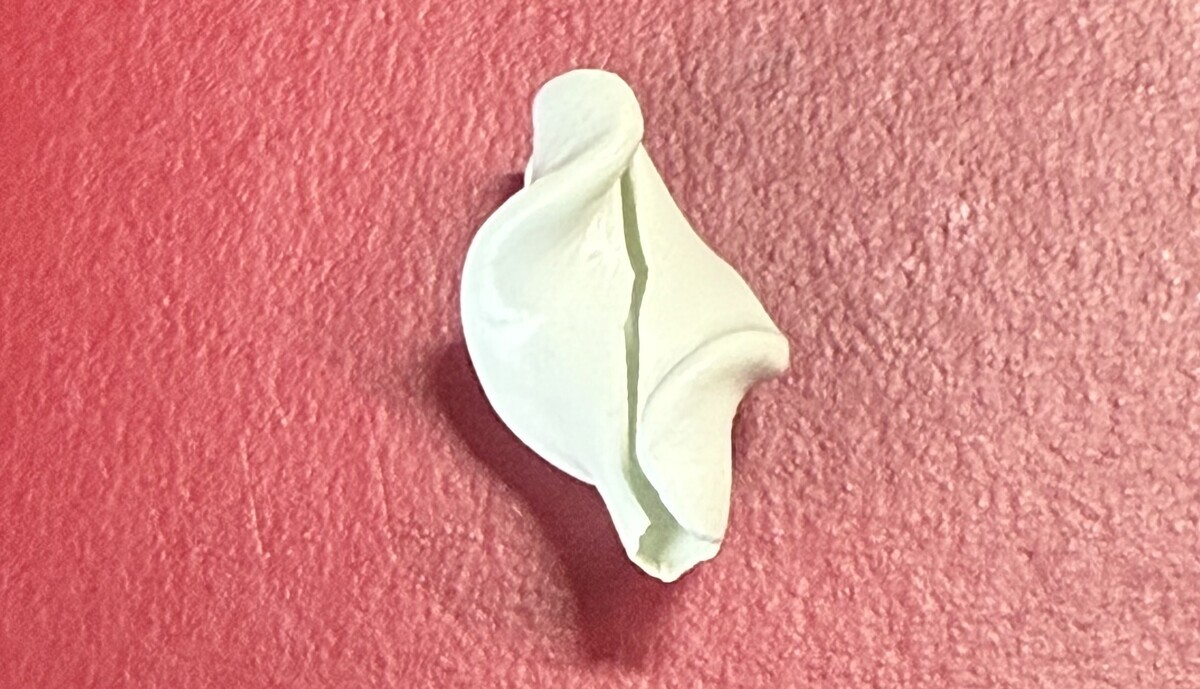
Tail modification had a separate quoted charge in December 2025
In a December 2025 entry, a customer requested a custom multi-part prostate device with a tail. The quote listed tail work up to 25cm at ¥3,300 (about $21 at ¥156 = $1, rate as of 2026-09-04), separately from its other components. The diary does not record how that customer's device felt in use.
(Source: ok-lab's diary, published December 2025)
https://ok-lab.hatenablog.com/entry/2025/12/13/122917
The maker's answer to prostate chip tail and parts
Mr. Okada revised the supporting parts to address urine pressure, sliding, and differences in tube fit.
Mesh tail stoppers replaced solid plates that caught urine pressure
In an entry published in November 2023, Mr. Okada reported that a solid stopper on the tail acted like a shield against urine. His response was a mesh stopper (a plate with openings), intended to let urine pass through. He also thought multiple stoppers could resist movement in both directions.
The permanently fitted type cost ¥2,000 (about $13 at ¥156 = $1, rate as of 2026-09-04) excluding tax, and the detachable type cost ¥2,500 (about $16 at ¥156 = $1, rate as of 2026-09-04) excluding tax that month. His own tests favored three or four; extra parts extended into the narrower passage and caused discomfort. Mr. Okada favored the permanently fitted version for the part nearest the main chip, because he wanted that connection secure.
(Source: ok-lab's diary, published November 2023)
https://ok-lab.hatenablog.com/entry/2023/11/25/122934
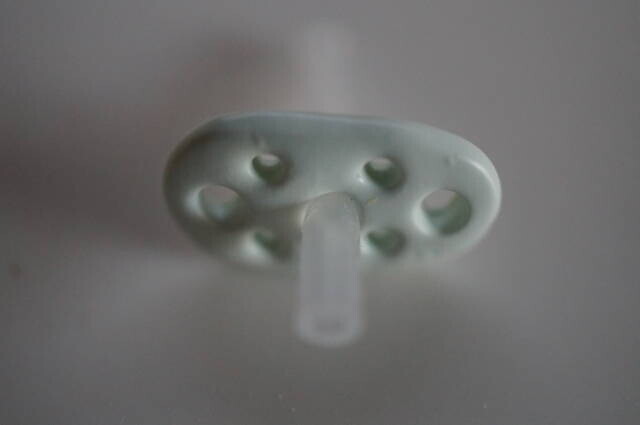
A dedicated tail stopper addressed sliding in the revised curved supports
In a December 2023 entry, Mr. Okada described curved supports (bent auxiliary chips) that were difficult to reposition. He initially expected to supply them with their positions fixed. In January 2024, he reported enlarging their internal holes to 2.5mm.
Once wet, those revised supports slid very freely, so he added separate stoppers with holes about 1.5mm across. He reported that these smaller holes resisted slipping even when wet. Mr. Okada favored the flat curved support for ease of handling.
(Source: ok-lab's diary, published December 2023)
https://ok-lab.hatenablog.com/entry/2023/12/30/122243
(Source: ok-lab's diary, published January 2024)
https://ok-lab.hatenablog.com/entry/2024/01/06/123004
Tail tube diameter changed how firmly the supporting parts stayed put
In an October 2024 entry, Mr. Okada compared tube sizes for a loop-ended wire prototype. Its screws and mesh stoppers had 2mm holes. He reported freer movement on 2mm tubing than on the 2.5mm tubing used for tails.
Both tube choices cost the same for that prototype. Mr. Okada favored the thicker tube for a firmer position and the thinner one for easier adjustment.
(Source: ok-lab's diary, published October 2024)
https://ok-lab.hatenablog.com/entry/2024/10/26/122649
If you see blood in your urine, even a small amount or for the first time, do not wait and see. See a urologist right away. If you suddenly cannot urinate, or the device cannot be removed, do not try to fix it yourself. Go to a medical facility, including emergency care, immediately.
How prostate chip tail and parts changed over time

| Published | What the diary said then |
|---|---|
| Nov 2023 | Original tail pricing: up to 10cm, ¥2,000 (about $13 at ¥156 = $1, rate as of 2026-09-04) excluding tax. |
| Dec 2023 | Dedicated screw widths: SS 7mm, S 8mm, M 9mm, L 10mm. |
| Dec 2023 | A wire anchor replaced direct attachment to thread at the chip end. |
| Dec 2023 | Curved supports introduced with 40mm, 45mm, and 50mm lengths. |
| Jan 2024 | Dedicated tail stopper priced at ¥500 (about $3 at ¥156 = $1, rate as of 2026-09-04) excluding tax each. |
| Feb 2024 | Cord and spaced resin reinforcement introduced in a stiffer tail prototype. |
| May 2024 | Staff estimated about 6mm as the smallest reinforced wire-to-tail connection. |
| Apr 2025 | An evolved tail combined nylon thread with 0.2mm wire inside 2.5mm tubing. |
| Jun 2025 | Cracked screw supports prompted an inspection warning. |
| Feb 2026 | A thin nylon-filled tube was successfully enclosed in a larger tube. |
The diary does not say what the current state is.
OK Prostate Chip products related to prostate chip tail and parts

The current list includes related devices, while the dedicated tail parts lack confirmed listings.
Products that appear in these entries
| Product (official name) | Price incl. tax | Relation to this topic |
|---|---|---|
| Resin prostate chip (OKプロステートチップ 覚醒タイプ(生体適合樹脂)) | ¥8,800 (about $56 at ¥156 = $1, rate as of 2026-09-04) | In June 2025, the customer reporting a detached tail screw had bought this chip with a tail and dedicated support. |
| External slide-lock clamp (スライドロック式尿道ゲートキーパー) | ¥6,600 (about $42 at ¥156 = $1, rate as of 2026-09-04) | In May 2024, Mr. Okada described adapting a customer's tail to fit this external retaining clamp. |
(Source: ok-lab's diary, published May 2024)
https://ok-lab.hatenablog.com/entry/2024/05/25/122919
(Source: ok-lab's diary, published June 2025)
https://ok-lab.hatenablog.com/entry/2025/06/07/122954
Products the diary mentioned as alternatives
The diary names no alternative.
Historical tail modifications, dedicated tail parts, and the wire-and-tube prototypes: No matching product can be confirmed on the current list.
Common worries about prostate chip tail and parts
Reader questions distinguish stiffness, compatibility, and limitations of external restraints.
"Can external rings keep tail parts from moving?"
In an entry published in February 2024, a customer asked whether external rings could stabilize a tail-mounted support. Mr. Okada thought the proposal could work in principle if the rings stayed in place. However, his own tests used different rings, not the customer's card rings.
He reported blisters with tighter restraint; looser restraint let the internal screw pass the ring. The diary does not record the customer's result. He offered a tail-mounted screw for consideration, with those reservations.
(Source: ok-lab's diary, published February 2024)
https://ok-lab.hatenablog.com/entry/2024/02/10/123023
"Can a tail screw be made longer?"
In an entry published in March 2024, a customer requested a modified screw arrangement and asked about changing the twists. Mr. Okada was unsure whether the request concerned the main chip or the separate tail support. For the tail support, exceeding about 15mm would make sliding harder and require a different internal hole, he said.
He could not settle the requested design from words alone. The diary does not record whether this proposed order was completed. Mr. Okada requested a drawing, or suggested waiting for the multi-part device he was developing if the customer was not in a hurry.
(Source: ok-lab's diary, published March 2024)
https://ok-lab.hatenablog.com/entry/2024/03/09/122635
"Is the standard prostate chip tail stiff enough?"
In an entry published in June 2024, a customer asked about a tail-equipped multi-part device because insertion seemed difficult. Staff said the standard 2.5mm tail was too soft to transmit pushing force and depended on external manipulation. After a follow-up question, Mr. Okada made a double-tube prototype: a 2mm inner tube within a 4mm outer tube.
He reported better stiffness, but acknowledged that it might still fail to advance under dry conditions. The June 2024 prototype cost ¥3,000 (about $19 at ¥156 = $1, rate as of 2026-09-04) excluding tax up to 15cm, or ¥4,500 (about $29 at ¥156 = $1, rate as of 2026-09-04) excluding tax up to 25cm. He offered the prototype for this difficulty; the entry records no customer-use result.
(Source: ok-lab's diary, published June 2024)
https://ok-lab.hatenablog.com/entry/2024/06/01/123036
"Can thin nylon-filled tubing take a tail stopper?"
In an entry published in February 2026, a customer asked whether a thin nylon-filled silicone tube could carry a stopper. Staff said they believed a stopper could not attach to that existing thin-tube design. They also said thicker electrical-cable tubing was incompatible with mesh stoppers.
Staff offered to investigate a combined construction after the customer suggested an outer covering. Mr. Okada successfully made a prototype combining a 1mm inner tube with a 2mm outer tube. He described it as slightly stiffer than the original tail; the diary records no customer-use result.
(Source: ok-lab's diary, published February 2026)
https://ok-lab.hatenablog.com/entry/2026/02/07/122919
Buying from outside Japan

OK Lab ships internationally to countries covered by Japan Post's EMS courier service. Overseas orders are paid in advance by PayPal. Each order carries a ¥400 (about $3 at ¥156 = $1, rate as of 2026-09-04) handling fee, and EMS shipping is charged on top. These terms come from OK Lab's official sales-terms page (written here as plain text, not a link: ok-lab.net/docs/law), checked on September 7, 2026; confirm them on the official store before you order, because they can change.
Summary of this article
| What you wanted to know | The answer |
|---|---|
| What is the short answer? | The tail covers thread; dedicated supports still have documented limitations. |
| What is the product? | A urethral device made by OK Lab in Japan. |
| What do the part names mean? | Screws, mesh plates, hollow supports, and petals serve different supporting roles. |
| What can happen with a tail? | The diary records sliding, outward movement, cracks, and a detached support. |
| What was the maker's answer? | Revised holes, stopper designs, and tube choices addressed specific problems. |
| What changed over time? | Designs progressed from covered thread to additional supports and reinforced tube prototypes. |
| Which current products are related? | The listed resin chip and external clamp appear in relevant cases. |
| What did customers ask? | Questions concerned restraint, stiffness, stopper compatibility, and longer screws. |
| How does overseas buying work? | Advance PayPal payment, a handling fee, and separate EMS shipping charges. |
Source: ok-lab's diary (Okada Comfortable Life Laboratory). The original entries are in Japanese; quotations on this page are translated. Photos and videos are on the original entries.
This article is a summary of the maker's development diary. The product is not a medical device and no result is guaranteed. If anything feels wrong or worries you, see a doctor. Prices, specifications and cautions change, so confirm the latest information on the official blog and the official site. Questions about ordering and shipping go to the seller.