![Will a cable stopper keep my chip in place? | Loosening has been reported [OK Prostate Chip]](/img/a/T0232/eyecatch.svg)
This page is based on entries from "ok-lab's diary" (https://ok-lab.hatenablog.com/), the Japanese development diary written by Mr. Okada, founder of OK Lab, a small company in Japan (Okada Comfortable Life Laboratory). Only the entries about "four-hole parallel-cable stoppers" are summarized here, in order of publication. Past prices and sizes are as written at the time. Current prices come from the official product list (retrieved September 4, 2026). Quotations are translated from Japanese.
This article is about cable stoppers, and summarizes reported problems, different designs, and the maker's replies. It also includes customer questions, current products, alternatives, and buying from outside Japan.
Note: This page is a personal reading log by someone with no connection to the maker or the seller. It reflects the source entries as of their publication dates and makes no guarantee of accuracy or safety. The product is not a medical device; talk to a doctor about any health decision. Check the official site for current information. This page contains advertising.
In short
Cable stoppers are intended to limit movement, but a customer reported loosening.
Mr. Okada offered different stopper designs for different cable arrangements and reported problems.
The current cable-stopper option costs ¥1,100 (about $7 at ¥156 = $1, rate as of 2026-09-04) including tax; later custom assemblies had separate historical prices.
About this product

The OK Prostate Chip is a small device that is placed in the urethra (the urine passage) so that it acts on the prostate; the maker sells it in several shapes, sizes and materials. It is made and sold by OK Lab (Okada Comfortable Life Laboratory), a small company in Japan, through its own online store, and prices are in Japanese yen (JPY).
The maker's development diary, "ok-lab's diary", is written in Japanese. This page is an English summary of it, and every quotation is translated. OK Lab ships internationally, so readers outside Japan can order (see "Buying from outside Japan" below).
Product names on this page are plain-English descriptions. The official Japanese product name is shown once in the product table so you can find the same item in the store.
Before you read: key terms
| Term | Plain-English meaning |
|---|---|
| Parallel cable | A paired cord used for electrical connections and as a support for cable stoppers. |
| Cable stopper | A resin part carried on a cable, intended to limit movement of the chip or cable. |
| Electrode chip | A chip containing electrical contact components, made for electrical stimulation. |
| Three-hole thread stopper | A part carried on nylon thread, intended to restrain the chip. |
| U-turn stopper | A return-shaped cable attachment intended to limit inward movement and outward cable movement. |
| Adjustable loop | A cable loop supported by separate stopper plates, allowing different curves in the assembly. |
| Two-hole stopper | A small plate used to secure wire in the reinforced adjustable-loop design. |
What happens: cable stopper problems
The OK Prostate Chip is a small device placed in the urethra, the urine passage, to act on the prostate. A cable stopper is a resin part carried on its parallel cable (a paired cord), intended to limit movement. The diary discusses versions near internal muscles and others outside the head of the penis, with different limitations. Later designs used separate plates to support a changeable cable loop.
The first cable stopper brought fitting limits and splash warnings
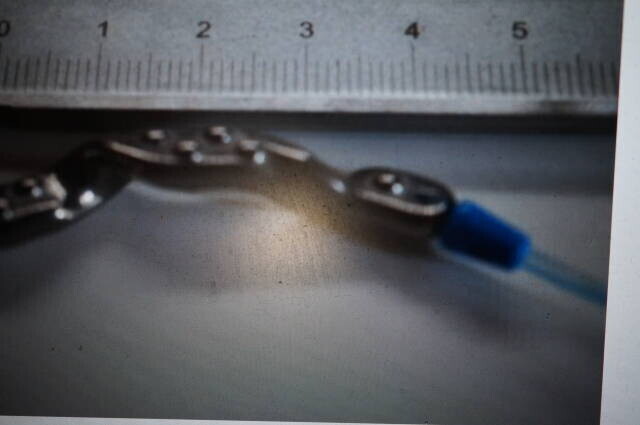
In an entry published in July 2019, Mr. Okada introduced a cable stopper after previously relying on nylon-thread stoppers. Retrofitting existing vibrating or electrode chips required rewiring; newly ordered devices could arrive with the stopper already fitted. An electrode chip contains electrical contact components for electrical stimulation.
The planned price was ¥1,500 (about $10 at ¥156 = $1, rate as of 2026-09-04) excluding tax, with M at 9mm and L at about 11mm. Mr. Okada reported that restricted stopper movement could slow urination. He also warned that urine could strike an external stopper near the penis head and splash.
(Source: ok-lab's diary, published July 2019)
https://ok-lab.hatenablog.com/entry/2019/07/06/152113
A customer reported two loose cable stoppers during repeated use
In an entry published in August 2021, a customer reported that 2 cable stoppers loosened during the third use. They also mentioned a makeshift tape repair. The same customer described treatment for swelling near one testicle, which had improved but remained present when they wrote.
The entry gives no later result for the repaired stoppers. Mr. Okada said he could not establish whether the chip was connected to the inflammation and asked for reports of similar symptoms.
(Source: ok-lab's diary, published August 2021)
https://ok-lab.hatenablog.com/entry/2021/08/21/125838
A wire cable stopper followed dangerous movement into the bladder
In an entry published in October 2021, Mr. Okada described a rotating prototype intended to transmit vibration from an external motor. He reported that its first version lacked a stopper and traveled beyond the prostate, deep into the bladder. He called this very dangerous and described a later version with a wire stopper.
The wire-specific stopper was offered for ¥1,000 (about $6 at ¥156 = $1, rate as of 2026-09-04) excluding tax at that time. Mr. Okada required customers to specify the wire diameter when requesting it.
(Source: ok-lab's diary, published October 2021)
https://ok-lab.hatenablog.com/entry/2021/10/09/125823
The detachable U-turn cable stopper introduced a possible breakage problem
In an entry published in January 2022, Mr. Okada reported that his U-turn stopper (a return-shaped cable attachment) kept the chip's position nearly unchanged. He described this as his own experience during extended testing. A newly detachable version was intended for existing vibrating chips.
He had not yet decided to release that version and wanted further strength testing. Mr. Okada cautioned that the long, thin part could break under strong bending.
(Source: ok-lab's diary, published January 2022)
https://ok-lab.hatenablog.com/entry/2022/01/15/124252
Separate cable stopper plates answered an impractical cylindrical design request
In an entry published in July 2026, a customer requested a stronger cylindrical stopper for a paired electrode build. Mr. Okada judged cable friction too great for assembly through a 10mm resin passage. His substitute used 3 plates, each about 8mm wide and 3mm thick, with a spaced version he found easier to handle.
The published price was ¥1,500 (about $10 at ¥156 = $1, rate as of 2026-09-04) per plate, or ¥4,500 (about $29 at ¥156 = $1, rate as of 2026-09-04) for 3, excluding tax. In an entry published in August 2026, the same customer selected 2 plates, and OK Lab reported making the requested custom build. No use result appears there; Mr. Okada's July offer cautioned that extremely short cable requests might be unworkable.
(Source: ok-lab's diary, published July 2026)
https://ok-lab.hatenablog.com/entry/2026/07/25/123012
(Source: ok-lab's diary, published August 2026)
https://ok-lab.hatenablog.com/entry/2026/08/08/122906
Adjustable cable stopper sizes became more clearly defined in August 2026
In an entry published in August 2026, Mr. Okada introduced size choices for the adjustable loop (a cable loop supported by separate stopper plates). Widths were S 6–7mm, M 7–8mm, and L 8–9mm; thickness was approximately 2.5–3mm. He explained that resin movement during manufacture meant finished parts were measured before receiving their size labels.
The first and second stoppers could have different sizes, and the assembly could accompany short through long chips. Mr. Okada requested total cable length or approximate distances to the stoppers and the end-loop length.
(Source: ok-lab's diary, published August 2026)
https://ok-lab.hatenablog.com/entry/2026/08/01/122916
The reinforced cable stopper assembly needed additional wire-holding parts
In an entry published in August 2026, Mr. Okada described developing a wire-reinforced adjustable loop after several unsuccessful attempts. The ordinary adjustable design used 2 four-hole stoppers. The reinforced version required 3 additional two-hole stoppers (small plates used to secure the wire).
Those additional plates were approximately 5mm wide and served only to hold the wire. Mr. Okada warned that heavy demand might make the labor-intensive build impossible to keep offering.
(Source: ok-lab's diary, published August 2026)
https://ok-lab.hatenablog.com/entry/2026/08/29/122931
The maker's answer to cable stopper problems
Mr. Okada's replies distinguish simpler cable handling, an optional restraint, and an external stopper role.
The cable stopper avoided managing separate cable and thread connections
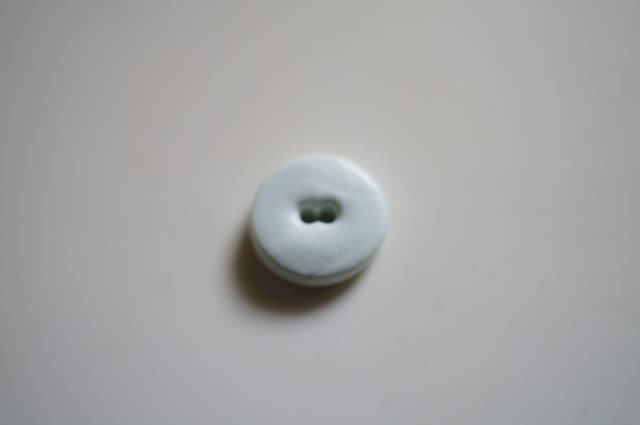
In an entry published in July 2019, Mr. Okada compared the cable stopper with a nylon-thread stopper after about a week of testing. He reported that the cable could fold into an S shape, making the cable version harder to handle. He found the thread version easier in that respect, but described difficulties managing both the thread and cable.
His comparison concerned the three-hole thread stopper (a thread-mounted restraint) described in the preceding entry. Mr. Okada favored the cable version for people uncomfortable managing the more complicated separate connections.
(Source: ok-lab's diary, published July 2019)
https://ok-lab.hatenablog.com/entry/2019/07/06/152113
(Source: ok-lab's diary, published July 2019)
https://ok-lab.hatenablog.com/entry/2019/07/13/150108
A cable stopper was offered for reported inward chip movement
In an entry published in February 2021, a customer considering an electrode chip asked about repeated movement into the bladder. They wanted a build addressing this concern alongside questions about materials and electrical equipment. Mr. Okada explained that the embedded electrical components required a resin body.
The diary does not record a subsequent order or a result for this customer. Mr. Okada offered a cable stopper as an option, while saying he could not explain electrical use he had not verified.
(Source: ok-lab's diary, published February 2021)
https://ok-lab.hatenablog.com/entry/2021/02/13/121440
An external cable stopper was accepted for one vibrating setup
In an entry published in November 2021, a customer reported that a vibrating chip's thickness prevented the stopper from passing inside. The stopper remained outside, and the customer said vibration tended to move the chip outward instead of toward the bladder.
They therefore felt an internal stopper was unnecessary in their particular case. Mr. Okada agreed that, for this vibrating setup, the cable stopper could serve at the penis opening.
(Source: ok-lab's diary, published November 2021)
https://ok-lab.hatenablog.com/entry/2021/11/20/125643
How cable stopper problems changed over time
| Published | What the diary said then |
|---|---|
| Jul 2019 | Rounded entry holes and close-fitting exits were designed to resist movement. |
| Dec 2019 | Additional thread holes were limited to uncertain custom trials. |
| Mar 2020 | Mr. Okada reported greater stability with a two-cable prototype. |
| Aug 2021 | A customer reported loosening during repeated use. |
| Oct 2021 | A wire stopper followed dangerous inward movement of an unrestrained prototype. |
| Jan 2022 | The detachable U-turn design awaited further strength testing. |
| Aug 2024 | The four-hole stopper remained available at ¥1,000 (about $6 at ¥156 = $1, rate as of 2026-09-04) excluding tax. |
| Jul 2026 | Minimum adjustable assembly: plates ¥3,000, (about $19 at ¥156 = $1, rate as of 2026-09-04) loop connection ¥2,000 (about $13 at ¥156 = $1, rate as of 2026-09-04); stated total ¥5,000, (about $32 at ¥156 = $1, rate as of 2026-09-04) excluding tax. |
| Aug 2026 | Independent stopper sizes and cable-length specifications became available. |
| Aug 2026 | Wire reinforcement required additional two-hole plates. |
OK Prostate Chip products related to cable stopper problems
The current list includes the cable-stopper option and the thread stopper discussed in the maker's comparison.
Products that appear in these entries

| Product (official name) | Price incl. tax | Relation to this topic |
|---|---|---|
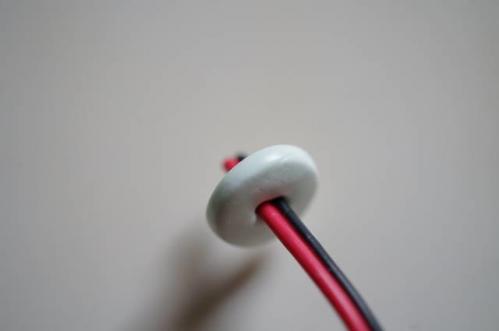
| Cable-stopper addition (平行ケーブル用ストッパー追加(オプション)) | ¥1,100 (about $7 at ¥156 = $1, rate as of 2026-09-04) | In February 2021, Mr. Okada offered this option to a customer concerned about an electrode chip moving inward. |
An entry published in August 2024 also offered the four-hole stopper with a paired aluminum-electrode build. That entry supplies the historical price in the timeline.
The cable-stopper addition is listed in OK Lab's own online store.
(Source: ok-lab's diary, published February 2021)
https://ok-lab.hatenablog.com/entry/2021/02/13/121440
(Source: ok-lab's diary, published August 2024)
https://ok-lab.hatenablog.com/entry/2024/08/10/122913
Products the diary mentioned as alternatives
| Product (official name) | Price incl. tax | Relation to this topic |
|---|---|---|
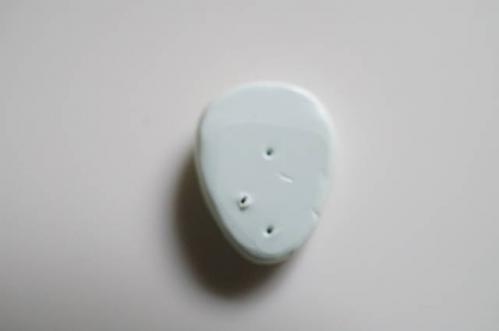
| Three-hole internal thread stopper (三穴方式オプションチップ(括約筋ストッパーチップ)) | ¥1,650 (about $11 at ¥156 = $1, rate as of 2026-09-04) | In July 2019, Mr. Okada favored the thread alternative for people able to manage separate thread and cable connections carefully. |
The three-hole internal thread stopper is listed in OK Lab's own online store.
(Source: ok-lab's diary, published July 2019)
https://ok-lab.hatenablog.com/entry/2019/07/06/152113
(Source: ok-lab's diary, published July 2019)
https://ok-lab.hatenablog.com/entry/2019/07/13/150108
Historical two-cable and wire-driven prototypes, the detachable U-turn stopper, and custom adjustable-loop assemblies:
No matching product can be confirmed on the current list.
Common worries about cable stopper problems
The reader requests concerned extra holes, compatibility with two cables, and stopper thickness.
"Can a cable stopper have extra thread holes?"
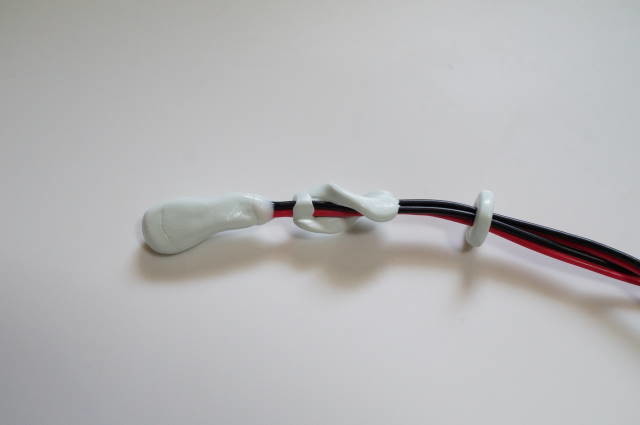
In an entry published in December 2019, a customer requested a cable stopper with 3 additional holes for nylon thread. Mr. Okada said the work might be possible, but delicate resin processing made success uncertain. He would not make it a regular product because of the manufacturing difficulty.
His corrected explanation rejected one extra hole as sufficient to stop sliding and questioned whether peripheral holes would provide the intended alignment. The diary does not record whether the customer received a finished part. Mr. Okada offered only an experimental custom attempt, without promising that he could complete it.
(Source: ok-lab's diary, published December 2019)
https://ok-lab.hatenablog.com/entry/2019/12/14/151232
"Can a cable stopper work with two cables?"
In an entry published in March 2020, a customer asked whether a miniature vibrating chip could have both two cables and a cable stopper. Mr. Okada initially said manufacture seemed possible, but practical fit needed testing. He then made a prototype and reported his own trial results.
He found the two-cable assembly harder to bend and initially harder to accommodate, but more stable once positioned. The entry reports his testing, rather than a later result from the customer. His initial advice was that this proposed combination needed a trial before its practical behavior could be known.
(Source: ok-lab's diary, published March 2020)
https://ok-lab.hatenablog.com/entry/2020/03/21/143802
"Could the requested cable stopper keep its usual thickness?"
In an entry published in August 2026, a customer requested a broad stopper on a vibrating chip, close to its usual width and thickness. Mr. Okada explained that combining this design with the parallel cable would make it 9mm or more thick. He said that was far from the requested standard thickness.
After this explanation, the customer accepted a change from the ¥4,400 (about $28 at ¥156 = $1, rate as of 2026-09-04) stopper to the ordinary L cable stopper at ¥1,100 (about $7 at ¥156 = $1, rate as of 2026-09-04). The entry records the specification change but no later account of how it felt. Mr. Okada's proposed alternative was the ordinary cable stopper because the requested design could not retain its usual thickness.
(Source: ok-lab's diary, published August 2026)
https://ok-lab.hatenablog.com/entry/2026/08/01/122916
Buying from outside Japan

OK Lab ships internationally to countries covered by Japan Post's EMS courier service. Overseas orders are paid in advance by PayPal. Each order carries a ¥400 (about $3 at ¥156 = $1, rate as of 2026-09-04) handling fee, and EMS shipping is charged on top. These terms come from OK Lab's official sales-terms page (written here as plain text, not a link: ok-lab.net/docs/law), checked on September 7, 2026; confirm them on the official store before you order, because they can change.
Summary of this article
| What you wanted to know | The answer |
|---|---|
| What is the short answer? | The stopper is intended to restrain movement, but loosening was reported. |
| What is the base product? | A urethral device made and sold by OK Lab in Japan. |
| What do the terms mean? | Cable stoppers, thread stoppers, and adjustable loops describe different supporting parts or arrangements. |
| What problems appeared? | Reports included loosening, splashing, fitting difficulties, and possible breakage of a thin prototype. |
| What did the maker suggest? | His replies varied with the cable arrangement and the customer's reported problem. |
| What changed over time? | Development expanded from a cable attachment to detachable and adjustable assemblies with separate specifications. |
| What is currently listed? | The cable-stopper addition costs ¥1,100 (about $7 at ¥156 = $1, rate as of 2026-09-04) including tax; the internal three-hole thread stopper costs ¥1,650 (about $11 at ¥156 = $1, rate as of 2026-09-04). |
| What did customers ask? | They asked about extra thread holes, two-cable compatibility, and thickness limits. |
| How do overseas orders work? | Advance PayPal payment, a ¥400 (about $3 at ¥156 = $1, rate as of 2026-09-04) handling fee, and additional Japan Post EMS shipping charges. |
Source: ok-lab's diary (Okada Comfortable Life Laboratory). The original entries are in Japanese; quotations on this page are translated. Photos and videos are on the original entries.
This article is a summary of the maker's development diary. The product is not a medical device and no result is guaranteed. If anything feels wrong or worries you, see a doctor. Prices, specifications and cautions change, so confirm the latest information on the official blog and the official site. Questions about ordering and shipping go to the seller.