![Three, six or eight stopper holes? | The thread arrangement matters [OK Prostate Chip]](/img/a/T0231/eyecatch.svg)
This page is based on entries from "ok-lab's diary" (https://ok-lab.hatenablog.com/), the Japanese development diary written by Mr. Okada, founder of OK Lab, a small company in Japan (Okada Comfortable Life Laboratory). Only the entries about "three-hole, six-hole and eight-hole stoppers" are summarized here, in order of publication. Past prices and sizes are as written at the time. Current prices come from the official product list (retrieved September 4, 2026). Quotations are translated from Japanese.
Note: This page is a personal reading log by someone with no connection to the maker or the seller. It reflects the source entries as of their publication dates and makes no guarantee of accuracy or safety. The product is not a medical device; talk to a doctor about any health decision. Check the official site for current information. This page contains advertising.
In short
- Three-hole and six-hole stoppers serve different thread arrangements; two threads do not always require a six-hole sphincter stopper.
- Mr. Okada distinguished the internal stopper’s job from the external safety chip’s job.
- The current list includes three-hole, six-hole and eight-hole parts, with different functions and prices.
About this product

The OK Prostate Chip is a small device that is placed in the urethra (the urine passage) so that it acts on the prostate; the maker sells it in several shapes, sizes and materials. It is made and sold by OK Lab (Okada Comfortable Life Laboratory), a small company in Japan, through its own online store, and prices are in Japanese yen (JPY).
The maker's development diary, "ok-lab's diary", is written in Japanese. This page is an English summary of it, and every quotation is translated.
OK Lab ships internationally, so readers outside Japan can order (see "Buying from outside Japan" below). Product names on this page are plain-English descriptions. The official Japanese product name is shown once in the product table so you can find the same item in the store.
Before you read: key terms
| Term | Plain-English meaning |
|---|---|
| Sphincter stopper | A part near the muscle controlling urine flow, intended to resist the chip moving toward the bladder. |
| External stopper | A part outside the penis tip, intended as a final barrier against inward movement. |
| Safety chip | An end piece; the six-hole version brings two thread lengths together outside the body. |
| Screw-shaped helper | A twisted accessory near the main chip, intended to help move it. |
| Jointed extension | A connected series of resin sections intended to support the chip’s movement and position. |
| Gatekeeper | A cap at the penis tip, developed to control movement of compatible threads or cables. |
| Biocompatible resin | The maker’s name for a resin used in these parts; the diary does not explain its biological compatibility. |
What happens: three-hole vs six-hole stoppers
The OK Prostate Chip is a small device placed in the urethra to act on the prostate. Its sphincter stopper (a part intended to resist inward movement near the urine-control muscle) connects to the chip’s thread. An external stopper sits outside the penis tip, while a safety chip brings thread ends together. The diary distinguishes these parts by their jobs, thread arrangements and hole patterns, rather than treating every stopper as interchangeable.
Six-hole stoppers accommodated two threads without fixing their stretch together
In an entry published in April 2019, Mr. Okada introduced six-hole stoppers for two-thread arrangements previously served by three-hole parts. The standard safety chip was omitted because, he wrote, fixing both threads together could leave them stretching unevenly.
Each six-hole part cost ¥500 (about $3 at ¥156 = $1, rate as of 2026-09-04) more, excluding tax, than its three-hole counterpart. Prices excluding tax were ¥2,000 (about $13 at ¥156 = $1, rate as of 2026-09-04) for the sphincter stopper, ¥1,500 (about $10 at ¥156 = $1, rate as of 2026-09-04) for the external stopper, and ¥1,000 (about $6 at ¥156 = $1, rate as of 2026-09-04) for the safety chip. Mr. Okada allowed a three-hole stopper on one thread, but specified the separately sold six-hole safety chip for matching both thread lengths.
(Source: ok-lab's diary, published April 2019)
https://ok-lab.hatenablog.com/entry/2019/04/27/153239
Three-hole stopper compatibility became more limited with stainless steel thread
In an entry published in September 2019, Mr. Okada discussed stainless steel thread in parts originally intended for nylon. Three-hole and six-hole parts had openings approximately 0.3 mm across. Nylon measured approximately 0.25 mm, while the 0.29 mm steel thread barely fitted.
His account identified problems with stopper alignment, exposed wire ends and difficult position changes. He considered the external stopper useful as a final barrier against inward movement. Mr. Okada’s cautions called for alignment attention and taped wire-end protection, with stopper positions generally left unchanged.
(Source: ok-lab's diary, published September 2019)
https://ok-lab.hatenablog.com/entry/2019/09/14/143710
An eight-hole stopper combined the earlier single-thread and two-thread functions
In an entry published in May 2021, Mr. Okada introduced an eight-hole sphincter stopper made from biocompatible resin. It combined the three-hole, single-thread function with the six-hole, two-thread function.
The designer also included side openings at the tip. Mr. Okada thought those openings might ease withdrawal, but could leave the stopper sitting diagonally instead of across the thread. He favored the flat-face openings for the stopper’s intended stopping function.
(Source: ok-lab's diary, published May 2021)
https://ok-lab.hatenablog.com/entry/2021/05/22/125847
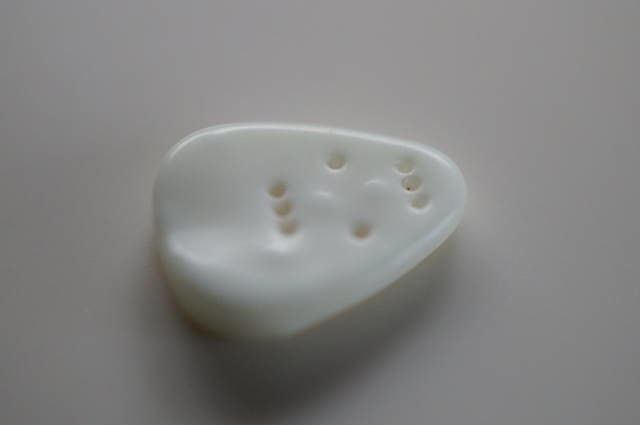
An eight-hole stopper extension reached sale while the floating design remained unlaunched
In an entry published in January 2023, Mr. Okada revisited the proposed eight-hole floating extension. Despite its earlier announcement, it remained unreleased because he lacked confidence in its stability. He instead announced sales of an eight-hole jointed extension (connected resin sections intended to support chip movement and position).
Its four front holes and four rear holes carried an additional charge of ¥1,000, (about $6 at ¥156 = $1, rate as of 2026-09-04) excluding tax. Mr. Okada wrote that he felt confident about this jointed design’s stability. He recommended a curved, flat-tipped resin end for the jointed extension.
(Source: ok-lab's diary, published January 2023)
https://ok-lab.hatenablog.com/entry/2023/01/21/122941
Twelve-hole stoppers extended the range to arrangements with four threads
In an entry published in July 2023, Mr. Okada introduced twelve-hole sphincter and external stoppers after receiving requests for four-thread products. He had expected little demand and had not prioritized making these parts.
The sphincter stopper came in M and L, priced at ¥3,000, (about $19 at ¥156 = $1, rate as of 2026-09-04) excluding tax. The external stopper had one size, priced at ¥2,500, (about $16 at ¥156 = $1, rate as of 2026-09-04) excluding tax. Mr. Okada offered these additions to customers with pending four-thread orders, while warning that delivery would take longer.
(Source: ok-lab's diary, published July 2023)
https://ok-lab.hatenablog.com/entry/2023/07/15/123004
The maker's answer to three-hole vs six-hole stoppers
Mr. Okada’s answer depended on where the threads started, which part held them, and the particular stopper design.
A three-hole stopper preserved the purpose of separately attached threads
In an entry published in September 2020, a customer requested a custom ceramic chip with threads emerging from separate points. The order included a six-hole sphincter stopper. Mr. Okada advised against that combination because a shared stopper would largely cancel the different pulling points.
The customer accepted a change to the three-hole version. The diary does not record how that arrangement felt in use. Mr. Okada recommended a three-hole stopper serving only the main thread, with a six-hole safety chip outside the body.
(Source: ok-lab's diary, published September 2020)
https://ok-lab.hatenablog.com/entry/2020/09/26/124400
The eight-hole stopper launch retained both earlier patterns in one part
In an entry published in August 2021, Mr. Okada announced the resin stopper’s launch for the following week. This material would be offered only in the eight-hole version. Within that design, central openings served the three-hole pattern, while outer openings served the six-hole pattern.
Its price was ¥2,000, (about $13 at ¥156 = $1, rate as of 2026-09-04) excluding tax, matching the previous six-hole stopper. Mr. Okada explained that a dedicated three-hole version in the new material would not reduce the price. He directed customers wanting a dedicated three-hole part to the existing epoxy-resin version.
(Source: ok-lab's diary, published August 2021)
https://ok-lab.hatenablog.com/entry/2021/08/28/125823
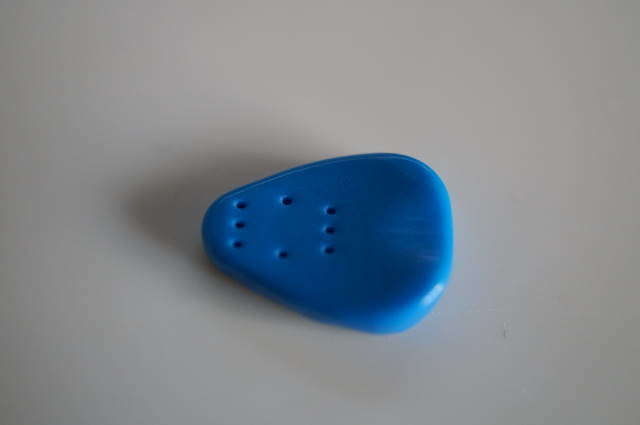
Six-hole Gatekeeper orders needed their specification settled before manufacture
In an entry published in May 2022, an illustrator asked whether the Gatekeeper could work with ordinary nylon-thread chips. Mr. Okada responded by making a version with six holes. He believed the added stopper function could prevent inward movement, but that was his assessment.
The additional charge was ¥1,000, (about $6 at ¥156 = $1, rate as of 2026-09-04) excluding tax. Existing orders could not receive that change once the resin had hardened. Mr. Okada therefore asked customers to specify the six-hole version when ordering.
(Source: ok-lab's diary, published May 2022)
https://ok-lab.hatenablog.com/entry/2022/05/07/123013
How three-hole vs six-hole stoppers changed over time
| Published | What the diary said then |
|---|---|
| Jul 2018 | Three-hole release was delayed by demand for another chip. |
| Dec 2019 | A single anti-slip hole was rejected; the central hole’s position mattered. |
| Jan 2022 | A U-shaped six-hole prototype entered testing; launch depended on results. |
| Dec 2022 | The proposed floating eight-hole extension also supported a single thread. |
| Jul 2023 | Twelve-hole stoppers had greater adjustment resistance than three-hole or six-hole versions. |
| Nov 2023 | A dedicated six-hole connector was smaller than the six-hole safety chip. |
| Mar 2026 | A custom stainless steel screw-shaped helper accommodated all four nylon threads. |
For the U-shaped prototype, the diary does not say what the current state is.
OK Prostate Chip products related to three-hole vs six-hole stoppers
The current list includes parts from these discussions, but their names describe different functions and versions.
Products that appear in these entries
| Product (official name) | Price incl. tax | Relation to this topic |
|---|---|---|
| Six-hole safety chip (六穴方式オプションチップ(セーフティチップ)) | ¥1,100 (about $7 at ¥156 = $1, rate as of 2026-09-04) | In September 2020, Mr. Okada accepted this external part alongside a three-hole internal stopper. |
| Eight-hole resin sphincter stopper (八穴方式括約筋ストッパーチップ(生体適合樹脂)) | ¥2,200 (about $14 at ¥156 = $1, rate as of 2026-09-04) | The August 2021 launch combined the earlier three-hole and six-hole functions. |
The eight-hole resin stopper is listed in OK Lab’s own online store.

(Source: ok-lab's diary, published September 2020)
https://ok-lab.hatenablog.com/entry/2020/09/26/124400
(Source: ok-lab's diary, published August 2021)
https://ok-lab.hatenablog.com/entry/2021/08/28/125823
(Source: ok-lab's diary, published December 2025)
https://ok-lab.hatenablog.com/entry/2025/12/20/123000
Products the diary mentioned as alternatives
| Product (official name) | Price incl. tax | Relation to this topic |
|---|---|---|
| Three-hole sphincter stopper (三穴方式オプションチップ(括約筋ストッパーチップ)) | ¥1,650 (about $11 at ¥156 = $1, rate as of 2026-09-04) | In September 2020, Mr. Okada recommended this instead of the six-hole stopper for threads emerging from separate points. |
The three-hole sphincter stopper is listed in OK Lab’s own online store.
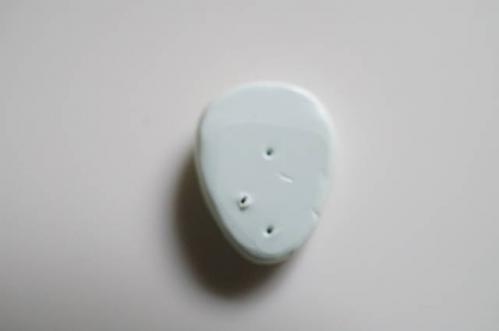
(Source: ok-lab's diary, published September 2020)
https://ok-lab.hatenablog.com/entry/2020/09/26/124400
Mr. Okada announced the previous six-hole sphincter stopper’s discontinuation in August 2021. The current product list also contains a six-hole sphincter-stopper listing.
(Source: ok-lab's diary, published August 2021)
https://ok-lab.hatenablog.com/entry/2021/08/28/125823
For the historical custom ceramic build, unfixed helper, floating and jointed extensions, twelve-hole stoppers, dedicated connector and six-hole Gatekeeper: No matching product can be confirmed on the current list.
Common worries about three-hole vs six-hole stoppers
The reader questions concerned custom holes, manufacturing limits and whether a stopper could prevent inward movement.
"Could a screw-shaped helper have three-hole stopper adjustment?"
In an entry published in November 2019, a customer asked for three adjustment holes in a screw-shaped helper. Mr. Okada said the workshop’s methods could not combine the hole-making and twisting work. He also explained that the helper needed its thread to emerge from the central axis.
He offered an unfixed version, but warned that its spacing might move from 2 mm to 5 mm. The diary does not record whether the customer bought that version. Mr. Okada offered it only with the possibility of unwanted movement understood.
(Source: ok-lab's diary, published November 2019)
https://ok-lab.hatenablog.com/entry/2019/11/23/162919
"Could three-hole stopper features be added to a cable stopper?"
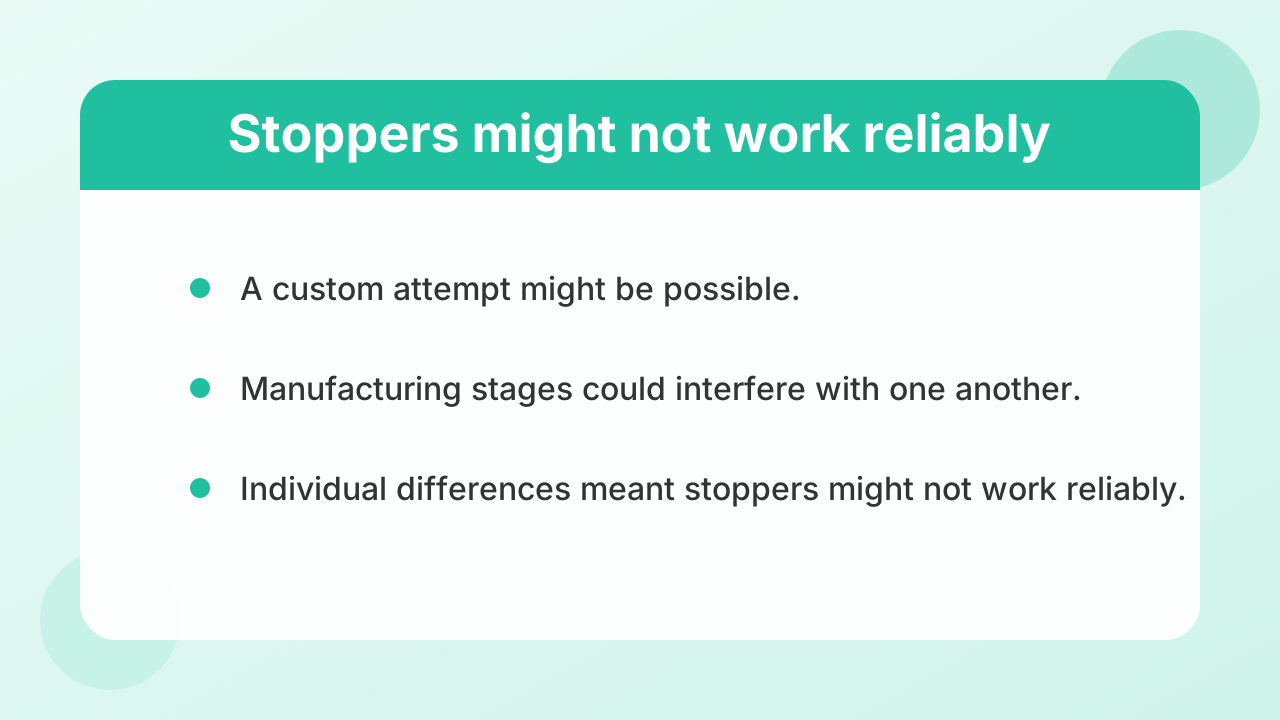
In an entry published in December 2019, a customer requested nylon-thread holes in a cable stopper. Mr. Okada said a custom attempt might be possible, but he could not promise success. He explained that six-hole work required several times the labor of three-hole work.
The manufacturing stages could interfere with one another, making the proposed combination difficult. The diary does not record whether this experimental order was completed. Mr. Okada offered a trial build, while ruling out adoption as a standard product.
(Source: ok-lab's diary, published December 2019)
https://ok-lab.hatenablog.com/entry/2019/12/14/151232
"Would a six-hole stopper prevent my chip moving inward?"
In an entry published in February 2024, a customer described a chip slipping farther inward until sensation disappeared. The customer suspected movement into the bladder and asked whether the requested stopper was appropriate. The diary does not confirm that the chip actually reached the bladder.
Mr. Okada explained that the sphincter stopper was designed to resist that movement, but individual differences meant it might not work reliably. No later result for this customer’s stopper appears in the paragraph. His advice was that the part matched the intended purpose, without guaranteeing its performance.
(Source: ok-lab's diary, published February 2024)
https://ok-lab.hatenablog.com/entry/2024/02/10/123023
Buying from outside Japan

OK Lab ships internationally to countries covered by Japan Post's EMS courier service. Overseas orders are paid in advance by PayPal. Each order carries a ¥400 (about $3 at ¥156 = $1, rate as of 2026-09-04) handling fee, and EMS shipping is charged on top. These terms come from OK Lab's official sales-terms page (written here as plain text, not a link: ok-lab.net/docs/law), checked on September 7, 2026; confirm them on the official store before you order, because they can change.
Summary of this article
| What you wanted to know | The answer |
|---|---|
| What is the short answer? | Hole count depends on the thread arrangement and the part’s job. |
| What is the base product? | A urethral device made and sold by OK Lab in Japan. |
| What do the part names mean? | Internal stoppers, external stoppers and safety chips have different roles. |
| Why did hole counts increase? | Designs accommodated additional threads and combined earlier functions. |
| What did the maker advise? | Separately attached threads sometimes called for a three-hole internal stopper. |
| What changed over time? | New patterns appeared, prototypes remained uncertain, and an older stopper was discontinued. |
| What do listed parts cost? | The table gives current prices in JPY, including tax. |
| Does a stopper guarantee stability? | Mr. Okada explicitly acknowledged individual differences and possible failure. |
| How do overseas purchases work? | Advance PayPal payment, a handling fee and additional EMS shipping charges. |
Source: ok-lab's diary (Okada Comfortable Life Laboratory). The original entries are in Japanese; quotations on this page are translated. Photos and videos are on the original entries.
This article is a summary of the maker's development diary. The product is not a medical device and no result is guaranteed. If anything feels wrong or worries you, see a doctor. Prices, specifications and cautions change, so confirm the latest information on the official blog and the official site. Questions about ordering and shipping go to the seller.