![Can a wire or straw remove a stuck chip? | Failed removal needs medical care [OK Prostate Chip]](/img/a/T0150/eyecatch.svg)
This page is based on entries from "ok-lab's diary" (https://ok-lab.hatenablog.com/), the Japanese development diary written by Mr. Okada, founder of OK Lab, a small company in Japan (Okada Comfortable Life Laboratory). Only the entries about "chip removal with wire or straws" are summarized here, in order of publication. Past prices and sizes are as written at the time. Current prices come from the official product list (retrieved September 4, 2026). Quotations are translated from Japanese.
Note: This page is a personal reading log by someone with no connection to the maker or the seller. It reflects the source entries as of their publication dates and makes no guarantee of accuracy or safety. The product is not a medical device; talk to a doctor about any health decision. Check the official site for current information. This page contains advertising.
In short
- The diary records successful wire and straw trials, failed retrieval, and a hospital removal.
- Mr. Okada warned against excessive force and searching inside the bladder with a wire.
- The supplied current list includes the multipurpose stainless-steel wire at ¥550 (about $4 at ¥156 = $1, rate as of 2026-09-04) including tax.
If you see blood in your urine, even a small amount or for the first time, do not wait and see. See a urologist right away. If you suddenly cannot urinate, or the device cannot be removed, do not try to fix it yourself. Go to a medical facility, including emergency care, immediately.
About this product
The OK Prostate Chip is a small device that is placed in the urethra (the urine passage) so that it acts on the prostate; the maker sells it in several shapes, sizes and materials. It is made and sold by OK Lab (Okada Comfortable Life Laboratory), a small company in Japan, through its own online store, and prices are in Japanese yen (JPY). The maker's development diary, "ok-lab's diary", is written in Japanese. This page is an English summary of it, and every quotation is translated. OK Lab ships internationally, so readers outside Japan can order (see "Buying from outside Japan" below). Product names on this page are plain-English descriptions. The official Japanese product name is shown once in the product table so you can find the same item in the store.
Before you read: key terms
| Term | Plain-English meaning |
|---|---|
| Urethra | The urine passage; the diary describes chips and retrieval parts remaining inside it. |
| Retrieval loop | A small ring on a thread or device component, intended as an attachment point for a retrieval tool. |
| J-hook | A wire tip curved like the letter J, intended to catch a retrieval loop or component. |
| Auxiliary chip | An extra attached component, used in arrangements for keeping the main device in place and retrieving it. |
| Guide wire | A wire intended to help position a device; the December entry also proposed a retrieval function. |
| Nylon extension thread | A thread with loops at both ends, proposed to preserve an accessible connection outside the body. |
| Chipless device | A wire-and-silicone-tube design serving as a prostate device without a solid main chip. |
| Sphincter | A closing muscle involved in controlling urine flow; crossing it affected retrieval in the reported cases. |
| Cystoscope | A bladder scope used by the hospital to retrieve the device. |
What happens: chip removal
The OK Prostate Chip is a small device placed in the urethra (the urine passage), with its main part near the prostate. The diary discusses wires and straws as retrieval tools when a chip's thread or loop remains inside the body. A retrieval loop (a small attachment ring) may sit on a thread, an extra chip, or a wire extension. Entries describe both successful trials and failures when parts became unreachable.
Straw removal brought a warning about excessive air pressure
In an entry published in March 2018, Mr. Okada proposed a straw-based approach relying on air pressure. He believed this could release a chip that had stuck against surrounding tissue.
He also warned that excessive air could reach and inflate the bladder, with further pressure possibly causing rupture. The paragraph records his proposal, without a customer follow-up confirming a successful outcome. For a chip that still would not come out, Mr. Okada advised seeking a urologist.
(Source: ok-lab's diary, published March 2018)
https://ok-lab.hatenablog.com/entry/20180304/1520151387
Early wire removal tests exposed difficulty catching a thread loop
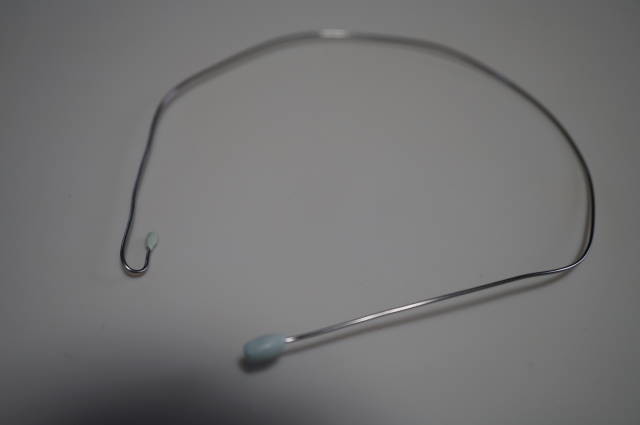
In an entry published in January 2021, Mr. Okada tested a retrieval idea after a customer's request exposed an untested assumption. His J-hook (a wire tip shaped like the letter J) caught the thread loop only about 10% of the time.
The wire measured 25 cm long and 0.7 mm across, with resin covers at both ends. It cost ¥500 (about $3 at ¥156 = $1, rate as of 2026-09-04) excluding tax as published in January 2021. Mr. Okada warned that the hook could push the resin connector and thread farther inside.
(Source: ok-lab's diary, published January 2021)
https://ok-lab.hatenablog.com/entry/2021/01/09/130022
A keyring design gave wire removal another potential attachment point
An entry published in August 2024 described a flexible cord loop shaped like a keyring. Mr. Okada intended it to remain near the penile tip, with wire retrieval proposed when the thread was hidden.
The keyring portion cost ¥2,000 (about $13 at ¥156 = $1, rate as of 2026-09-04) for up to 10 cm, plus ¥500 (about $3 at ¥156 = $1, rate as of 2026-09-04) per additional 5 cm, excluding tax. Those August 2024 charges were added to the chosen chip's price. He tested the design while his penis was held inward; he had not tested its version for ordinary positioning. Mr. Okada offered an additional stopper for customers concerned about inward movement.
(Source: ok-lab's diary, published August 2024)
https://ok-lab.hatenablog.com/entry/2024/08/17/122842
A new extension brought fit problems during straw removal trials
In an entry published in March 2025, Mr. Okada described a firm wire extension ending in a small retrieval loop. The loop measured about 20 mm long and 8 mm wide; the complete extension was 4 cm or longer. His straw concept depended on friction, but he found engagement inside the urethra difficult.
He believed the firmer loop's position was easier to detect than a loose thread's position. The extension cost ¥4,000 (about $26 at ¥156 = $1, rate as of 2026-09-04) excluding tax, with a ¥1,000 (about $6 at ¥156 = $1, rate as of 2026-09-04) reduction when the chip had no thread. Mr. Okada offered a temporary nylon thread for customers who wanted one while assessing safety.
(Source: ok-lab's diary, published March 2025)
https://ok-lab.hatenablog.com/entry/2025/03/29/122912
April wire removal trials succeeded with several differently priced tools
In an entry published in April 2025, Mr. Okada reported successful first attempts with the multipurpose hook in 3 trials. He also reported no tendency for that test setup to push the chip farther inward. His prices were ¥10 (about $0 at ¥156 = $1, rate as of 2026-09-04) or less for straws and ¥500 (about $3 at ¥156 = $1, rate as of 2026-09-04) excluding tax for the multipurpose wire.
Single-loop and double-loop tools cost ¥3,000 (about $19 at ¥156 = $1, rate as of 2026-09-04) and ¥5,000 (about $32 at ¥156 = $1, rate as of 2026-09-04) excluding tax, respectively, for tubing up to 20 cm long. Either could be made up to 30 cm for an additional ¥1,000 (about $6 at ¥156 = $1, rate as of 2026-09-04) excluding tax. Mr. Okada advised against longer tubing because he expected increased friction.
(Source: ok-lab's diary, published April 2025)
https://ok-lab.hatenablog.com/entry/2025/04/05/122932
A failed wire removal ended with hospital treatment in May 2025
In an entry published in May 2025, a customer sought help after wire retrieval failed and the attached thread disappeared. Their device, made only of shape-memory wire and silicone tubing, was called chipless in the diary. Initial advice assumed accessible retrieval loops; after learning the thread was missing, Mr. Okada advised a urology visit.
Hospital removal used a cystoscope (a bladder scope); a scan, urine testing, and waiting took about 5 hours, costing ¥34,000 (about $218 at ¥156 = $1, rate as of 2026-09-04). Mr. Okada blamed the 2.5 mm tubing and 0.3 mm wire loop crossing the sphincter (urine-control muscle) after being forced inward. He warned against excessive inward force because the flexible device could move beyond its intended position.
(Source: ok-lab's diary, published May 2025)
https://ok-lab.hatenablog.com/entry/2025/05/03/122907
The maker's answer to chip removal
Mr. Okada's replies favored an accessible thread, acknowledged wire limitations, and included referral for medical removal.
An external thread remained Mr. Okada's fallback for wire removal
In an entry published in January 2021, Mr. Okada discussed keeping an entire chip assembly inside the urethra. He proposed a retrieval loop beyond the auxiliary chip (an extra attached part) as a backup connection for the wire.
He had kept the whole assembly inside for about a week, but had not actually used the prepared wire for removal. He specifically discouraged this arrangement for people whose devices readily moved into the bladder. Mr. Okada strongly favored a nylon extension thread while control of movement or removal remained uncertain.
(Source: ok-lab's diary, published January 2021)
https://ok-lab.hatenablog.com/entry/2021/01/16/124800
A missing chip led to firm limits on wire removal
In an entry published in December 2021, a customer reported losing track of a fully internal chip after sleeping. Mr. Okada initially requested a wire search, but the entry records no follow-up confirming the chip's location or removal.
His reply limited wire retrieval to the urethra and acknowledged that medical care might be necessary. Mr. Okada warned against searching inside the bladder with a wire.
(Source: ok-lab's diary, published December 2021)
https://ok-lab.hatenablog.com/entry/2021/12/18/123756
Small loops required a dedicated hook for wire removal
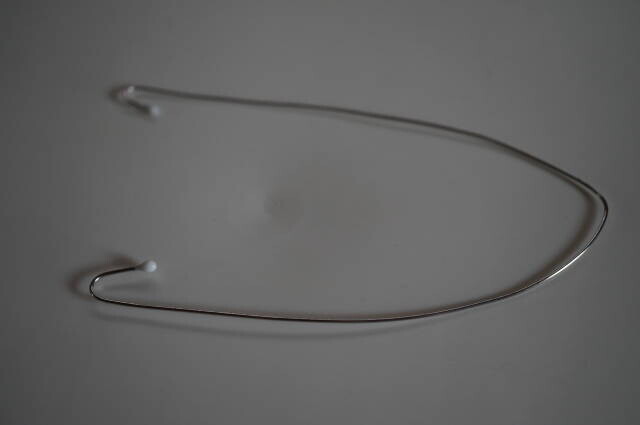
In an entry published in April 2025, Mr. Okada described a compatibility problem with 0.2 mm wire loops. The usual multipurpose hook's covered tip was too large to catch their small end loops.
He made a dedicated wire with smaller covered hooks, measuring 20 cm long and 0.7 mm across. It cost ¥500 (about $3 at ¥156 = $1, rate as of 2026-09-04) excluding tax as published in April 2025; existing buyers of those loop products were offered it free. Mr. Okada recommended this dedicated hook for future purchases of those particular loops.
(Source: ok-lab's diary, published April 2025)
https://ok-lab.hatenablog.com/entry/2025/04/19/122913
If you see blood in your urine, even a small amount or for the first time, do not wait and see. See a urologist right away. If you suddenly cannot urinate, or the device cannot be removed, do not try to fix it yourself. Go to a medical facility, including emergency care, immediately.
How chip removal changed over time
| Published | What the diary said then |
|---|---|
| Mar 2018 | Mr. Okada reported a 5 mm straw stopping about 2 cm inside. |
| Jan 2021 | Mr. Okada found 0.5 mm bends straightened; 1 mm wire felt harsh. |
| Nov 2023 | Mr. Okada warned that a buried mesh-stopper thread made retrieval harder. |
| Mar 2025 | Mr. Okada blamed dryness for friction and warned that semen could become sticky. |
| Apr 2025 | A paired-straw trial worked, but Mr. Okada flagged the 8 mm fit requirement. |
| May 2025 | Mr. Okada proposed a softer 0.2 mm retrieval extension after the hospital case. |
| May 2025 | A custom build combined a firm extension with a softer retrieval loop. |
| Nov 2025 | Mr. Okada found looped wire threads harder to remove with 4 strands than 2. |
| Apr 2026 | A proposed alternative retrieval device remained unbuilt and untested. |
The diary does not say what the current state is.

OK Prostate Chip products related to chip removal
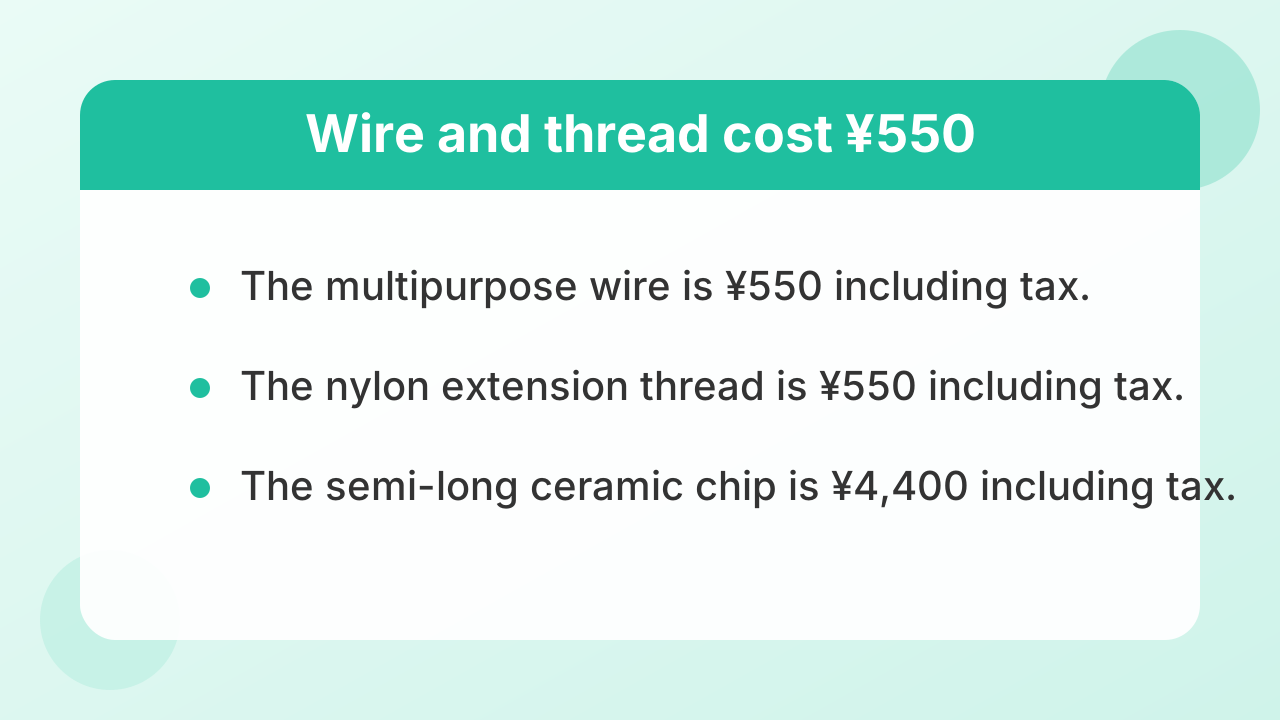
The current list includes the multipurpose wire and extension thread, while the cases also name components involved in failed removal.
Products that appear in these entries
| Product (official name) | Price incl. tax | Relation to this topic |
|---|---|---|
| Multipurpose stainless-steel wire (多目的ステンレスワイヤー) | ¥550 (about $4 at ¥156 = $1, rate as of 2026-09-04) | In March 2025, this wire failed to retrieve the customer's ceramic chip assembly. |
| Semi-long ceramic chip (OKプロステートチップ 陶器素材セミロングタイプ) | ¥4,400 (about $28 at ¥156 = $1, rate as of 2026-09-04) | In March 2025, the customer identified this ceramic model within the assembly that initially would not come out. |
| Resin screw auxiliary chip (スクリュー型補助チップ追加オプション(生体適合樹脂)) | ¥3,300 (about $21 at ¥156 = $1, rate as of 2026-09-04) | In March 2025, this auxiliary component formed part of the same troublesome ceramic assembly. |
| Six-hole sphincter stopper (六穴方式オプションチップ(括約筋ストッパーチップ)) | ¥2,200 (about $14 at ¥156 = $1, rate as of 2026-09-04) | In March 2025, this stopper was another named component of the assembly whose wire retrieval failed. |
(Source: ok-lab's diary, published March 2025)
https://ok-lab.hatenablog.com/entry/2025/03/01/122825
Products the diary mentioned as alternatives
| Product (official name) | Price incl. tax | Relation to this topic |
|---|---|---|
| Nylon extension thread with loops at both ends (両端ループナイロン糸) | ¥550 (about $4 at ¥156 = $1, rate as of 2026-09-04) | In January 2021, Mr. Okada favored this extension over fully hidden threads while movement or removal remained uncertain. |
(Source: ok-lab's diary, published January 2021)
https://ok-lab.hatenablog.com/entry/2021/01/16/124800
| Historical or custom items | Current-list status |
|---|---|
| Keyring builds, loop-ended extensions, chipless devices, chipless guide wires, mesh-stopper assemblies, and looped wire-thread assemblies | No matching product can be confirmed on the current list. |
| Single-loop retrieval tool, double-loop retrieval tool, dedicated small-hook wire, and the unbuilt retrieval concept | No matching product can be confirmed on the current list. |
Common worries about chip removal
The customer questions concern failed retrieval, tools serving two purposes, and a broken thread.
"Can a guide wire also support chip removal?"
In an entry published in December 2024, a customer asked whether a guide wire (a positioning tool) could also support removal. Mr. Okada proposed separate ends for the guiding and retrieval functions. He thought a loop remaining in the wider urethral section might still be reachable.
But if the entire device crossed the sphincter, he thought wire retrieval would fail. The diary does not record a removal test for that customer's proposed version. Mr. Okada favored a thread remaining visible outside the body over reliance on the wire alone.
(Source: ok-lab's diary, published December 2024)
https://ok-lab.hatenablog.com/entry/2024/12/14/122948

"Can chip removal fail even while the thread remains visible?"
In an entry published in March 2025, a customer feared their ceramic chip assembly had entered the bladder. The multipurpose wire had not retrieved it, and the customer feared breaking the exposed thread.
Before receiving practical advice, the same customer reported successful thread-assisted removal during urination. Staff acknowledged the follow-up; the suspected bladder movement was not confirmed in this exchange. Mr. Okada warned against force, saying tension sufficient to break the thread would injure the urethra.
(Source: ok-lab's diary, published March 2025)
https://ok-lab.hatenablog.com/entry/2025/03/01/122825
"Would wire removal help after the chip's thread breaks?"
In an entry published in April 2026, a customer reported pain and no natural release after about a week. They were considering the multipurpose wire after the retrieval thread had broken. OK Lab's staff warned that its hook could slip from the chip, while pressure could send the device into the bladder.
The customer then asked about another developing tool; Mr. Okada replied that it lacked the required retrieval function. The diary does not record whether the customer's chip was subsequently removed. Mr. Okada cautioned that even the alternative he proposed would not provide certain retrieval.
(Source: ok-lab's diary, published April 2026)
https://ok-lab.hatenablog.com/entry/2026/04/04/122916
Buying from outside Japan
OK Lab ships internationally to countries covered by Japan Post's EMS courier service. Overseas orders are paid in advance by PayPal. Each order carries a ¥400 (about $3 at ¥156 = $1, rate as of 2026-09-04) handling fee, and EMS shipping is charged on top. These terms come from OK Lab's official sales-terms page (written here as plain text, not a link: ok-lab.net/docs/law), checked on September 7, 2026; confirm them on the official store before you order, because they can change.
Summary of this article
| What you wanted to know | The answer |
|---|---|
| In short: will a wire or straw work? | The diary records successes, failures, and hospital removal. |
| About this product: who makes it? | OK Lab in Japan makes the urethral device; prices are in JPY. |
| Key terms: what does the hook catch? | A retrieval loop or component, depending on the design. |
| What happens: what did trials establish? | Mr. Okada reported success in particular setups; customers also reported failed retrieval. |
| The maker's answer: what limits did he identify? | Hidden threads, inaccessible parts, excessive force, and bladder probing complicated his proposals. |
| Changes over time: what developed? | Straw proposals expanded into several hook and loop tools, alongside reports of limitations. |
| Related products: what is currently listed? | The multipurpose wire and nylon extension thread each cost ¥550 (about $4 at ¥156 = $1, rate as of 2026-09-04) including tax. |
| Common worries: does an exposed thread guarantee retrieval? | The March 2025 customer initially could not retrieve the assembly despite an accessible thread. |
| Buying abroad: what payment and fees apply? | Advance PayPal payment, a ¥400 (about $3 at ¥156 = $1, rate as of 2026-09-04) handling fee, and additional EMS shipping. |
Source: ok-lab's diary (Okada Comfortable Life Laboratory). The original entries are in Japanese; quotations on this page are translated. Photos and videos are on the original entries.
This article is a summary of the maker's development diary. The product is not a medical device and no result is guaranteed. If anything feels wrong or worries you, see a doctor. Prices, specifications and cautions change, so confirm the latest information on the official blog and the official site. Questions about ordering and shipping go to the seller.