![Can I pee with a prostate chip in place? | Reports vary by design [OK Prostate Chip]](/img/a/T0140/eyecatch.svg)
This page is based on entries from "ok-lab's diary" (https://ok-lab.hatenablog.com/), the Japanese development diary written by Mr. Okada, founder of OK Lab, a small company in Japan (Okada Comfortable Life Laboratory). Only the entries about "peeing with a prostate chip" are summarized here, in order of publication. Past prices and sizes are as written at the time. Current prices come from the official product list (retrieved September 4, 2026). Quotations are translated from Japanese.
Note: This page is a personal reading log by someone with no connection to the maker or the seller. It reflects the source entries as of their publication dates and makes no guarantee of accuracy or safety. The product is not a medical device; talk to a doctor about any health decision. Check the official site for current information. This page contains advertising.
In short
Reports describe easier peeing with some open designs, but slipping, pain, and a hospital removal also appear.
Mr. Okada favored shapes that leave urine passages open, while revising joints, cables, and supports.
Current listings include screw and ceramic models; several historical custom builds cannot be matched confidently.
If you see blood in your urine, even a small amount or for the first time, do not wait and see. See a urologist right away. If you suddenly cannot urinate, or the device cannot be removed, do not try to fix it yourself. Go to a medical facility, including emergency care, immediately.
About this product
The OK Prostate Chip is a small device that is placed in the urethra (the urine passage) so that it acts on the prostate; the maker sells it in several shapes, sizes and materials. It is made and sold by OK Lab (Okada Comfortable Life Laboratory), a small company in Japan, through its own online store, and prices are in Japanese yen (JPY).
The maker's development diary, "ok-lab's diary", is written in Japanese. This page is an English summary of it, and every quotation is translated.
OK Lab ships internationally, so readers outside Japan can order (see "Buying from outside Japan" below). Product names on this page are plain-English descriptions. The official Japanese product name is shown once in the product table so you can find the same item in the store.
Before you read: key terms
| Term | Plain-English meaning |
|---|---|
| Urethra | The urine passage; the chip occupies part of this route. |
| Prostate | The diary does not explain this. |
| Urinary sphincter | A muscle involved in controlling urine release; some supports sit near it. |
| Support chip | An extra component intended to help keep the main chip in place. |
| Resin | Plastic used for chip bodies; the maker labels some versions biocompatible, meaning suitable for placement inside the body. |
| Urethral sound | A rod-like urethral device; the February 2023 version could also connect to a prostate chip. |
| Mineral buildup | Hard deposits reported on a chip; the term describes the customer's stone-like coating. |
| USB | An electrical connector used to connect a motor chip to its controller. |
What happens: peeing with a prostate chip
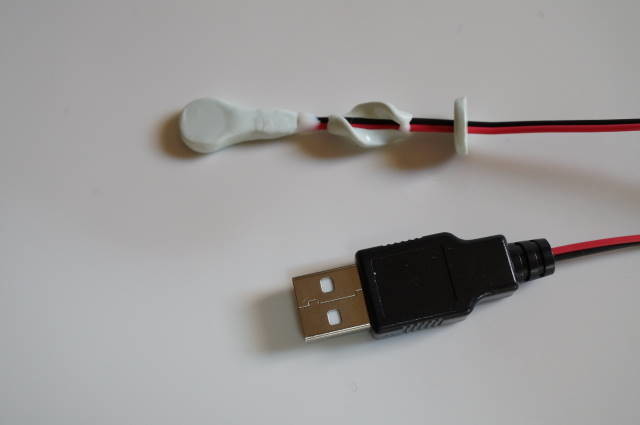
The OK Prostate Chip is a small device placed in the urethra, the urine passage, to act on the prostate. The question is whether urine passes freely while the chip stays inside. The comparisons cover flat and twisted bodies, plus support pieces and cable arrangements intended to keep the chip in place. Mr. Okada describes urine flowing around some shapes and through openings in others.
A stuck linked pair exposed risks beyond ease of peeing
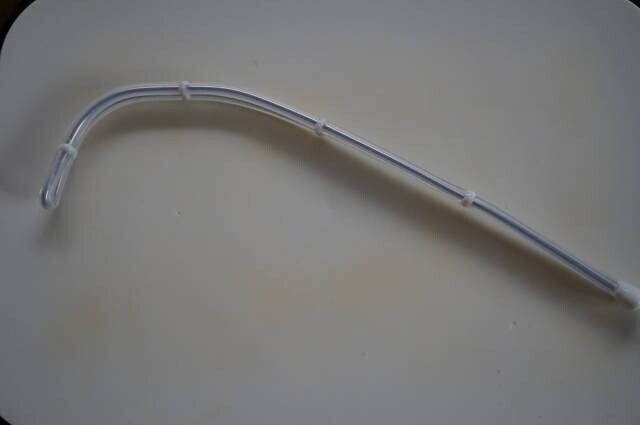
In an entry published in March 2018, a customer reported that linked chips became entangled and required hospital removal. No further circumstances were available. He announced that future leading chips would be at least 30 mm long.
His proposed explanation was that a short leading section had turned around inside the urethra. Mr. Okada cautioned that even 30 mm might not prevent this because anatomy varies.
(Source: ok-lab's diary, published March 2018)
https://ok-lab.hatenablog.com/entry/20180310/1520672565
A cable stopper slowed urine flow compared with the thread model
In an entry published in July 2019, Mr. Okada introduced a stopper for motor-chip cables. He reported slower urination than with the three-hole thread stopper, attributing this to the thicker cable restricting sideways movement. Planned sizes were M at 9 mm and L at about 11 mm.
The planned price was ¥1,500 (about $10 at ¥156 = $1, rate as of 2026-09-04) tax excluded. Mr. Okada warned that a stopper caught in the urinary sphincter (the muscle controlling urine release) could move inward.
(Source: ok-lab's diary, published July 2019)
https://ok-lab.hatenablog.com/entry/2019/07/06/152113
A short ceramic chip flew out while peeing and broke
In an entry published in October 2019, a customer compared a single-chip resin (plastic) screw with an S short ceramic chip. The screw reportedly allowed ordinary urination, while the ceramic version was difficult to keep in place. The customer asked about a lingering feeling of incomplete emptying; no specific answer to that question appears.
The ceramic chip later flew out during urination, hit the toilet, and broke in half. Mr. Okada said that week's revised ceramic version was stronger, while acknowledging limited impact testing. He cautioned that breakage depended on where an impact struck.
(Source: ok-lab's diary, published October 2019)
https://ok-lab.hatenablog.com/entry/2019/10/05/141806
A stopper test raised concerns about leakage and slower urine flow
In an entry published in November 2020, Mr. Okada revisited leakage after testing a stopper attached through a projecting connector. He suspected sphincter injury, but did not present a confirmed diagnosis. Subsequent tests with differently connected chips did not reproduce that problem.
In one later test, he felt that thicker coating restricted stopper movement and partly held back urine. Mr. Okada cautioned that further problems might still emerge with continued testing.
(Source: ok-lab's diary, published November 2020)
https://ok-lab.hatenablog.com/entry/2020/11/14/131426
A flat silicone-covered sound paired urine flow claims with historical prices
In an entry published in February 2023, Mr. Okada introduced a flat silicone-covered urethral sound (a rod-like device for the urine passage). He attributed unobstructed urine passage to the valley between its parallel tubes. The design could also connect to a prostate chip.
Launch prices were ¥2,500 (about $16 at ¥156 = $1, rate as of 2026-09-04) for 10 cm, ¥4,500 (about $29 at ¥156 = $1, rate as of 2026-09-04) for 20 cm, and ¥5,500 (about $35 at ¥156 = $1, rate as of 2026-09-04) for 25 cm, all tax excluded. Mr. Okada recommended this design as a basic urethral sound.
(Source: ok-lab's diary, published February 2023)
https://ok-lab.hatenablog.com/entry/2023/02/18/122910
A flat-curve customer reported easier peeing after changing size
In an entry published in May 2023, a customer followed up on mineral buildup (hard, stone-like deposits) on a flat-curve chip. The M version had developed deposits after 3 days, while the L remained clean after 10 days in place. They also reported easier urination with L.
They suspected the shorter chip had interrupted urine flow and left urine around it. Mr. Okada considered that explanation possible; the entry does not establish the cause. His suggestion that a longer chip might address incomplete emptying remained tentative.
(Source: ok-lab's diary, published May 2023)
https://ok-lab.hatenablog.com/entry/2023/05/06/123024
A customer reported easy peeing with linked screws, then later pain
In an entry published in July 2026, a customer reported easy urination with a ceramic twisted chip and three linked screw supports. However, pain stopped a later attempt, and the customer also wanted a larger support for a different setup that slipped. The eventual request included steel and resin three-plus-one screw arrangements.
Quoted steel screws in L, M, and S were ¥5,500 (about $35 at ¥156 = $1, rate as of 2026-09-04) each; second-generation resin screws in those sizes were ¥3,500 (about $22 at ¥156 = $1, rate as of 2026-09-04) each. The extra L resin screw was also quoted at ¥3,500 (about $22 at ¥156 = $1, rate as of 2026-09-04). The diary does not record how the newly requested arrangements felt in use.
(Source: ok-lab's diary, published July 2026)
https://ok-lab.hatenablog.com/entry/2026/07/18/122919
The maker's answer to peeing with a prostate chip
Mr. Okada's responses focused on leaving a urine passage while limiting unwanted movement.
A crossed joint became standard to improve urine flow
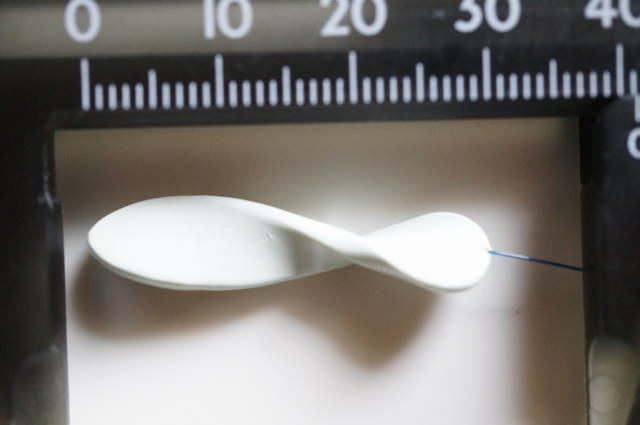
In an entry published in September 2018, Mr. Okada replaced tip-to-tip contact between linked resin chips with an interlocking crossed joint. The connection could bend in two directions. He believed its shape improved urine passage and made the chips less likely to be expelled.
This joint became standard for the connected plain-resin and resin-screw designs described then. Mr. Okada also noted stronger urethral stimulation from the crossed section. He invited interested customers to consider the revised joint.
(Source: ok-lab's diary, published September 2018)
https://ok-lab.hatenablog.com/entry/20180908/1536384939
Two parallel cables reportedly reduced slipping without slowing urine flow
In an entry published in February 2020, a customer's request for an extra cable led Mr. Okada to test parallel motor cables. He reported no additional interference with urination and less outward movement than with one cable. His test used a motor without a main chip.
Quoted upgrades cost ¥1,000 (about $6 at ¥156 = $1, rate as of 2026-09-04) for the cable and ¥500 (about $3 at ¥156 = $1, rate as of 2026-09-04) for USB (an electrical controller connection), totaling ¥1,500 (about $10 at ¥156 = $1, rate as of 2026-09-04) as quoted, all tax excluded. Mr. Okada favored the directly attached two-cable arrangement because of its observed stability.
(Source: ok-lab's diary, published February 2020)
https://ok-lab.hatenablog.com/entry/2020/02/08/151653
A twisted cable offered another approach to peeing with a chip
In an entry published in March 2020, Mr. Okada announced a custom motor chip with a twisted cable intended to replace separate support components. He reported that the twist allowed urine passage while helping maintain position. The custom version cost ¥3,000 (about $19 at ¥156 = $1, rate as of 2026-09-04), with a ¥500 (about $3 at ¥156 = $1, rate as of 2026-09-04) USB option.
A March update changed the factory-set distance between chip and twist from 2.5 cm to 3.5 cm. Mr. Okada cautioned that prolonged contact between the twist and the prostate or sphincter could cause discomfort.
(Source: ok-lab's diary, published March 2020)
https://ok-lab.hatenablog.com/entry/2020/03/07/152901
A hollow support offered easier urine flow, with limited early testing
In an entry published in December 2023, Mr. Okada introduced a hollow support with a rigid 4 mm urine passage. He described freer flow than through a screw support under external pressure. Its announced length was about 15 mm, with an M oval measuring approximately 8.5 mm × 6.5 mm.
The published price was ¥3,000 (about $19 at ¥156 = $1, rate as of 2026-09-04) tax excluded. Mr. Okada cautioned that testing was still limited and the smooth surface could allow the support to slide.
(Source: ok-lab's diary, published December 2023)
https://ok-lab.hatenablog.com/entry/2023/12/23/122035
If you see blood in your urine, even a small amount or for the first time, do not wait and see. See a urologist right away. If you suddenly cannot urinate, or the device cannot be removed, do not try to fix it yourself. Go to a medical facility, including emergency care, immediately.
How peeing with a prostate chip changed over time
| Published | What the diary said then |
|---|---|
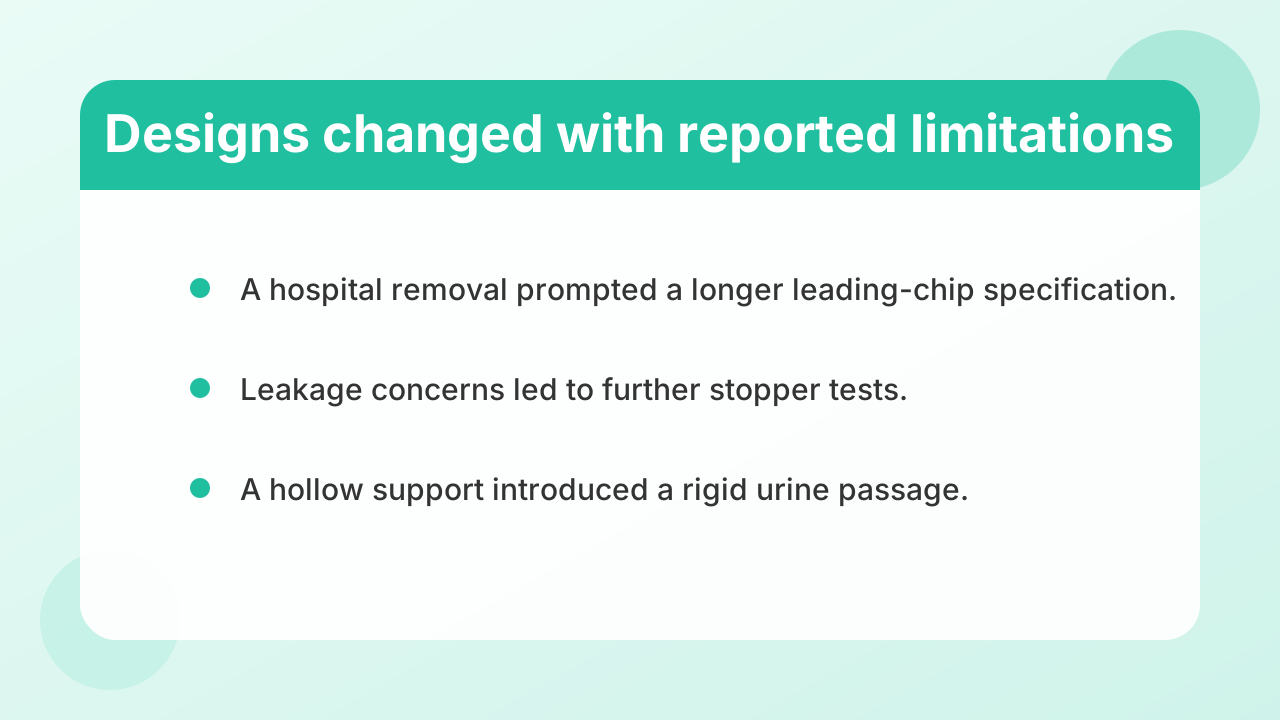
| Mar 2018 | A hospital removal prompted a longer leading-chip specification. |
| Sep 2018 | Crossed joints became standard for connected plain-resin and screw designs. |
| Jul 2019 | A cable stopper restricted urine flow more than its thread counterpart. |
| Nov 2020 | Leakage concerns led to further stopper tests, including reports of restricted flow. |
| May 2023 | A customer reported smoother flow and no deposits after changing flat-curve size. |
| Dec 2023 | A hollow support introduced a rigid urine passage, with limited testing. |
| May 2026 | Resin and surgical-steel versions of the semi-long ceramic twisted design remained unavailable. |
| Jul 2026 | Custom three-plus-one screw arrangements received material-specific quotes. |
OK Prostate Chip products related to peeing with a prostate chip
These current listings identify individual products, without confirming every historical configuration or size option.
Products that appear in these entries
| Product (official name) | Price incl. tax | Relation to this topic |
|---|---|---|
| Single-chip resin screw (OKプロステートチップ 樹脂素材1チップタイプ スクリュー) | ¥4,400 (about $28 at ¥156 = $1, rate as of 2026-09-04) | An October 2019 customer reported easier urination with this resin screw than with their short ceramic chip. |
| Short ceramic chip (OKプロステートチップ 陶器素材ショートタイプ) | ¥3,300 (about $21 at ¥156 = $1, rate as of 2026-09-04) | In October 2019, this was the customer's chip that flew out during urination and broke against the toilet. |
| Semi-long ceramic curved-tail chip (OKプロステートチップ 陶器素材セミロング勾玉タイプ) | ¥5,500 (about $35 at ¥156 = $1, rate as of 2026-09-04) | A January 2020 customer asked how this curved-tail design compared with a screw support for urine flow. |
| Semi-long ceramic twisted chip (OKプロステートチップ 陶器素材セミロングタイプ コブラツイスト) | ¥5,500 (about $35 at ¥156 = $1, rate as of 2026-09-04) | In May 2026, a customer wanted this ceramic twisted design in a less breakable material. |
(Source: ok-lab's diary, published October 2019)
https://ok-lab.hatenablog.com/entry/2019/10/05/141806
(Source: ok-lab's diary, published January 2020)
https://ok-lab.hatenablog.com/entry/2020/01/25/150127
(Source: ok-lab's diary, published May 2026)
https://ok-lab.hatenablog.com/entry/2026/05/23/122904
Products the diary mentioned as alternatives
| Product (official name) | Price incl. tax | Relation to this topic |
|---|---|---|
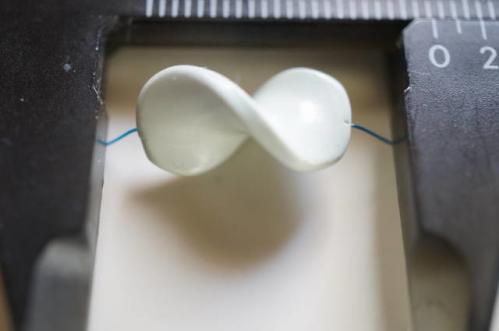
| Screw-shaped support option (スクリュー型補助チップ追加オプション) | ¥3,300 (about $21 at ¥156 = $1, rate as of 2026-09-04) | In December 2019, Mr. Okada favored this addition after a beginner reported their chip coming out during urination. |
This support option is listed in OK Lab's own online store.
(Source: ok-lab's diary, published December 2019)
https://ok-lab.hatenablog.com/entry/2019/12/28/131319
Historical builds and nicknames: linked pairs, flat silicone-covered sound, flat-curve chip, hollow support, custom cable arrangements, and three-plus-one screws. No matching product can be confirmed on the current list.
Common worries about peeing with a prostate chip
Readers asked about slipping, urine flow, and material choices; some replies lacked follow-up results.
"Can a support stop my chip slipping out while peeing?"
In an entry published in December 2019, a beginner said their chip came out during urination and asked which option to choose. The reply listed a larger semi-long chip, a curved-tail design, and a screw-shaped support. These suggestions concerned parts easier to locate in the wider urethral section near the prostate.
The diary does not record whether this customer tried an alternative. Mr. Okada's stated preference was the screw-shaped support for its insertion characteristics and resistance to expulsion during urination.
(Source: ok-lab's diary, published December 2019)
https://ok-lab.hatenablog.com/entry/2019/12/28/131319
"Does a screw allow easier peeing than the curved tail?"
In an entry published in January 2020, a customer considering the semi-long ceramic curved-tail chip asked what a screw support added. Mr. Okada explained that pressure around the curved tail could stop urine flow, whereas the screw left a passage open. He described the screw support as a separate component near the main chip.
The customer confirmed payment, but no report of use followed in this exchange. Mr. Okada favored the screw for this purpose while explicitly declining to guarantee pain-free use.
(Source: ok-lab's diary, published January 2020)
https://ok-lab.hatenablog.com/entry/2020/01/25/150127
"Can easier peeing come with a less breakable twisted chip?"
In an entry published in May 2026, a customer wanted the semi-long ceramic twisted shape in biocompatible resin or surgical stainless steel. Mr. Okada replied that neither material version existed then and that sales plans were undecided. The customer also asked whether multiple supports could reduce expulsion.
Mr. Okada thought additional contact could resist movement, but distinguished potentially restrictive stoppers from screws he expected to impede urine less. The diary does not record a purchase or trial following this reply. His answer favored screws over stoppers when considering urine passage.
(Source: ok-lab's diary, published May 2026)
https://ok-lab.hatenablog.com/entry/2026/05/23/122904
Buying from outside Japan
OK Lab ships internationally to countries covered by Japan Post's EMS courier service. Overseas orders are paid in advance by PayPal. Each order carries a ¥400 (about $3 at ¥156 = $1, rate as of 2026-09-04) handling fee, and EMS shipping is charged on top. These terms come from OK Lab's official sales-terms page (written here as plain text, not a link: ok-lab.net/docs/law), checked on September 7, 2026; confirm them on the official store before you order, because they can change.
Summary of this article
| What you wanted to know | The answer |
|---|---|
| What is the short answer? | Reports vary by design and individual experience. |
| What is this product? | A urethral device made by OK Lab in Japan. |
| What do the terms mean? | Main chips, supports, and connectors serve different roles in the diary. |
| What happened during urination? | Accounts included easier flow, expulsion, breakage, and leakage. |
| What did the maker propose? | Crossed joints, parallel or twisted cables, and hollow supports. |
| What changed over time? | Designs and prices evolved, with limitations still reported in 2026. |
| What is listed today? | The tables identify current products and tax-inclusive yen prices. |
| What remains uncertain? | Some replies lack outcomes; proposed causes remain unconfirmed. |
| How do overseas orders work? | Advance PayPal payment, a ¥400 (about $3 at ¥156 = $1, rate as of 2026-09-04) handling fee, and additional EMS shipping. |
Source: ok-lab's diary (Okada Comfortable Life Laboratory). The original entries are in Japanese; quotations on this page are translated. Photos and videos are on the original entries.
This article is a summary of the maker's development diary. The product is not a medical device and no result is guaranteed. If anything feels wrong or worries you, see a doctor. Prices, specifications and cautions change, so confirm the latest information on the official blog and the official site. Questions about ordering and shipping go to the seller.