![Can a prostate chip come out while peeing? | Sometimes, but hospital removal may be needed [OK Prostate Chip]](/img/a/T0148/eyecatch.svg)
This page is based on entries from "ok-lab's diary" (https://ok-lab.hatenablog.com/), the Japanese development diary written by Mr. Okada, founder of OK Lab, a small company in Japan (Okada Comfortable Life Laboratory). Only the entries about "chip removal while peeing" are summarized here, in order of publication. Past prices and sizes are as written at the time. Current prices come from the official product list (retrieved September 4, 2026). Quotations are translated from Japanese.
Note: This page is a personal reading log by someone with no connection to the maker or the seller. It reflects the source entries as of their publication dates and makes no guarantee of accuracy or safety. The product is not a medical device; talk to a doctor about any health decision. Check the official site for current information. This page contains advertising.
In short
Some chips passed during urination; other reports describe bleeding, breakage, or hospital removal.
Mr. Okada connected easier removal with urine flow, moisture, and the retrieval thread (the thread attached for removal).
Current listings include products involved in past accidents; those reports do not establish dependable removal.
If you see blood in your urine, even a small amount or for the first time, do not wait and see. See a urologist right away. If you suddenly cannot urinate, or the device cannot be removed, do not try to fix it yourself. Go to a medical facility, including emergency care, immediately.
About this product
The OK Prostate Chip is a small device that is placed in the urethra (the urine passage) so that it acts on the prostate; the maker sells it in several shapes, sizes and materials. It is made and sold by OK Lab (Okada Comfortable Life Laboratory), a small company in Japan, through its own online store, and prices are in Japanese yen (JPY). The maker's development diary, "ok-lab's diary", is written in Japanese. This page is an English summary of it, and every quotation is translated. OK Lab ships internationally, so readers outside Japan can order (see "Buying from outside Japan" below). Product names on this page are plain-English descriptions. The official Japanese product name is shown once in the product table so you can find the same item in the store.
Before you read: key terms
| Term | Plain-English meaning |
|---|---|
| Urethra | The urine passage; the chip sits inside it to act on the prostate. |
| Bladder | The space that holds urine before urination; several reports concern chips that moved into it. |
| Retrieval thread | A thread attached to the chip, intended to help with removal. |
| Urinary sphincter | A muscle controlling the urine passage; Mr. Okada says its grip also helps hold a chip. |
| Internal stopper | A part intended to prevent the chip moving farther inward past the urinary sphincter. |
| External stopper | A part outside the penis intended to keep the thread outside. |
| Endoscopic surgery | A hospital procedure used to remove a trapped chip. The diary does not explain this. |
What happens: chip removal while peeing
The OK Prostate Chip is a small device placed inside the urethra to act on the prostate. Chip removal while peeing means the device comes out during urination, sometimes with help from its retrieval thread. Mr. Okada links this to urine flow and moisture around the device. The entries concern chips in the urethra and chips that moved into the bladder (the space holding urine before urination).
Early claims about chip removal while peeing emphasized moisture
In an entry published in December 2017, Mr. Okada described the chip as continually washed by urine and rarely dry. He presented this as an advantage when discussing friction during removal. His advice at that time associated easier removal with the period immediately after urination.
(Source: ok-lab's diary, published December 2017)
https://ok-lab.hatenablog.com/entry/20171231/1514712104
Long-chip tests showed that peeing out a chip could fail initially
In an entry published in January 2018, Mr. Okada recalled 2 long-chip tests in which the device became stuck. He considered seeking hospital care, but reported eventual passage during urination. He attributed eventual passage to urine pressure. He advised beginners and intermediate users against buying that long design.
(Source: ok-lab's diary, published January 2018)
https://ok-lab.hatenablog.com/entry/20180111/1515662782
Peeing out a broken chip did not prevent bladder injury
In an entry published in January 2019, a customer reported that a semi-long twisted glass chip broke inside the body. The broken piece entered the bladder and passed about 1 week later. An examination found widespread injury to the bladder lining.
The customer requested a plain single-chip glass model instead, and Mr. Okada apologized. The diary does not record whether the requested order change was completed. Mr. Okada advised people concerned about glass breakage to consider resin instead.
(Source: ok-lab's diary, published January 2019)
https://ok-lab.hatenablog.com/entry/2019/01/26/152042
Peeing out a chip failed with one large curved design
A separate customer report in the entry published in January 2019 concerned a strongly curved chip with a section over 10mm. After it entered the bladder, the customer reported no sign of natural passage. A urology department removed it through endoscopic surgery (a hospital removal procedure). Mr. Okada emphasized the importance of the retrieval thread remaining outside the body.
(Source: ok-lab's diary, published January 2019)
https://ok-lab.hatenablog.com/entry/2019/01/26/152042
Chip removal while peeing failed before hospital treatment became necessary
In an entry published in April 2022, a customer described a curved double-twist ceramic chip that entered the bladder. Previous removal experiences had seemed reassuring, but this time urination and thread assistance failed. The customer reported blood in urine, leakage, and pain.
The hospital found the chip off to one side of the bladder and ultimately removed it using force. The reported treatment cost was about ¥8,000 (about $51 at ¥156 = $1, rate as of 2026-09-04), as published in April 2022. Mr. Okada questioned internal stoppers (parts limiting inward movement) and favored external stoppers (parts keeping the thread outside).
(Source: ok-lab's diary, published April 2022)
https://ok-lab.hatenablog.com/entry/2022/04/02/123050
Chip removal while peeing preceded fever in one reported case
In an entry published in January 2023, a customer reported several days of difficulty with a long chip and screw-shaped second chip. Removal attempts caused pain and bleeding, and initial attempts during urination failed. The assembly eventually came out following urination, but the customer then experienced high fever for about 2 days.
The customer reported recovery. Mr. Okada suspected rotation and thread tangling, rather than confirming what had happened inside the body. He proposed connections he thought would be less prone to tangling.
(Source: ok-lab's diary, published January 2023)
https://ok-lab.hatenablog.com/entry/2023/01/07/123115
A rigid curved extension complicated chip removal while peeing
In an entry published in May 2023, a customer described a long curved-extension chip that resisted removal, including during urination. It eventually came out the following morning. The customer asked whether its angle explained the difficulty.
Mr. Okada described a 6cm section and roughly 2cm extension: a rigid 8cm device. He suspected the curved end could return at an unsuitable angle after moving beyond the urinary sphincter (the muscle controlling the urine passage). He did not recommend this rigid design for people seeking deeper placement.
(Source: ok-lab's diary, published May 2023)
https://ok-lab.hatenablog.com/entry/2023/05/06/123024
A broken attachment remained inside after chip removal while peeing
In an entry published in June 2025, a customer reported a cracked screw attachment made specifically for a tail. The main device came out, but the attachment remained inside and some blood appeared in urine. The retained part passed during urination 2–3 hours later.
Other attachments bought around the same time also showed cracks. Mr. Okada suspected separation where resin pieces had been joined, rather than establishing a confirmed cause. He advised inspection before use and cautioned against strong forces.
(Source: ok-lab's diary, published June 2025)
https://ok-lab.hatenablog.com/entry/2025/06/07/122954
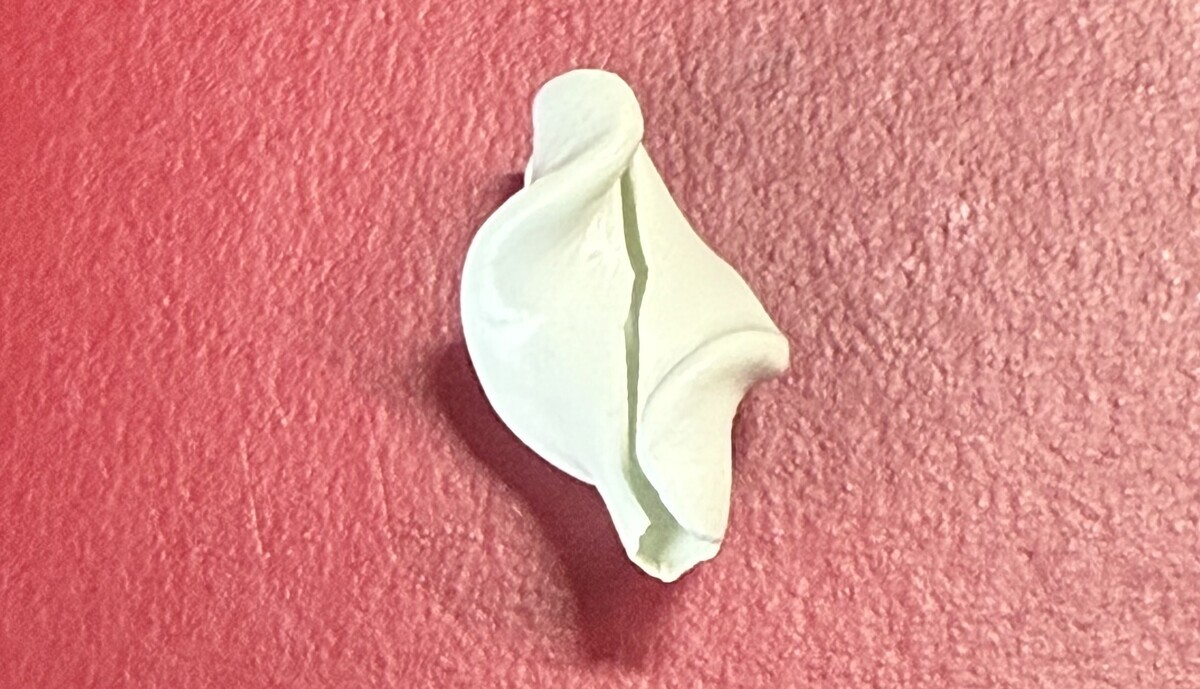
The maker's answer to chip removal while peeing
Mr. Okada emphasized urine flow and avoiding force, but the diary also records failures requiring hospital treatment.
Thread tangling changed the maker's explanation of chip removal while peeing
In an entry published in March 2018, Mr. Okada considered tangling between a retrieval thread and the shorter thread connecting two chips. He distinguished tangled threads from tangled chip bodies. He treated urine flow as the main force in removal and the thread's role as secondary. He cautioned against forceful pulling when tangling was suspected.
(Source: ok-lab's diary, published March 2018)
https://ok-lab.hatenablog.com/entry/20180312/1520844839
Bladder warnings linked chip removal while peeing with thread protection
In an entry published in May 2018, Mr. Okada warned that chips could move into the bladder. He described urine flow with thread assistance as a likely route back out, even after 1 failed attempt. He also warned about the thread's safety end disappearing inside. He advised against use extending beyond one night.
(Source: ok-lab's diary, published May 2018)
https://ok-lab.hatenablog.com/entry/20180505/1525509161
Bleeding reports shaped the maker's advice about chip removal while peeing
In an entry published in January 2020, a customer reported pinkish bleeding after using a chip. Mr. Okada attributed bleeding to forceful insertion or removal; this was his explanation, not a confirmed diagnosis. His reply associated difficult removal with urination timing. The advice emphasized avoiding force when the device felt tight.
(Source: ok-lab's diary, published January 2020)
https://ok-lab.hatenablog.com/entry/2020/01/18/132849
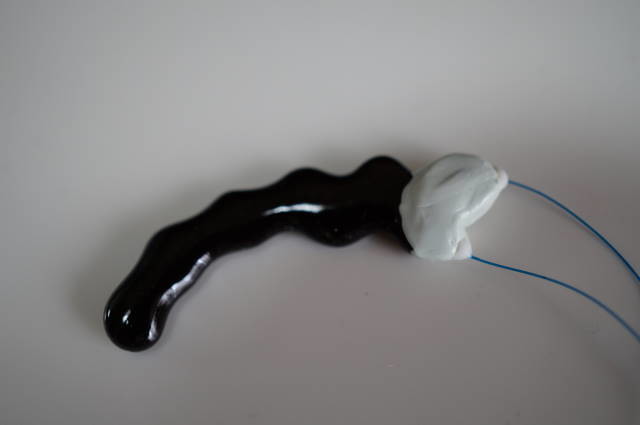
A second thread addressed difficult chip removal while peeing
In an entry published in September 2020, Mr. Okada described testing a sea-slug-shaped version with an additional retrieval thread. He thought the original attachment point could create an unfavorable direction of force. He reported easier removal in his test. He proposed the extra thread as a response to this particular design's removal difficulty.
(Source: ok-lab's diary, published September 2020)
https://ok-lab.hatenablog.com/entry/2020/09/05/095734
Historical guidance for chip removal while peeing included delayed consultation
In an entry published in July 2021, Mr. Okada included a broken-thread section in a draft instruction sheet. It described waiting for passage in urine, with specialist consultation after more than 1 week without passage. That historical waiting advice differs from the immediate-care warning on this page. The sheet advised consulting a doctor for people receiving treatment or noticing physical problems.
(Source: ok-lab's diary, published July 2021)
https://ok-lab.hatenablog.com/entry/2021/07/24/125923
If you see blood in your urine, even a small amount or for the first time, do not wait and see. See a urologist right away. If you suddenly cannot urinate, or the device cannot be removed, do not try to fix it yourself. Go to a medical facility, including emergency care, immediately.
How chip removal while peeing changed over time
| Published | What the diary said then |
|---|---|
| Feb 2018 | Thicker coatings addressed two peeling reports; affected January shipments qualified for replacement. |
| Apr 2018 | Mr. Okada described the thread as a backup despite a customer's discomfort. |
| Mar 2019 | External and internal stoppers were distinguished by their intended protective roles. |
| Oct 2021 | Mr. Okada suspected semen could become sticky over time. |
| Aug 2022 | A combined sea-slug version reportedly shifted during ordinary urination without passing out. |
| Apr 2023 | After a bleeding complaint, staff offered the same chip back or a refund. |
| Jul 2023 | A sea-slug version reached the bladder; the planned hospital removal outcome remained unreported. |
| Feb 2024 | An 11-12mm arrowhead prototype passed during urination, with pain reported by Mr. Okada. |
| Mar 2024 | Mr. Okada reported difficult removal during repeated testing and associated it with reduced moisture. |
| Mar 2025 | Suspected bladder migration resolved; Mr. Okada cautioned against forceful pulling. |
OK Prostate Chip products related to chip removal while peeing
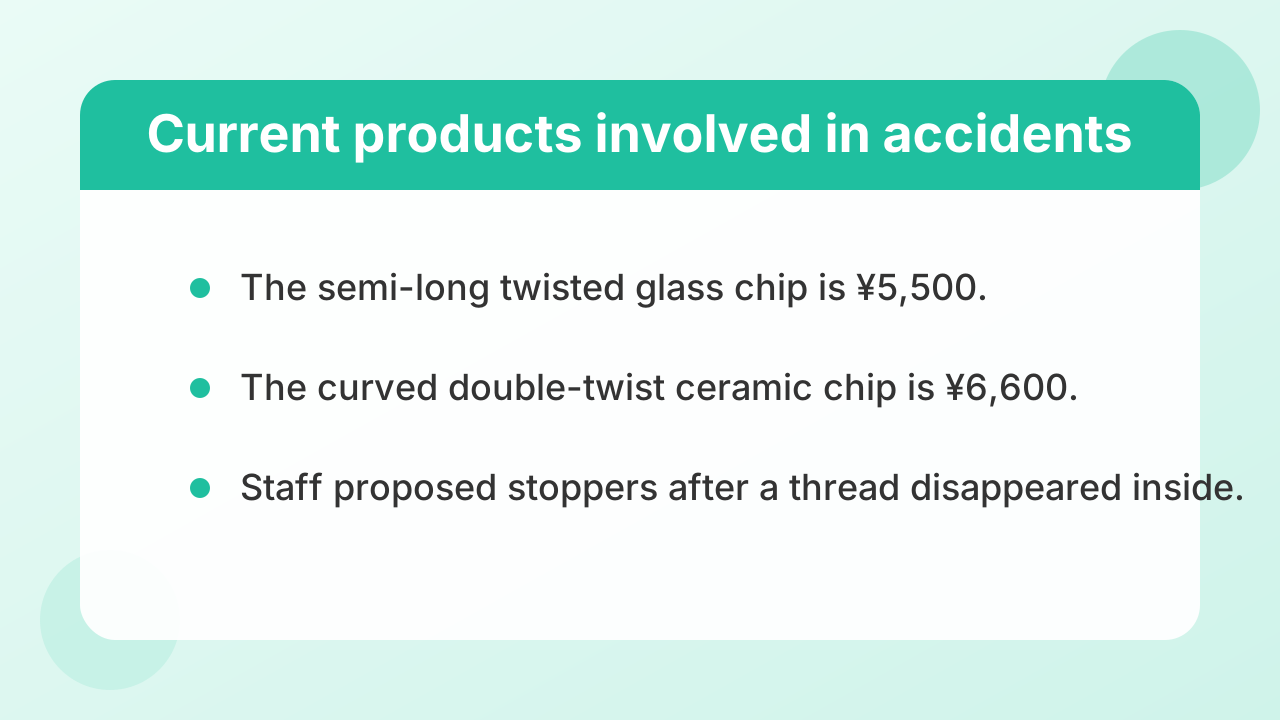
The current list includes products involved in accidents and stoppers proposed after a separate removal incident.
Products that appear in these entries
| Product (official name) | Price incl. tax | Relation to this topic |
|---|---|---|
| Semi-long twisted glass chip (OKプロステートチップ ガラス素材セミロングタイプ コブラツイスト) | ¥5,500 (about $35 at ¥156 = $1, rate as of 2026-09-04) | A January 2019 customer reported breakage followed by bladder injury. |
| Curved double-twist ceramic chip (OKプロステートチップ 陶器素材覚醒タイプ ダブルツイスト(ラブカチップ)) | ¥6,600 (about $42 at ¥156 = $1, rate as of 2026-09-04) | An April 2022 customer required hospital removal after urination and thread assistance failed. |
(Source: ok-lab's diary, published January 2019)
https://ok-lab.hatenablog.com/entry/2019/01/26/152042
(Source: ok-lab's diary, published April 2022)
https://ok-lab.hatenablog.com/entry/2022/04/02/123050
Products the diary mentioned as alternatives
| Product (official name) | Price incl. tax | Relation to this topic |
|---|---|---|
| Thread-retaining stopper (OKプロステートチップ用糸飲み込み防止ストッパーチップ) | ¥550 (about $4 at ¥156 = $1, rate as of 2026-09-04) | In March 2019, staff proposed this after a customer's thread disappeared inside. |
| Three-hole external stopper (三穴方式オプションチップ(亀頭外側ストッパーチップ)) | ¥1,100 (about $7 at ¥156 = $1, rate as of 2026-09-04) | In March 2019, staff named this for keeping the thread outside after that incident. |
| Three-hole internal stopper (三穴方式オプションチップ(括約筋ストッパーチップ)) | ¥1,650 (about $11 at ¥156 = $1, rate as of 2026-09-04) | In March 2019, staff proposed this instead to prevent the chip itself entering the bladder. |
(Source: ok-lab's diary, published March 2019)
https://ok-lab.hatenablog.com/entry/2019/03/23/173222
Historical builds include sea-slug versions, the rigid curved extension, the long-chip assembly, the arrowhead prototype, and the tail-specific screw attachment. No matching product can be confirmed on the current list.
Common worries about chip removal while peeing
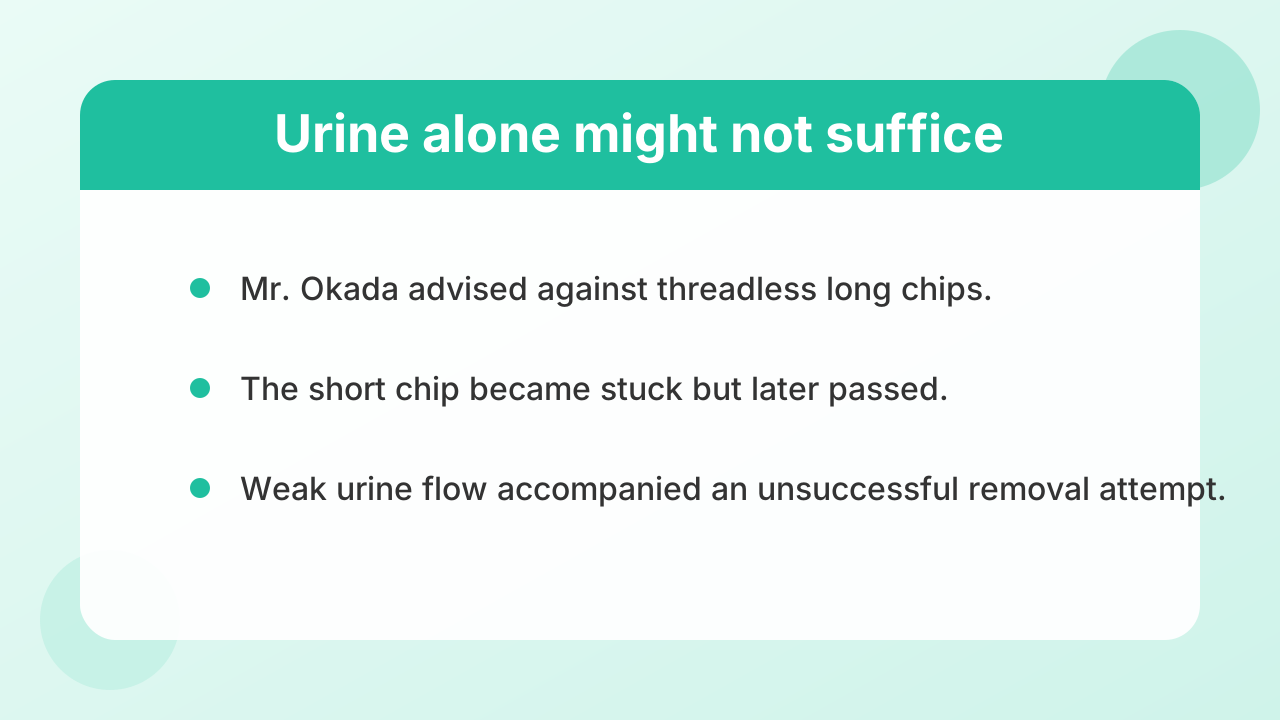
Customers asked about threads, stoppers, difficult shapes, and movement during urination.
"Can peeing out a chip replace its retrieval thread?"
In an entry published in February 2018, a customer asked about a threadless long chip after using a short chip without its thread. Mr. Okada thought straight short chips could pass with little urine, while curved long chips might resist both urination and ejaculation. His reply cited detached-thread incidents in his own tests that eventually ended with passage during urination.
The customer's short chip later became stuck but passed the following morning. Mr. Okada advised against threadless use of the long design.
(Source: ok-lab's diary, published February 2018)
https://ok-lab.hatenablog.com/entry/20180214/1518601774
"Can peeing out a chip also release an internal stopper?"
In an entry published in March 2019, a customer asked whether urination alone would release an internal stopper. The customer worried that the thread could injure the urine passage. Mr. Okada said urine alone might not suffice and discussed a role for the retrieval thread. His advice treated urine flow and the thread as complementary rather than interchangeable.
(Source: ok-lab's diary, published March 2019)
https://ok-lab.hatenablog.com/entry/2019/03/02/151104
"Why did chip removal while peeing fail initially?"
In an entry published in September 2020, a customer reported a sea-slug-shaped chip still stuck the next day, with occasional bleeding. The customer said weak urine flow had accompanied an unsuccessful removal attempt. Mr. Okada acknowledged that this design was harder to remove than earlier versions.
A follow-up reported eventual removal during urination. His reply advised consulting a urologist if removal remained impossible.
(Source: ok-lab's diary, published September 2020)
https://ok-lab.hatenablog.com/entry/2020/09/05/095734
"Can a semi-long chip come out while peeing?"
In an entry published in July 2026, a customer in Austria asked about a large semi-long chip's position and possible bladder entry. Mr. Okada described the urinary sphincter's grip as helping hold the narrow part in place. He said that muscle opens during urination, allowing urine pressure to expel the chip in some circumstances. He suggested consulting anatomical drawings to better understand its position.
(Source: ok-lab's diary, published July 2026)
https://ok-lab.hatenablog.com/entry/2026/07/18/122919
Buying from outside Japan
OK Lab ships internationally to countries covered by Japan Post's EMS courier service. Overseas orders are paid in advance by PayPal. Each order carries a ¥400 (about $3 at ¥156 = $1, rate as of 2026-09-04) handling fee, and EMS shipping is charged on top. These terms come from OK Lab's official sales-terms page (written here as plain text, not a link: ok-lab.net/docs/law), checked on September 7, 2026; confirm them on the official store before you order, because they can change.
Summary of this article
| What you wanted to know | The answer |
|---|---|
| The short answer | Passage during urination occurred, but some chips required hospital removal. |
| What the product is | A urethral device made by OK Lab in Japan. |
| What the terms mean | Threads assist retrieval; internal and external stoppers have different intended roles. |
| Reported outcomes | Bladder injury, retained parts, bleeding, and fever. |
| What the maker proposed | Urine flow, reduced force, thread protection, and design changes. |
| Changes over time | Shapes and attachment failures prompted further responses. |
| Current products | Tables show Japanese names and tax-inclusive yen prices. |
| Customer questions | Urine alone, stoppers, and failed removal. |
| How overseas buying works | EMS shipping, advance PayPal payment, and a ¥400 (about $3 at ¥156 = $1, rate as of 2026-09-04) handling fee. |
Source: ok-lab's diary (Okada Comfortable Life Laboratory). The original entries are in Japanese; quotations on this page are translated. Photos and videos are on the original entries.
This article is a summary of the maker's development diary. The product is not a medical device and no result is guaranteed. If anything feels wrong or worries you, see a doctor. Prices, specifications and cautions change, so confirm the latest information on the official blog and the official site. Questions about ordering and shipping go to the seller.