![Can I pee with a prostate chip in? | The diary reports success, pain, and movement [OK Prostate Chip]](/img/a/T0139/eyecatch.svg)
This page is based on entries from "ok-lab's diary" (https://ok-lab.hatenablog.com/), the Japanese development diary written by Mr. Okada, founder of OK Lab, a small company in Japan (Okada Comfortable Life Laboratory). Only the entries about peeing with a chip retained, including during prostate fullness, are summarized here, in order of publication. Past prices and sizes are as written at the time. Current prices come from the official product list (retrieved September 4, 2026). Quotations are translated from Japanese.
Note: This page is a personal reading log by someone with no connection to the maker or the seller. It reflects the source entries as of their publication dates and makes no guarantee of accuracy or safety. The product is not a medical device; talk to a doctor about any health decision. Check the official site for current information. This page contains advertising.
In short
Customers and Mr. Okada reported peeing with chips retained, but pain and outward movement also appeared.
Mr. Okada focused on positional support and warned against prolonged wear in specific cases.
Current listings include ceramic twist chips and supports; the later threadless designs have no confirmed match.
If you see blood in your urine, even a small amount or for the first time, do not wait and see. See a urologist right away.
If you suddenly cannot urinate, or the device cannot be removed, do not try to fix it yourself. Go to a medical facility, including emergency care, immediately.
About this product
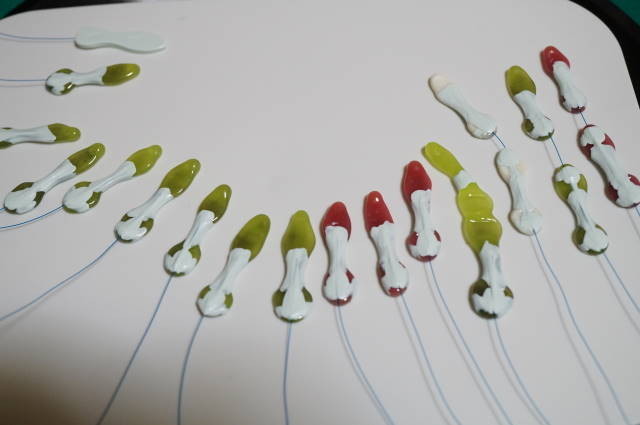
The OK Prostate Chip is a small device that is placed in the urethra (the urine passage) so that it acts on the prostate; the maker sells it in several shapes, sizes and materials.
It is made and sold by OK Lab (Okada Comfortable Life Laboratory), a small company in Japan, through its own online store, and prices are in Japanese yen (JPY). The maker's development diary, "ok-lab's diary", is written in Japanese. This page is an English summary of it, and every quotation is translated.
OK Lab ships internationally, so readers outside Japan can order (see "Buying from outside Japan" below). Product names on this page are plain-English descriptions. The official Japanese product name is shown once in the product table so you can find the same item in the store.
Before you read: key terms
| Term | Plain-English meaning |
|---|---|
| Urethra | The urine passage, where the device sits and urine travels outward. |
| Prostate | The body structure targeted for stimulation; its biological function: The diary does not explain this. |
| Prostate fullness | Mr. Okada's description of the filling sensation during a chip test, used to describe his experience. |
| Bladder | The organ holding urine before it passes out; some entries describe experimental devices retained there. |
| Sphincter | A muscle that closes the passage; the diary discusses its grip around chips and their connections. |
| Auxiliary chip | An additional support intended to help keep the main chip in position. |
| Retrieval thread | Thread attached to a chip for retrieval. |
| 4-wire support cable | A cable with paired reinforcing wires, intended to support a connected chip. |
| Gatekeeper | An external holder at the urinary opening, intended to restrain a connected tube or device. |
| Threadless design | A wire-and-silicone device intended to remain in place without a conventional retrieval thread. |
What happens: peeing with a prostate chip
The OK Prostate Chip is a small device retained in the urethra (the urine passage) to stimulate the prostate. The entries examine whether urine can pass while the device stays in that passage. Supports attached to chips are intended to prevent outward movement during urination. Mr. Okada describes urine flowing past solid chips and between parts of more open designs.
Prostate chip urination reports included a warning about continuous long-chip wear
In an entry published in January 2018, Mr. Okada reports trouble during extended continuous wear of the long chip. The diary does not describe those problems or record how the affected customers recovered. Mr. Okada advises against wearing that long chip continuously for 1 day or longer.
(Source: ok-lab's diary, published January 2018)
https://ok-lab.hatenablog.com/entry/20180130/1517311002
A vibrating prototype allowed urine flow, but its cable could get wet
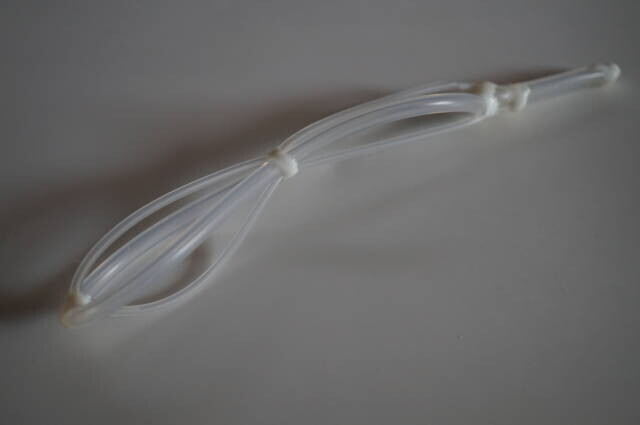
In an entry published in December 2018, Mr. Okada describes testing a hollow vibrating prototype inside the urethra. He reports that urination remained possible, although the cable could become slightly wet. Mr. Okada says the urethral prototype needed longer durability testing before release.
(Source: ok-lab's diary, published December 2018)
https://ok-lab.hatenablog.com/entry/20181215/1544857573
A screw-shaped support brought one customer's urine flow close to normal
In an entry published in January 2020, a customer wanted bathroom breaks to stop limiting chip use. Their purchase combined an M-size short ceramic twist chip with an auxiliary chip (an additional support), using 0mm spacing. They reported almost normal urination with support, including during stronger flow, although it took slightly longer.
Mr. Okada replied that the screw-shaped support did not block urine flow under pressure. He presents that support as an option for people struggling to pee with a chip retained.
(Source: ok-lab's diary, published January 2020)
https://ok-lab.hatenablog.com/entry/2020/01/04/155235
Prostate fullness did not prevent Mr. Okada from urinating during his test
In an entry published in August 2020, Mr. Okada describes pronounced prostate fullness during a fat double-twist chip test. He reports that he could still urinate, despite that sensation. Mr. Okada cautions that his experience depended on his own anatomy and that someone with a narrower urethra might not accommodate the chip.
(Source: ok-lab's diary, published August 2020)
https://ok-lab.hatenablog.com/entry/2020/08/01/124144
A bladder prototype allowed urine flow but caused pain and moved
In an entry published in October 2021, Mr. Okada describes a chip retained inside his bladder (the organ holding urine). Slow urine flow was possible, but he felt pain around the muscle at the bladder outlet. During ordinary urination, the chip moved into the portion of the urethra passing through the prostate.
He concluded that urine pressure made bladder retention difficult for a screw-shaped chip alone. Mr. Okada says further testing would precede guidance to customers.
(Source: ok-lab's diary, published October 2021)
https://ok-lab.hatenablog.com/entry/2021/10/02/125825
Successful urination during prolonged wear still drew Mr. Okada's warning
In an entry published in November 2022, a customer reported that a long custom chip stayed positioned through several bathroom visits during 22h of wear. Mr. Okada explains that he had already advised against prolonged bladder retention of a long chip. The customer had reassured him, but he still found the account frightening.
Mr. Okada's stated advice remained against that prolonged bladder use.
(Source: ok-lab's diary, published November 2022)
https://ok-lab.hatenablog.com/entry/2022/11/05/122757
A 50mm bladder loop stayed put while urine flow became slower
In an entry published in January 2025, Mr. Okada discusses a threadless prototype with a 50mm bladder loop. He describes his own bladder capacity as 200cc and reports slightly slower urination with the loop retained. He felt that most urine passed, although this required effort, and that the loop stayed positioned.
Mr. Okada says he would investigate possible adverse effects before reporting further results from larger loops.
(Source: ok-lab's diary, published January 2025)
https://ok-lab.hatenablog.com/entry/2025/01/04/122911
The maker's answer to peeing with a prostate chip
Mr. Okada's proposed supports addressed movement during urination, while his later replies also acknowledged pain and retrieval concerns.
A cable-linked prototype maintained position during slow urine flow
In an entry published in January 2020, Mr. Okada presents a cable-linked leading chip and screw-shaped support. The connecting section crossed a sphincter (a muscle that closes the passage), with a chip on either side. He reports urination without manual support, but that result was limited to slow flow.
The connection also included a retrieval thread (thread intended for retrieving the chip) because he considered unexpected cable failure possible. Mr. Okada advises interested buyers to request the cable-linked arrangement with their order.
(Source: ok-lab's diary, published January 2020)
https://ok-lab.hatenablog.com/entry/2020/01/11/151714
Ring supports reduced chip movement during urination without eliminating it
In an entry published in December 2020, Mr. Okada identifies a weakness in a fully internal arrangement. Urine pressure moved its outer screw-shaped support toward the opening, so the arrangement still required manual restraint. He reports less outward movement after replacing that support with a ring.
Mr. Okada cautions that the ring could still advance during urination, although his test ring stopped just before the head of the penis.
(Source: ok-lab's diary, published December 2020)
https://ok-lab.hatenablog.com/entry/2020/12/12/124126
A reinforced cable resisted chip movement during forceful urination
In an entry published in March 2022, Mr. Okada describes a 4-wire support cable (a cable reinforced by paired wires). He reports no sign of the chip coming out during forceful urination in his downward-facing test arrangement. The cable combined support inside the passage with flexibility outside it.
In an entry published in April 2022, he says earlier arrangements could shift slightly, whereas this support allowed stronger flow. Mr. Okada advises interested customers to inquire, explaining that the work remained experimental and had no immediate formal-release plan.
(Source: ok-lab's diary, published March 2022)
https://ok-lab.hatenablog.com/entry/2022/03/26/123336
(Source: ok-lab's diary, published April 2022)
https://ok-lab.hatenablog.com/entry/2022/04/02/123050
An empty tube allowed urine flow through more than one route
In an entry published in October 2023, Mr. Okada describes an empty 4mm tube used with an external holder. He reports urine passing both through its hollow center and around its outside. Mr. Okada warns against bladder placement because urine could suddenly escape.
(Source: ok-lab's diary, published October 2023)
https://ok-lab.hatenablog.com/entry/2023/10/28/122832
A gourd-shaped device allowed urine flow but still needed external support
In an entry published in November 2023, Mr. Okada answers a patent adviser's question about the gourd-shaped tube device. He explains that urine passes between and around its tubes, rather than through their hollow centers. He reports urination at almost the same speed as without the device.
Mr. Okada cautions that it would probably be pushed outward without a gatekeeper (an external holder at the urinary opening).
(Source: ok-lab's diary, published November 2023)
https://ok-lab.hatenablog.com/entry/2023/11/11/122638
If you see blood in your urine, even a small amount or for the first time, do not wait and see. See a urologist right away.
If you suddenly cannot urinate, or the device cannot be removed, do not try to fix it yourself. Go to a medical facility, including emergency care, immediately.
How peeing with a prostate chip changed over time
| Published | What the diary said then |
|---|---|
| Mar 2018 | Mr. Okada reported no leakage with the hollow chip despite its open center. |
| Apr 2019 | Custom connectors cost ¥2,000 (about $13 at ¥156 = $1, rate as of 2026-09-04) per half, ¥4,000 (about $26 at ¥156 = $1, rate as of 2026-09-04) together, tax excluded. |
| Apr 2019 | Flat cables barely affected urination; the second electrode chip acted as an anchor. |
| May 2019 | An exposed loop in a roughly 30cm cable could scatter urine. |
| Dec 2022 | An untested prototype's roughly 5mm diameter was expected to leave room for urine. |
| Nov 2023 | A ceramic twist chip used a 2.5mm connecting tube across the sphincter. |
| Nov 2024 | An unpublished hooked prototype reportedly stayed stable and allowed urination during roughly 24 hours. |
| Apr 2025 | Mr. Okada reported continued comfortable urination with the threadless design. |
The diary does not say what the current state is.
OK Prostate Chip products related to peeing with a prostate chip
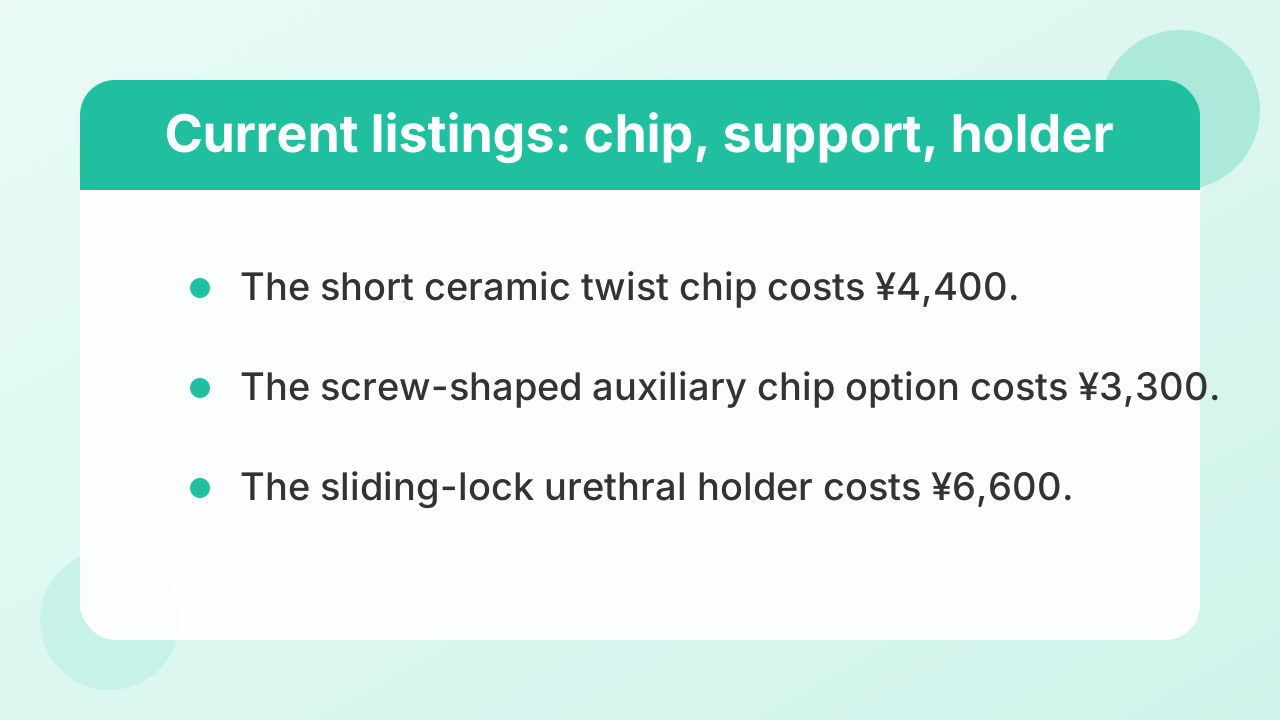
The current list includes the ceramic twist chip, screw-shaped support, and sliding-lock holder discussed in these entries.
Products that appear in these entries
| Product (official name) | Price incl. tax | Relation to this topic |
|---|---|---|
| Short ceramic twist chip (OKプロステートチップ 陶器素材ショートタイプ ツイスト) | ¥4,400 (about $28 at ¥156 = $1, rate as of 2026-09-04) | In January 2020, this chip appeared in the customer's urination report alongside a screw-shaped support. |
| Screw-shaped auxiliary chip option (スクリュー型補助チップ追加オプション) | ¥3,300 (about $21 at ¥156 = $1, rate as of 2026-09-04) | In January 2020, this support accompanied the short ceramic twist chip in the customer's bathroom-use report. |
(Source: ok-lab's diary, published January 2020)
https://ok-lab.hatenablog.com/entry/2020/01/04/155235
Products the diary mentioned as alternatives
| Product (official name) | Price incl. tax | Relation to this topic |
|---|---|---|
| Sliding-lock urethral holder (スライドロック式尿道ゲートキーパー) | ¥6,600 (about $42 at ¥156 = $1, rate as of 2026-09-04) | In November 2023, Mr. Okada recommended this holder to prevent outward movement instead of relying on the gourd-shaped device alone. |
(Source: ok-lab's diary, published November 2023)
https://ok-lab.hatenablog.com/entry/2023/11/04/122744
(Source: ok-lab's diary, published November 2023)
https://ok-lab.hatenablog.com/entry/2023/11/11/122638
Older vibrating, fat double-twist, cable-linked, and bladder prototypes: No matching product can be confirmed on the current list. Custom linked chips, ring supports, reinforced cables, and gourd-shaped devices: No matching product can be confirmed on the current list. Threadless designs, bladder loops, and later shape-memory supports: No matching product can be confirmed on the current list.
Common worries about peeing with a prostate chip
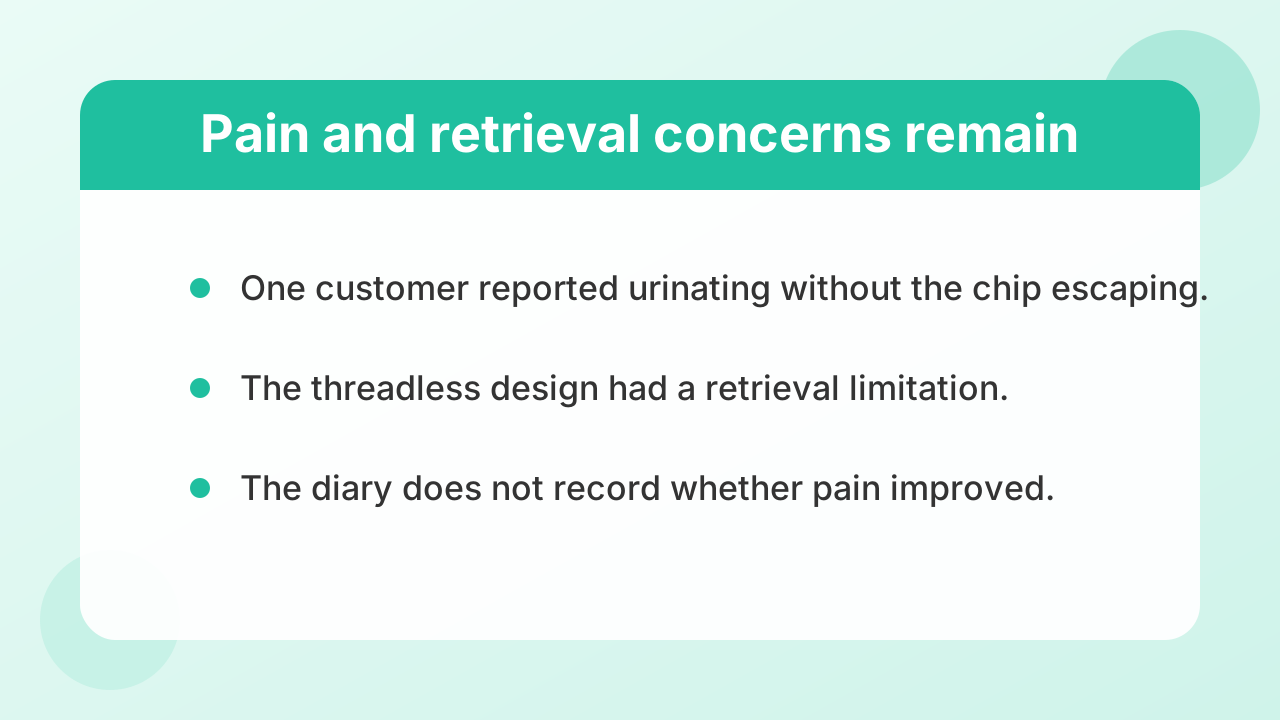
Readers asked about chips slipping out, bathroom use during continued wear, and pain; Mr. Okada gave different answers to each concern.
"Will my chip slip out when I pee?"
In an entry published in January 2018, a customer asked how to keep a linked double chip from escaping during urination. Mr. Okada's reply focused on supporting the first chip toward the prostate. The customer subsequently reported urinating without the chip coming out.
Mr. Okada's advice concerned maintaining its position, rather than simply catching the device as it moved outward.
(Source: ok-lab's diary, published January 2018)
https://ok-lab.hatenablog.com/entry/20180130/1517311002
"Can I pee or pass stool with a chip in?"
In an entry published in April 2025, a reader asked whether bathroom use would push a retained chip out. Staff initially requested fewer questions and answered about conventional solid chips. Mr. Okada then proposed a threadless design (a wire-and-silicone device without a conventional retrieval thread).
He described continued retention, smooth urination and bowel movements, and easy removal, while acknowledging that someone might still be unable to retrieve it. The diary does not record what this reader bought or experienced. Mr. Okada presents the threadless design as an option alongside conventional solid chips, with that retrieval limitation.
(Source: ok-lab's diary, published April 2025)
https://ok-lab.hatenablog.com/entry/2025/04/05/122932
"Why does peeing with my prostate chip hurt?"
In an entry published in July 2025, a customer said their M-size medium-length chip made urination painful. Mr. Okada replied that peeing with the device retained was a basic design goal. He suggested size, inflammation, or damage to the urethral lining during insertion as possible explanations.
He did not answer the customer's questions about a less burdensome size or shape. The diary does not record whether the pain improved. For the separate movement concern, Mr. Okada recommends a shape-memory external holder paired with a flexible, tube-covered support.
(Source: ok-lab's diary, published July 2025)
https://ok-lab.hatenablog.com/entry/2025/07/26/122909
Buying from outside Japan
OK Lab ships internationally to countries covered by Japan Post's EMS courier service. Overseas orders are paid in advance by PayPal. Each order carries a ¥400 (about $3 at ¥156 = $1, rate as of 2026-09-04) handling fee, and EMS shipping is charged on top. These terms come from OK Lab's official sales-terms page (written here as plain text, not a link: ok-lab.net/docs/law), checked on September 7, 2026; confirm them on the official store before you order, because they can change.
Summary of this article
| What you wanted to know | The answer |
|---|---|
| What is the short answer? | Successful urination appears in the diary, alongside pain, movement, and wear warnings. |
| What is this product? | A urethral device made and sold by OK Lab in Japan. |
| What do the terms mean? | Auxiliary chips, cables, and external holders are different supports intended to maintain position. |
| What happened in use? | Customers and Mr. Okada reported different results across specific chips and prototypes. |
| What did the maker propose? | Cable connections, ring supports, reinforced cables, external holders, and later threadless designs. |
| What changed over time? | Development increasingly addressed positional support alongside room for urine to pass. |
| Which current products appear here? | The ceramic twist chip costs ¥4,400 (about $28 at ¥156 = $1, rate as of 2026-09-04); the support ¥3,300 (about $21 at ¥156 = $1, rate as of 2026-09-04); the sliding-lock holder ¥6,600, (about $42 at ¥156 = $1, rate as of 2026-09-04) including tax. |
| What remains unresolved in reader questions? | The later customer's pain outcome and the earlier reader's purchase outcome are unrecorded. |
| How do overseas orders work? | Advance PayPal payment, a ¥400 (about $3 at ¥156 = $1, rate as of 2026-09-04) handling fee, and additional EMS shipping under the stated terms. |
Source: ok-lab's diary (Okada Comfortable Life Laboratory). The original entries are in Japanese; quotations on this page are translated. Photos and videos are on the original entries.
This article is a summary of the maker's development diary. The product is not a medical device and no result is guaranteed. If anything feels wrong or worries you, see a doctor. Prices, specifications and cautions change, so confirm the latest information on the official blog and the official site. Questions about ordering and shipping go to the seller.