![My prostate chip won't come out | Get urgent medical help [OK Prostate Chip]](/img/a/T0149/eyecatch.svg)
This page is based on entries from "ok-lab's diary" (https://ok-lab.hatenablog.com/), the Japanese development diary written by Mr. Okada, founder of OK Lab, a small company in Japan (Okada Comfortable Life Laboratory). Only the entries about "chip removal problems" are summarized here, in order of publication. Past prices and sizes are as written at the time. Current prices come from the official product list (retrieved September 4, 2026). Quotations are translated from Japanese.
Note: This page is a personal reading log by someone with no connection to the maker or the seller. It reflects the source entries as of their publication dates and makes no guarantee of accuracy or safety. The product is not a medical device; talk to a doctor about any health decision. Check the official site for current information. This page contains advertising.
In short
The diary describes stuck chips, overlapping parts, and retrieval threads that disappeared inside the body.
Mr. Okada discusses design changes and advises medical care when a chip cannot be removed.
The current list includes products from these cases; newer prototypes cannot all be matched.
If you see blood in your urine, even a small amount or for the first time, do not wait and see. See a urologist right away. If you suddenly cannot urinate, or the device cannot be removed, do not try to fix it yourself. Go to a medical facility, including emergency care, immediately.
About this product
The OK Prostate Chip is a small device that is placed in the urethra (the urine passage) so that it acts on the prostate; the maker sells it in several shapes, sizes and materials. It is made and sold by OK Lab (Okada Comfortable Life Laboratory), a small company in Japan, through its own online store, and prices are in Japanese yen (JPY). The maker's development diary, "ok-lab's diary", is written in Japanese. This page is an English summary of it, and every quotation is translated. OK Lab ships internationally, so readers outside Japan can order (see "Buying from outside Japan" below). Product names on this page are plain-English descriptions. The official Japanese product name is shown once in the product table so you can find the same item in the store.
Before you read: key terms
| Term | Plain-English meaning |
|---|---|
| Urethra | The urine passage; it carries urine out and is where the device is placed. |
| Retrieval thread | A thread attached to the device, intended to provide a connection for removal. |
| Urinary sphincters | Muscles around the urine passage; the diary describes them holding long chips in place. |
| Bulbar urethra | A curved part of the urine passage; the diary places certain supporting chip parts here. |
| Cystoscope | A viewing instrument used inside the bladder; the diary describes doctors using it during retrieval. |
| CT | A test included in one hospital visit. The diary does not explain this. |
| Shape-memory wire | Wire that returns toward a set shape, used to make flexible connections between device parts. |
What happens: chip removal problems
The OK Prostate Chip is a small device placed in the urethra to act on the prostate. A retrieval thread (the attached connection intended for removal) runs from the chip through the urine passage and may extend outside the body. The diary describes removal problems involving the chip itself, attached supporting parts, or threads that become inaccessible. Its cases include overlapping parts, rigid curved shapes, and devices that moved into the bladder.
A longer retrieval thread addressed one customer's chip removal concern
In an entry published in January 2018, a customer described painful removal attempts with a custom short chip, about 1cm longer than usual. The customer also found the maximum 25cm thread insufficient and requested longer options.
A note confirmed that lengths beyond 25cm could then be requested in the order remarks. The diary does not record how a longer thread worked for this customer. Mr. Okada suggested a linked two-chip design as an alternative.
(Source: ok-lab's diary, published January 2018)
https://ok-lab.hatenablog.com/entry/20180118/1516263011
Folded parts made one semi-long chip hard to remove
An entry published in July 2018 described a customer testing a semi-long chip with a separate companion chip. Mr. Okada had expressed reservations before agreeing that a cautious trial might be possible.
The parts folded together, and the customer reported that one thread could not move the assembly. Removal eventually succeeded with the parts still folded together. Mr. Okada warned that rotation of the companion chip remained possible.
(Source: ok-lab's diary, published July 2018)
https://ok-lab.hatenablog.com/entry/20180707/1530947332
An off-center thread complicated one customer's stuck chip case
In an entry published in September 2020, a customer sought help because a curved version 4 chip remained stuck the following day. The customer reported slight bleeding and a catching sensation.
Mr. Okada's reply focused on moisture and the direction of force at the off-center thread attachment. A follow-up confirmed successful removal, without a hospital visit being recorded. Mr. Okada advised consulting a urologist if removal remained impossible.
(Source: ok-lab's diary, published September 2020)
https://ok-lab.hatenablog.com/entry/2020/09/05/095734
A folded custom assembly required medical help for chip removal
An entry published in December 2022 described a customer asking whether a trapped custom assembly's cable could be cut. The reply acknowledged the idea in principle but raised concerns about cutting near the urine passage.
A doctor chose removal without cutting; the overlapped parts measured about 15mm. The customer reported a small urethral injury, 1 week of prescribed antibiotics, and a ¥1,760 (about $11 at ¥156 = $1, rate as of 2026-09-04) charge under Japan's National Health Insurance. The customer later reported recovery, and OK Lab's advice had favored medical assessment.
(Source: ok-lab's diary, published December 2022)
https://ok-lab.hatenablog.com/entry/2022/12/24/122944
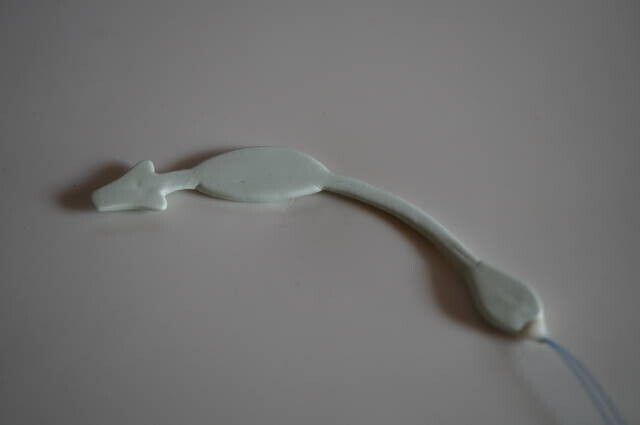
Mr. Okada reported pain after difficult arrowhead chip removal
In an entry published in February 2024, Mr. Okada described difficulty removing an arrowhead-shaped prototype after its tip entered the bladder. He reported mild pain afterward around the inner urinary sphincter (a muscle surrounding the urine passage). He reported no bleeding.
He connected the problem to the backward-facing shape intended to resist withdrawal. Mr. Okada described the design as dangerous and warned against use without understanding its fit.
(Source: ok-lab's diary, published February 2024)
https://ok-lab.hatenablog.com/entry/2024/02/10/123023
A loop device needed hospital treatment when chip removal failed
In an entry published in May 2025, a customer could no longer locate a loop-only device's retrieval point. OK Lab initially offered advice based on an assumed position, then changed its assessment when the attached thread was also missing.
The customer reported that the device and thread had entered the bladder and were removed using a cystoscope (a bladder-viewing instrument). The visit included CT (a test the diary does not explain) and urine testing. Waiting, tests, and removal took about 5 hours, with a reported charge of ¥34,000 (about $218 at ¥156 = $1, rate as of 2026-09-04). Once the deeper position became apparent, OK Lab advised urological care.
(Source: ok-lab's diary, published May 2025)
https://ok-lab.hatenablog.com/entry/2025/05/03/122907
The maker's answer to chip removal problems
Mr. Okada explored friction and device design, while also directing unresolved cases to medical care.
Vibration changed Mr. Okada's account of difficult chip removal
In an entry published in December 2018, Mr. Okada reported less resistance during removal of vibrating prototypes, including larger chips. He attributed this to movement separating the device from the urethral lining.
He contrasted this with his earlier difficulty removing the same kind of device from a dry urine passage. His proposed measure was vibration-assisted removal, described through his own testing.
(Source: ok-lab's diary, published December 2018)
https://ok-lab.hatenablog.com/entry/20181222/1545459719
Independent thread attachments became a design response to stuck chips
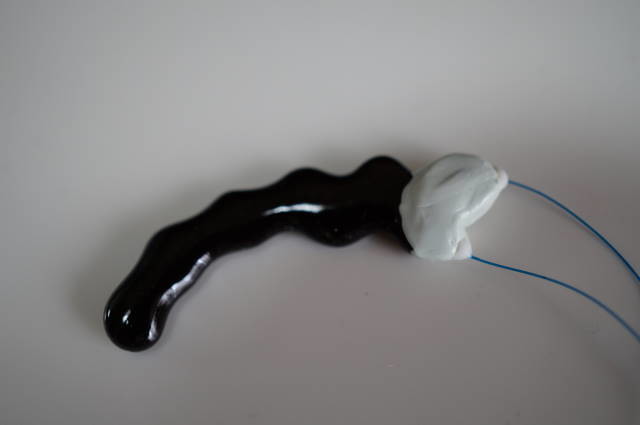
In the prototype portion of an entry published in September 2020, Mr. Okada described adding an independent thread on the opposite side. His test of that arrangement produced easier removal than the original attachment arrangement.
He acknowledged that his earlier customer reply had preceded his own test of the original version. His proposed design response was a separate retrieval attachment positioned to address the awkward angle.
(Source: ok-lab's diary, published September 2020)
https://ok-lab.hatenablog.com/entry/2020/09/05/095734
The maker linked some chip removal problems to dryness
An entry published in July 2021 included a draft instruction booklet addressing resistance despite an attached thread. Mr. Okada proposed excessive dryness or semen sticking to the device as possible explanations.
The booklet also distinguished those situations from overlapping chips and an awkward device angle. It directed people with unusual symptoms or relevant health problems toward medical consultation.
(Source: ok-lab's diary, published July 2021)
https://ok-lab.hatenablog.com/entry/2021/07/24/125923
A March 2026 chip removal discussion included separate tool prices
An entry published in March 2026 introduced a revised wire positioning tool for devices with rubber or tubing. Mr. Okada reported that bare ceramic and resin surfaces slipped out of its grip.
Published prices were ¥3,000 (about $19 at ¥156 = $1, rate as of 2026-09-04) tax excluded up to 20cm, and ¥4,000 (about $26 at ¥156 = $1, rate as of 2026-09-04) tax excluded up to 30cm. Adding a suitable rubber section to a chip cost ¥500 (about $3 at ¥156 = $1, rate as of 2026-09-04) tax excluded.
The same entry still described the beaded loop design as difficult to remove. Mr. Okada restricted his recommendation for that design to people accepting its difficult handling in exchange for stable positioning.
(Source: ok-lab's diary, published March 2026)
https://ok-lab.hatenablog.com/entry/2026/03/14/122910
If you see blood in your urine, even a small amount or for the first time, do not wait and see. See a urologist right away. If you suddenly cannot urinate, or the device cannot be removed, do not try to fix it yourself. Go to a medical facility, including emergency care, immediately.
How chip removal problems changed over time
| Published | What the diary said then |
|---|---|
| Mar 2018 | Separate threads were presented as a response to earlier entanglement requiring hospital care. |
| Mar 2020 | Mr. Okada thought thinner glass parts were more prone to lying side by side. |
| Mar 2021 | A linked prototype took about 20 minutes to remove in Mr. Okada's test. |
| Mar 2021 | A revised linked prototype came out in 30 seconds in his later test. |
| Jul 2023 | A curved version 4 bladder-migration report lacked a hospital outcome at publication. |
| Apr 2024 | Shape-memory wire (which returns toward a set shape) was proposed to reduce angle-related catching. |
| May 2024 | Mr. Okada reported easier removal with a centrally supported, linked version 4 arrangement. |
| Feb 2026 | Greater flexibility eased removal in Mr. Okada's test, with milder prostate pressure. |
OK Prostate Chip products related to chip removal problems
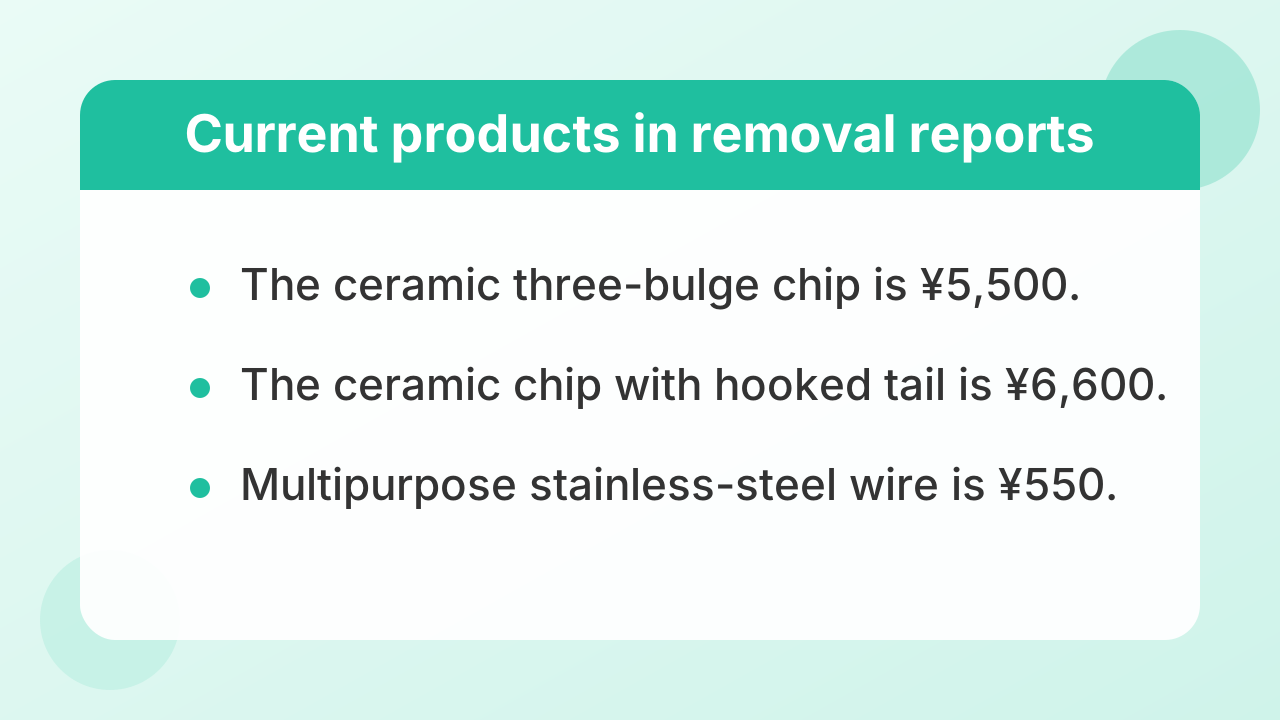
These current listings include products involved in difficult-removal reports.
Products that appear in these entries
| Product (official name) | Price incl. tax | Relation to this topic |
|---|---|---|
| Ceramic three-bulge chip (OKプロステートチップ 陶器素材覚醒タイプ) | ¥5,500 (about $35 at ¥156 = $1, rate as of 2026-09-04) | An October 2022 entry reported resistance near the urethral opening during removal of this ceramic model. |
| Ceramic three-bulge chip with hooked tail (OKプロステートチップ 陶器素材覚醒勾玉タイプ) | ¥6,600 (about $42 at ¥156 = $1, rate as of 2026-09-04) | A May 2023 entry described a customer unable to remove this rigid curved model until the following morning. |
| Multipurpose stainless-steel wire (多目的ステンレスワイヤー) | ¥550 (about $4 at ¥156 = $1, rate as of 2026-09-04) | A March 2025 entry recorded an unsuccessful retrieval attempt with this tool before the customer's problem resolved. |
(Source: ok-lab's diary, published October 2022)
https://ok-lab.hatenablog.com/entry/2022/10/08/122859
(Source: ok-lab's diary, published May 2023)
https://ok-lab.hatenablog.com/entry/2023/05/06/123024
(Source: ok-lab's diary, published March 2025)
https://ok-lab.hatenablog.com/entry/2025/03/01/122825
Products the diary mentioned as alternatives
The diary names no alternative.
Historical builds discussed above include the custom longer short chip, linked alternative, folded pair, vibrating prototype, curved version 4, and arrowhead prototypes. They also include the loop-only build, linked experimental versions, beaded loop design, and revised wire tool. No matching product can be confirmed on the current list.
Common worries about chip removal problems
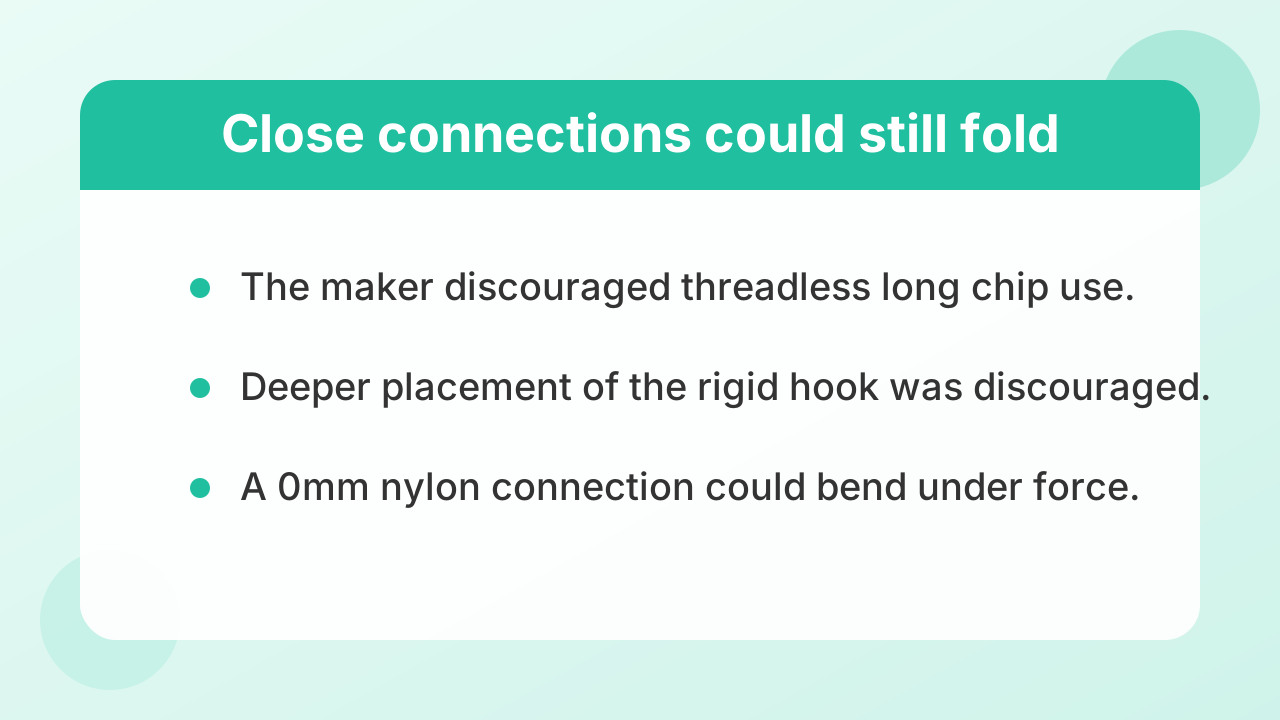
Readers asked about missing threads, rigid curves, and whether closely connected parts could still fold.
"Could a missing thread leave my long chip stuck?"
In an entry published in February 2018, a customer asked about using a long chip without a retrieval thread. Mr. Okada said the curved long design could be held at both urinary sphincters (muscles around the urine passage).
He distinguished it from the customer's short chip, which later also became temporarily difficult to remove. The follow-up recorded the short chip's eventual release, without establishing an outcome for a threadless long chip. Mr. Okada advised against threadless use of the long design then available.
(Source: ok-lab's diary, published February 2018)
https://ok-lab.hatenablog.com/entry/20180214/1518601774
"Why was my rigid curved chip hard to remove?"
An entry published in May 2023 described a customer's rigid three-bulge chip with a hooked tail becoming stuck. The customer reported removal the following morning and asked how to avoid a repeat.
Mr. Okada described a 6cm main section and an approximately 2cm hook, giving an 8cm rigid shape. He explained that the original design placed the supporting hook in the bulbar urethra (a curved part of the urine passage). He considered that intended position comparatively safer and discouraged deeper placement of the rigid hook.
(Source: ok-lab's diary, published May 2023)
https://ok-lab.hatenablog.com/entry/2023/05/06/123024
"Can a zero-gap connection prevent my chip getting stuck?"
In an entry published in May 2023, a customer wanted a connection less likely to fold or entangle. OK Lab described a trade-off between reducing tangling and reducing movement toward the bladder.
Mr. Okada said even a 0mm nylon connection could bend through 180 degrees under force. He did not provide a measured accident rate or guarantee that a close connection eliminated entanglement. For the particular concern about thread tangling, he suggested considering standalone instruments without a thread connection.
(Source: ok-lab's diary, published May 2023)
https://ok-lab.hatenablog.com/entry/2023/05/27/122912
Buying from outside Japan
OK Lab ships internationally to countries covered by Japan Post's EMS courier service. Overseas orders are paid in advance by PayPal. Each order carries a ¥400 (about $3 at ¥156 = $1, rate as of 2026-09-04) handling fee, and EMS shipping is charged on top. These terms come from OK Lab's official sales-terms page (written here as plain text, not a link: ok-lab.net/docs/law), checked on September 7, 2026; confirm them on the official store before you order, because they can change.
Summary of this article
| What you wanted to know | The answer |
|---|---|
| What is the immediate answer? | A device that cannot be removed needs immediate medical care. |
| What is this product? | A small urethral device made by OK Lab in Japan. |
| What do the terms mean? | Threads provide a retrieval connection; supporting parts and flexible wire affect device structure. |
| What happened in reported cases? | Reports include folded assemblies, inaccessible threads, pain, and hospital retrieval. |
| What did the maker propose? | Changes to attachment points, friction, and flexibility; unresolved cases also prompted medical referrals. |
| What changed over time? | Later designs addressed earlier problems, but removal difficulties continued to appear. |
| Which current products are related? | The table identifies ceramic models and a wire tool involved in reports. |
| What concerned customers? | Threadless use, rigid hooks, and folding despite close connections. |
| How does overseas buying work? | Advance PayPal payment, a handling fee, and additional EMS shipping. |
Source: ok-lab's diary (Okada Comfortable Life Laboratory). The original entries are in Japanese; quotations on this page are translated. Photos and videos are on the original entries. Unused facts: F04 (self-removal procedure omitted for safety), F06 (injection procedure and quantities omitted for safety), F24 (advice to delay medical care omitted for safety)
This article is a summary of the maker's development diary. The product is not a medical device and no result is guaranteed. If anything feels wrong or worries you, see a doctor. Prices, specifications and cautions change, so confirm the latest information on the official blog and the official site. Questions about ordering and shipping go to the seller.