![Chip slips every time you pee? | The diary reports movement and tradeoffs [OK Prostate Chip]](/img/a/T0136/eyecatch.svg)
This page is based on entries from "ok-lab's diary" (https://ok-lab.hatenablog.com/), the Japanese development diary written by Mr. Okada, founder of OK Lab, a small company in Japan (Okada Comfortable Life Laboratory). Only entries about the topic “pushing the chip back after every urination” are summarized here, in order of publication. Past prices and sizes are as written at the time. Current prices come from the official product list (retrieved September 4, 2026). Quotations are translated from Japanese.
Note: This page is a personal reading log by someone with no connection to the maker or the seller. It reflects the source entries as of their publication dates and makes no guarantee of accuracy or safety. The product is not a medical device; talk to a doctor about any health decision. Check the official site for current information. This page contains advertising.
In short
Customers and Mr. Okada reported chips moving during urination, sometimes followed by pain during repositioning.
Mr. Okada proposed support parts and cautioned against forcing a chip that resisted movement.
The current list includes a screw-shaped auxiliary option priced at ¥3,300 (about $21 at ¥156 = $1, rate as of 2026-09-04) including tax.
If you see blood in your urine, even a small amount or for the first time, do not wait and see. See a urologist right away.
If you suddenly cannot urinate, or the device cannot be removed, do not try to fix it yourself. Go to a medical facility, including emergency care, immediately.
About this product

The OK Prostate Chip is a small device that is placed in the urethra (the urine passage) so that it acts on the prostate; the maker sells it in several shapes, sizes and materials. It is made and sold by OK Lab (Okada Comfortable Life Laboratory), a small company in Japan, through its own online store, and prices are in Japanese yen (JPY). The maker's development diary, "ok-lab's diary", is written in Japanese. This page is an English summary of it, and every quotation is translated. OK Lab ships internationally, so readers outside Japan can order (see "Buying from outside Japan" below). Product names on this page are plain-English descriptions. The official Japanese product name is shown once in the product table so you can find the same item in the store.
Before you read: key terms
| Term | Plain-English meaning |
|---|---|
| Urethra | The urine passage; it carries urine and is where the diary describes the chip being placed. |
| Urethral sphincter | A muscle involved in urine control; the diary discusses its opening during urination and its relationship to chip movement. |
| Retrieval thread | A cord attached to the device, intended for retrieval. |
| Auxiliary chip | An additional part behind the main chip, intended to limit movement and help repositioning. |
| Sphincter stopper | An additional part intended to limit the chip’s movement toward the bladder. |
| Horn extension | A flexible rear projection intended to prevent thread folding and keep the chip and stopper apart. |
| Wing attachment | Looped wire at the chip’s front, intended to help it stay in place. |
| Apple-shaped stopper | A looped wire support intended to restrict movement in either direction near the penis base. |
What happens: chip slipping when peeing
The OK Prostate Chip is a small device placed in the urethra (urine passage) to stimulate the prostate. This topic concerns outward movement during urination and difficulty returning the chip to its earlier position. The diary discusses support parts intended to limit movement, including components behind the main chip near the penis base. These accounts include customer questions, Mr. Okada’s tests, and changes intended to address movement or discomfort.
Chip slipping can expose a sharp thread junction during repositioning
In an entry published in August 2020, a customer reported sharp resin on the retrieval thread (cord intended for retrieval) of a curved Version 4 chip. They noticed the defect before insertion and believed it could otherwise have caused severe pain or bleeding. Their message did not report that those injuries actually happened.
Mr. Okada acknowledged difficulty finishing the narrow rear connection and said similar complaints had continued. His response was to make rubber covers standard in principle at thread connections on Version 4 and two-thread chips.
(Source: ok-lab's diary, published August 2020)
https://ok-lab.hatenablog.com/entry/2020/08/08/130037
Preventing chip slipping came with prolonged leakage in a horn prototype
In an entry published in November 2020, Mr. Okada described prototype 4, which directly joined a horn extension (flexible rear projection) to a stopper. This was a sphincter stopper (a part intended to limit inward movement), and he reported that the arrangement stayed still during urination. After about 10 hours, however, he experienced slight urine leakage lasting about 1 day.
He suspected muscle fatigue or injury; the entry does not establish a medical diagnosis. Mr. Okada warned that the direct connection could place excessive strain on the muscle.
(Source: ok-lab's diary, published November 2020)
https://ok-lab.hatenablog.com/entry/2020/11/07/121125
Repeated repositioning after peeing became painful around the fourth day
In an entry published in April 2022, a customer described pain developing around day 4 after repeated repositioning of stainless and blue resin chips. They suspected rubbing at the external urethral sphincter (a muscle involved in urine control). They wanted connected screw-shaped parts because their preferred short resin twist chip also caused pain at its central edge.
Mr. Okada agreed that different sizes and a cable connection were possible. The customer paid an additional ¥1,100 (about $7 at ¥156 = $1, rate as of 2026-09-04) for a 30mm connection combining cable and thread. He offered that custom arrangement, but the diary does not record how the finished pair felt in use.
(Source: ok-lab's diary, published April 2022)
https://ok-lab.hatenablog.com/entry/2022/04/30/123451
A ceramic prototype still showed chip slipping despite its retaining loops
In an entry published in January 2025, Mr. Okada compared a ceramic prototype supported by loops with a similarly sized wire-only design. He reported about 2 days of testing for the ceramic version, compared with roughly 3 weeks for the wire-only version. The ceramic version moved outward about 1cm during urination or exercise, although he said it did not come out.
He considered its position less stable than the wire-only design and suspected the ceramic’s weight and smoothness contributed. Mr. Okada presented the ceramic version as an option for someone who found the wire-only version’s stimulation too mild.
(Source: ok-lab's diary, published January 2025)
https://ok-lab.hatenablog.com/entry/2025/01/04/122911
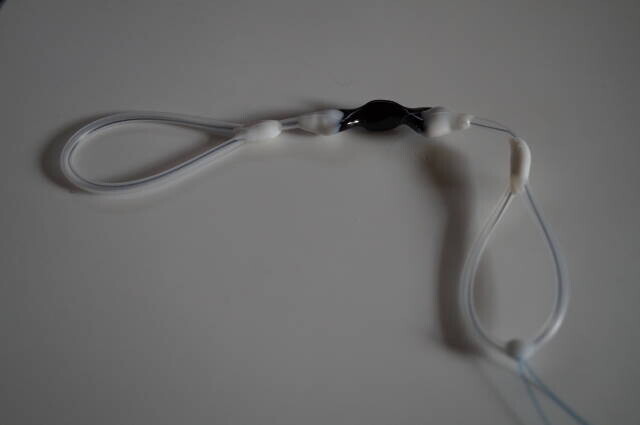
A detached stopper limited chip slipping but made removal difficult
In an entry published in December 2025, Mr. Okada tested prototype 1 with a detached apple-shaped stopper (a looped wire support). He reported slight movement during urination, without the chip leaving the prostate region. Both detached and integrated versions were priced at ¥4,000 (about $26 at ¥156 = $1, rate as of 2026-09-04) excluding tax in that entry.
He described difficult removal, citing movement of only about 1cm in 10 seconds. The designs depended on a retrieval thread extending outside the penis. Mr. Okada described the detached arrangement as offering less strain and comparatively easier removal because its angle could change.
(Source: ok-lab's diary, published December 2025)
https://ok-lab.hatenablog.com/entry/2025/12/20/123000
The maker's answer to chip slipping when peeing
Mr. Okada explored different stops and supports, but firmer holding sometimes came with discomfort or difficult removal.
A screw-shaped auxiliary part addressed chip slipping through added support
In an entry published in November 2019, Mr. Okada introduced a screw-shaped auxiliary chip (an additional part behind the main chip). He described it as helping retain the device during urination, limiting further outward travel, and supporting repositioning. Standard dimensions were 15-18mm long and 8-9mm wide, with a proposed price of ¥3,000 (about $19 at ¥156 = $1, rate as of 2026-09-04) excluding tax.
The entry also said lengths of 15mm or less could not be made. Mr. Okada specified ordering it together with the main product because it could not be added afterward.
(Source: ok-lab's diary, published November 2019)
https://ok-lab.hatenablog.com/entry/2019/11/16/154802
Wing attachments reduced chip slipping without preventing every outward movement
In an entry published in September 2025, Mr. Okada tested wing attachments (looped wire parts for retention) on a short stainless chip. He reported roughly 20 hours of retention, although forceful urination still caused some downward movement. The attachment therefore did not eliminate the movement described in his account.
Wings up to 40mm cost ¥3,000 (about $19 at ¥156 = $1, rate as of 2026-09-04) excluding tax, with another ¥1,000 (about $6 at ¥156 = $1, rate as of 2026-09-04) excluding tax for mandatory wire attachment along the chip. Mr. Okada recommended approximately 25mm as the wing size he considered easier to accommodate.
(Source: ok-lab's diary, published September 2025)
https://ok-lab.hatenablog.com/entry/2025/09/27/123018
An integrated stopper prevented chip slipping in one test, with reservations
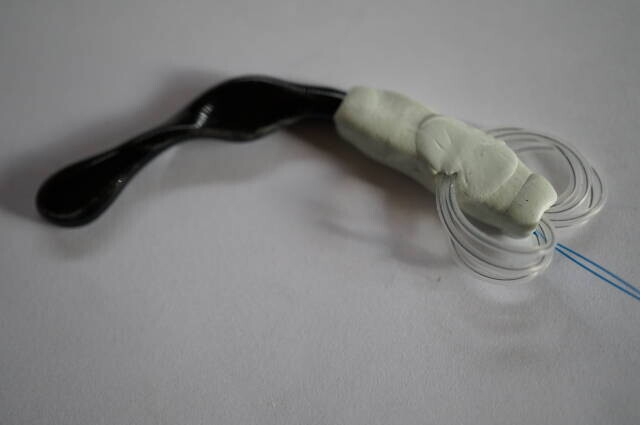
In an entry published in December 2025, Mr. Okada described prototype 3, a slim curved ceramic chip with an integrated apple-shaped stopper. He reported no outward movement during urination and no unwanted deeper movement toward the bladder. Unlike the detached arrangement, this design fixed the relationship between the chip and its stopper.
He described that fixed relationship as providing nearly complete retention in his test. Mr. Okada nevertheless cautioned that an integrated arrangement could strain the urethra, depending on its position.
(Source: ok-lab's diary, published December 2025)
https://ok-lab.hatenablog.com/entry/2025/12/20/123000
If you see blood in your urine, even a small amount or for the first time, do not wait and see. See a urologist right away.
If you suddenly cannot urinate, or the device cannot be removed, do not try to fix it yourself. Go to a medical facility, including emergency care, immediately.
How chip slipping when peeing changed over time
| Published | What the diary said then |
|---|---|
| Aug 2018 | A customer’s experience prompted a planned 50mm version and added S size. |
| Jun 2019 | Hole-free curved ceramic chips launched in nine versions across three lengths. |
| Jul 2019 | Custom quotes: ¥7,000 (about $45 at ¥156 = $1, rate as of 2026-09-04) excluding tax with an auxiliary chip; ¥5,000 (about $32 at ¥156 = $1, rate as of 2026-09-04) excluding tax without one. |
| Aug 2020 | A customer reported no thread-junction irritation after the rubber-cover repair. |
| Mar 2021 | A three-chip prototype stayed put during urination but took 20 minutes to remove. |
| Nov 2021 | A long prototype reportedly kept its tip in place despite some outward movement. |
| Dec 2021 | Strongly curved ceramic designs launched, with the maker reporting limited movement during urination. |
| Mar 2025 | A ceramic-and-wire test design shifted 5mm-10mm during urination or exercise. |
| Sep 2025 | Wing attachments offered retention with some remaining movement during forceful urination. |
| Dec 2025 | Integrated apple-shaped stoppers reportedly held firmly, with possible urethral strain. |
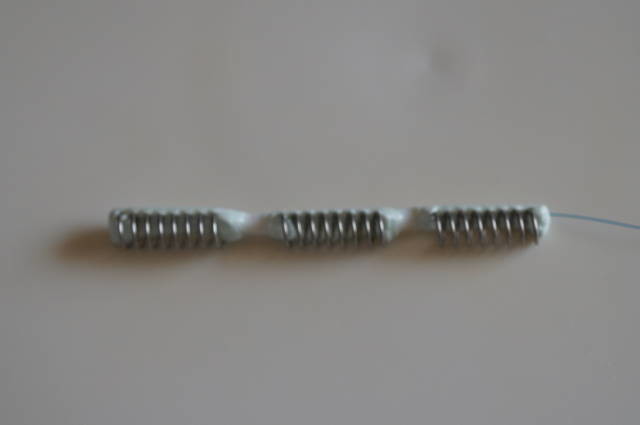
OK Prostate Chip products related to chip slipping when peeing
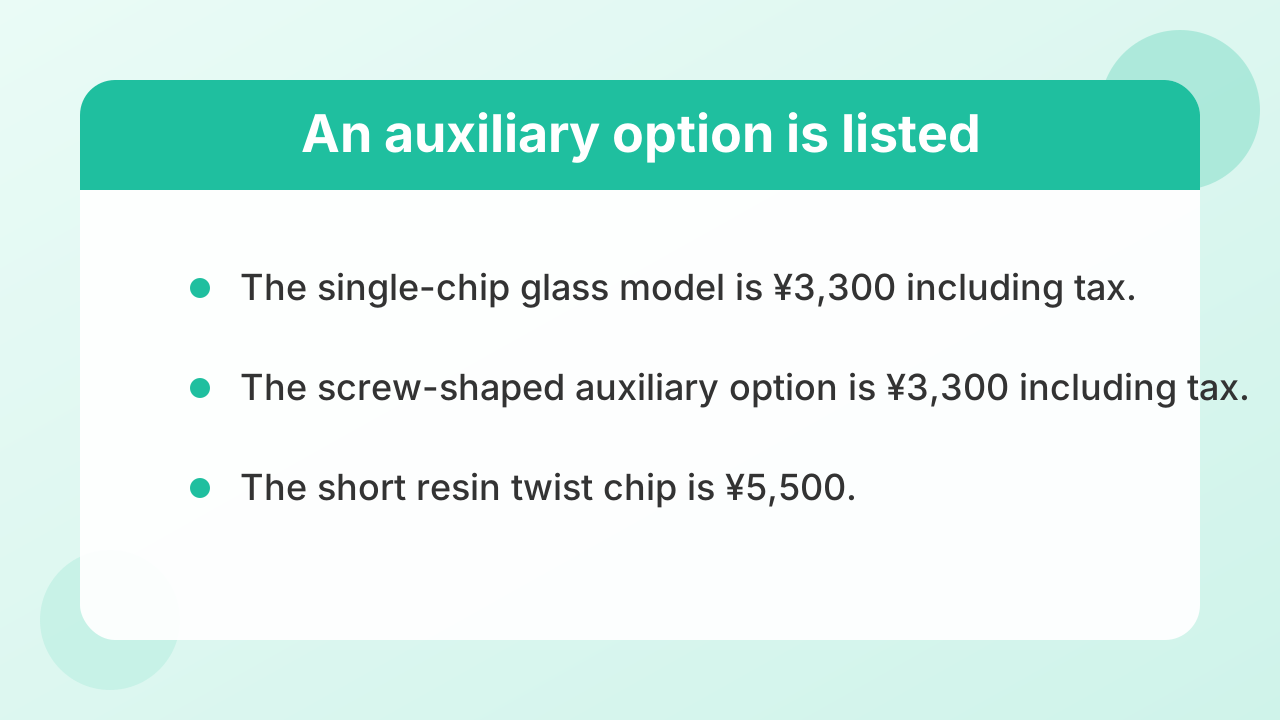
The current list includes the screw-shaped auxiliary option and models mentioned in customers’ reports.
Products that appear in these entries
| Product (official name) | Price incl. tax | Relation to this topic |
|---|---|---|
| Single-chip glass model (OKプロステートチップ ガラス素材1チップタイプ) | ¥3,300 (about $21 at ¥156 = $1, rate as of 2026-09-04) | In November 2019, a customer reported that this type slipped out of position during urination. |
| Screw-shaped auxiliary option (スクリュー型補助チップ追加オプション) | ¥3,300 (about $21 at ¥156 = $1, rate as of 2026-09-04) | In April 2022, a customer requested a custom connected pair after repeated repositioning became painful. |
| Short resin twist chip (OKプロステートチップ ショートタイプ ツイスト(生体適合樹脂)) | ¥5,500 (about $35 at ¥156 = $1, rate as of 2026-09-04) | In April 2022, the same customer liked its holding ability but reported pain at its central edge. |
(Source: ok-lab's diary, published November 2019)
https://ok-lab.hatenablog.com/entry/2019/11/09/132111
(Source: ok-lab's diary, published April 2022)
https://ok-lab.hatenablog.com/entry/2022/04/30/123451
Products the diary mentioned as alternatives
| Product (official name) | Price incl. tax | Relation to this topic |
|---|---|---|
| Penis-rim cushion (亀頭淵クッション) | ¥310 (about $2 at ¥156 = $1, rate as of 2026-09-04) | In June 2019, Mr. Okada suggested this instead of a ring while warning that prolonged tight constriction could cause tissue death. |
(Source: ok-lab's diary, published June 2019)
https://ok-lab.hatenablog.com/entry/2019/06/01/155432
The diary also describes historical custom builds, reverse-curved chips, horn extensions, loop-supported prototypes, wing attachments, and apple-shaped stoppers. No matching product can be confirmed on the current list.
Common worries about chip slipping when peeing
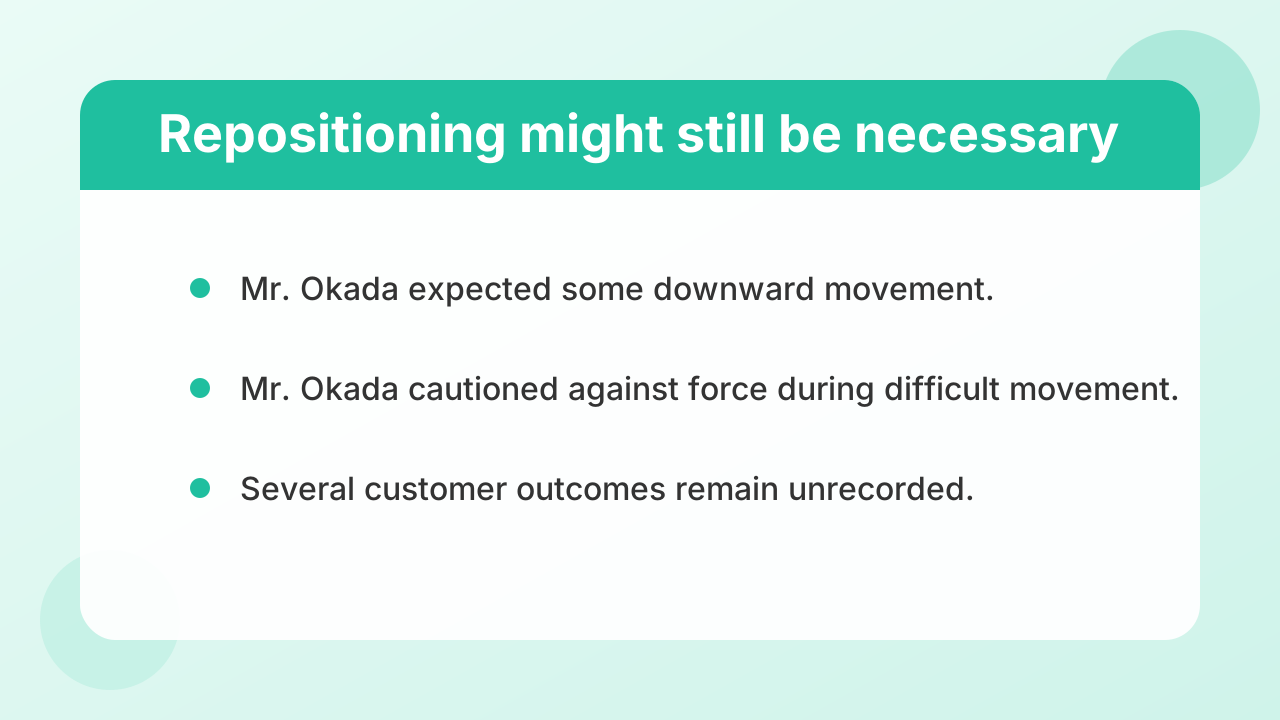
The diary addresses movement, resistance, and alternative shapes, but several customer outcomes remain unrecorded.
"Is repositioning after peeing hygienic if the chip stayed inside?"
In an entry published in January 2019, a customer asked about a two-chip model moving outward until an auxiliary part stopped it. Mr. Okada considered that stopping point expected and expressed the opinion that repositioning entirely within the urethra posed no hygiene problem. The diary provides no health follow-up for this customer.
The customer also asked whether a brief, distinctive sensation identified the chip’s position. Mr. Okada suspected passage through the internal urethral sphincter and interpreted further inward travel as possible movement into the bladder. For that inward movement, he recommended a sphincter stopper.
(Source: ok-lab's diary, published January 2019)
https://ok-lab.hatenablog.com/entry/20190112/1547275441
"Can a semi-long design prevent chip slipping when peeing?"
In an entry published in September 2019, a customer asked about urination after successfully positioning a semi-long vibrating chip. Mr. Okada’s reply focused on its accessible rear section as a support point. He still anticipated some outward movement and thought the chip could return to position afterward.
The diary does not record whether that customer achieved the longer retention they wanted. Mr. Okada also suggested longer curved shapes, while acknowledging that their size could be difficult for some customers.
(Source: ok-lab's diary, published September 2019)
https://ok-lab.hatenablog.com/entry/2019/09/21/131939
"Would a longer model prevent chip slipping when peeing?"
In an entry published in November 2019, a customer wanted longer retention after a single glass chip moved out during urination. Mr. Okada suggested longer, curved, or connected designs, but said he expected some downward movement with any chip during natural urination. He attributed this to the urethral sphincter opening.
His answer treated repositioning as something that might still be necessary, rather than promising a model that would remain fixed. He also considered dryness a possible reason for resistance and did not insist on an immediate complete return. Mr. Okada cautioned against force when movement was difficult.
(Source: ok-lab's diary, published November 2019)
https://ok-lab.hatenablog.com/entry/2019/11/09/132111
"Why won't the chip go back after peeing?"
In an entry published in June 2024, a customer asked why a reverse-curved chip had passed the muscle only once. Mr. Okada suspected insufficient moisture and resistance from the urethral lining, which he thought could bend the wire instead of moving the chip. He connected that explanation with his own episodes of difficulty repositioning a chip after urination.
The diary does not record whether the customer’s difficulty was resolved. Mr. Okada’s proposed measure focused on lubrication, although the explanation remained his interpretation.
(Source: ok-lab's diary, published June 2024)
https://ok-lab.hatenablog.com/entry/2024/06/29/123044
Buying from outside Japan

OK Lab ships internationally to countries covered by Japan Post's EMS courier service. Overseas orders are paid in advance by PayPal. Each order carries a ¥400 (about $3 at ¥156 = $1, rate as of 2026-09-04) handling fee, and EMS shipping is charged on top. These terms come from OK Lab's official sales-terms page (written here as plain text, not a link: ok-lab.net/docs/law), checked on September 7, 2026; confirm them on the official store before you order, because they can change.
Summary of this article
| What you wanted to know | The answer |
|---|---|
| What is the short answer? | Movement during urination persisted across several designs; some repositioning reports included pain. |
| What is this product? | A urethral device made and sold by OK Lab in Japan. |
| What do the terms mean? | Auxiliary parts, stoppers, wings, and extensions serve different movement-control roles. |
| What happened in the reports? | Experiences ranged from small shifts to painful thread defects and leakage after unusually firm retention. |
| What did the maker propose? | Added supports and different connections, with reservations about strain and difficult removal. |
| What changed over time? | Designs progressed from curved chips and auxiliary parts to wire-supported attachments and apple-shaped stoppers. |
| Which related products are currently listed? | The tables identify listed products separately from historical custom configurations. |
| What remained uncertain? | Several customer questions have no recorded follow-up confirming resolution. |
| How do overseas orders work? | Advance PayPal payment, EMS shipping, and a ¥400 (about $3 at ¥156 = $1, rate as of 2026-09-04) handling fee under the supplied terms. |
Source: ok-lab's diary (Okada Comfortable Life Laboratory). The original entries are in Japanese; quotations on this page are translated. Photos and videos are on the original entries.
This article is a summary of the maker's development diary. The product is not a medical device and no result is guaranteed. If anything feels wrong or worries you, see a doctor. Prices, specifications and cautions change, so confirm the latest information on the official blog and the official site. Questions about ordering and shipping go to the seller.