![Prostate chip comes out when peeing | Both slipping and complete ejection are reported [OK Prostate Chip]](/img/a/T0135/eyecatch.svg)
This page is based on entries from "ok-lab's diary" (https://ok-lab.hatenablog.com/), the Japanese development diary written by Mr. Okada, founder of OK Lab (Okada Comfortable Life Laboratory). Only the entries about "chips falling out when peeing" are summarized here, in order of publication. Past prices and sizes are as written at the time. Current prices come from the official product list (retrieved September 4, 2026). Quotations are translated from Japanese.
This article is about chips falling out when peeing, and summarizes reported problems, support designs, and changes over time. It discusses current products, common worries, medical care, and buying from outside Japan.
Note: This page is a personal reading log by someone with no connection to the maker or the seller. It reflects the source entries as of their publication dates and makes no guarantee of accuracy or safety. The product is not a medical device; talk to a doctor about any health decision. Check the official site for current information. This page contains advertising.
In short
Chips can shift during urination, come out completely, or strike the toilet.
OK Lab, a small company in Japan, discusses support designs, with results that depend on the device and person.
Current listings include screw-shaped supports and a guard intended to prevent chips reaching the toilet.
If you see blood in your urine, even a small amount or for the first time, do not wait and see. See a urologist right away.
If you suddenly cannot urinate, or the device cannot be removed, do not try to fix it yourself. Go to a medical facility, including emergency care, immediately.
About this product

The OK Prostate Chip is a small device that is placed in the urethra (the urine passage) so that it acts on the prostate; the maker sells it in several shapes, sizes and materials. It is made and sold by OK Lab (Okada Comfortable Life Laboratory), a small company in Japan, through its own online store, and prices are in Japanese yen (JPY). The maker's development diary, "ok-lab's diary", is written in Japanese. This page is an English summary of it, and every quotation is translated. OK Lab ships internationally, so readers outside Japan can order (see "Buying from outside Japan" below). Product names on this page are plain-English descriptions. The official Japanese product name is shown once in the product table so you can find the same item in the store.
Before you read: key terms
| Term | Plain-English meaning |
|---|---|
| Urethra | The urine passage, also the location where these devices sit. |
| Urethral sphincter | A muscle closing the urine passage; the maker discusses its grip on a chip. |
| Bulbar urethra | The wider passage near the penis base, discussed as space for supporting pieces. |
| Auxiliary chip | An additional piece intended to help stabilize the main chip. |
| Screw-shaped support | A twisted auxiliary piece intended to resist movement while leaving space for urine. |
| Sphincter stopper | An attached piece intended to prevent movement toward the bladder; it may not stop outward movement. |
| Neck groove | A narrowed chip section intended for the sphincter's grip. |
| U-turn stopper | A stopping piece that bends back on itself, intended to limit inward and outward movement. |
| 4-line support cable | Paired cable lines reinforced with wires, intended to improve stability. |
| Fully internal | A design with no exposed thread, intended to keep the assembly within the body. |
| Elastomer | A soft, bendable material tested as an alternative to rigid chip materials. |
| Sliding-lock urethral guard | An accessory intended to prevent a thread-linked chip from escaping into the toilet. |
What happens: chips falling out when peeing
The OK Prostate Chip is a small device placed inside the urethra to provide direct stimulation around the prostate. The worry here is movement during urination, ranging from a shift inside the body to the whole chip coming out. The diary describes additional supports and stoppers attached to a chip, its thread, or its cable, intended to limit that movement. Some sit within the urine passage; others form part of an external stopping arrangement.
A beginner reported the entire chip coming out during urination
In an entry published in October 2017, a staff member new to the device reported sudden, complete ejection while urinating. Every chip came out almost instantly, and the assembly nearly fell into the toilet. Catching the thread's end-piece prevented the loss. Mr. Okada says he cannot provide suitable beginner guidance from memory.
(Source: ok-lab's diary, published October 2017)
https://ok-lab.hatenablog.com/entry/20171019/1508375473
A ceramic chip falling out shattered against the toilet bowl
In an entry published in October 2019, a customer compared a short ceramic chip with a single-chip resin screw model. The customer found the screw version easier to urinate with, while straining could expel the short chip. In the reported accident, the ceramic chip struck the toilet and broke in half.
Mr. Okada said that week's revised ceramic chips were considerably stronger. He cautioned that impact resistance depended on where the chip was struck and that comparative testing was limited.
(Source: ok-lab's diary, published October 2019)
https://ok-lab.hatenablog.com/entry/2019/10/05/141806
Changing the neck did not stop chips from slipping during tests
In an entry published in May 2021, Mr. Okada compared resin prototypes with neck grooves (narrow sections) of different lengths. That groove affected how the urethral sphincter (the muscle closing the urine passage) held the chip, according to his discussion. He reported that strong urination displaced every shape tested. His conclusion was that none of these shapes provided certain retention.
(Source: ok-lab's diary, published May 2021)
https://ok-lab.hatenablog.com/entry/2021/05/22/125847
Chip slipping during peeing preceded hospital removal of overlapping pieces
In an entry published in August 2022, a customer described a linked resin chip that became stuck after shifting during urination. Attempts to restore its position preceded the main and auxiliary chips becoming wedged together; hospital examination found them overlapping. Medical removal took place on day 5, costing about ¥8,000 (about $51 at ¥156 = $1, rate as of 2026-09-04) with insurance coverage.
The customer reported some bleeding and pain afterward, plus concern about possible lasting changes to urination. Mr. Okada acknowledged the risks of linked pieces and discussed possible rotation and tangled thread. His reply emphasized checking the device's changed shape or position after unsuccessful repositioning.
(Source: ok-lab's diary, published August 2022)
https://ok-lab.hatenablog.com/entry/2022/08/20/122920
A flexible prototype still showed chip slipping during peeing
In an entry published in March 2024, Mr. Okada tested a flexible prototype made from elastomer (a soft, bendable material). He had expected its less slippery surface to improve retention. Instead, it shifted and moved partly outward during the second urination. He said the design still needed substantial improvement and might be far from sale.
(Source: ok-lab's diary, published March 2024)
https://ok-lab.hatenablog.com/entry/2024/03/02/123027
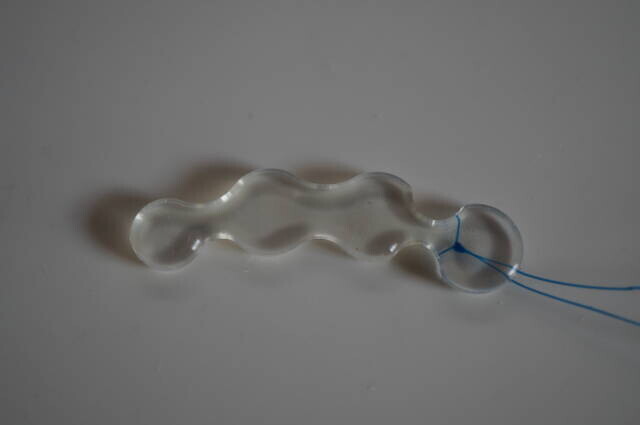
The maker's answer to chips falling out when peeing
The maker's proposals evolved from manual support to attached supports, reinforced cables, and an external guard.
Manual support was an early response to chip slipping during peeing
In an entry published in January 2018, a customer asked how a linked pair could stay inside without an auxiliary chip. Mr. Okada's historical response relied on forceful support of the linked pair during urination. The same customer reported success about an hour later. His advice assumed continued manual support during urination.
(Source: ok-lab's diary, published January 2018)
https://ok-lab.hatenablog.com/entry/20180130/1517311002
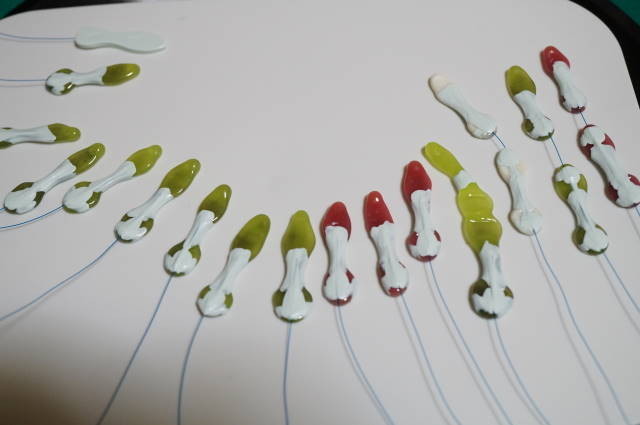
Screw-shaped supports addressed slipping chips while leaving room for urine
An entry published in December 2019 addressed a beginner whose chip came out during urination. OK Lab focused on retaining it within the bulbar urethra (the wider passage near the penis base), before the narrower penile passage. The developer favored a screw-shaped auxiliary chip (an additional supporting piece) for this problem.
In an entry published in January 2020, Mr. Okada explained why: the twisted shape was intended to preserve space for urine around a supported chip. He described the main piece at the prostate and its auxiliary screw in the wider passage. He favored that support because he believed it could resist expulsion without shutting off urine flow.
(Source: ok-lab's diary, published December 2019)
https://ok-lab.hatenablog.com/entry/2019/12/28/131319
(Source: ok-lab's diary, published January 2020)
https://ok-lab.hatenablog.com/entry/2020/01/25/150127
A U-turn stopper aimed to keep chips from slipping in either direction
In an entry published in January 2022, Mr. Okada described a U-turn stopper (a stopping piece that bends back on itself). His starting problem was a cable moving outward during urination and redirecting the urine stream. He applied the idea to cable and nylon-thread designs, claiming prevention of movement toward the bladder and almost no complete ejection. He said the freshly made prototypes needed further testing before release.
(Source: ok-lab's diary, published January 2022)
https://ok-lab.hatenablog.com/entry/2022/01/08/123729
A 4-line cable prevented chips from slipping in one development test
In an entry published in March 2022, Mr. Okada reported a different approach: a 4-line support cable (paired cable lines reinforced with wires). In his downward-facing test arrangement, even his strongest urination produced no sign of the chip coming out. He credited the balanced support structure with resisting bending inside the narrow passage. He proposed the design as a way to keep a chip in place.
(Source: ok-lab's diary, published March 2022)
https://ok-lab.hatenablog.com/entry/2022/03/26/123336
A sliding-lock guard limited the ejection of chips without stopping internal movement
In an entry published in October 2023, Mr. Okada announced sales of a sliding-lock urethral guard (an accessory limiting outward escape). He explained that a nylon-thread chip could still shift during urination. For the described setup, the guard would stop it from flying into the toilet and breaking. He presented it as an option for compatible chips already fitted with the specified safety end-piece.
(Source: ok-lab's diary, published October 2023)
https://ok-lab.hatenablog.com/entry/2023/10/28/122832
If you see blood in your urine, even a small amount or for the first time, do not wait and see. See a urologist right away.
If you suddenly cannot urinate, or the device cannot be removed, do not try to fix it yourself. Go to a medical facility, including emergency care, immediately.
How chips falling out when peeing changed over time
| Published | What the diary said then |
|---|---|
| May 2018 | Grooved glass prototypes still slipped during urination. |
| Feb 2020 | Twin-cable tests suggested improved retention, but had lasted only a few days. |
| Mar 2021 | Fully internal (no exposed thread) did not mean resistance to expulsion. |
| Apr 2024 | Mr. Okada reported improved prototype retention with an approximately 90-degree ceramic-pair connection. |
| Jan 2025 | A loop-supported ceramic prototype shifted about 1cm, without complete ejection. |
| Mar 2026 | Movable short SS slipped more readily than movable semi-long S. |
| Jun 2026 | A nominal 0mm screw gap still included cushioning tubing. |
| Jul 2026 | Mr. Okada reported better retention with a 90-degree auxiliary spiral. |
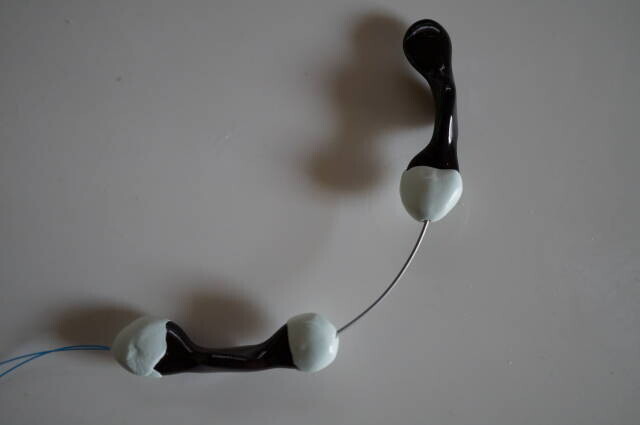
OK Prostate Chip products related to chips falling out when peeing
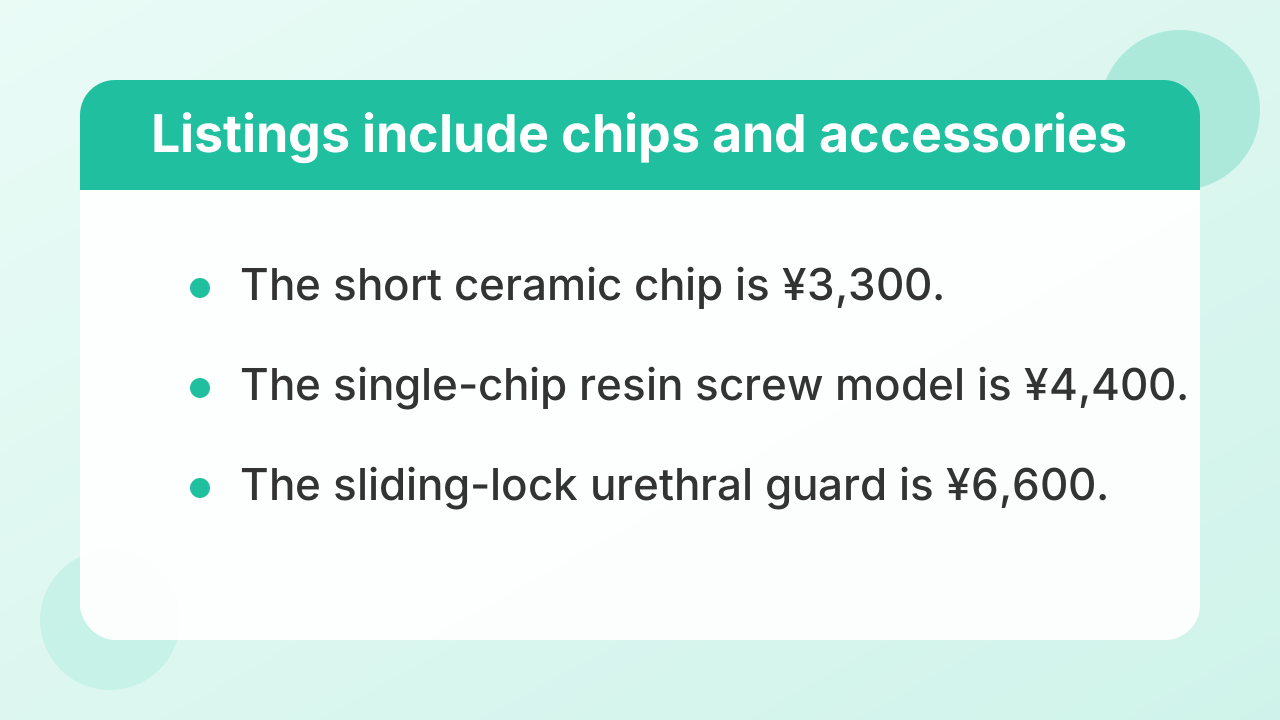
Current listings include models involved in reported problems and accessories the maker discussed for limiting ejection.
Products featured in these entries about chips
| Product (official name) | Price incl. tax | Relation to this topic |
|---|---|---|
| Short ceramic chip (OKプロステートチップ 陶器素材ショートタイプ) | ¥3,300 (about $21 at ¥156 = $1, rate as of 2026-09-04) | In October 2019, a customer reported this chip breaking after ejection into the toilet. |
| Single-chip resin screw model (OKプロステートチップ 樹脂素材1チップタイプ スクリュー) | ¥4,400 (about $28 at ¥156 = $1, rate as of 2026-09-04) | In October 2019, the same customer found urination easier with this model. |
| Sliding-lock urethral guard (スライドロック式尿道ゲートキーパー) | ¥6,600 (about $42 at ¥156 = $1, rate as of 2026-09-04) | In October 2023, Mr. Okada described preventing toilet impacts despite continued internal shifting. |
| Second-generation resin semi-long chip (OKプロステートチップ セミロングタイプ(第二世代生体適合樹脂)) | ¥6,050 (about $39 at ¥156 = $1, rate as of 2026-09-04) | In April 2026, a beginner reported expulsion and questioned the position of its auxiliary screw. |
| Second-generation resin screw support (スクリュー型補助チップ追加オプション(第二世代生体適合樹脂)) | ¥3,500 (about $22 at ¥156 = $1, rate as of 2026-09-04) | In April 2026, this support accompanied the beginner's semi-long chip in that report. |
The sliding-lock guard is listed in OK Lab's own online store.

(Source: ok-lab's diary, published October 2019)
https://ok-lab.hatenablog.com/entry/2019/10/05/141806
(Source: ok-lab's diary, published October 2023)
https://ok-lab.hatenablog.com/entry/2023/10/28/122832
(Source: ok-lab's diary, published April 2026)
https://ok-lab.hatenablog.com/entry/2026/04/18/122906
Alternative products mentioned in diary entries about chips
| Product (official name) | Price incl. tax | Relation to this topic |
|---|---|---|
| Screw-shaped support option (スクリュー型補助チップ追加オプション) | ¥3,300 (about $21 at ¥156 = $1, rate as of 2026-09-04) | In December 2019, the developer favored this add-on after a beginner reported a chip coming out. |
The screw-shaped support option is listed in OK Lab's own online store.
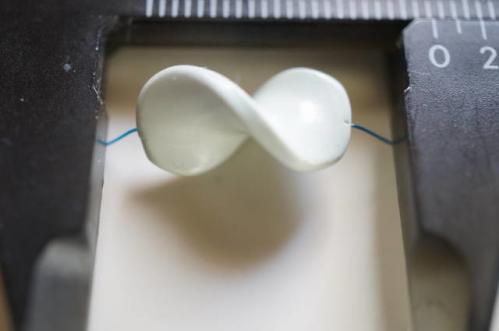
(Source: ok-lab's diary, published December 2019)
https://ok-lab.hatenablog.com/entry/2019/12/28/131319
In an entry published in October 2021, Mr. Okada said standard sales of the old glass linked pair ended about 3 years earlier. He cited the risk of pieces overlapping and becoming impossible to remove.
(Source: ok-lab's diary, published October 2021)
https://ok-lab.hatenablog.com/entry/2021/10/16/125843
Historical custom builds, prototypes, and the movable models: No matching product can be confirmed on the current list.
Common worries about chips falling out when peeing
The questions distinguish remaining inside the body from staying at the original position.
"Can a stopper prevent my chip falling out when peeing?"
In an entry published in July 2018, a customer said short and semi-long chips slipped out of the desired position. Mr. Okada distinguished inward movement toward the bladder from outward movement during urination. He said a sphincter stopper could prevent inward movement, while forceful urination could still expel the chip.
The diary does not record this customer's outcome after the reply. He suggested a chip with a cross-shaped neck as another possible improvement.
(Source: ok-lab's diary, published July 2018)
https://ok-lab.hatenablog.com/entry/20180721/1532152353
"Is it expected for chips to slip down to the auxiliary piece?"
In an entry published in January 2019, a customer asked whether movement down to the auxiliary piece was expected. The customer said that piece stopped the main chip from leaving the urethra. Mr. Okada treated that movement as expected and discussed internal repositioning, but the entry records no follow-up result. For the customer's separate concern about possible movement toward the bladder, he suggested a sphincter stopper.
(Source: ok-lab's diary, published January 2019)
https://ok-lab.hatenablog.com/entry/20190112/1547275441
"Would a longer model prevent my chip falling out?"
In an entry published in November 2019, a customer whose glass chip came out asked about models suited to longer retention. Mr. Okada said urination opens the sphincter, so he expected some downward movement with any chip under the conditions he described. He suggested longer or curved designs, while warning that remaining fixed throughout urination was not assured. He also advised against force when a displaced chip would not return easily.
(Source: ok-lab's diary, published November 2019)
https://ok-lab.hatenablog.com/entry/2019/11/09/132111
"Would extra supports stop my chip falling out when peeing?"
In an entry published in May 2026, a customer asked whether multiple auxiliary pieces could reduce expulsion without making urination harder. Mr. Okada thought the added contact would increase friction and make outward movement less likely. The entry records no test result for that customer's proposed arrangement.
The customer also wanted the ceramic cross-neck design in resin or surgical stainless steel. Mr. Okada said those versions were unavailable then and future sales plans remained undecided. He cautioned that stopper-shaped pieces could restrict urine flow; he considered screw-shaped supports barely obstructive.
(Source: ok-lab's diary, published May 2026)
https://ok-lab.hatenablog.com/entry/2026/05/23/122904
Buying from outside Japan

OK Lab ships internationally to countries covered by Japan Post's EMS courier service. Overseas orders are paid in advance by PayPal. Each order carries a ¥400 (about $3 at ¥156 = $1, rate as of 2026-09-04) handling fee, and EMS shipping is charged on top. These terms come from OK Lab's official sales-terms page (written here as plain text, not a link: ok-lab.net/docs/law), checked on September 7, 2026; confirm them on the official store before you order, because they can change.
Summary of this article
| What you wanted to know | The answer |
|---|---|
| What is the main concern? | Urination can shift or completely expel a chip. |
| What is this product? | A urethral device made by OK Lab in Japan. |
| What are auxiliary pieces for? | Supporting the main chip while allowing urine passage. |
| What happened in reported cases? | Outcomes included ejection, breakage, and hospital removal of overlapping pieces. |
| What did the maker propose? | Support pieces, reinforced cables, and guards, with different limits. |
| What changed over time? | Later experiments examined cables, connection angles, and loop structures. |
| What do current listings cost? | The short ceramic chip is ¥3,300 (about $21 at ¥156 = $1, rate as of 2026-09-04); the sliding-lock guard is ¥6,600, (about $42 at ¥156 = $1, rate as of 2026-09-04) including tax. |
| Does a stopper guarantee no movement? | The diary distinguishes inward stopping, internal shifting, and complete ejection. |
| Can someone outside Japan order? | The stated terms use EMS, advance PayPal payment, and additional fees. |
Source: ok-lab's diary (Okada Comfortable Life Laboratory). The original entries are in Japanese; quotations on this page are translated. Photos and videos are on the original entries.
This article is a summary of the maker's development diary. The product is not a medical device and no result is guaranteed. If anything feels wrong or worries you, see a doctor. Prices, specifications and cautions change, so confirm the latest information on the official blog and the official site. Questions about ordering and shipping go to the seller.