![How does the prostate chip move inside the body? | The maker describes pressure from outside [OK Prostate Chip]](/img/a/T0008/eyecatch.svg)
This page is based on entries from "ok-lab's diary" (https://ok-lab.hatenablog.com/), the Japanese development diary
written by Mr. Okada, founder of OK Lab (Okada Comfortable Life Laboratory). Only the entries about "prostate chip movement"
are summarized here, in order of publication. Past prices and sizes are as written at the time. Current prices come from
the official product list (retrieved September 4, 2026). Quotations are translated from Japanese.
Note: This page is a personal reading log by someone with no connection to the maker or the seller. It reflects the source entries as of their publication dates and makes no guarantee of accuracy or safety. The product is not a medical device; talk to a doctor about any health decision. Check the official site for current information. This page contains advertising.
In short
- OK Lab, a small company in Japan, says its chip moves through the urine passage using pressure from outside.
- Mr. Okada attributes movement to widened ends and a rigid middle, while stressing that infection remains possible.
- No matching product can be confirmed on the current list.
About this product
The OK Prostate Chip is a small device that is placed in the urethra (the urine passage) so that it acts on the prostate; the maker sells it in several shapes, sizes and materials. It is made and sold by OK Lab (Okada Comfortable Life Laboratory), a small company in Japan, through its own online store, and prices are in Japanese yen (JPY). The maker's development diary, "ok-lab's diary", is written in Japanese. This page is an English summary of it, and every quotation is translated. OK Lab ships internationally, so readers outside Japan can order (see "Buying from outside Japan" below). Product names on this page are plain-English descriptions. The official Japanese product name is shown once in the product table so you can find the same item in the store.
Before you read: key terms
| Term | Plain-English meaning |
|---|---|
| Urethra | The urine passage; the diary describes the chip occupying part of the route through which urine passes. |
| Milking | Pressure applied from outside a soft tube, intended to move its contents; Mr. Okada applies this idea to chip movement. |
| Microchip | The diary's early name for the small insert, intended to reach the prostate through the urine passage. |
| Retrieval thread | A thread attached to the device to support retrieval; the original system used thread intended for surgical stitches. |
| Auxiliary chip | An additional small piece intended to help control the main chip's movement and support retrieval. |
| Bulbar urethra | A wider section of the urine passage described in the diary; it accommodates the chip's lower section. |
| External urethral sphincter | A muscle surrounding the passage; Mr. Okada describes it gripping the chip's narrow middle. |
| Nozzle | The narrow liquid-carrying part of the later tube attachment, intended to deliver liquid deeper into the urine passage. |
What happens: prostate chip movement
The OK Prostate Chip is a small device placed in the urethra (the urine passage) to act on the prostate. Mr. Okada calls the movement principle milking (moving something through a soft tube by pressure from outside). The early design had widened ends and a narrow, rigid middle, which he credited with allowing this movement. In this account, movement occurs inside the penis's urine passage, toward the prostate.
The first prostate chip movement system awaited a name and instructions
In an entry published in October 2017, Mr. Okada announced a small chip system designed to reach the prostate through the urine passage. He described a microchip (a small insert) a few centimeters long, with movement and retrieval based on milking. OK Lab filed its patent application on October 3, 2017, under application number 2017-193218.
He said the product itself was ready for release, but the supporting explanation and product name were unfinished. No matching product can be confirmed on the current list. Mr. Okada asked readers to wait while those remaining launch preparations were completed.
(Source: ok-lab's diary, published October 2017)
https://ok-lab.hatenablog.com/entry/20171003/1507036624
Widened ends explain prostate chip movement, but early travel could reverse
In an entry published in October 2017, Mr. Okada illustrated the idea with a small chip about 30mm long. He attributed movement to the enlarged sections at both ends, saying the same shape allowed movement in either direction. He described the chip reaching the bulbar urethra (a wider part of the urine passage).
An auxiliary chip (an additional small piece) was also described as flattened, with space for urine to pass beside it. Mr. Okada presented that extra piece as a stopper intended to help prevent the main chip leaving during urination. The diary cautions that at about 3cm of early travel, milking could instead send the chip outward.
(Source: ok-lab's diary, published October 2017)
https://ok-lab.hatenablog.com/entry/20171008/1507448709
The initial chip milking launch was planned around a simpler version
In an entry published in October 2017, Mr. Okada distinguished the simple chip from a more extensive design. The extensive design had sections for the bladder, the prostate region, and the bulbar urethra. The simple version had no bladder section, and the initial sales plan covered only that version.
For the chip design described, he said urine would pass around the device, beside its flattened projections. No matching product can be confirmed on the current list. Mr. Okada favored a design that people could have present only when they wanted it.
(Source: ok-lab's diary, published October 2017)
https://ok-lab.hatenablog.com/entry/20171018/1508291723
Mr. Okada linked prostate chip movement feedback to the shorter device
In an entry published in October 2017, Mr. Okada contrasted a short chip with a long instrument controlled from farther away. He thought distance made sensation at a long instrument's tip harder to judge. He argued that a short chip kept the point of control near its position inside the urine passage.
In his account, only the thread spanned the area where the passage changed direction. He reported almost a year of near-daily personal testing without bladder or prostate infections. Mr. Okada cautioned that his own experience offered no guarantee for other users.
(Source: ok-lab's diary, published October 2017)
https://ok-lab.hatenablog.com/entry/20171026/1508989298
Thin liquid tubing bent in an experiment discussed alongside chip milking
In an entry published in March 2024, Mr. Okada described a trial nozzle (liquid-delivery tube) mostly 4mm across, with a 2mm opening. He reported that thinner tubing bent under pressure and failed to reach the deeper urine passage. He found that an inner width of 1mm passed water, but the thicker test liquid required 2mm.
The historical offer was ¥500 (about $3 at ¥156 = $1, rate as of 2026-09-04), tax excluded, for a 4mm tube section up to 25cm long, as published in March 2024. No matching product can be confirmed on the current list. Mr. Okada said he would not particularly recommend this attachment, because he expected more convenient equipment to exist.
(Source: ok-lab's diary, published March 2024)
https://ok-lab.hatenablog.com/entry/2024/03/09/122635
The maker's answer to prostate chip movement
Mr. Okada's explanation combines a rigid shape, a connected retrieval system, and claimed limits on pressure from outside.
An auxiliary piece formed the proposed backup for prostate chip movement
In an entry published in October 2017, Mr. Okada described a retrieval thread (a connection intended to support removal) using thread for surgical stitches. The system also included an auxiliary chip, which he said supported retrieval without relying on the thread.
In his October 2017 safety explanation, he also claimed the connection would permit retrieval if the entire chip entered the bladder. He said the thread would provide the connection in that hypothetical situation. The diary does not record a real recovery demonstrating this particular fallback. Mr. Okada presented the auxiliary chip as part of the intended retrieval safeguard.
(Source: ok-lab's diary, published October 2017)
https://ok-lab.hatenablog.com/entry/20171003/1507036624
(Source: ok-lab's diary, published October 2017)
https://ok-lab.hatenablog.com/entry/20171010/1507618022
The maker's chip milking reassurance depended on a short rear section
In an entry published in October 2017, Mr. Okada described diagram part 25 as at most about 10mm long. He said pressure from outside could not carry that section into the external urethral sphincter, labeled K. His explanation relied on layers of muscle around that area limiting reach from outside.
From this, he claimed milking would prevent the entire chip entering the prostate region or reaching the bladder. The diary does not record independent testing of that claim. Mr. Okada nevertheless warns that no such system can eliminate infection risk, and urges attention to cleanliness.
(Source: ok-lab's diary, published October 2017)
https://ok-lab.hatenablog.com/entry/20171010/1507618022
A rigid narrow middle was central to Mr. Okada's chip milking claim
In an entry published in October 2017, Mr. Okada identified the narrow middle as a key difference from the other designs he discussed. That section sat at the external urethral sphincter (the muscle he described as gripping the chip). It was thinner than the neighboring prostate and bulbar sections, but made from a material that would not fold.
He credited this structure with allowing milking and said it made placement and retrieval possible without a doctor. The diary does not record an independent assessment of that claim. Mr. Okada's preference was for a device that could be removed whenever its owner wanted.
(Source: ok-lab's diary, published October 2017)
https://ok-lab.hatenablog.com/entry/20171018/1508291723
How prostate chip movement changed over time
| Published | What the diary said then |
|---|---|
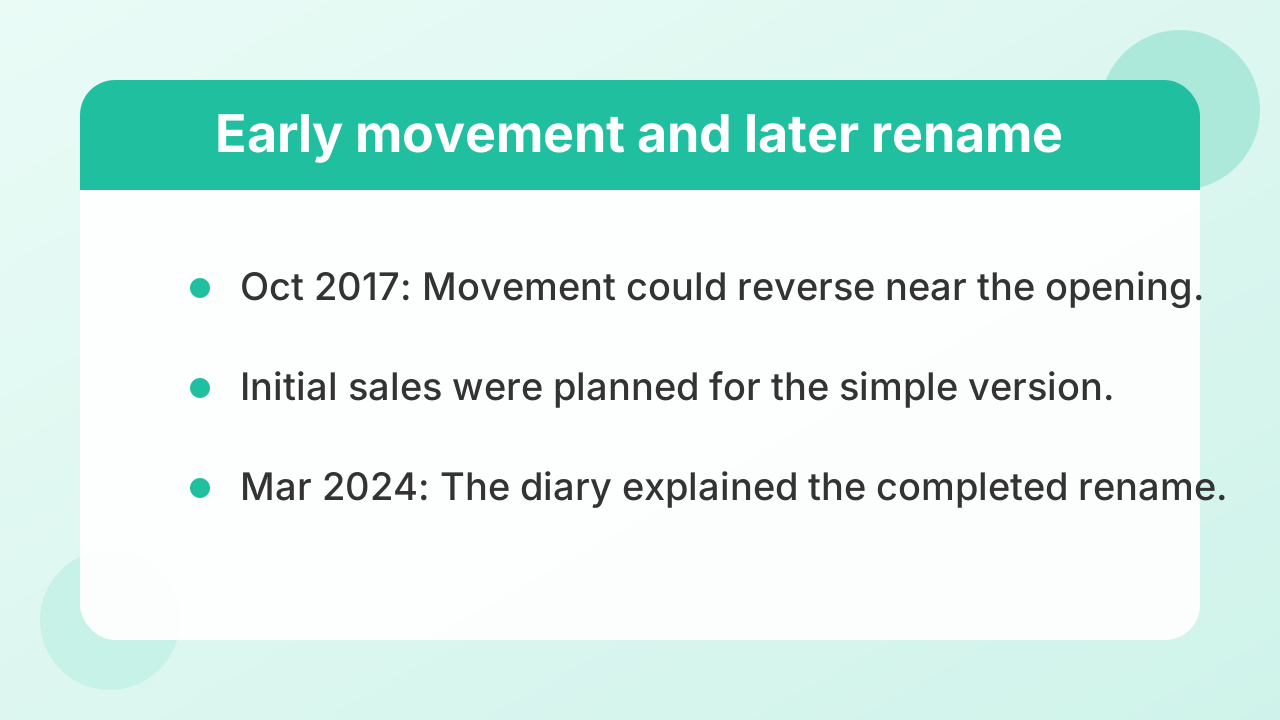
| Oct 2017 | Release awaited a finished product name and usage explanation. |
| Oct 2017 | Early chip movement could reverse near the opening. |
| Oct 2017 | Mr. Okada attributed depth limits to anatomy and the short rear section. |
| Oct 2017 | Initial sales were planned for the simple version, without a bladder section. |
| Oct 2017 | Mr. Okada warned that his personal infection-free experience guaranteed nothing for others. |
| Mar 2024 | The diary explained the completed rename from milking microchip to Prostate Chip. |
| Mar 2024 | A custom liquid tube was offered for ¥500, (about $3 at ¥156 = $1, rate as of 2026-09-04) tax excluded, with a length limit. |
The diary does not say what the current state is.
OK Prostate Chip products related to prostate chip movement
No current product is directly tied to this topic.
Common worries about prostate chip movement
The recorded concerns involve cotton swabs, the meaning of milking, and whether a long liquid tube is worthwhile.
"Are cotton swabs suitable for chip movement?"
An entry published in October 2017 records a customer's objection to the diary's earlier cotton-swab suggestion. The added correction is marked 1/29; the material does not identify its year. The customer said cotton swabs were unsuitable for the urethra, and Mr. Okada accepted the correction.
The diary does not record an injury or a separate follow-up from that customer. Mr. Okada withdrew the suggestion, so his corrected position rules out cotton swabs for that purpose.
(Source: ok-lab's diary, published October 2017)
https://ok-lab.hatenablog.com/entry/20171008/1507448709
"Does chip milking mean extracting semen?"
In an entry published in March 2024, Mr. Okada recalled an inquiry about the device's former name, milking microchip. The inquirer associated milking with expressing semen and asked whether the device had that function. Mr. Okada explained that his name referred to movement through a soft tube, using nursing terminology as his comparison.
He reported accepting someone else's suggestion to rename it the Prostate Chip. The entry records an already completed rename, without saying when the change took effect. Mr. Okada favored the replacement because the old name could suggest a function he had not intended it to describe.
(Source: ok-lab's diary, published March 2024)
https://ok-lab.hatenablog.com/entry/2024/03/09/122635
"Could chip milking send liquid without a long tube?"
In an entry published in March 2024, a reader proposed milking liquid deeper and raised concerns about maintaining a long tube. Mr. Okada agreed with the milking idea, but wanted liquid near the chip without wetting the whole urine passage.
His response included the prototype described above, rather than a reported result from that reader. The diary does not record whether that reader tried either approach. Mr. Okada's reply also treats cleaning the tube's interior as necessary.
(Source: ok-lab's diary, published March 2024)
https://ok-lab.hatenablog.com/entry/2024/03/09/122635
Buying from outside Japan
OK Lab ships internationally to countries covered by Japan Post's EMS courier service. Overseas orders are paid in advance by PayPal. Each order carries a ¥400 (about $3 at ¥156 = $1, rate as of 2026-09-04) handling fee, and EMS shipping is charged on top. These terms come from OK Lab's official sales-terms page (written here as plain text, not a link: ok-lab.net/docs/law), checked on September 7, 2026; confirm them on the official store before you order, because they can change.
Summary of this article
| What you wanted to know | The answer |
|---|---|
| What is the short answer? | Mr. Okada describes movement caused by pressure from outside, supported by the chip's shape. |
| What is the product? | A small device made by OK Lab in Japan, intended to act on the prostate through the urine passage. |
| What does milking mean here? | The maker's term for moving contents through a soft tube using external pressure. |
| What do the development entries show? | Early chip shapes, a launch delay, a movement problem, and a later liquid-tube experiment. |
| What was the maker's answer? | A rigid middle, retrieval components, and claimed anatomical limits; he acknowledged infection risk. |
| What changed over time? | The diary moved from the October 2017 launch explanations to a March 2024 naming clarification and tube offer. |
| Which current product matches? | No matching product can be confirmed on the current list. |
| What concerns did readers raise? | Cotton-swab suitability, confusion over the old name, and liquid delivery with long tubing. |
| How do overseas orders work? | Advance PayPal payment, a ¥400 (about $3 at ¥156 = $1, rate as of 2026-09-04) handling fee, and additional Japan Post EMS shipping. |
| What can this account establish? | The maker's explanation and historical specifications; his personal experience does not establish a safety guarantee. |
Source: ok-lab's diary (Okada Comfortable Life Laboratory). The original entries are in Japanese; quotations on this page are translated. Photos and videos are on the original entries.
This article is a summary of the maker's development diary. The product is not a medical device and no result is guaranteed. If anything feels wrong or worries you, see a doctor. Prices, specifications and cautions change, so confirm the latest information on the official blog and the official site. Questions about ordering and shipping go to the seller.