![What causes that prostate chip twinge? | The maker links it to sphincter stimulation [OK Prostate Chip]](/img/a/T0003/eyecatch.svg)
This page is based on entries from "ok-lab's diary" (https://ok-lab.hatenablog.com/), the Japanese development diary written by Mr. Okada, founder of OK Lab, a small company in Japan (Okada Comfortable Life Laboratory). Only the entries about "sphincter stimulation and the brief twinge" are summarized here, in order of publication. Past prices and sizes are as written at the time. Current prices come from the official product list (retrieved September 4, 2026). Quotations are translated from Japanese.
Note: This page is a personal reading log by someone with no connection to the maker or the seller. It reflects the source entries as of their publication dates and makes no guarantee of accuracy or safety. The product is not a medical device; talk to a doctor about any health decision. Check the official site for current information. This page contains advertising.
In short
- Mr. Okada links the brief prostate chip twinge to sphincter stimulation, while acknowledging that sensations can fade.
- His replies discuss stopper designs and changing contact, but also describe injury risks and uncertain results.
- The August 2026 reply still offers several possible explanations for faint sensations, without confirming the customer's chip position.
If you see blood in your urine, even a small amount or for the first time, do not wait and see. See a urologist right away. If you suddenly cannot urinate, or the device cannot be removed, do not try to fix it yourself. Go to a medical facility, including emergency care, immediately.
About this product

The OK Prostate Chip is a small device that is placed in the urethra (the urine passage) so that it acts on the prostate; the maker sells it in several shapes, sizes and materials. It is made and sold by OK Lab (Okada Comfortable Life Laboratory), a small company in Japan, through its own online store, and prices are in Japanese yen (JPY). The maker's development diary, "ok-lab's diary", is written in Japanese. This page is an English summary of it, and every quotation is translated. OK Lab ships internationally, so readers outside Japan can order (see "Buying from outside Japan" below). Product names on this page are plain-English descriptions. The official Japanese product name is shown once in the product table so you can find the same item in the store.
Before you read: key terms
| Term | Plain-English meaning |
|---|---|
| Urethra | The urine passage; the chip occupies part of this passage to act on the prostate. |
| External urinary sphincter | The muscle before the prostate that Mr. Okada describes as consciously controlled during urination. |
| Internal urinary sphincter | The muscle at the bladder boundary; Mr. Okada describes it as controlling that opening without conscious control. |
| Involuntary | Not consciously controlled; the diary uses this term to explain why the inner muscle cannot be deliberately opened or closed. |
| Gap | The distance between linked chips; the maker varied it to change their contact with the sphincter. |
| Sphincter stopper | An additional chip intended to limit movement toward the bladder; the diary does not promise that it always works. |
| External stopper | A stop outside the penis tip, proposed to limit inward movement if an internal stopper failed. |
| Retrieval thread | A thread attached to a chip for removal; the diary records failures of older connections. |
| Balloon catheter | A urine-draining tube with a balloon that holds it in place inside the bladder, as described in the diary. |
What happens: prostate chip sensations
The OK Prostate Chip is a small device placed in the urethra to act on the prostate. A sphincter (a muscle controlling a passage) is central to Mr. Okada's explanation of the brief twinge. He places the relevant muscles before the prostate and at its boundary with the bladder. He attributes the twinge to muscle contact, but later reports show that the same area can stop producing noticeable sensations.
The prostate chip twinge was initially linked to an involuntary muscle
In an entry published in October 2017, Mr. Okada described the internal urinary sphincter (the inner muscle at the bladder boundary). He called it involuntary (not under conscious control) and associated passage through it with a brief, slightly painful twinge.
He distinguished the external urinary sphincter (the muscle before the prostate), which he described as consciously controlled. His early account treated the inner twinge as a sign that the chip had reached the bladder. His initial recommendation for beginners favored the shorter design.
(Source: ok-lab's diary, published October 2017)
https://ok-lab.hatenablog.com/entry/20171007/1507362243
Changing linked-chip gaps changed Mr. Okada's reported sphincter stimulation
In an entry published in January 2018, Mr. Okada reported testing perhaps 20 prototypes to explore spacing between linked chips. A gap (the distance between linked chips) of about 10mm felt comfortable to him but eventually unsatisfying. At about 3mm, he reported gentler sphincter sensations than with the original single-piece design.
He also tested touching chips whose joint could bend, describing less strain than a rigid design. He planned to let buyers choose the spacing and recommended the gentler linked arrangement as another option.
(Source: ok-lab's diary, published January 2018)
https://ok-lab.hatenablog.com/entry/20180106/1515230584

Long designs changed the maker's approach to sphincter stimulation
An entry published in January 2018 announced cancellation of the rigid long chip after sphincter injury. Mr. Okada proposed linked short chips with a zero gap instead. A later January 2018 entry reversed that sales decision while openly acknowledging the risk.
In two earlier incidents, the retrieval thread (the thread attached for removal) detached, leaving the devices difficult to remove. Mr. Okada reported that he eventually removed those devices. He restricted the proposed long model to short stays because he said prolonged placement could injure the sphincter.
(Source: ok-lab's diary, published January 2018)
https://ok-lab.hatenablog.com/entry/20180106/1515230584
(Source: ok-lab's diary, published January 2018)
https://ok-lab.hatenablog.com/entry/20180111/1515662782
An early curved-tip test connected sphincter stimulation with bleeding
In an entry published in January 2018, an early tester reported slight bleeding with a curved, bladder-anchoring prototype. Mr. Okada warned that misalignment of the tip's curve during passage could place excessive strain on the sphincter.
The tester reportedly said the bleeding had stopped by the next urination. Mr. Okada deferred a sales decision on that design pending further testing.
(Source: ok-lab's diary, published January 2018)
https://ok-lab.hatenablog.com/entry/20180111/1515662782
Bladder-wall pressure did not explain Mr. Okada's strongest prostate chip sensations
In an entry published in November 2020, a customer proposed a design targeting possible sensation sources around the bladder. Mr. Okada replied that his strongest sensations occurred near the inner sphincter. He contrasted catheter passage there with barely noticeable pressure from a balloon inside the bladder.
A balloon catheter (a urine-draining tube held in place by a balloon) informed that personal comparison. He proposed that changes in tissue shape, rather than continuing pressure, explained why the sensation faded. His design preference for longer stays kept the main chip centered on the prostate.
(Source: ok-lab's diary, published November 2020)
https://ok-lab.hatenablog.com/entry/2020/11/14/131426
An arrowhead prototype made sphincter stimulation difficult to separate from removal trouble
In an entry published in February 2024, Mr. Okada described an arrowhead-shaped test piece about 11-12mm wide. He reported that it would not move under ordinary pulling and was eventually removed with some pain.
His proposed design used the narrow neck behind the arrowhead to help retain the device at the bladder boundary. He planned further shape research intended to reduce injury during removal.
(Source: ok-lab's diary, published February 2024)
https://ok-lab.hatenablog.com/entry/2024/02/10/123023
Later testing showed that the prostate chip twinge could disappear
In an entry published in March 2024, Mr. Okada reported a clear twinge during abrupt passage through the inner sphincter. Gradual movement, however, could pass unnoticed in his tests.
He also described fading awareness when the muscle remained stretched, which he thought might reflect numbness. He reported repeatedly discovering that a chip had moved into the bladder without his noticing. He favored reducing outer-sphincter contact to separate prostate sensations from muscle discomfort.
(Source: ok-lab's diary, published March 2024)
https://ok-lab.hatenablog.com/entry/2024/03/30/122958
The maker's answer to prostate chip sensations
Mr. Okada's replies distinguish sensation from position and pair proposed design changes with warnings about inward movement or broken connections.
The prostate chip twinge prompted stopper advice in January 2019
In an entry published in January 2019, a customer asked whether a piercing twinge meant prostate contact or arrival at the bladder. They described little continuing awareness afterward.
Mr. Okada attributed the twinge to the inner sphincter and distinguished it from prostate sensation. He thought movement beyond that point meant movement into the bladder. He suggested a sphincter stopper (an additional chip intended to limit inward travel); the diary does not record whether this resolved the problem.
(Source: ok-lab's diary, published January 2019)
https://ok-lab.hatenablog.com/entry/20190112/1547275441
Closer linked chips increased sphincter stimulation but raised connection concerns
In an entry published in September 2019, Mr. Okada preferred nearly touching ceramic chips after finding 4-8mm gaps less satisfying. He proposed 1-2mm connections that allowed the chips to change angle.
He warned that the stainless-steel connector would eventually break and included a parallel nylon thread as a backup. Although he initially said a broken connection could still function, he warned that exposed metal might damage the nylon. Mr. Okada therefore required customers to request thread replacement after a break.
(Source: ok-lab's diary, published September 2019)
https://ok-lab.hatenablog.com/entry/2019/09/28/140637
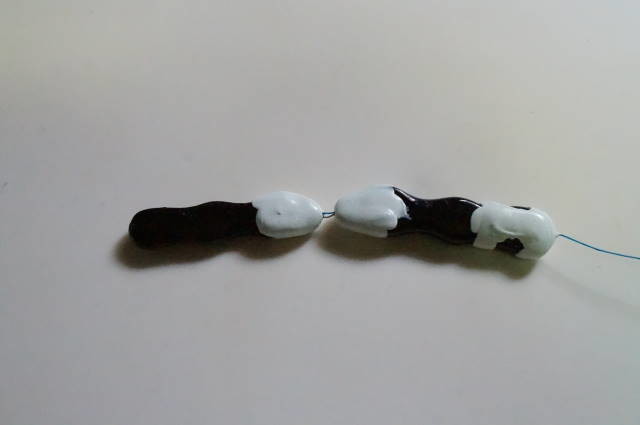
Fading prostate chip sensations led to advice carrying an inward-movement warning
In an entry published in October 2019, a customer reported losing a pleasurable position as the chip moved farther inward. Mr. Okada suspected that the whole chip had crossed the outer sphincter.
He discussed about 5mm stopper spacing as a possible response to lost contact, while explicitly warning that inward movement became more likely. He also considered longer, curved designs, but acknowledged that extra length would not solve complete movement into the bladder. If the internal stopper failed, he suggested an external stopper (a stop outside the penis tip). No subsequent result is recorded for this customer.
(Source: ok-lab's diary, published October 2019)
https://ok-lab.hatenablog.com/entry/2019/10/26/145539
If you see blood in your urine, even a small amount or for the first time, do not wait and see. See a urologist right away. If you suddenly cannot urinate, or the device cannot be removed, do not try to fix it yourself. Go to a medical facility, including emergency care, immediately.
How prostate chip sensations changed over time
| Published | What the diary said then |
|---|---|
| Oct 2017 | Short chips were described as about 30-35mm long. |
| Jan 2018 | Planned linked models: 1mm, 5mm, 8mm gaps; ¥6,000 (about $38 at ¥156 = $1, rate as of 2026-09-04) excluding tax. |
| May 2018 | Mr. Okada found a grooved glass prototype more comfortable than deeply grooved resin. |
| Dec 2018 | A vibrating prototype was being developed to make location and sensations easier to detect. |
| Jan 2021 | A shifted ring produced excessive sensation at the inner sphincter during his test. |
| Feb 2024 | Mr. Okada explained larger rear bulges were intended to resist inward movement. |
| Jan 2025 | His 30mm loop prototype reportedly eliminated inner sphincter stimulation. |
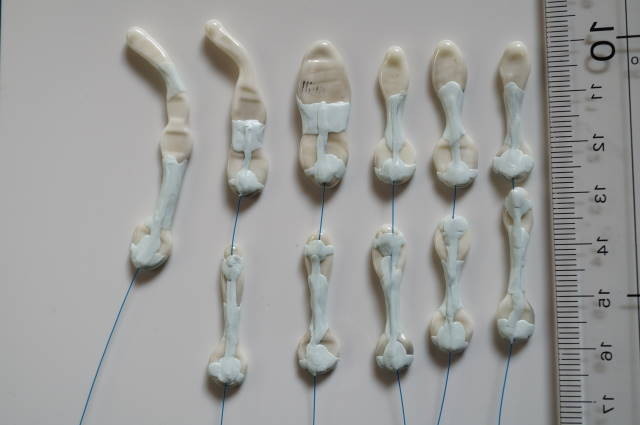
OK Prostate Chip products related to prostate chip sensations

The October 2019 account names current products, but reports difficulty keeping sensations consistent.
Products that appear in these entries
| Product (official name) | Price incl. tax | Relation to this topic |
|---|---|---|
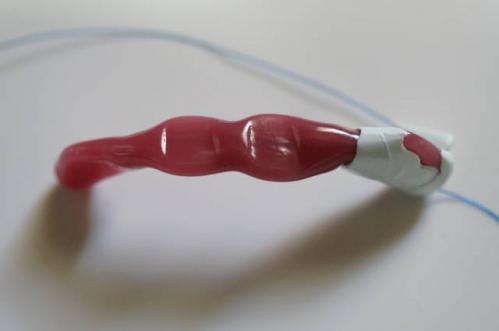
| Twisted semi-long glass chip (OKプロステートチップ ガラス素材セミロングタイプ コブラツイスト) | ¥5,500 (about $35 at ¥156 = $1, rate as of 2026-09-04) | In October 2019, this was among the customer's chips associated with inward movement and fading sensations. |
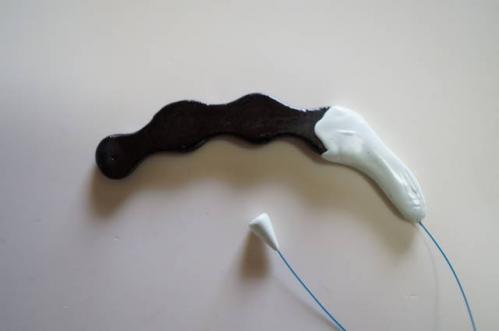
| Comma-shaped semi-long ceramic chip (OKプロステートチップ 陶器素材セミロング勾玉タイプ) | ¥5,500 (about $35 at ¥156 = $1, rate as of 2026-09-04) | In October 2019, the same customer listed this model when asking about lost contact near the sphincter. |
The twisted semi-long glass chip is listed in OK Lab's own online store.
The comma-shaped semi-long ceramic chip is listed in OK Lab's own online store.
(Source: ok-lab's diary, published October 2019)
https://ok-lab.hatenablog.com/entry/2019/10/26/145539
Products the diary mentioned as alternatives
The diary names no alternative.
Historical prototypes and test builds described above:
No matching product can be confirmed on the current list.
Common worries about prostate chip sensations

The reader questions concern missing sensations, possible injury, and uncertainty about where the chip has moved.
"Are prostate chip sensations supposed to start immediately?"
In an entry published in December 2018, a customer asked why the chip produced no pleasure despite apparently reaching the prostate. They also asked whether sensations could change with experience.
Mr. Okada replied that individual differences were substantial and that learning to recognize prostate sensations could matter. The diary does not record whether this customer's experience improved. He suggested vibration as a possible aid to recognizing sensation.
(Source: ok-lab's diary, published December 2018)
https://ok-lab.hatenablog.com/entry/20181222/1545459719
"Could sphincter stimulation explain bleeding with a particular chip?"
In an entry published in December 2025, a customer requested size comparisons after noticing different discomfort levels with different chips. They suspected that involuntary squeezing might explain bleeding associated with certain designs.
Mr. Okada recalled a nurse's account of bleeding when a catheter balloon expanded while still at the inner sphincter. In that account, the catheter had not reached the bladder before inflation. He allowed that chip-related injury there might be possible, while stressing that a nonprofessional could not reliably identify the bleeding site.
(Source: ok-lab's diary, published December 2025)
https://ok-lab.hatenablog.com/entry/2025/12/27/122915
"Do faint prostate chip sensations mean the position is correct?"
In an entry published in August 2026, a customer asked whether weak sensations and resistance to withdrawal meant successful placement. Mr. Okada said the strongest awareness usually came from the outer sphincter, while inner sensations could fade.
He offered several explanations: a groove fitting the muscle, the chip passing beyond it, or complete movement into the bladder. He acknowledged that resistance to withdrawal could occur both with the intended placement and after movement into the bladder. His reply did not establish which explanation applied to this customer.
(Source: ok-lab's diary, published August 2026)
https://ok-lab.hatenablog.com/entry/2026/08/08/122906
Buying from outside Japan

OK Lab ships internationally to countries covered by Japan Post's EMS courier service. Overseas orders are paid in advance by PayPal. Each order carries a ¥400 (about $3 at ¥156 = $1, rate as of 2026-09-04) handling fee, and EMS shipping is charged on top. These terms come from OK Lab's official sales-terms page (written here as plain text, not a link: ok-lab.net/docs/law), checked on September 7, 2026; confirm them on the official store before you order, because they can change.
Summary of this article
| What you wanted to know | The answer |
|---|---|
| In short | Mr. Okada links the twinge to sphincter contact, but later reports describe fading awareness. |
| About this product | A urethral device made by OK Lab in Japan; prices are in JPY. |
| Key terms | The diary distinguishes the consciously controlled outer muscle from the involuntary inner muscle. |
| What happens | Personal tests and customer accounts include changing sensations, bleeding, and removal difficulty. |
| The maker's answer | His proposals involve stoppers and connections, with warnings and uncertain outcomes. |
| Changes over time | Designs evolved through linked chips, altered gaps, and shorter loops. |
| Related products | The listed glass and ceramic models appear in a customer's October 2019 account. |
| Common worries | The replies do not establish every customer's chip position or bleeding source. |
| Buying outside Japan | EMS delivery, advance PayPal payment, a ¥400 (about $3 at ¥156 = $1, rate as of 2026-09-04) handling fee, and additional shipping charges. |
Source: ok-lab's diary (Okada Comfortable Life Laboratory). The original entries are in Japanese; quotations on this page are translated. Photos and videos are on the original entries.
This article is a summary of the maker's development diary. The product is not a medical device and no result is guaranteed. If anything feels wrong or worries you, see a doctor. Prices, specifications and cautions change, so confirm the latest information on the official blog and the official site. Questions about ordering and shipping go to the seller.