![Where is the prostate sweet spot? | The diary describes several possibilities [OK Prostate Chip]](/img/a/T0001/eyecatch.svg)
This page is based on entries from "ok-lab's diary" (https://ok-lab.hatenablog.com/), the Japanese development diary written by Mr. Okada, founder of OK Lab, a small company in Japan (Okada Comfortable Life Laboratory). Only the entries about "finding the prostate sweet spot" are summarized here, in order of publication. Past prices and sizes are as written at the time. Current prices come from the official product list (retrieved September 4, 2026). Quotations are translated from Japanese.
Note: This page is a personal reading log by someone with no connection to the maker or the seller. It reflects the source entries as of their publication dates and makes no guarantee of accuracy or safety. The product is not a medical device; talk to a doctor about any health decision. Check the official site for current information. This page contains advertising.
In short
- The diary describes several possible prostate sweet spots, without establishing one location that works for everyone.
- Mr. Okada emphasizes shape, movement, and individual fit, while recording injuries and limits to his knowledge.
- Current chips remain listed, but the fine-wire instrument described in May 2026 has no confirmed current match.
If you see blood in your urine, even a small amount or for the first time, do not wait and see. See a urologist right away. If you suddenly cannot urinate, or the device cannot be removed, do not try to fix it yourself. Go to a medical facility, including emergency care, immediately.
About this product
The OK Prostate Chip is a small device that is placed in the urethra (the urine passage) so that it acts on the prostate; the maker sells it in several shapes, sizes and materials. It is made and sold by OK Lab (Okada Comfortable Life Laboratory), a small company in Japan, through its own online store, and prices are in Japanese yen (JPY). The maker's development diary, "ok-lab's diary", is written in Japanese. This page is an English summary of it, and every quotation is translated. OK Lab ships internationally, so readers outside Japan can order (see "Buying from outside Japan" below). Product names on this page are plain-English descriptions. The official Japanese product name is shown once in the product table so you can find the same item in the store.
Before you read: key terms
| Term | Plain-English meaning |
|---|---|
| Prostate sweet spot | A location associated with strong sensations; used here to discuss where contact matters. |
| Urethra | The urine passage; the maker describes the chip as acting from inside it. |
| Ejaculatory ducts | Semen passages whose openings Mr. Okada identifies as possible sensitive areas. |
| Prostatic ducts | Passages for prostate fluid; their openings are another proposed stimulation target. |
| Cowper’s glands | Glands discussed as nearby stimulation targets. Their bodily function: The diary does not explain this. |
| Internal urethral sphincter | The muscle at the bladder boundary; Mr. Okada links it to sensation and stability. |
| External urethral sphincter | The muscle at the prostate’s outer boundary; the diary discusses its role in stability. |
| Mucosa | The urethra’s lining; discussed as a contact surface involved in friction. |
| Tissue deformation | A change in tissue shape; Mr. Okada’s proposed explanation for sensations beyond constant pressure. |
| Sphincter stopper | An accessory intended to limit unwanted chip movement. |
| Micro prostate bougie | A fine-wire urethral instrument intended to contact several areas around the prostate. |
What happens: finding the prostate sweet spot
The OK Prostate Chip is a small urethral device that the maker describes as applying pressure to the prostate. The prostate sweet spot means a location linked to strong sensations in these accounts, rather than one consistently identified point. Mr. Okada discusses duct openings and the boundaries between the prostate and neighboring parts of the urine passage. His explanations distinguish where contact occurs from the pressure, movement, and shape involved.
Mr. Okada initially linked the prostate sweet spot to duct openings
In an entry published in October 2017, Mr. Okada described clustered openings in the prostate’s urine passage. These included the ejaculatory ducts (semen passages) and prostatic ducts (passages for prostate fluid). He also identified Cowper’s glands (glands with nearby duct openings).
His account included injuries: oversized development chips had caused tears in his urethra. He wrote that he could not wear a chip for several days while recovering. Mr. Okada cautioned that his experiences might not apply to others.
(Source: ok-lab's diary, published October 2017)
https://ok-lab.hatenablog.com/entry/20171004/1507126713
Focused prostate sweet spot sensations prompted Mr. Okada’s sideways-bulge design
In an entry published in July 2018, a customer compared focused large-bulge contact with a long chip’s broader contact. The customer requested a custom design with differently oriented bulges. Mr. Okada initially declined because his equipment could not make the requested localized bends.
Testing instead led to a sideways-bulge design (Cobra), which he announced for curved chips. No matching product can be confirmed on the current list. Mr. Okada cautioned that he did not know whether this different contact pattern would work better than the existing flat design.
(Source: ok-lab's diary, published July 2018)
https://ok-lab.hatenablog.com/entry/20180721/1532152353
The prostate sweet spot became a question of contact angle
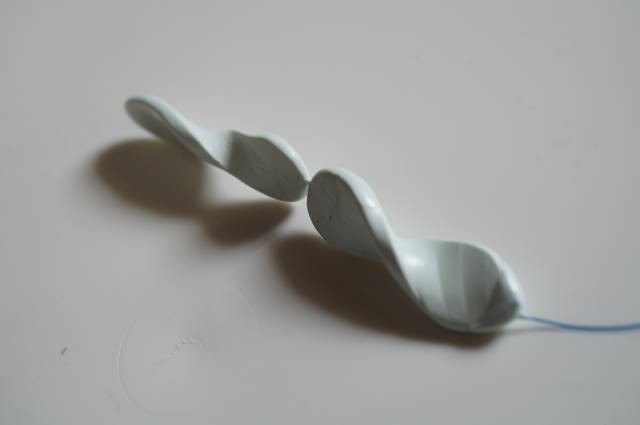
In an entry published in July 2018, Mr. Okada argued that contact through the bowel wall made precise targeting difficult. He contrasted this with contact through the urine passage running through the prostate, which he considered nearly pinpoint. His flexible spiral chip (Tornado), he wrote, changed contact location and angle with small movements.
No matching product can be confirmed on the current list. Mr. Okada favored this as a general-purpose design, while recognizing that some customers preferred rigid long chips.
(Source: ok-lab's diary, published July 2018)
https://ok-lab.hatenablog.com/entry/20180728/1532762071
One prostate sweet spot report documented bleeding with a custom chip
A customer’s report published in August 2018 favored a paired glass chip for its balance of fit and sensation. However, the customer reported bleeding during the first use of a custom spiral pair. The customer suspected its greater length, three-dimensional shape, or both, without establishing the cause.
The diary does not record how the bleeding resolved. No matching product can be confirmed on the current list. Mr. Okada cautioned that the glass spiral pair might be an unsuitable design.
(Source: ok-lab's diary, published August 2018)
https://ok-lab.hatenablog.com/entry/20180825/1535182626
Mr. Okada associated the prostate sweet spot with changing tissue shape
In an entry published in November 2020, a customer proposed a custom two-part chip (Sea Slug version 5) to investigate bladder contact. Mr. Okada recalled his strongest sensation as a hospital tube crossed the internal urethral sphincter (the muscle at the bladder boundary). He attributed this to tissue deformation (changes in shape), rather than constant pressure.
A follow-up published in November 2020 describes a smooth bladder-facing prototype; the diary does not record the customer’s experience with it. No matching product can be confirmed on the current list. Mr. Okada questioned prolonged bladder placement because, in his view, constant pressure would not sustain pleasure.
(Source: ok-lab's diary, published November 2020)
https://ok-lab.hatenablog.com/entry/2020/11/14/131426
(Source: ok-lab's diary, published November 2020)
https://ok-lab.hatenablog.com/entry/2020/11/21/130647
A fine-wire prototype renewed Mr. Okada’s interest in the prostate sweet spot
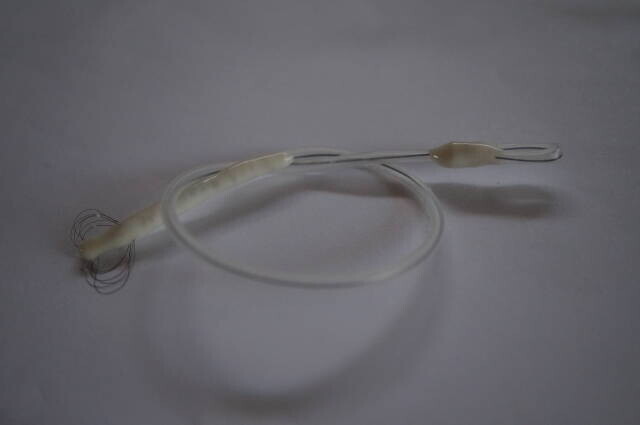
In an entry published in May 2026, Mr. Okada reported testing a prototype with 0.03mm wire loops. He described moderate sensations around Cowper’s glands and much stronger sensations around the ejaculatory ducts. He attributed the difference to suspected contact near those ducts.
At that point, he said manufacture was too difficult to accept customer requests. No matching product can be confirmed on the current list. Mr. Okada described the sensation as difficult to tolerate and said he still needed a reliable manufacturing method.
(Source: ok-lab's diary, published May 2026)
https://ok-lab.hatenablog.com/entry/2026/05/16/122906
The maker's answer to finding the prostate sweet spot
Mr. Okada emphasizes fit and changing contact, while acknowledging limits on stability and production.
Glass slippage complicated one customer’s search for the prostate sweet spot
In an entry published in May 2018, a customer asked why a glass medium-length chip slipped more readily than a resin pair. Mr. Okada replied that glass was markedly more slippery than resin, and only the long glass design could stay fixed reliably.
He suggested a custom resin chip of similar length, but the diary does not record whether the customer chose it. No matching product can be confirmed on the current list. Mr. Okada cautioned that a deeply narrowed glass design placed excessive strain on the sphincter during prolonged wear.
(Source: ok-lab's diary, published May 2018)
https://ok-lab.hatenablog.com/entry/20180519/1526708081
Stopper support did not guarantee a stable prostate sweet spot
In an entry published in July 2018, a customer asked why short and medium-length chips kept slipping toward the urethral entrance. Mr. Okada explained stable retention mainly through a long design engaging both sphincters. His stopper-based explanation concerned a chip beyond the external urethral sphincter (the muscle at the prostate’s outer boundary).
He thought this resisted backward slippage, but the chip was not anchored inside the bladder. The diary does not record whether this customer obtained a stable fit. Mr. Okada cautioned that forceful urination could still dislodge a chip supported by a sphincter stopper (an accessory intended to limit movement).
(Source: ok-lab's diary, published July 2018)
https://ok-lab.hatenablog.com/entry/20180721/1532152353
Stronger wire stimulation did not become Mr. Okada’s prostate sweet spot solution
In an entry published in May 2026, Mr. Okada compared prototypes using 0.05mm, 0.075mm, and 0.1mm wire. He reported stronger sensations with thicker wire, but worried that intensity could place excessive strain on the lining. His concern remained even when he had seen no bleeding.
He therefore planned a finer 0.03mm version aimed at light contact around duct openings, rather than pressure on the prostate. Mr. Okada decided against selling the thicker-wire versions because of that concern.
(Source: ok-lab's diary, published May 2026)
https://ok-lab.hatenablog.com/entry/2026/05/09/122904
The prostate sweet spot project gained specifications and prices in May 2026
In a later entry published in May 2026, Mr. Okada outlined specifications and prices for a fine-wire urethral instrument (micro prostate bougie). His intended targets were both sphincters, the semen and prostate-fluid ducts, and Cowper’s glands. Published prices, excluding tax, were ¥3,000 (about $19 at ¥156 = $1, rate as of 2026-09-04) for the 25cm shaft and ¥8,000 (about $51 at ¥156 = $1, rate as of 2026-09-04) for the 8cm loop section.
The published total was ¥11,000 (about $70 at ¥156 = $1, rate as of 2026-09-04) excluding tax. No matching product can be confirmed on the current list. Mr. Okada cautioned that the intended eight pairs of wire loops could vary from seven to ten pairs.
(Source: ok-lab's diary, published May 2026)
https://ok-lab.hatenablog.com/entry/2026/05/23/122904
If you see blood in your urine, even a small amount or for the first time, do not wait and see. See a urologist right away. If you suddenly cannot urinate, or the device cannot be removed, do not try to fix it yourself. Go to a medical facility, including emergency care, immediately.
How finding the prostate sweet spot changed over time
| Published | What the diary said then |
|---|---|
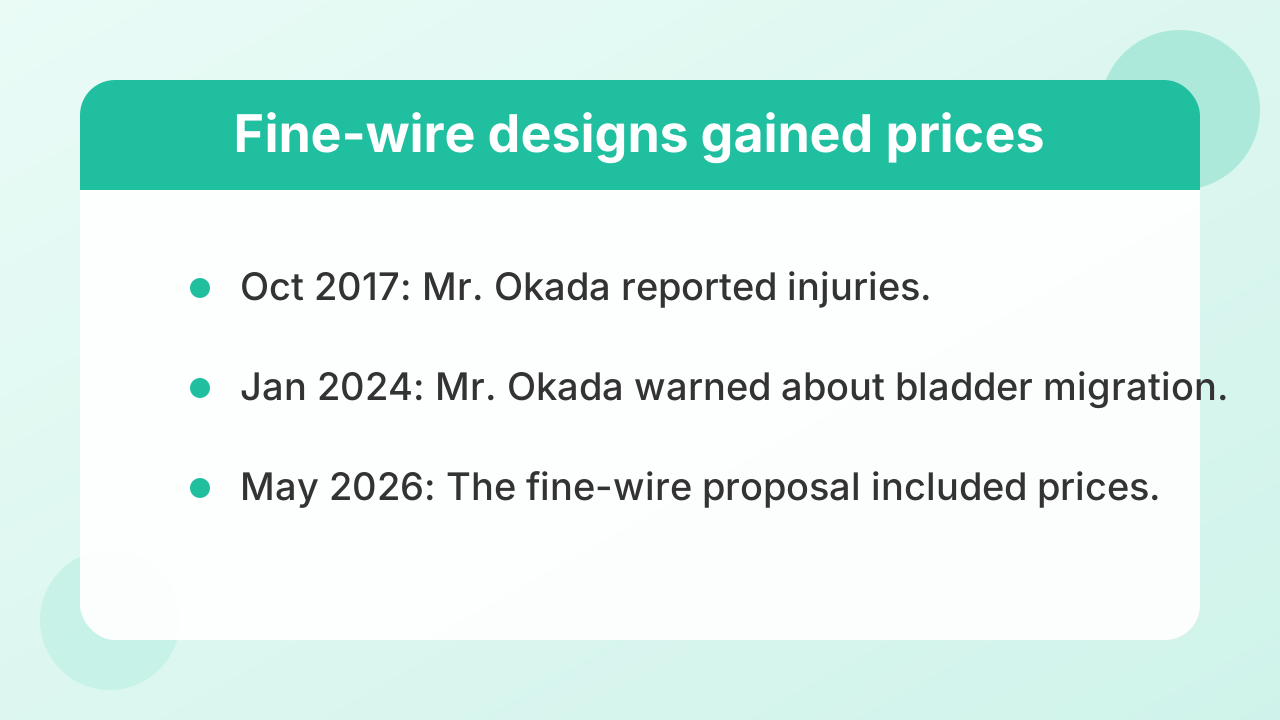
| Oct 2017 | Mr. Okada linked sensations to duct openings and reported injuries from oversized test chips. |
| May 2018 | His reply distinguished glass slippage from resin behavior. |
| Jul 2018 | A sideways-bulge design offered a different contact pattern. |
| Jul 2018 | The flexible spiral design emphasized changes in contact location and angle. |
| Aug 2018 | Customer reports disagreed over whether paired glass chips or a long chip felt better. |
| Apr 2019 | A short resin prototype finished longer than requested. |
| Nov 2020 | A revised custom prototype had a smooth bladder-facing section. |
| Jan 2024 | Mr. Okada warned about bladder migration with a long chip’s deeper position. |
| May 2026 | Fine-wire manufacturing difficulties initially prevented customer orders. |
| May 2026 | The later fine-wire proposal included dimensions and prices. |
OK Prostate Chip products related to finding the prostate sweet spot
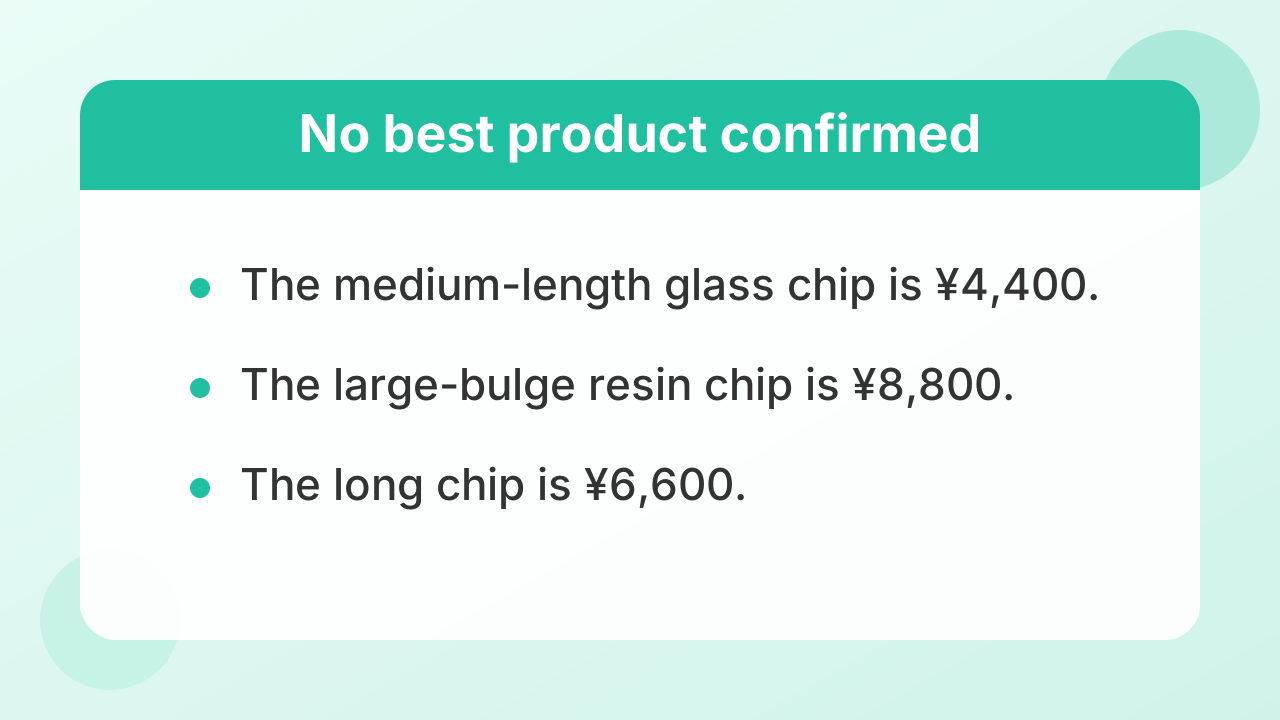
The current list includes discussed chips, without establishing a best product for a specific sensitive area.
Products that appear in these entries
| Product (official name) | Price incl. tax | Relation to this topic |
|---|---|---|
| Medium-length glass chip (OKプロステートチップ ガラス素材セミロングタイプ) | ¥4,400 (about $28 at ¥156 = $1, rate as of 2026-09-04) | In May 2018, a customer reported difficulty keeping this glass design in place. |
| Large-bulge resin chip (OKプロステートチップ 覚醒タイプ(生体適合樹脂)) | ¥8,800 (about $56 at ¥156 = $1, rate as of 2026-09-04) | In January 2024, a customer asked about this model after reporting sensations near the bladder boundary. |
(Source: ok-lab's diary, published May 2018)
https://ok-lab.hatenablog.com/entry/20180519/1526708081
(Source: ok-lab's diary, published January 2024)
https://ok-lab.hatenablog.com/entry/2024/01/27/123012
Products the diary mentioned as alternatives
| Product (official name) | Price incl. tax | Relation to this topic |
|---|---|---|
| Long chip (OKプロステートチップ ロングタイプ) | ¥6,600 (about $42 at ¥156 = $1, rate as of 2026-09-04) | In May 2018, Mr. Okada identified the long glass design as the stable alternative when shorter glass chips slipped. |
(Source: ok-lab's diary, published May 2018)
https://ok-lab.hatenablog.com/entry/20180519/1526708081
Common worries about finding the prostate sweet spot
Readers asked about anatomy, chip thickness, and bladder migration; the replies did not establish one dependable fit.
"Can an anatomy diagram locate my prostate sweet spot?"
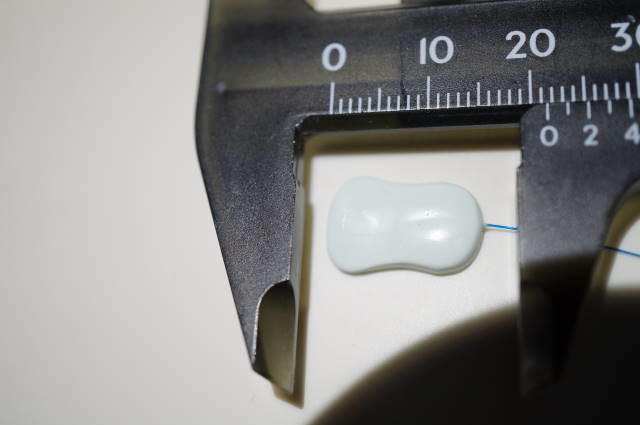
In an entry published in May 2018, a customer requested anatomical measurements for a custom chip. Mr. Okada had no suitable diagram.
The diary does not record whether the customer subsequently ordered a design. Mr. Okada cautioned that individual differences, including prostate enlargement, made choosing dimensions from a diagram difficult.
(Source: ok-lab's diary, published May 2018)
https://ok-lab.hatenablog.com/entry/20180519/1526708081
"Does a thicker chip reach the prostate sweet spot?"
In an entry published in April 2019, a customer said contact location seemed more important than size after trying larger chips. The customer requested a very short resin spiral chip and also reported bleeding and pain with larger designs. Mr. Okada thought uninterrupted contact could increase friction against the mucosa (the urethra’s lining).
His prototype targeted 10mm width and 10mm length, but finished about 10mm wide and 18mm long. No matching product can be confirmed on the current list. Mr. Okada suggested that a shorter shape could reduce friction, although the diary does not record how this prototype felt.
(Source: ok-lab's diary, published April 2019)
https://ok-lab.hatenablog.com/entry/2019/04/13/150233
"Does deeper placement reach a better prostate sweet spot?"
In an entry published in January 2024, a customer described strong sensations during accidental bladder migration and asked about a large-bulge resin chip. Mr. Okada thought L might fit, based on the customer’s existing curved model, but could not confirm stopper performance in the proposed position. He explained that the long design’s tip would project substantially into the bladder when the whole chip lay beyond the sphincter.
The diary does not record the customer’s subsequent experience with that model. Mr. Okada considered this the position most prone to bladder migration during prolonged wear.
(Source: ok-lab's diary, published January 2024)
https://ok-lab.hatenablog.com/entry/2024/01/27/123012
Buying from outside Japan
OK Lab ships internationally to countries covered by Japan Post's EMS courier service. Overseas orders are paid in advance by PayPal. Each order carries a ¥400 (about $3 at ¥156 = $1, rate as of 2026-09-04) handling fee, and EMS shipping is charged on top. These terms come from OK Lab's official sales-terms page (written here as plain text, not a link: ok-lab.net/docs/law), checked on September 7, 2026; confirm them on the official store before you order, because they can change.
Summary of this article
| What you wanted to know | The answer |
|---|---|
| In short | Several possible sensitive areas, with individual differences. |
| About this product | A urethral device from OK Lab in Japan. |
| Key terms | Duct openings, nearby glands, and sphincters frame the discussion. |
| What happens | Reports include changing sensations, uncertain explanations, and injuries. |
| The maker’s answer | Different shapes and materials, followed by light-contact wire experiments. |
| Changed over time | The discussion expanded to include priced fine-wire designs. |
| Related products | Current names and prices do not confirm historical custom builds. |
| Common worries | Fit predictions and customer outcomes remain limited. |
| Buying abroad | Advance PayPal payment, EMS postage, and a ¥400 (about $3 at ¥156 = $1, rate as of 2026-09-04) handling fee. |
Source: ok-lab's diary (Okada Comfortable Life Laboratory). The original entries are in Japanese; quotations on this page are translated. Photos and videos are on the original entries. Unused facts: F31 (the diary explicitly states that the customer withheld permission to republish the report).
This article is a summary of the maker's development diary. The product is not a medical device and no result is guaranteed. If anything feels wrong or worries you, see a doctor. Prices, specifications and cautions change, so confirm the latest information on the official blog and the official site. Questions about ordering and shipping go to the seller.