![Can prostate pressure from both sides feel stronger? | Mr. Okada thinks so [OK Prostate Chip]](/img/a/T0002/eyecatch.svg)
This page is based on entries from "ok-lab's diary" (https://ok-lab.hatenablog.com/), the Japanese development diary written by Mr. Okada, founder of OK Lab, a small company in Japan (Okada Comfortable Life Laboratory). Only the entries about "prostate pressure from both sides" are summarized here, in order of publication. Past prices and sizes are as written at the time. Current prices come from the official product list (retrieved September 4, 2026). Quotations are translated from Japanese.
Note: This page is a personal reading log by someone with no connection to the maker or the seller. It reflects the source entries as of their publication dates and makes no guarantee of accuracy or safety. The product is not a medical device; talk to a doctor about any health decision. Check the official site for current information. This page contains advertising.
In short
Mr. Okada describes pressure from different directions as a possible source of stronger sensation.
His designs use spring connections and stoppers (parts that limit movement), while later flexible versions reduce pressure.
Some related products remain listed, but the latest spiral design was still a prototype in the supplied diary.
If you see blood in your urine, even a small amount or for the first time, do not wait and see. See a urologist right away.
If you suddenly cannot urinate, or the device cannot be removed, do not try to fix it yourself. Go to a medical facility, including emergency care, immediately.
About this product
The OK Prostate Chip is a small device that is placed in the urethra (the urine passage) so that it acts on the prostate; the maker sells it in several shapes, sizes and materials. It is made and sold by OK Lab (Okada Comfortable Life Laboratory), a small company in Japan, through its own online store, and prices are in Japanese yen (JPY). The maker's development diary, "ok-lab's diary", is written in Japanese. This page is an English summary of it, and every quotation is translated. OK Lab ships internationally, so readers outside Japan can order (see "Buying from outside Japan" below). Product names on this page are plain-English descriptions. The official Japanese product name is shown once in the product table so you can find the same item in the store.
Before you read: key terms
| Term | Plain-English meaning |
|---|---|
| Urethra | The urine passage, where the base chip is placed to act on the prostate. |
| Opposing pressure | Pressure from different directions, which Mr. Okada proposes as a way to increase sensation. |
| Rectal chip | An anal device intended to press on the prostate through the bowel wall. |
| Stopper | An added part intended to limit unwanted chip movement; some versions also provide spring pressure. |
| Nickel–titanium spring wire | A flexible metal connection used to join ceramic chips and provide spring resistance. |
| End loops | Loops of springy wire at the ends of a chip, intended to support its position. |
What happens: prostate pressure from both sides
The OK Prostate Chip is a small device placed in the urethra to act on the prostate. Opposing pressure means pressure from different directions, sometimes involving a rectal chip (an anal device pressing through the bowel wall). Other designs use spring connections or stoppers (parts intended to limit chip movement) at the ends of the device. Mr. Okada links these arrangements to stronger sensation, but his accounts also include unwanted movement and difficult removal.
Prostate pressure from both sides began as a proposal about shape
In an entry published in July 2018, Mr. Okada described possible advantages of a chip with a horizontally widened section. He thought this shape might resist pressure from a rectal device, increasing the opposing effect.
He also expected it to contact different areas than the existing flat chip, which could change the sensation. Mr. Okada explicitly left open which shape would work better.
(Source: ok-lab's diary, published July 2018)
https://ok-lab.hatenablog.com/entry/20180721/1532152353
Prostate pressure from both sides extended to an external vibrating frame
In an entry published in April 2020, Mr. Okada introduced an external vibrating frame intended to press from the pubic-bone side. He described vibration travelling through the frame and acting around the prostate from above and below.
The launch price was ¥7,000 (about $45 at ¥156 = $1, rate as of 2026-09-04) excluding tax. He also reported two serious episodes he described as heart failure during tests involving excessive tension. Mr. Okada directed interested customers to contact the company about a custom order.
(Source: ok-lab's diary, published April 2020)
https://ok-lab.hatenablog.com/entry/2020/04/11/151453
Mr. Okada revised the rectal component for prostate pressure from both sides
In an entry published in May 2020, Mr. Okada changed his view of the rectal component in the external-frame design. He had expected versions 3 and 4 to need only a small rectal component because the frame supplied pressure from the other side.
His later account argued that pressure through the bowel wall still mattered and described a connection to the company's rectal chip. Mr. Okada favored that revised connection because he believed it also held the pressure point at a steady angle.
(Source: ok-lab's diary, published May 2020)
https://ok-lab.hatenablog.com/entry/2020/05/16/131332
Mr. Okada reported gentler prostate pressure through a yielding connection
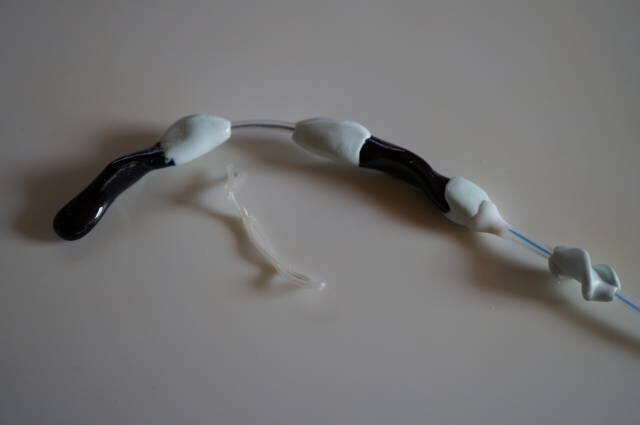
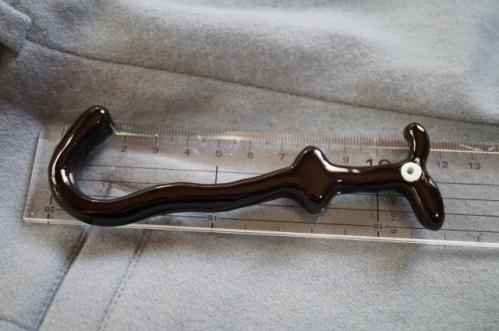
In an entry published in July 2022, Mr. Okada described combining a ceramic rectal chip with a glass-tipped semi-long urethral chip. The rectal device had two bumps, and he described its pressure as stronger than expected.
He thought the worn rubber connection on the urethral assembly yielded under that pressure, giving a gentler combined sensation. The diary does not record how this combination felt for a customer.
(Source: ok-lab's diary, published July 2022)
https://ok-lab.hatenablog.com/entry/2022/07/09/123142
Prostate pressure from both sides with paired motors remained untested
In an entry published in February 2024, Mr. Okada reconsidered a chip with motors at both ends. He described it as a version of an elongated, shaped chip whose front and rear ends were replaced by motors.
He proposed that this arrangement might provide vibration from opposite ends of the prostate. Mr. Okada explicitly said he lacked a personal example and had not tested that arrangement.
(Source: ok-lab's diary, published February 2024)
https://ok-lab.hatenablog.com/entry/2024/02/24/122947
Mr. Okada found prostate pressure more distinct with a solid chip
In an entry published in December 2024, Mr. Okada compared a loop-only device with a short twisted ceramic chip. Its end loops (springy wire supports) held the solid chip from opposite ends.
He initially felt rougher local stimulation, which mostly faded after several hours. He still thought the solid chip produced a more distinct sensation, while the loops added spring resistance to movement. Mr. Okada planned about a week of comparison before deciding which design he preferred.
(Source: ok-lab's diary, published December 2024)
https://ok-lab.hatenablog.com/entry/2024/12/28/122907
The spiral prototype's stronger prostate pressure was Mr. Okada's claim
In an entry published in July 2026, Mr. Okada described a wire spiral around a supporting shaft. He claimed the spiral resisted compression more strongly than earlier simple loops and produced greater outward pressure. Only one prototype existed, and its specifications were undecided.
He reported an acute episode he described as heart failure within minutes of testing it, with recovery taking about an hour. He said repeatable production still needed confirmation before specifications and sales could follow.
(Source: ok-lab's diary, published July 2026)
https://ok-lab.hatenablog.com/entry/2026/07/04/122918
The maker's answer to prostate pressure from both sides
Mr. Okada changed connections and stoppers to control pressure, movement and handling difficulties.
Prostate pressure tests revealed unwanted movement in the linked ceramic prototype
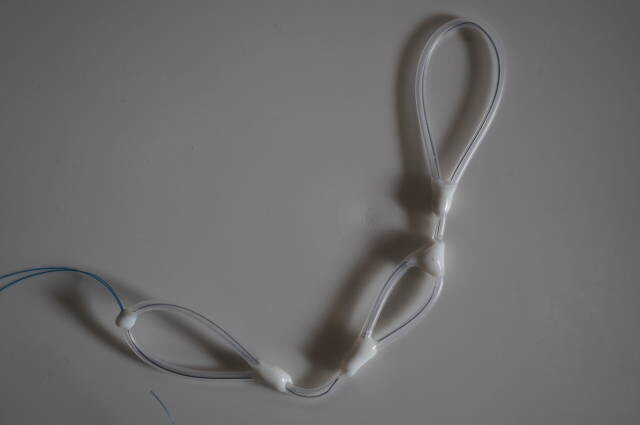
In an entry published in March 2024, Mr. Okada proposed a ceramic pair joined by nickel–titanium spring wire (a flexible metal connection). He expected the spring to resist pressure from an anal device instead of simply letting the assembly shift. The wire measured 0.6 mm and had a 2.5 mm tube cover because he worried about direct contact with the thin metal.
During his own test, the tip unexpectedly moved more than 3 cm beyond his intended position. He questioned whether the slippery design suited stable positioning. Mr. Okada cautioned that cracked bonding resin could weaken the connection and said further strength testing was needed before sales.
(Source: ok-lab's diary, published March 2024)
https://ok-lab.hatenablog.com/entry/2024/03/16/123023
Integrated end stoppers introduced Mr. Okada's theory of lengthwise prostate pressure
In an entry published in October 2025, Mr. Okada attached spring-wire stoppers directly to a short chip. He believed the end parts compressed the prostate lengthwise, describing a chip 30 mm or less and an assembly about 40 mm long. The stoppers sat about 5–6 mm from the chip, and he thought longer chips might retain position without producing that same compression.
The published rear-stopper charge was ¥3,000 (about $19 at ¥156 = $1, rate as of 2026-09-04) excluding tax, including reinforcement or side attachment; the front stopper cost ¥2,000 (about $13 at ¥156 = $1, rate as of 2026-09-04) excluding tax. The quoted price for both was ¥5,000 (about $32 at ¥156 = $1, rate as of 2026-09-04) excluding tax. Mr. Okada required reinforcement for ceramic chips and specified threads that remained attached independently of the spring wire.
(Source: ok-lab's diary, published October 2025)
https://ok-lab.hatenablog.com/entry/2025/10/04/122910
Mr. Okada linked greater flexibility to reduced prostate pressure
In an entry published in February 2026, a customer praised a jointed chip's steady sensation but reported difficult insertion and removal. The customer eventually removed it and reported no bleeding; Mr. Okada focused on the handling difficulties in his reply. He developed an extra-flexible version with thinner rubber over covered wire; the diary does not record that customer's experience with the revision.
The revised design kept about 15 mm between chips, with roughly 5 mm of flexible rubber and an unloaded angle around 45 degrees. He said reduced rubber stiffness meant less prostate pressure and less stimulation. Mr. Okada cautiously suggested this version as an alternative for combinations involving pressure from an anal device.
(Source: ok-lab's diary, published February 2026)
https://ok-lab.hatenablog.com/entry/2026/02/07/122919
If you see blood in your urine, even a small amount or for the first time, do not wait and see. See a urologist right away.
If you suddenly cannot urinate, or the device cannot be removed, do not try to fix it yourself. Go to a medical facility, including emergency care, immediately.
How prostate pressure from both sides changed over time
| Published | What the diary said then |
|---|---|
| Apr 2020 | A vibration motor distinguished the commercial frame from its earlier patented design. |
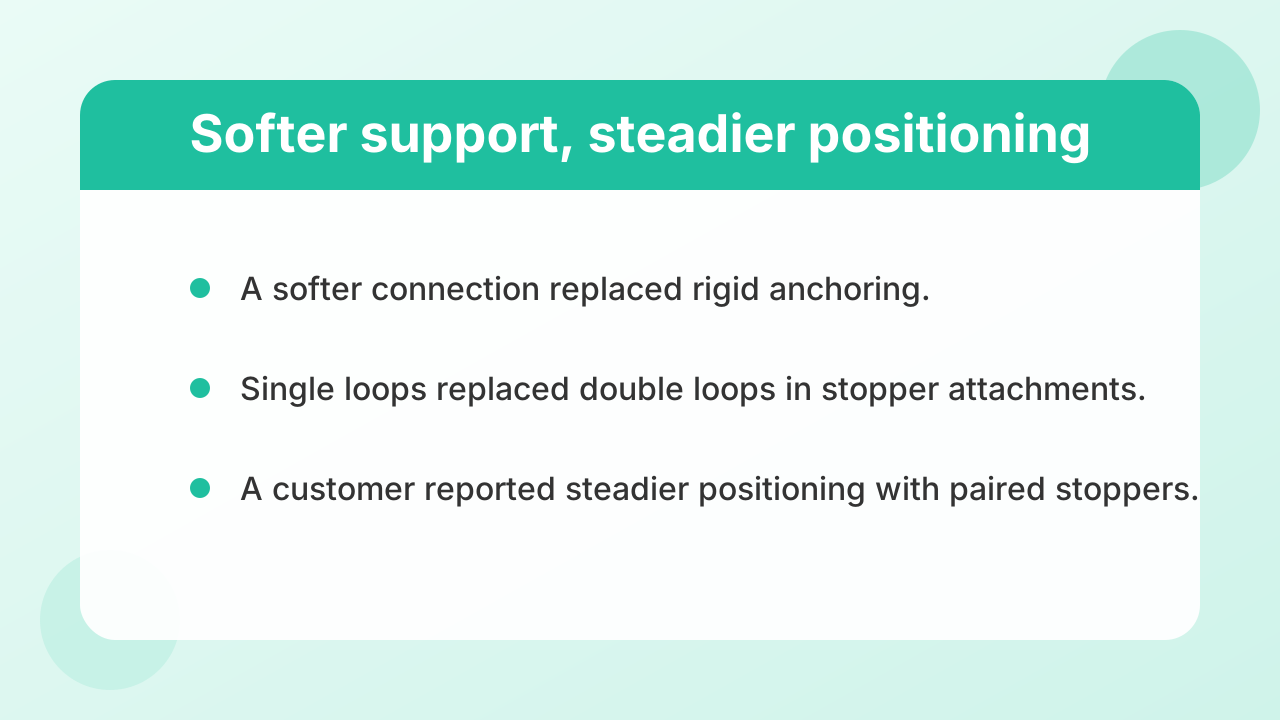
| Apr 2021 | A softer connection replaced rigid anchoring that Mr. Okada found burdensome. |
| Mar 2022 | A balanced support cable used paired 0.3 mm wires. |
| Dec 2024 | A screw-shaped addition to a wire loop was prototyped; testing was still pending. |
| Oct 2025 | Stopper attachments used single loops instead of double loops, with a lower quoted price. |
| Nov 2025 | A customer reported steadier positioning with paired stoppers, despite weaker momentary sensation. |
| Dec 2025 | Extra retaining connections were added to the modular design without changing its quoted prices. |
| Feb 2026 | A longer jointed prototype used 30 mm spacing and a 20 mm flexible section. |
OK Prostate Chip products related to prostate pressure from both sides
The current list includes related products, but it does not identify the custom pressure arrangements described here.
Products that appear in these entries
| Product (official name) | Price incl. tax | Relation to this topic |
|---|---|---|
| Semi-long resin chip (OKプロステートチップ セミロングタイプ(生体適合樹脂)) | ¥5,500 (about $35 at ¥156 = $1, rate as of 2026-09-04) | A May 2022 buyer asked what sensations to expect once the chip reached position. |
| Ceramic rectal chip with two bumps (OKプロステートお尻チップ 陶器素材2コブUターン型) | ¥6,600 (about $42 at ¥156 = $1, rate as of 2026-09-04) | In July 2022, Mr. Okada described it providing rectal pressure alongside a glass-tipped urethral assembly. |
The semi-long resin chip is listed in OK Lab's own online store.

The ceramic rectal chip with two bumps is listed in OK Lab's own online store.
(Source: ok-lab's diary, published May 2022)
https://ok-lab.hatenablog.com/entry/2022/05/21/124217
(Source: ok-lab's diary, published July 2022)
https://ok-lab.hatenablog.com/entry/2022/07/09/123142
Products the diary mentioned as alternatives
The diary names no alternative.
Unmatched historical designs, custom assemblies and prototypes:
No matching product can be confirmed on the current list.
Common worries about prostate pressure from both sides
The customer exchanges cover uncertain sensation, stronger effects from smaller chips, and requests for tighter custom arrangements.
"Does prostate pressure always produce a noticeable sensation?"
In an entry published in May 2022, a semi-long resin chip buyer asked what sensations to expect after positioning. The buyer also wondered whether the initial feeling would continue.
Mr. Okada replied that some people might notice little afterward and that stronger mechanical stimulation might produce a response. The diary does not record whether that customer later experienced the sensation they wanted. Mr. Okada cautioned that sensation could depend on relaxation and sexual interest.
(Source: ok-lab's diary, published May 2022)
https://ok-lab.hatenablog.com/entry/2022/05/21/124217
"Why did prostate pressure make a smaller chip feel stronger?"
In an entry published in October 2022, a customer asked why a previously unsatisfying smaller chip now felt much stronger. The report concerned external compression combined with a supported urethral chip, rather than a change to the smaller chip itself.
Mr. Okada replied that surrounding tissue might transmit pressure along the support, limiting sideways movement and directing pressure inward. He presented this as his explanation of the reported sensation; the diary does not record a measured test of that mechanism.
(Source: ok-lab's diary, published October 2022)
https://ok-lab.hatenablog.com/entry/2022/10/29/122854
"Can prostate pressure increase with a shorter custom chip?"
In an entry published in May 2026, a customer wanted firmer opposing pressure from a chip shorter than their previous short ceramic model. Mr. Okada replied that no shorter version was available and proposed a custom chip shortened by 5 mm.
The quote listed ¥3,300 (about $21 at ¥156 = $1, rate as of 2026-09-04) for the chip and ¥5,500 (about $35 at ¥156 = $1, rate as of 2026-09-04) × 2 for front and rear stopper work. The requested stoppers had four wings at each end; the diary does not record how the proposed build felt in use.
(Source: ok-lab's diary, published May 2026)
https://ok-lab.hatenablog.com/entry/2026/05/23/122904
Buying from outside Japan
OK Lab ships internationally to countries covered by Japan Post's EMS courier service. Overseas orders are paid in advance by PayPal. Each order carries a ¥400 (about $3 at ¥156 = $1, rate as of 2026-09-04) handling fee, and EMS shipping is charged on top. These terms come from OK Lab's official sales-terms page (written here as plain text, not a link: ok-lab.net/docs/law), checked on September 7, 2026; confirm them on the official store before you order, because they can change.
Summary of this article
| What you wanted to know | The answer |
|---|---|
| What is the short answer? | Mr. Okada proposes stronger sensation from pressure acting in different directions. |
| What is this product? | A urethral device made by OK Lab in Japan, with prices in Japanese yen. |
| What do the terms mean? | Rectal chips, spring connections and stoppers play different roles in the diary's pressure theories. |
| What happened in the diary? | Accounts range from shape proposals and personal comparisons to untested prototypes and adverse experiences. |
| What was the maker's answer? | He changed spring connections, stopper arrangements and flexibility in response to the problems described. |
| What changed over time? | Designs evolved through softer supports, integrated stoppers and more flexible joints. |
| Which current products appear here? | The listed semi-long resin chip and ceramic rectal chip appear in the customer and maker accounts. |
| What worried customers? | They asked about expected sensations, unexpectedly stronger effects and smaller custom builds. |
| How does international buying work? | Eligible EMS destinations, advance PayPal payment, a ¥400 (about $3 at ¥156 = $1, rate as of 2026-09-04) handling fee and additional shipping charges. |
Source: ok-lab's diary (Okada Comfortable Life Laboratory). The original entries are in Japanese; quotations on this page are translated. Photos and videos are on the original entries.
This article is a summary of the maker's development diary. The product is not a medical device and no result is guaranteed. If anything feels wrong or worries you, see a doctor. Prices, specifications and cautions change, so confirm the latest information on the official blog and the official site. Questions about ordering and shipping go to the seller.