![What does a second chip add? | Extra sensation is the maker's aim [OK Prostate Chip]](/img/a/T0004/eyecatch.svg)
This page is based on entries from "ok-lab's diary" (https://ok-lab.hatenablog.com/), the Japanese development diary written by Mr. Okada, founder of OK Lab, a small company in Japan (Okada Comfortable Life Laboratory). Only the entries about "a second chip intended to stimulate Cowper's glands" are summarized here, in order of publication. Past prices and sizes are as written at the time. Current prices come from the official product list (retrieved September 4, 2026). Quotations are translated from Japanese.
Note: This page is a personal reading log by someone with no connection to the maker or the seller. It reflects the source entries as of their publication dates and makes no guarantee of accuracy or safety. The product is not a medical device; talk to a doctor about any health decision. Check the official site for current information. This page contains advertising.
In short
Mr. Okada links second chip sensation to Cowper's glands (paired organs), while acknowledging personal differences.
The maker distinguishes added sensation from dependable protection against movement into the bladder.
The screw-shaped auxiliary option remains listed at ¥3,300 (about $21 at ¥156 = $1, rate as of 2026-09-04) including tax; historical prototypes need separate identification.
About this product
The OK Prostate Chip is a small device that is placed in the urethra (the urine passage) so that it acts on the prostate; the maker sells it in several shapes, sizes and materials. It is made and sold by OK Lab (Okada Comfortable Life Laboratory), a small company in Japan, through its own online store, and prices are in Japanese yen (JPY). The maker's development diary, "ok-lab's diary", is written in Japanese. This page is an English summary of it, and every quotation is translated. OK Lab ships internationally, so readers outside Japan can order (see "Buying from outside Japan" below). Product names on this page are plain-English descriptions. The official Japanese product name is shown once in the product table so you can find the same item in the store.
Before you read: key terms
| Term | Plain-English meaning |
|---|---|
| Second chip / auxiliary chip | An additional part used with the main chip for added sensation or support, depending on the design. |
| Cowper's glands | Paired glands Mr. Okada associates with sensation near the second chip. Their biological function: The diary does not explain this. |
| Prostate | The body structure targeted by the main chip for stimulation. Its biological function: The diary does not explain this. |
| Urethra | The urine passage, where the device is placed. |
| Bulbar urethra (wider urethral section) | The area described for the second chip; staff also discuss it when addressing chips slipping out during urination. |
| Sphincter (a muscle that opens and closes) | The muscle discussed between the chips; the designs aim to balance stimulation with comfort around it. |
| Bladder | The destination of unwanted inward movement discussed by the maker. Its biological function: The diary does not explain this. |
| Shape-memory wire | Wire used inside tubing and in springy stopper designs. How shape memory works: The diary does not explain this. |
| Petal stopper | Wire loops arranged like petals, intended to resist passage through the sphincter. |
| Chipless device | A device made from thin wire and silicone tubing, discussed by Mr. Okada as a source of sensation. |
What happens: adding a second chip
The OK Prostate Chip is a device placed in the urethra to provide stimulation around the prostate. The second chip is an additional piece on the connecting thread, intended for the wider section called the bulbar urethra. Mr. Okada describes this location as near the sphincter and attributes the added sensation to pressure around Cowper's glands, alongside the main chip's prostate stimulation.
An adjustable second chip still could not guarantee protection against bladder movement
In an entry published in June 2018, Mr. Okada described the design's progression through three versions. The first fixed both size and spacing; the second allowed spacing changes; the third offered choices of size and spacing. He planned separate chips with selectable width, length, and thickness.
His own tests felt pleasant, although he reported slight discomfort where he believed the stopper had been after waking. He also suggested that his sensitivity near Cowper's glands might explain his favorable experience. Mr. Okada cautioned against expecting dependable bladder protection: customer reports had shown that the sphincter stopper could not guarantee it.
(Source: ok-lab's diary, published June 2018)
https://ok-lab.hatenablog.com/entry/20180616/1529136608
A resin second chip received praise in one customer's electrical test
In an entry published in June 2019, a customer reported pleasant sensations from a resin two-chip electrical version, including without electrical stimulation. The customer said slight movement made little difference to the sensation and attributed this to electrical stimulation. Mr. Okada explained that the assembly consisted of two chips, each 38mm long.
He believed the front piece stimulated the prostate and the second piece added stimulation around Cowper's glands. Mr. Okada suggested that Cowper's gland stimulation might be enjoyable, while acknowledging that he had received few comments about it.
(Source: ok-lab's diary, published June 2019)
https://ok-lab.hatenablog.com/entry/2019/06/01/155432
A flat auxiliary chip felt steadier in the maker's personal testing
In an entry published in November 2021, Mr. Okada described testing a flat auxiliary chip connected at 90 degrees to the front chip. He reported a pleasant feel and stable positioning during almost a week of personal testing. He attributed the fit partly to slight rotation at the connection, which let the angle vary.
Mr. Okada also described Cowper's glands as paired organs with two connecting tubes entering the urethra. He believed a flatter surface could stimulate those connection areas, and favored that design direction.
(Source: ok-lab's diary, published November 2021)
https://ok-lab.hatenablog.com/entry/2021/11/20/125643
The 4-wire auxiliary chip had its own price in May 2022
In an entry published in May 2022, Mr. Okada introduced a screw-shaped auxiliary part within a 4-wire support cable. He hoped the added part would improve stability even with a small main chip. He also explained that the cable alone had already provided the support he needed, while he missed sensation in the bulbar area.
The historical price was ¥3,000 (about $19 at ¥156 = $1, rate as of 2026-09-04) excluding tax, matching the screw-shaped additions for nylon-thread and parallel-cable arrangements at that time. Mr. Okada suggested that owners of the nylon-thread combination might be interested in comparing the new design.
(Source: ok-lab's diary, published May 2022)
https://ok-lab.hatenablog.com/entry/2022/05/14/123043
Second chip benefits remained personal in the maker's petal-stopper report
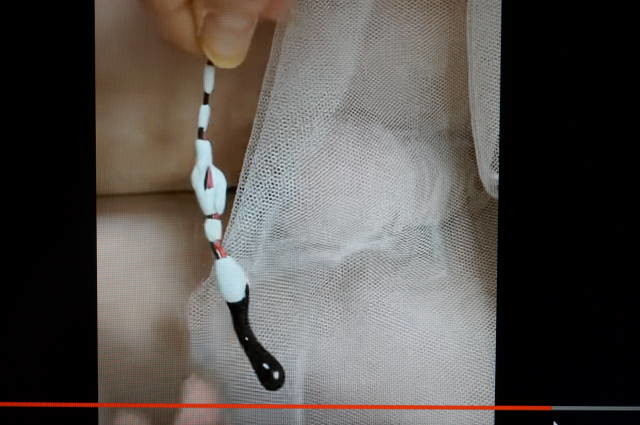
In an entry published in May 2025, Mr. Okada said he particularly liked the sensation from a soft petal stopper. He planned to include it on every chipless device (a wire-and-tube device) he made for his own testing. He linked that preference to what he believed was his unusually sensitive Cowper's gland area.
Mr. Okada explained that his choice served his own preference for sensation. He did not consider the stopper necessary to prevent inward movement in his own case.
(Source: ok-lab's diary, published May 2025)
https://ok-lab.hatenablog.com/entry/2025/05/03/122907
The maker's answer to adding a second chip
Mr. Okada's answers changed with the design, and his recommendations remained conditional.
Second chip development continued after the planned long version was cancelled
In an entry published in January 2018, Mr. Okada said he had made and tested roughly 20 prototypes. A gap of 10mm felt comfortable but less satisfying to him; 3mm restored some sphincter sensation with a gentler feel. At 0mm, the touching pieces could bend at their meeting point, which he believed reduced strain.
He cancelled the planned long version's release after reporting that it had injured his sphincter. His proposed replacement for that purpose was the linked arrangement with 0mm spacing. Mr. Okada favored that approach and announced preparations to let buyers choose the spacing for the two-chip type.
(Source: ok-lab's diary, published January 2018)
https://ok-lab.hatenablog.com/entry/20180106/1515230584

A screw-shaped auxiliary chip was suggested for people sensitive in that area
In an entry published in December 2019, a customer described seeking variety in the sensations produced by longer chips. Mr. Okada interpreted the reported sensation as possibly coming from Cowper's gland stimulation. He described his own experience favorably but acknowledged that customers rarely mentioned the same sensation.
He therefore raised the possibility of individual differences. Mr. Okada suggested that a screw-shaped auxiliary chip could be particularly effective for someone sensitive in that area.
(Source: ok-lab's diary, published December 2019)
https://ok-lab.hatenablog.com/entry/2019/12/28/131319
Second chip design tradeoffs continued with softer wire and petal stoppers
In an entry published in April 2025, Mr. Okada introduced a stopper with 3 petals using 0.2mm wire, compatible with tubing containing shape-memory wire. The announced prices were ¥1,000 (about $6 at ¥156 = $1, rate as of 2026-09-04) per petal excluding tax and ¥3,000 (about $19 at ¥156 = $1, rate as of 2026-09-04) for 3 petals excluding tax. He reported that about five days of personal testing produced no strong sphincter stimulation, with pleasant sensations depending on position.
He rejected 0.3mm wire as too stimulating for extended wear and selected softer 0.2mm wire. He warned that combining external and sphincter petals on overly long supports could cause protrusion at the penis opening or excessive sphincter pressure. Mr. Okada cautioned that, despite functioning as a stopper in ordinary positioning, the petals could invert and cross the sphincter under forced instrument pressure.
(Source: ok-lab's diary, published April 2025)
https://ok-lab.hatenablog.com/entry/2025/04/26/122909
How adding a second chip changed over time
| Published | What the diary said then |
|---|---|
| Jan 2018 | A planned long version was cancelled; linked pieces became the proposed answer. |
| Mar 2018 | A movable second piece entered prototyping to address fixed-spacing compromises. |
| Jun 2018 | The third version offered choices of chip dimensions as well as spacing. |
| Nov 2021 | A flat auxiliary part's angled connection felt steadier in the maker's tests. |
| May 2022 | A 4-wire screw addition was priced at ¥3,000 (about $19 at ¥156 = $1, rate as of 2026-09-04) excluding tax. |
| Dec 2024 | Beginner guidance distinguished screw assistance from protection against inward movement. |
| Apr 2025 | Softer wire was selected for petal stoppers after stronger-wire testing. |
| May 2025 | Petal stoppers became the maker's personal testing preference for added sensation. |
The diary does not say what the current state is.
OK Prostate Chip products related to adding a second chip
The screw-shaped auxiliary option is a confirmed current listing recommended in a December 2019 reply.
Products that appear in these entries
The screw-shaped auxiliary chip option appears in these entries.
Products the diary mentioned as alternatives
| Product (official name) | Price incl. tax | Relation to this topic |
|---|---|---|
| Screw-shaped auxiliary chip option (スクリュー型補助チップ追加オプション) | ¥3,300 (about $21 at ¥156 = $1, rate as of 2026-09-04) | In December 2019, staff recommended this addition after a beginner reported that a chip slipped out during urination. |
The screw-shaped auxiliary chip option is listed in OK Lab's own online store.
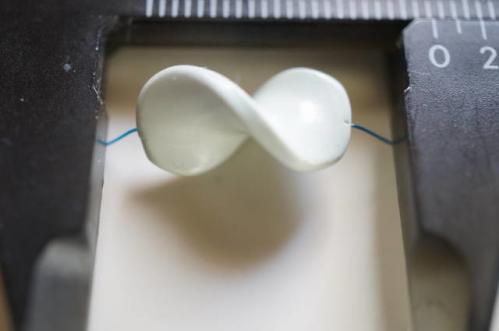
(Source: ok-lab's diary, published December 2019)
https://ok-lab.hatenablog.com/entry/2019/12/28/131319
The historical linked, adjustable, electrical, flat, 4-wire, petal, and chipless builds are described in the dated cases above. No matching product can be confirmed on the current list.
The customer replies also discuss short, medium-length, and bead-shaped chips, plus an external stopper for beginners. No matching product can be confirmed on the current list.
The January 2018 long version had its planned release cancelled.
Common worries about adding a second chip
The recorded questions concern spacing, slipping during urination, and whether an extra part is necessary.
"Can the spacing of a second chip be changed?"
In an entry published in March 2018, Mr. Okada credited customer suggestions for a movable second chip and adjustable spacing. He described a compromise in the fixed-spacing version: closer spacing helped placement, while more separation from the sphincter felt more comfortable afterward. His proposed design gave each piece its own thread connection to the outside.
The design was entering prototyping; the diary does not record how those customers found the finished arrangement. Mr. Okada asked interested customers to wait while development continued.
(Source: ok-lab's diary, published March 2018)
https://ok-lab.hatenablog.com/entry/20180312/1520844839
"Could an auxiliary chip help with slipping during urination?"
In an entry published in December 2019, a beginner reported a chip coming out during urination and asked which option to choose. The buyer had first purchased a short chip and subsequently ordered a medium-length one. Staff described alternatives that included a larger medium-length chip, a curved bead-shaped chip, and a screw-shaped auxiliary addition.
The diary does not record whether this customer tried the suggested addition or whether the slipping stopped. Staff conveyed the recommendation for the screw-shaped auxiliary chip, citing both relative ease of placement and reduced likelihood of coming out during urination.
(Source: ok-lab's diary, published December 2019)
https://ok-lab.hatenablog.com/entry/2019/12/28/131319
"Do beginners need an auxiliary chip with the main device?"
In an entry published in December 2024, a first-time buyer asked whether adding an auxiliary chip would complicate placement or removal. Staff said preference and physical differences mattered, offered to pause production, and suggested reading Mr. Okada's explanation before deciding. The diary does not record whether the order was changed.
Mr. Okada considered the screw-shaped part comparatively easy for beginners because its direction stays stable and it helps advance the main chip. He said it crosses the sphincter about as readily as the main chip, offering little protection against movement into the bladder. He preferred an external stopper for beginners over a sphincter stopper, because its position was easier to understand.
(Source: ok-lab's diary, published December 2024)
https://ok-lab.hatenablog.com/entry/2024/12/28/122907
Buying from outside Japan
OK Lab ships internationally to countries covered by Japan Post's EMS courier service. Overseas orders are paid in advance by PayPal. Each order carries a ¥400 (about $3 at ¥156 = $1, rate as of 2026-09-04) handling fee, and EMS shipping is charged on top. These terms come from OK Lab's official sales-terms page (written here as plain text, not a link: ok-lab.net/docs/law), checked on September 7, 2026; confirm them on the official store before you order, because they can change.
Summary of this article
| What you wanted to know | The answer |
|---|---|
| What does a second chip aim to add? | Mr. Okada describes added sensation, with individual differences. |
| What is the base product? | A urethral device made by OK Lab in Japan. |
| What do the unfamiliar terms mean? | They distinguish the main chip, additional parts, and the body areas discussed. |
| What did testing show? | Personal reports described changing sensations and stability; stopper limitations also appeared. |
| What did the maker propose? | Adjustable spacing, conditional screw-chip recommendations, and softer petal wire. |
| How did the designs change? | Fixed connections gave way to adjustable arrangements and later wire-based designs. |
| What current price is confirmed? | The screw-shaped auxiliary option is ¥3,300 (about $21 at ¥156 = $1, rate as of 2026-09-04) including tax. |
| What did customers ask? | About spacing, slipping during urination, and whether beginners needed an extra part. |
| How do overseas orders work? | Advance PayPal payment, a ¥400 (about $3 at ¥156 = $1, rate as of 2026-09-04) handling fee, and additional EMS shipping charges. |
| What remains unknown? | Several customer outcomes and the current status of historical builds. |
Source: ok-lab's diary (Okada Comfortable Life Laboratory). The original entries are in Japanese; quotations on this page are translated. Photos and videos are on the original entries.
This article is a summary of the maker's development diary. The product is not a medical device and no result is guaranteed. If anything feels wrong or worries you, see a doctor. Prices, specifications and cautions change, so confirm the latest information on the official blog and the official site. Questions about ordering and shipping go to the seller.