![Where are the motors in a vibrating prostate chip? | Shape and motor count changed over time [OK Prostate Chip]](/img/a/T0554/eyecatch.svg)
This page is based on entries from "ok-lab's diary" (https://ok-lab.hatenablog.com/), the Japanese development diary written by Mr. Okada, founder of OK Lab, a small company in Japan (Okada Comfortable Life Laboratory). Only the entries about "vibrating chip shape, motor count and position" are summarized here, in order of publication. Past prices and sizes are as written at the time. Current prices come from the official product list (retrieved September 4, 2026). Quotations are translated from Japanese.
Note: This page is a personal reading log by someone with no connection to the maker or the seller. It reflects the source entries as of their publication dates and makes no guarantee of accuracy or safety. The product is not a medical device; talk to a doctor about any health decision. Check the official site for current information. This page contains advertising.
In short
Vibrating chip shape affects finished width, while motor placement changes which parts receive vibration.
Mr. Okada's responses included stronger connections and cautions about fit, bladder entry, and prolonged vibration.
The current list includes a long ceramic vibrating chip; later custom configurations lack confirmed matches.
If you see blood in your urine, even a small amount or for the first time, do not wait and see. See a urologist right away. If you suddenly cannot urinate, or the device cannot be removed, do not try to fix it yourself. Go to a medical facility, including emergency care, immediately.
About this product

The OK Prostate Chip is a small device that is placed in the urethra (the urine passage) so that it acts on the prostate; the maker sells it in several shapes, sizes and materials. It is made and sold by OK Lab (Okada Comfortable Life Laboratory), a small company in Japan, through its own online store, and prices are in Japanese yen (JPY). The maker's development diary, "ok-lab's diary", is written in Japanese. This page is an English summary of it, and every quotation is translated. OK Lab ships internationally, so readers outside Japan can order (see "Buying from outside Japan" below). Product names on this page are plain-English descriptions. The official Japanese product name is shown once in the product table so you can find the same item in the store.
Before you read: key terms
| Term | Plain-English meaning |
|---|---|
| Urethra | The urine passage; the device occupies part of it to act on the prostate. |
| Rear bulge | The rounded back portion of a chip; several designs replace it with a vibration motor. |
| Resin | Material molded around parts; the maker uses it to cover motors and strengthen connections. |
| Stopper | A separate part intended to limit inward movement; an ordinary rounded bulge is not necessarily equivalent. |
| Seminal vesicles | The diary does not explain this. |
| Nitinol | Shape-memory wire; later designs use it to connect separated parts and carry vibration. |
What happens: vibrating chip shape and motor placement
The OK Prostate Chip is a small device placed in the urethra to apply pressure around the prostate. Its vibrating versions add motors, originally within the rear bulge (the rounded back portion of the chip). Later entries describe motors at both ends, several motors along a connecting cable, and motors separated from ceramic tips by flexible wire. These designs were intended to deliver vibration at different positions, including near the prostate, within the bladder, or near the penis head.
Early vibrating chip design became wider once the motor was covered
In an entry published in December 2018, Mr. Okada described a short prototype with a motor inside its rear bulge. The motor measured about 10mm across and 3mm thick; the finished part was about 11mm wide and 5mm thick.
A medium-length version used resin (a molded covering material) and had a similar rear profile. Mr. Okada reported no apparent waterproofing problem during several days of testing, but cautioned that the extra width could challenge beginners.
(Source: ok-lab's diary, published December 2018)
https://ok-lab.hatenablog.com/entry/20181215/1544857573
The two-motor chip brought a warning about prolonged use
In an entry published in February 2019, Mr. Okada described placing flat 8mm motors in the front and rear bulges. Covered in resin, each motor became slightly wider than 9mm.
He found all-day vibration too intense, while the unpowered resin model also caused him discomfort. His conclusion was that this two-motor design was for short periods. For longer retention, Mr. Okada instead favored an ordinary vibrating chip containing 1 motor.
(Source: ok-lab's diary, published February 2019)
https://ok-lab.hatenablog.com/entry/2019/02/09/152257
Historical vibrating chip prices depended on shape and motor count
An entry published in March 2019 quoted 8mm-motor builds at ¥6,000 (about $38 at ¥156 = $1, rate as of 2026-09-04) for medium-length chips and ¥5,000 (about $32 at ¥156 = $1, rate as of 2026-09-04) for short chips, tax excluded. The two-motor three-bulge model was ¥8,000 (about $51 at ¥156 = $1, rate as of 2026-09-04), tax excluded, as published in March 2019. The diary does not record how these builds felt in use.
(Source: ok-lab's diary, published March 2019)
https://ok-lab.hatenablog.com/entry/2019/03/16/165528
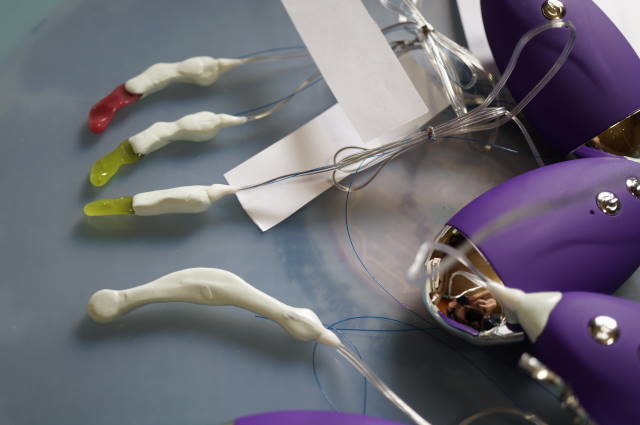
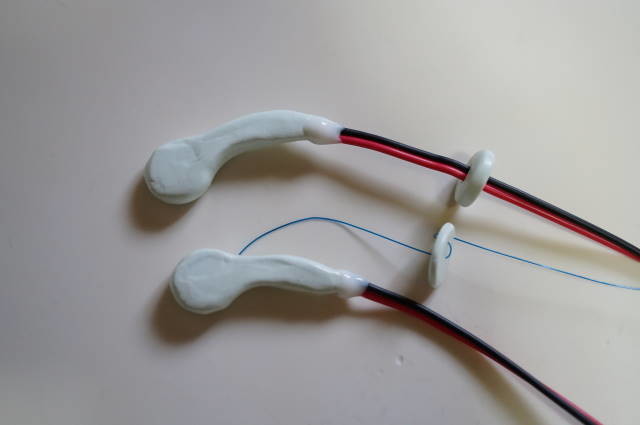
Rear motor placement could preserve the whole ceramic chip
In an entry published in January 2022, Mr. Okada described attaching a motor behind an intact chip, instead of replacing its rear bulge. He named this arrangement after its resemblance to a curved-bead chip.
The published price was the ordinary chip price plus ¥2,000, (about $13 at ¥156 = $1, rate as of 2026-09-04) tax excluded, in January 2022. Mr. Okada noted that the controller and other associated costs were separate.
(Source: ok-lab's diary, published January 2022)
https://ok-lab.hatenablog.com/entry/2022/01/29/123455
A six-motor chip arrangement remained untested inside the body
In an entry published in May 2022, Mr. Okada described a chain of 6 motors, each 6mm, supported by a cable. The arrangement had a leading motor, 4 intermediate motors, and a final motor. The second motor assembly measured 6.0mm thick because its wiring ran underneath.
The proposed price was ¥23,000, (about $147 at ¥156 = $1, rate as of 2026-09-04) tax excluded, as published in May 2022. He had checked vibration outside the body, but had not performed an internal test. Mr. Okada also warned that the increased power demand could challenge a depleted battery.
(Source: ok-lab's diary, published May 2022)
https://ok-lab.hatenablog.com/entry/2022/05/21/124217
Bladder motor placement produced an alarming personal test report
In an entry published in May 2024, Mr. Okada described a bladder-positioned prototype aimed toward the seminal vesicles (the diary does not explain this term). Its motor was 8mm, while the motor section and both other chip sections were 9mm wide.
Mr. Okada reported switching it off after roughly 5–10 minutes, following a disturbance in his heart function. He said one prototype took about 5 days to make, and sales could not begin unless production became more efficient.
(Source: ok-lab's diary, published May 2024)
https://ok-lab.hatenablog.com/entry/2024/05/11/122910
Flexible vibrating chip connections separated the motor from its tip
In an entry published in February 2026, Mr. Okada described nitinol connections (shape-memory wire carrying vibration between separated parts). He offered ceramic tips with 8mm or 10mm motors, excluding 6mm motors because of connection concerns. Proposed spacing was 15–30mm, with approximate bends of 45, 60 or 90 degrees.
The connection could be about 3mm across for greater flexibility, or around 5mm for more spring. Published February 2026 surcharges were ¥4,000 (about $26 at ¥156 = $1, rate as of 2026-09-04) for short or medium-length ceramic chips and ¥5,000 (about $32 at ¥156 = $1, rate as of 2026-09-04) for three-bulge or long chips, tax excluded. Mr. Okada cautioned that prolonged bladder vibration might be harmful.
(Source: ok-lab's diary, published February 2026)
https://ok-lab.hatenablog.com/entry/2026/02/14/121602
Twin-wire vibrating chip design allowed an external motor position
In an entry published in February 2026, Mr. Okada described a ceramic tip joined to a distant motor by two parallel, exposed wires. He reported that the earlier tube covering had restricted vibration. The design allowed the motor near the penis head or outside the body.
The specifications offered 0.3mm or 0.4mm wires and 8mm or 10mm motors. February 2026 surcharges were ¥5,000 (about $32 at ¥156 = $1, rate as of 2026-09-04) up to 10cm, ¥6,000 (about $38 at ¥156 = $1, rate as of 2026-09-04) up to 15cm, and ¥8,000 (about $51 at ¥156 = $1, rate as of 2026-09-04) up to 20cm, tax excluded. Mr. Okada cautioned that, despite having no rubber or silicone tubing, the exposed-wire design was unsuitable for people with metal allergies.
(Source: ok-lab's diary, published February 2026)
https://ok-lab.hatenablog.com/entry/2026/02/21/122935
The maker's answer to vibrating chip shape and motor placement
Mr. Okada addressed connection strength and unwanted inward movement as separate design problems.
Vibrating chip connections changed after every tested motor joint failed
In an entry published in December 2018, Mr. Okada reported destructive testing of about 100 purchased vibration units. Every failure occurred at the motor connection. His revised connection enclosed the wire and its outer covering in resin.
Later versions moved the motor terminals, then the cable connection, into the chip's center. He described stronger construction, while identifying repeated bending and wire breakage as another concern.
(Source: ok-lab's diary, published December 2018)
https://ok-lab.hatenablog.com/entry/20181229/1546064791
A larger vibrating chip bulge was not a dependable stopper
In an entry published in March 2019, a customer requested a thicker design with an enlarged final bulge intended to prevent inward movement. Mr. Okada replied that a continuous rounded shape could still move toward the bladder, even at 15mm wide. A stopper (a separate part intended to limit inward movement) was a different design.
The customer withdrew the final-bulge request and asked for a thicker motor region instead. The diary does not record whether that revised order was completed. Mr. Okada cautioned against expecting the proposed final bulge to work as a stopper.
(Source: ok-lab's diary, published March 2019)
https://ok-lab.hatenablog.com/entry/2019/03/30/160657
Minimal vibrating chip design prompted a proposed compulsory stopper
In an entry published in July 2019, Mr. Okada described testing a design consisting only of a motor and cable. He found that this shape could advance easily into the bladder.
He also cited reports from outside Japan involving cables becoming tangled in the bladder and impossible to remove. Mr. Okada therefore wanted a stopper to be compulsory for the minimal design.
(Source: ok-lab's diary, published July 2019)
https://ok-lab.hatenablog.com/entry/2019/07/13/150108
If you see blood in your urine, even a small amount or for the first time, do not wait and see. See a urologist right away. If you suddenly cannot urinate, or the device cannot be removed, do not try to fix it yourself. Go to a medical facility, including emergency care, immediately.
How vibrating chip shape and motor placement changed over time
| Published | What the diary said then |
|---|---|
| Dec 2018 | Revised connections moved vulnerable joints into the chip. |
| Feb 2019 | A two-motor design brought a short-duration warning. |
| Apr 2019 | An aluminum-covered three-motor prototype was completed. |
| Jan 2022 | A rear-mounted motor could preserve the original chip shape. |
| May 2022 | A six-motor chain passed an external vibration check only. |
| May 2024 | A bladder-positioned prototype raised personal health and production concerns. |
| Feb 2026 | Flexible wire connections separated ceramic tips from motors. |
| Feb 2026 | Exposed twin wires enabled more distant motor placement. |
OK Prostate Chip products related to vibrating chip shape and motor placement
The long ceramic vibrating chip appears in a dated sizing question and in the current product list.
Products that appear in these entries
| Product (official name) | Price incl. tax | Relation to this topic |
|---|---|---|
| Long ceramic vibrating chip (OKプロステート核振チップ 陶器素材ロングタイプ) | ¥8,800 (about $56 at ¥156 = $1, rate as of 2026-09-04) | In February 2022, a prospective buyer asked how its stated length accounted for the motor and cable joint. |
The long ceramic vibrating chip is listed in OK Lab's own online store.
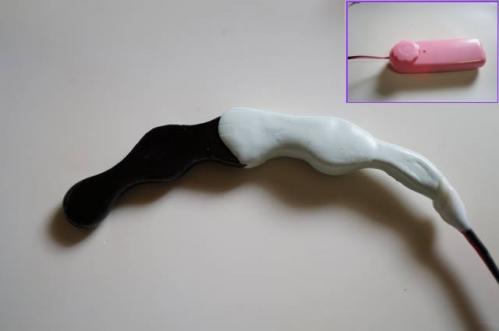
(Source: ok-lab's diary, published February 2022)
https://ok-lab.hatenablog.com/entry/2022/02/26/123231
Products the diary mentioned as alternatives
The diary names no alternative.
Custom vibrating chips, prototypes, curved-bead motor attachments, flexible connections, and twin-wire configurations:
No matching product can be confirmed on the current list.
Common worries about vibrating chip shape and motor placement
The reader questions concern finished width, motor interaction, stated length, and possible alternative shapes.
"Would a three-motor chip become too wide?"
In an entry published in April 2019, a customer asked whether adding a middle motor would make the chip too large. Mr. Okada reported that about 15% of buyers could not insert a 10mm-motor model whose rear measured nearly 12mm. He cautioned that silence from other buyers did not establish successful fitting.
The completed three-motor prototype measured 56mm long, with 10mm widths and thicknesses of 5, 5.5 and 6mm. Its aluminum covering cost ¥1,000 (about $6 at ¥156 = $1, rate as of 2026-09-04) per sheet, tax excluded, in April 2019; Mr. Okada credited it with improved strength and sliding without appreciable enlargement. He suggested two motors if the enlarged middle bulge seemed too big.
(Source: ok-lab's diary, published April 2019)
https://ok-lab.hatenablog.com/entry/2019/04/06/151323
"Do vibrating chip motors reinforce or cancel each other?"
In an entry published in October 2020, a reader asked about differences between two and three motors, including opposite rotation. Mr. Okada said he could not feel a difference from reversing rotation, and had not researched it. He felt that vibration increased roughly with motor count.
His three-motor designs occupied 50–60mm overall; closer spacing remained untried because it would distort the shape. His quoted addition price was ¥2,000 (about $13 at ¥156 = $1, rate as of 2026-09-04) per motor, tax excluded, as published in October 2020. Mr. Okada offered requested rotation combinations without claiming a tested advantage.
(Source: ok-lab's diary, published October 2020)
https://ok-lab.hatenablog.com/entry/2020/10/17/121023
"Does vibrating chip length include the cable joint?"
In an entry published in February 2022, a customer considering the long ceramic vibrating chip asked what 62+15mm meant. Mr. Okada explained that 62mm described the chip through the motor's rear, while about 15mm covered the motor-to-cable connection. That tapered section enclosed the joined wires in resin; he said manufacturing improvements had shortened it somewhat. The diary does not record whether the customer completed the purchase.
(Source: ok-lab's diary, published February 2022)
https://ok-lab.hatenablog.com/entry/2022/02/26/123231
"Was a cylindrical vibrating chip offered instead?"
In an entry published in February 2022, a different customer requested a capsule-shaped device containing a 6–7mm vibration motor. Mr. Okada replied that he had no plans to sell a cylindrical-motor model. He mentioned products from other companies, without identifying a specific alternative for that customer.
(Source: ok-lab's diary, published February 2022)
https://ok-lab.hatenablog.com/entry/2022/02/26/123231
Buying from outside Japan

OK Lab ships internationally to countries covered by Japan Post's EMS courier service. Overseas orders are paid in advance by PayPal. Each order carries a ¥400 (about $3 at ¥156 = $1, rate as of 2026-09-04) handling fee, and EMS shipping is charged on top. These terms come from OK Lab's official sales-terms page (written here as plain text, not a link: ok-lab.net/docs/law), checked on September 7, 2026; confirm them on the official store before you order, because they can change.
Summary of this article
| What you wanted to know | The answer |
|---|---|
| What is the short answer? | Shape, finished width, and motor placement all changed during development. |
| What is this product? | A urethral device made and sold by OK Lab in Japan. |
| Which terms matter? | Rear bulge, resin, stopper, and nitinol describe different structural features. |
| What happened in the diary? | Designs expanded from embedded motors to motor chains and flexible connections. |
| What did the maker propose? | Stronger joints and separate precautions against unwanted inward movement. |
| How did designs change? | Dated entries distinguish finished builds, prototypes, cautions, and historical prices. |
| Which current product is directly connected? | The long ceramic vibrating chip, listed at ¥8,800 (about $56 at ¥156 = $1, rate as of 2026-09-04) including tax. |
| What did customers ask? | Questions covered width, motor interaction, total length, and cylindrical alternatives. |
| How can overseas buyers order? | Advance PayPal payment, a ¥400 (about $3 at ¥156 = $1, rate as of 2026-09-04) handling fee, and additional EMS shipping apply. |
Source: ok-lab's diary (Okada Comfortable Life Laboratory). The original entries are in Japanese; quotations on this page are translated. Photos and videos are on the original entries.
This article is a summary of the maker's development diary. The product is not a medical device and no result is guaranteed. If anything feels wrong or worries you, see a doctor. Prices, specifications and cautions change, so confirm the latest information on the official blog and the official site. Questions about ordering and shipping go to the seller.