![What do screw chip attachments do? | Their role depends on the design [OK Prostate Chip]](/img/a/T0544/eyecatch.svg)
This page is based on entries from "ok-lab's diary" (https://ok-lab.hatenablog.com/), the Japanese development diary written by Mr. Okada, founder of OK Lab, a small company in Japan (Okada Comfortable Life Laboratory). Only the entries about "screw and auxiliary chips" are summarized here, in order of publication. Past prices and sizes are as written at the time. Current prices come from the official product list (retrieved September 4, 2026). Quotations are translated from Japanese.
Note: This page is a personal reading log by someone with no connection to the maker or the seller. It reflects the source entries as of their publication dates and makes no guarantee of accuracy or safety. The product is not a medical device; talk to a doctor about any health decision. Check the official site for current information. This page contains advertising.
In short
Screw chips served as main pieces or auxiliary attachments, with different roles in the diary.
Mr. Okada proposed changes to chip shape, connections, spacing, and stops as problems emerged.
The current list includes resin screw attachments; several older custom designs lack confirmed matches.
If you see blood in your urine, even a small amount or for the first time, do not wait and see. See a urologist right away. If you suddenly cannot urinate, or the device cannot be removed, do not try to fix it yourself. Go to a medical facility, including emergency care, immediately.
About this product

The OK Prostate Chip is a small device that is placed in the urethra (the urine passage) so that it acts on the prostate; the maker sells it in several shapes, sizes and materials. It is made and sold by OK Lab (Okada Comfortable Life Laboratory), a small company in Japan, through its own online store, and prices are in Japanese yen (JPY).
The maker's development diary, "ok-lab's diary", is written in Japanese. This page is an English summary of it, and every quotation is translated. OK Lab ships internationally, so readers outside Japan can order (see "Buying from outside Japan" below).
Product names on this page are plain-English descriptions. The official Japanese product name is shown once in the product table so you can find the same item in the store.
Before you read: key terms
| Term | Plain-English meaning |
|---|---|
| Urethra | The urine passage; the diary places the main chip in its prostate section. |
| Screw chip | A twisted chip used as a main piece or an additional attachment. |
| Auxiliary chip | An additional piece behind the main chip, intended to change contact or positioning. |
| Sphincter | The diary does not explain this. It describes this structure gripping a chip's narrowed section. |
| Bulbar urethra | The diary does not explain this. It names this urethral location for rear chips intended to limit movement. |
| Tail | The maker's silicone tube carrying connected chips, with nylon threads inside. |
| Stopper | A component intended to limit movement; the tube-mounted version holds spacing between chips. |
| Bladder loop | A loop beyond the prostate section, intended by Mr. Okada to improve stability. |
| Nitinol | The named wire material used for bladder loops. The diary does not explain this. |
What happens: screw chip attachments
The OK Prostate Chip is a device placed in the urethra to act on the prostate. Screw chips have a twisted shape and can form the main section or an auxiliary chip (an additional piece behind it). The diary describes rear screw chips intended to resist displacement during urination, and curved auxiliary chips connected along a silicone tube. These attachments have different roles across the designs described below.
Bleeding accompanied larger chips before a short resin screw was requested
In an entry published in April 2019, a customer reported difficulty with a large paired chip before requesting a shorter resin screw. The customer reported bleeding and urethral pain after increases in chip size, followed by feeling accustomed to the size after several days. A follow-up reported improved entry but easier displacement.
Mr. Okada said all the proposed screw shapes seemed possible, and a requested 10mm width and 10mm minimum length led to a prototype. Its finished width was 10mm, but its length reached approximately 18mm; the diary does not record how that prototype felt in use. Mr. Okada cautioned that removing the narrowed sections might increase friction against the lining.
(Source: ok-lab's diary, published April 2019)
https://ok-lab.hatenablog.com/entry/2019/04/13/150233
Titanium screw chips kept a rigid front and flexible rear attachments
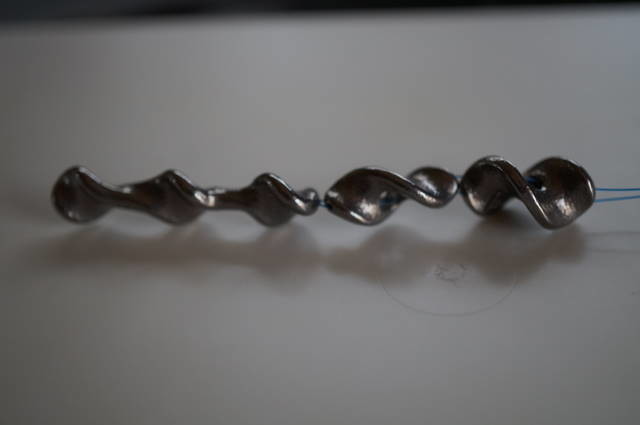
An entry published in June 2021 described a titanium prototype with a twice-twisted leading chip and two screw attachments. Mr. Okada considered an assembly made entirely of auxiliary screws too soft in its action on the prostate. The leading approximately 30mm therefore remained rigid, while the following screws could change direction.
The diary described the sphincter (a structure that grips the chip) engaging different narrowed sections. Mr. Okada favored this combination of a rigid front and flexible rear pieces.
(Source: ok-lab's diary, published June 2021)
https://ok-lab.hatenablog.com/entry/2021/06/19/125845
Screw chip prototypes addressed difficult passage around a bend for beginners
In an entry published in August 2021, Mr. Okada attributed beginners' difficulties to an approximately 90-degree urethral bend before the sphincter. He tested a front-pulling concept involving a tip hook and stainless-steel wire, but his large screw assembly still met substantial resistance. A smaller SS attachment was planned, 1mm narrower than S.
A separate rear chip was intended to limit inward travel in the bulbar urethra (the location described for this rear component). Its external thread formed part of his response to excessive inward movement. Mr. Okada emphasized that this rear chip needed to remain detectable from outside the body.
(Source: ok-lab's diary, published August 2021)
https://ok-lab.hatenablog.com/entry/2021/08/21/125838
Curved auxiliary chips initially required spacing fixed before shipment
An entry published in December 2023 introduced plain, flat, and twisted curved auxiliary chips for the tail (a silicone tube carrying connected chips). Their published lengths were 40mm+-1mm, 45mm+-1mm, and 50mm+-1mm. Widths were S=8mm+-0.5mm, M=9mm+-0.5mm, and L=10mm+-0.5mm.
The curve made sliding along the tube difficult, unlike a straight attachment. Prices published in December 2023 were ¥5,000 (about $32 at ¥156 = $1, rate as of 2026-09-04) tax excluded for either plain or flat curves, and ¥6,000 (about $38 at ¥156 = $1, rate as of 2026-09-04) tax excluded for twisted curves. Mr. Okada therefore proposed agreeing on adjacent-chip spacing before shipment and fixing the curved component's position at the workshop.
(Source: ok-lab's diary, published December 2023)
https://ok-lab.hatenablog.com/entry/2023/12/30/122243
Paired screw chips offered a variable span within the prostate
An entry published in April 2024 described a multi-part design (Alien) with either paired screws or a flat curved prostate section. The paired screws allowed the length of that section to vary. The illustrated configurations showed closer spacing for approximately 28mm, and wider spacing for approximately 35mm, of urethral length within the prostate. Mr. Okada presented this adjustable span as a response to differences in that length.
(Source: ok-lab's diary, published April 2024)
https://ok-lab.hatenablog.com/entry/2024/04/06/122941
Sales of screw chip prototypes with bladder loops depended on patent advice
An entry published in August 2025 described screw prototypes with a bladder loop (a loop intended to improve stability beyond the prostate section). The loop used nitinol (the named wire material), and Mr. Okada reported his first bladder-loop trial with 0.2mm wire. He withheld specifications and prices while planning a patent consultation.
The supplied entries do not record the consultation's outcome. Mr. Okada said sales would be put on hold if the consultation suggested intellectual property protection was possible.
(Source: ok-lab's diary, published August 2025)
https://ok-lab.hatenablog.com/entry/2025/08/16/122934
Four screw chips had separate metal and resin component prices
In an entry published in July 2026, a customer asked about replacing an S auxiliary screw with L and about resin supply. The customer ultimately ordered both materials; the diary does not record a direct answer about replacement alone, supply, or later performance. The stainless-steel assembly listed L, M, and S screws at ¥5,500 (about $35 at ¥156 = $1, rate as of 2026-09-04) each, plus an L second-generation resin screw at ¥3,500 (about $22 at ¥156 = $1, rate as of 2026-09-04).
All four screws in the resin assembly were ¥3,500 (about $22 at ¥156 = $1, rate as of 2026-09-04) each, as published in July 2026. The first three had 0 spacing with tube cushions; the fourth had 4mm spacing. Both descriptions specified two threads; the diary does not record Mr. Okada recommending one material over the other.
(Source: ok-lab's diary, published July 2026)
https://ok-lab.hatenablog.com/entry/2026/07/18/122919
The maker's answer to screw chip attachments

The maker changed connections and movement control after reports of breakage and difficulty adjusting curved attachments.
Curved auxiliary chips followed rubber failures at sharply bent connections
In an entry published in December 2023, Mr. Okada described reported rubber failures in a linked assembly (Sea Slug 5). Extremely bent connections were the reported problem, and recent builds used gentler angles. He then proposed tail-mounted curved attachments, using a silicone tube containing two nylon threads, for customers disappointed by the reduced curves.
(Source: ok-lab's diary, published December 2023)
https://ok-lab.hatenablog.com/entry/2023/12/30/122243
A wider hole changed how curved auxiliary chips moved
An entry published in January 2024 changed the curved chip's internal hole from 2mm to 2.5mm, matching the tail's diameter. Mr. Okada reported that water entering the gap greatly reduced friction, addressing the earlier adjustment problem. His comparison was approximately 3kg of pulling force when dry versus approximately 10g after water entered the gap.
He described water-assisted adjustment, while identifying easy sliding as a separate problem requiring stops. Among the curve shapes, Mr. Okada favored the flat curve for ease of use.
(Source: ok-lab's diary, published January 2024)
https://ok-lab.hatenablog.com/entry/2024/01/06/123004
Dedicated stops helped preserve spacing around curved auxiliary chips
The January 2024 entry also introduced a tail stopper (a component intended to restrict sliding along the tube). Its hole measured approximately 1.5mm around the 2.5mm tube, and Mr. Okada said it resisted sliding even when wet. The published price was ¥500 (about $3 at ¥156 = $1, rate as of 2026-09-04) tax excluded per stopper; curved-chip prices otherwise stayed unchanged.
These stops replaced the earlier reliance on positions fixed for shipment. Mr. Okada specified stops where a gap between neighboring chips was wanted.
(Source: ok-lab's diary, published January 2024)
https://ok-lab.hatenablog.com/entry/2024/01/06/123004
If you see blood in your urine, even a small amount or for the first time, do not wait and see. See a urologist right away. If you suddenly cannot urinate, or the device cannot be removed, do not try to fix it yourself. Go to a medical facility, including emergency care, immediately.
How screw chip attachments changed over time

| Published | What the diary said then |
|---|---|
| Sep 2018 | The maker favored a leading screw when stronger stimulation was requested. |
| Apr 2019 | A compact screw prototype finished longer than requested. |
| Jun 2021 | A titanium assembly combined a rigid front with movable rear screws. |
| Aug 2021 | A wire-traction prototype encountered resistance; smaller attachments were planned. |
| Dec 2023 | Curved attachments introduced new shapes but difficult position adjustment. |
| Jan 2024 | Larger holes and dedicated stops changed adjustment and spacing control. |
| Apr 2024 | Paired screws offered variable length within a multi-part design. |
| Mar 2025 | End-loop connections looked feasible in a resin screw prototype. |
| Aug 2025 | Possible patent protection could delay sales of bladder-loop prototypes. |
| Jun 2026 | Three joined screws suggested a flexible replacement for a separate main chip. |
OK Prostate Chip products related to screw chip attachments

The current list includes relevant resin products, while historical custom assemblies require separate identification.
Products that appear in these entries
| Product (official name) | Price incl. tax | Relation to this topic |
|---|---|---|
| Single resin screw chip (OKプロステートチップ 樹脂素材1チップタイプ スクリュー) | ¥4,400 (about $28 at ¥156 = $1, rate as of 2026-09-04) | In September 2018, a customer chose a resin screw alone after asking about stronger stimulation. |
| Resin semi-long chip (OKプロステートチップ セミロングタイプ(生体適合樹脂)) | ¥5,500 (about $35 at ¥156 = $1, rate as of 2026-09-04) | In July 2026, the customer described using this main-chip type while asking about replacing an auxiliary screw. |
| Second-generation resin screw attachment (スクリュー型補助チップ追加オプション(第二世代生体適合樹脂)) | ¥3,500 (about $22 at ¥156 = $1, rate as of 2026-09-04) | In July 2026, this material and attachment type appeared in both custom four-screw configurations. |
The second-generation resin screw attachment is listed in the company's own online store.

(Source: ok-lab's diary, published September 2018)
https://ok-lab.hatenablog.com/entry/20180908/1536384939
(Source: ok-lab's diary, published July 2026)
https://ok-lab.hatenablog.com/entry/2026/07/18/122919
Products the diary mentioned as alternatives
The diary names no alternative.
The historical custom builds include the compact resin screw, titanium assembly, wire-traction prototype, curved attachments, adjustable multi-part design, loop prototypes, and multi-screw assemblies. No matching product can be confirmed on the current list.
Common worries about screw chip attachments
Readers asked about the screw's position, possible connections, and whether joined screws could serve as the main chip.
"Is a screw chip better at the front?"
In an entry published in September 2018, a customer wanted stronger stimulation and asked about a glass chip followed by a resin screw. Mr. Okada had no experience making that combination and could not confirm its effects. He thought a rear screw might allow urine past while limiting inward movement of the first chip during urination.
The customer chose a resin screw alone; the diary does not record the resulting sensation. For the requested stimulation, Mr. Okada favored a screw as the first chip.
(Source: ok-lab's diary, published September 2018)
https://ok-lab.hatenablog.com/entry/20180908/1536384939
"Can a resin screw chip have loops at both ends?"
In an entry published in March 2025, a customer asked whether a white resin screw could have wire loops at both ends. Staff initially said they had no experience with that arrangement and could not confirm feasibility. Mr. Okada's prototype showed some hole distortion, but loop connections appeared possible.
The prototype tested connection feasibility and did not follow the requested dimensions. The diary does not record a completed customer order. Mr. Okada offered a revised quotation if the customer changed the request.
(Source: ok-lab's diary, published March 2025)
https://ok-lab.hatenablog.com/entry/2025/03/08/123016
"Can triple screw chips replace the main piece?"
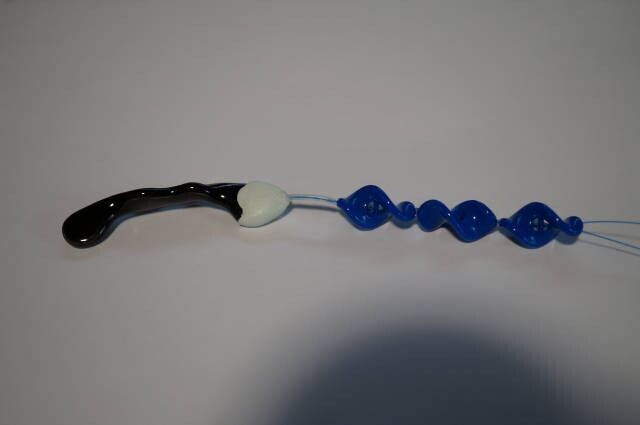
In an entry published in June 2026, a customer had asked how much a joined screw assembly could bend. The completed prototype combined three blue screws over approximately 45mm, with no spacing between them. Mr. Okada reported that the tube cushions allowed flexible bending.
He compared the result to a semi-long twisted chip; the diary does not record the customer's experience after delivery. Mr. Okada proposed treating the joined screws as the main section, without a separate leading chip.
(Source: ok-lab's diary, published June 2026)
https://ok-lab.hatenablog.com/entry/2026/06/13/122909
Buying from outside Japan

OK Lab ships internationally to countries covered by Japan Post's EMS courier service. Overseas orders are paid in advance by PayPal. Each order carries a ¥400 (about $3 at ¥156 = $1, rate as of 2026-09-04) handling fee, and EMS shipping is charged on top. These terms come from OK Lab's official sales-terms page (written here as plain text, not a link: ok-lab.net/docs/law), checked on September 7, 2026; confirm them on the official store before you order, because they can change.
Summary of this article
| What you wanted to know | The answer |
|---|---|
| What is the short answer? | Screw chips can be main pieces or attachments; their roles vary by design. |
| What is the base product? | A urethral device made and sold by OK Lab in Japan, with prices in yen. |
| What do the part names mean? | Auxiliary chips add another piece; tails connect parts, and stops limit movement. |
| What happened in the diary? | Custom designs raised questions about friction, stability, flexibility, and connection strength. |
| How did the maker respond? | He revised connections, curved-chip holes, and spacing control. |
| What changed over time? | Later designs explored adjustable spans, end loops, and flexible multi-screw main sections. |
| Which related products are listed now? | The table distinguishes listed resin products from historical custom assemblies. |
| What did customers ask? | They asked about screw position, end loops, and replacing a separate main chip. |
| Can customers outside Japan buy? | The stated terms use advance PayPal payment, a handling fee, and additional EMS shipping. |
Source: ok-lab's diary (Okada Comfortable Life Laboratory). The original entries are in Japanese; quotations on this page are translated. Photos and videos are on the original entries.
This article is a summary of the maker's development diary. The product is not a medical device and no result is guaranteed. If anything feels wrong or worries you, see a doctor. Prices, specifications and cautions change, so confirm the latest information on the official blog and the official site. Questions about ordering and shipping go to the seller.