![Do textured prostate chips feel different? | The maker reports changes, with limits [OK Prostate Chip]](/img/a/T0545/eyecatch.svg)
This page is based on entries from "ok-lab's diary" (https://ok-lab.hatenablog.com/), the Japanese development diary written by Mr. Okada, founder of OK Lab, a small company in Japan (Okada Comfortable Life Laboratory). Only the entries about "raised bumps, resin dots, and decorative chip finishes" are summarized here, in order of publication. Past prices and sizes are as written at the time. Current prices come from the official product list (retrieved September 4, 2026). Quotations are translated from Japanese.
This article is about raised bumps and decorative finishes on OK Prostate Chip products, and summarizes their development. It includes personal tests, design limits, customer questions, current products, and buying from outside Japan.
Note: This page is a personal reading log by someone with no connection to the maker or the seller. It reflects the source entries as of their publication dates and makes no guarantee of accuracy or safety. The product is not a medical device; talk to a doctor about any health decision. Check the official site for current information. This page contains advertising.
In short
The maker reports that raised surfaces change sensation, while ceramic bumps also increase thickness.
His responses include smaller designs, backup connections, and limits on what can be made.
Current listings confirm several base products; some custom finishes have no confirmed match.
About this product
The OK Prostate Chip is a small device that is placed in the urethra (the urine passage) so that it acts on the prostate; the maker sells it in several shapes, sizes and materials. It is made and sold by OK Lab (Okada Comfortable Life Laboratory), a small company in Japan, through its own online store, and prices are in Japanese yen (JPY). The maker's development diary, "ok-lab's diary", is written in Japanese. This page is an English summary of it, and every quotation is translated. OK Lab ships internationally, so readers outside Japan can order (see "Buying from outside Japan" below). Product names on this page are plain-English descriptions. The official Japanese product name is shown once in the product table so you can find the same item in the store.
Before you read: key terms
| Term | Plain-English meaning |
|---|---|
| Urethra | The urine passage, where these chips are placed to act on the prostate. |
| Prostate | The diary does not explain this. |
| Raised ceramic bumps | Projections formed in ceramic; the maker intended them to change sensation. |
| Resin dots | Raised spots of epoxy resin on a chip, intended to change its surface feel. |
| Screw-shaped auxiliary chip | A small tubular, screw-shaped second chip used in the decorative connection design for stability. |
| Backup nylon thread | An additional connection between chips, intended to keep them linked if the cable breaks. |
| Wire reinforcement | Wire combined with resin on ceramic; Mr. Okada intended it to resist breakage. |
What happens: textured prostate chips
The OK Prostate Chip is a small device placed in the urethra to act on the prostate. Textured versions have raised ceramic bumps or resin dots on the chip's surface, intended to change how it feels. Decorative cable builds join a main chip to a screw-shaped auxiliary chip, which Mr. Okada associates with appearance and stability. Later experiments combine raised resin sections with wire reinforcement, so the entries cover changes to both surface shape and connections.
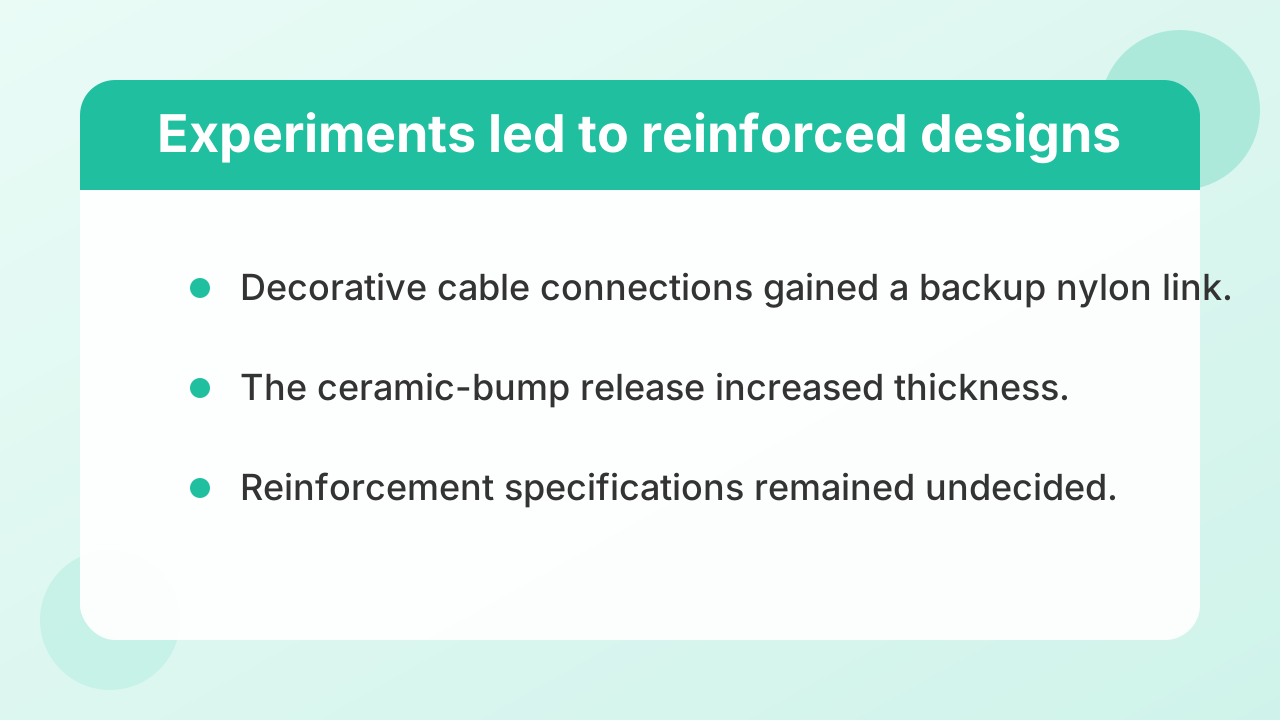
Decorative cable chips gained an extra connection against sudden cable failure
In an entry published in January 2020, Mr. Okada described a decorative design joining a main chip and an auxiliary chip. He reported favorable results from personal tests of how the cable connection stayed in place.
He also identified a concern: a cable used only as a connector might break without warning. The design therefore linked the 2 chips with backup nylon thread as well. Mr. Okada asked buyers to specify the decorative finish when purchasing the main chip and screw-shaped auxiliary chip.
(Source: ok-lab's diary, published January 2020)
https://ok-lab.hatenablog.com/entry/2020/01/11/151714
Raised bumps on chips started as resin prototypes before ceramic versions were planned
In an entry published in August 2020, Mr. Okada introduced ceramic chips with added resin bumps as experimental pieces. He distinguished these from the planned ceramic versions, whose bumps would also be ceramic.
He described a strong personal response, while acknowledging that anticipation might have influenced his impression. He planned to commission 6 ceramic designs, with a possible September release depending on successful firing. Mr. Okada cautioned against use by people who might struggle to limit it.
(Source: ok-lab's diary, published August 2020)
https://ok-lab.hatenablog.com/entry/2020/08/29/130333
Textured prostate chips became thicker, with an unexpected personal test result
In an entry published in September 2020, Mr. Okada reported that the first 6 bumpy ceramic designs had arrived. Their length and width matched the earlier versions, but their thickness had increased considerably.
He reported slight semen leakage during his roughly 5-minute personal test of the wider double-twist ceramic chip. The announced bump surcharge was ¥1,000 (about $6 at ¥156 = $1, rate as of 2026-09-04) excluding tax, and availability then covered only those six designs. Mr. Okada directed buyers to a separate bump-addition item for that release.
(Source: ok-lab's diary, published September 2020)
https://ok-lab.hatenablog.com/entry/2020/09/19/123115
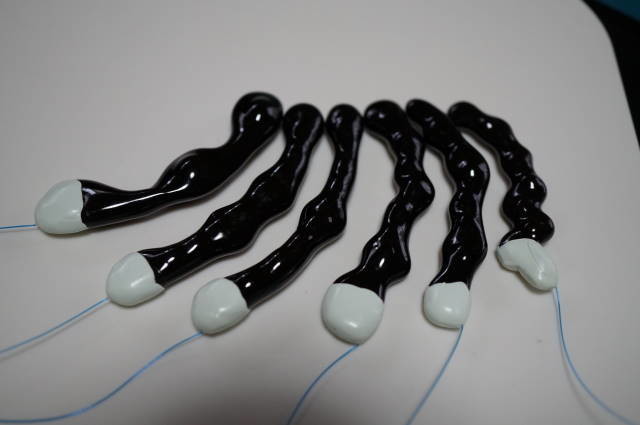
The textured chip range expanded before its additional models were tested
In an entry published in October 2020, Mr. Okada announced 6 additional bumpy ceramic designs, bringing the available range to 12. The additions included short and medium-length shapes, including twisted versions.
He stated that he had not personally tested the new group because another device test was occupying his schedule. The diary does not record their later test results in this material. Mr. Okada said orders for the expanded range would begin with the following week's sales.
(Source: ok-lab's diary, published October 2020)
https://ok-lab.hatenablog.com/entry/2020/10/17/121023
Resin dots were explored on smaller chips after continuous ridges disappointed
In an entry published in October 2024, Mr. Okada described disappointment with continuous resin ridges, which he found too smooth. He then explored separate raised dots measuring just under 1mm, reporting a modest change in sensation.
His prototypes used the S sizes of the short, medium-length, and extended ceramic chips. This followed inquiries from customers seeking stronger sensations whose larger chips would not fit. Mr. Okada suggested that dots on smaller chips might offer a change without choosing a larger base model.
(Source: ok-lab's diary, published October 2024)
https://ok-lab.hatenablog.com/entry/2024/10/05/122923
Textured chips gained separated resin reinforcement while detailed specifications remained unsettled
In an entry published in August 2026, Mr. Okada reconsidered the appearance of earlier wire-reinforced ceramic chips. He explained that the earlier minimum wire thickness of 0.1mm had prompted full epoxy (resin) coverage because he hesitated to leave wire exposed.
The newer prototype combined very fine wire across the chip with separated resin sections, leaving gaps where wire remained exposed. One sample had bulges comparable to ordinary bumpy chips; another had thinner resin coverage. Mr. Okada stated that wire thickness and other detailed specifications were still undecided.
(Source: ok-lab's diary, published August 2026)
https://ok-lab.hatenablog.com/entry/2026/08/08/122906
The maker's answer to textured prostate chips
Mr. Okada's responses depended on the chip's material, shape, and the particular finish requested.
Decorative cable chips had different limits for standard and shortened ceramics
In an entry published in January 2020, Mr. Okada set out compatibility for decorative cable connections. Standard ceramic short, medium-length, extended, and long chips were eligible, as were all ceramic twist types.
The shortened ceramic pieces for vibrating models had narrower coverage: only short and medium-length versions were supported. He stated that shortened twisted ceramic pieces did not exist. Mr. Okada asked buyers who wanted a shortened piece to specify that choice in their request.
(Source: ok-lab's diary, published January 2020)
https://ok-lab.hatenablog.com/entry/2020/01/11/151714
An 8mm textured chip request ended with a standard replacement
In an entry published in February 2020, a customer requested an 8mm version of an experimental short chip with prominent bulges. Mr. Okada found that its narrow sections could not be made thinner while retaining sufficient strength.
Reducing only the bulges left a shape almost identical to the ordinary short ceramic chip, so he canceled the custom design. The customer then requested the standard short ceramic chip in M, and Mr. Okada reported completing it with the decorative cable finish. He explained that ceramic lacked the embedded-thread reinforcement used in the resin comparison he discussed.
(Source: ok-lab's diary, published February 2020)
https://ok-lab.hatenablog.com/entry/2020/02/22/145216
Resin dots on chips cost extra, with no guarantee against breakage
In the pricing section of an entry published in October 2024, Mr. Okada specified approximately 5-7 dots per side, or 10-14 across both sides. The dots were epoxy resin, with intentional interruptions in their arrangement.
The finish cost ¥1,000 (about $6 at ¥156 = $1, rate as of 2026-09-04) excluding tax, with the pattern left to his judgment. He thought the additions would strengthen the ceramic considerably. Mr. Okada nevertheless stated that there was no guarantee against breakage.
(Source: ok-lab's diary, published October 2024)
https://ok-lab.hatenablog.com/entry/2024/10/05/122923

Raised bumps on twist chips followed wire paths, with adjustable height
In an entry published in August 2026, Mr. Okada described why reinforcement on twisted chips developed a shell-like appearance. He wrote that fitting the wire against the twisted surface required 2 crossing wires.
The resin bulges followed those wire paths, rather than a freely chosen decorative pattern. Their positions could barely change, but their height could vary. Mr. Okada said larger bulges were possible, distinguishing this flexibility from earlier bumps whose dimensions depended on fixed molds.
(Source: ok-lab's diary, published August 2026)
https://ok-lab.hatenablog.com/entry/2026/08/15/122912
How textured prostate chips changed over time
| Published | What the diary said then |
|---|---|
| Mar 2019 | Raised aluminum bumps were suggested as a possibility. |
| Jan 2020 | Decorative cable connections gained a backup nylon link. |
| Feb 2020 | Strength limits ended a narrower custom ceramic design. |
| Aug 2020 | Resin-bump experiments led to plans for ceramic-bump versions. |
| Sep 2020 | The first ceramic-bump release increased thickness without changing length or width. |
| Oct 2020 | The bumpy ceramic range expanded before the maker tested the additions. |
| Oct 2024 | Separate resin dots were explored after continuous ridges disappointed the maker. |
| Aug 2026 | Reinforcement prototypes used separated resin sections; detailed specifications remained undecided. |
| Aug 2026 | Twisted surfaces led to shell-like reinforcement with variable bulge height. |
OK Prostate Chip products related to textured prostate chips
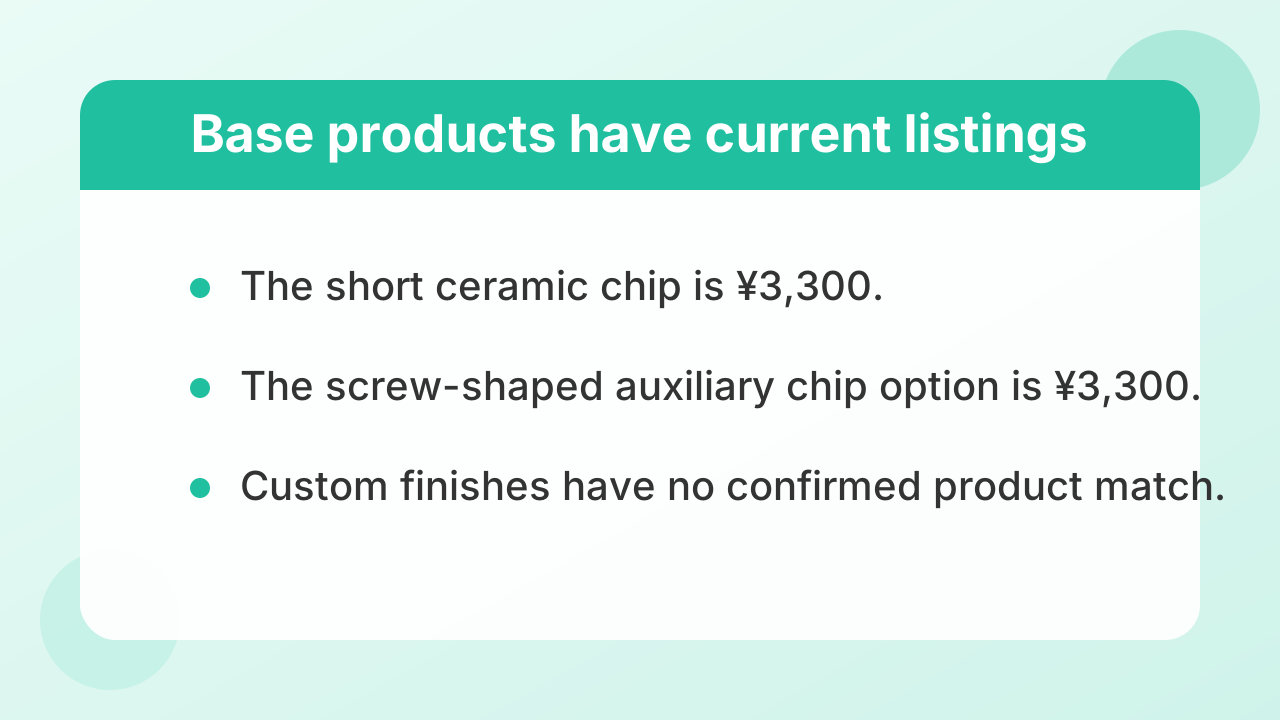
The current list includes base chips and an auxiliary option used in these discussions.
Chips featured in these entries
| Product (official name) | Price incl. tax | Relation to this topic |
|---|---|---|
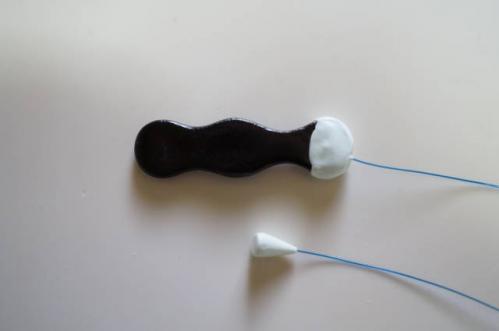
| Short ceramic chip (OKプロステートチップ 陶器素材ショートタイプ) | ¥3,300 (about $21 at ¥156 = $1, rate as of 2026-09-04) | In February 2020, this became the customer's replacement after the narrow custom ceramic design was canceled. |
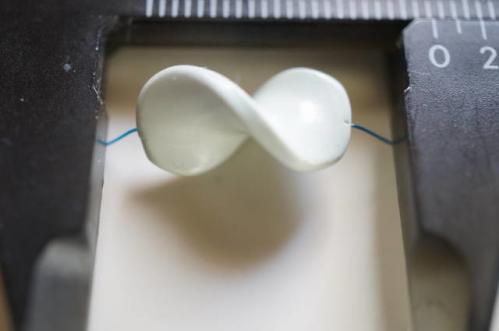
| Screw-shaped auxiliary chip option (スクリュー型補助チップ追加オプション) | ¥3,300 (about $21 at ¥156 = $1, rate as of 2026-09-04) | In February 2020, this option appeared in the order requesting a decorative cable connection. |
| Long ceramic chip with four-point twist (OKプロステートチップ 陶器素材ロングタイプ 4点ツイスト) | ¥7,700 (about $49 at ¥156 = $1, rate as of 2026-09-04) | In August 2026, a request involving this chip prompted investigation of reinforcement on twisted surfaces. |
The short ceramic chip is listed in OK Lab's own online store.
The screw-shaped auxiliary chip option is listed in OK Lab's own online store.
(Source: ok-lab's diary, published February 2020)
https://ok-lab.hatenablog.com/entry/2020/02/22/145216
(Source: ok-lab's diary, published August 2026)
https://ok-lab.hatenablog.com/entry/2026/08/15/122912
Chips mentioned as alternatives in the diary
| Product (official name) | Price incl. tax | Relation to this topic |
|---|---|---|
| Long ceramic chip (OKプロステートチップ 陶器素材ロングタイプ) | ¥6,600 (about $42 at ¥156 = $1, rate as of 2026-09-04) | In August 2026, OK Lab offered this flat model while reinforcement for the requested twisted model remained under investigation. |
(Source: ok-lab's diary, published August 2026)
https://ok-lab.hatenablog.com/entry/2026/08/15/122912
The older stiff-wire connected design (Rei chip) was described as discontinued by a customer in an entry published in January 2020. That customer requested the decorative cable design after learning of its release.
(Source: ok-lab's diary, published January 2020)
https://ok-lab.hatenablog.com/entry/2020/01/18/132849
Experimental shapes and custom decorative or reinforced finishes: No matching product can be confirmed on the current list.
Common worries about textured prostate chips
Reader questions concerned whether particular shapes and finishes could actually be made.
"Could an aluminum cover be textured by adding raised bumps?"
In an entry published in March 2019, a customer proposed adding numerous bumps where the chip acts on the prostate. The customer hoped for stronger stimulation.
Mr. Okada replied that an aluminum cover was under consideration and might allow bumps formed beforehand. The diary does not record whether this proposal became a finished item. His reply presented it as a manufacturing possibility, without promising a result.
(Source: ok-lab's diary, published March 2019)
https://ok-lab.hatenablog.com/entry/2019/03/02/151104
"Could a flat textured chip have a cross-shaped profile?"
In an entry published in August 2024, a customer proposed resin projections in the recessed parts of a flat chip. The intended result was a cross-shaped profile, which the customer hoped would change sensation and make urination easier.
Mr. Okada thought the shape could be made, but the diary does not record its completion or performance. Mr. Okada asked the customer for a more concrete illustration of the proposed cross.
(Source: ok-lab's diary, published August 2024)
https://ok-lab.hatenablog.com/entry/2024/08/17/122842
"Could long twist chips have larger raised bumps?"
In an entry published in August 2026, a customer requested an L-size long ceramic twist chip with enlarged resin bulges. At that point, existing bumpy twist models were limited to short and medium-length S sizes.
OK Lab's staff initially said the requested finish had only been achieved on flat chips and offered a flat long model instead. The customer briefly accepted that alternative, then decided to wait for the twisted model. The entry subsequently described the resulting shell-like design; the customer's experience in use is not recorded. Staff had asked the customer to wait for the technical investigation.
(Source: ok-lab's diary, published August 2026)
https://ok-lab.hatenablog.com/entry/2026/08/15/122912
Buying from outside Japan
OK Lab ships internationally to countries covered by Japan Post's EMS courier service. Overseas orders are paid in advance by PayPal. Each order carries a ¥400 (about $3 at ¥156 = $1, rate as of 2026-09-04) handling fee, and EMS shipping is charged on top. These terms come from OK Lab's official sales-terms page (written here as plain text, not a link: ok-lab.net/docs/law), checked on September 7, 2026; confirm them on the official store before you order, because they can change.
Summary of this article
| What you wanted to know | The answer |
|---|---|
| The short answer | The maker reports different sensations, alongside changes in thickness and construction. |
| What the product is | A urethral device made and sold by OK Lab in Japan. |
| What the terms mean | Ceramic bumps, resin dots, auxiliary chips, and reinforcement describe different features. |
| What happened in testing | The diary records personal observations and identifies some designs that had not been tested. |
| How the maker responded | Responses depended on material strength, compatible shapes, and manufacturing limits. |
| What changed over time | The entries move from proposed bumps to ceramic textures, dots, and reinforced designs. |
| Which products are listed today | The table gives current base-product prices without confirming every historical customization. |
| What customers asked | Questions concerned aluminum bumps, a cross-shaped profile, and larger bumps on twisted chips. |
| How overseas buying works | International orders use PayPal, with handling and EMS charges. |
Source: ok-lab's diary (Okada Comfortable Life Laboratory). The original entries are in Japanese; quotations on this page are translated. Photos and videos are on the original entries.
This article is a summary of the maker's development diary. The product is not a medical device and no result is guaranteed. If anything feels wrong or worries you, see a doctor. Prices, specifications and cautions change, so confirm the latest information on the official blog and the official site. Questions about ordering and shipping go to the seller.