![What makes a flat curve chip different? | A broad face, but fit varies [OK Prostate Chip]](/img/a/T0539/eyecatch.svg)
This page is based on entries from "ok-lab's diary" (https://ok-lab.hatenablog.com/), the Japanese development diary written by Mr. Okada, founder of OK Lab, a small company in Japan (Okada Comfortable Life Laboratory). Only the entries about "flat curve chips" are summarized here, in order of publication. Past prices and sizes are as written at the time. Current prices come from the official product list (retrieved September 4, 2026). Quotations are translated from Japanese.
Note: This page is a personal reading log by someone with no connection to the maker or the seller. It reflects the source entries as of their publication dates and makes no guarantee of accuracy or safety. The product is not a medical device; talk to a doctor about any health decision. Check the official site for current information. This page contains advertising.
In short
- A flat curve chip presents its broad face at a bend; the diary records both benefits and problems.
- Mr. Okada favored the shape, investigated surface changes, and warned about difficult removal with some later designs.
- The original resin flat curve chip remains on the supplied current list at ¥6,050 (about $39 at ¥156 = $1, rate as of 2026-09-04) including tax.
If you see blood in your urine, even a small amount or for the first time, do not wait and see. See a urologist right away. If you suddenly cannot urinate, or the device cannot be removed, do not try to fix it yourself. Go to a medical facility, including emergency care, immediately.
About this product

The OK Prostate Chip is a small device that is placed in the urethra (the urine passage) so that it acts on the prostate; the maker sells it in several shapes, sizes and materials. It is made and sold by OK Lab (Okada Comfortable Life Laboratory), a small company in Japan, through its own online store, and prices are in Japanese yen (JPY). The maker's development diary, "ok-lab's diary", is written in Japanese. This page is an English summary of it, and every quotation is translated. OK Lab ships internationally, so readers outside Japan can order (see "Buying from outside Japan" below). Product names on this page are plain-English descriptions. The official Japanese product name is shown once in the product table so you can find the same item in the store.
Before you read: key terms
| Term | Plain-English meaning |
|---|---|
| Urethra | The urine passage, where the chip is placed to act on the prostate. |
| Flat curve | A bend across the chip's thinner direction, intended to present its broad face at the urethral bend. |
| Sphincter | A urine-control muscle; the diary discusses inner and outer sphincters in explaining urine flow. |
| Retrieval thread | A thread attached to the chip, intended for removal. |
| Bendable metal shaft | A flexible metal core carrying flat beads, allowing different curve orientations. |
| Support chip | A connected secondary chip intended to help the main chip stay in place. |
What happens: flat curve chip
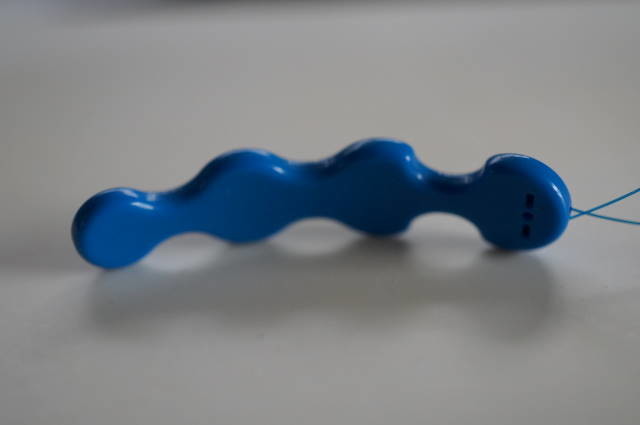
The OK Prostate Chip is a small device placed in the urethra to act on the prostate. A flat curve chip bends across its thinner direction, presenting a broad face instead of a narrow edge. Mr. Okada describes this shape in relation to the urine passage's bend before the sphincter (a urine-control muscle). He reports easier positioning and better stability in his own tests.
A flat curve chip changed which face followed the bend
In an entry published in November 2021, Mr. Okada introduces a proposed chip curved across its thinner dimension. He contrasts it with earlier chips, whose curves followed their thicker dimension. He reports finding the broad face easier and more comfortable during his trial. His design preference was a flat-oriented end, while the choice between a curved end and whole-body curve remained open.
(Source: ok-lab's diary, published November 2021)
https://ok-lab.hatenablog.com/entry/2021/11/20/125643
The flat curve chip launched with three separately specified sizes
In an entry published in December 2021, the flat curve chip launched at ¥5,500 (about $35 at ¥156 = $1, rate as of 2026-09-04) excluding tax, in S, M and L. Mr. Okada described its broad face as an advantage at the 90-degree urethral bend before the sphincter.
S measured 38mm long and 2.8mm thick, with widths of 7mm, 9mm, 9.5mm and 9mm from front to rear. M measured 42mm long and 3.0mm thick; the corresponding widths were 8mm, 10mm, 10.5mm and 10mm.
L measured 47mm long and 3.2mm thick; the corresponding widths were 9mm, 11mm, 11.5mm and 11mm. Mr. Okada qualifies the claimed comfort and staying power as personal impressions.
(Source: ok-lab's diary, published December 2021)
https://ok-lab.hatenablog.com/entry/2021/12/04/124140
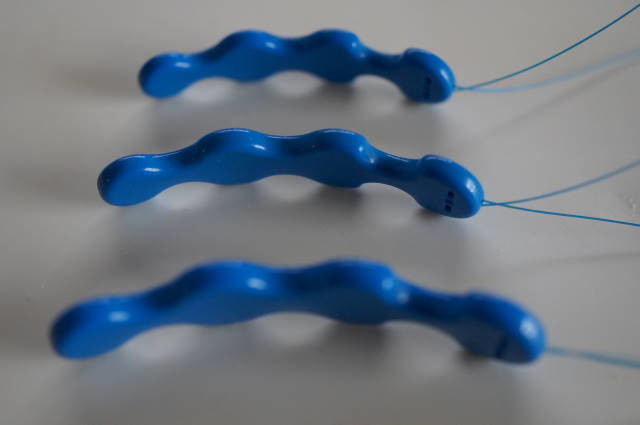
The large flat curve chip proved too wide for Mr. Okada
In another entry published in December 2021, Mr. Okada reports difficulty with the large flat-curve model. An 11mm wide bulge was difficult for him to pass beyond the sphincter. He says the same width had posed no problem with the earlier, vertically curved shape. Mr. Okada suggests that M might suit him better.
(Source: ok-lab's diary, published December 2021)
https://ok-lab.hatenablog.com/entry/2021/12/18/123756
The bendable flat curve chip introduced a serious retrieval warning
In an entry published in June 2023, Mr. Okada describes a bendable metal shaft (a flexible core carrying flat beads). This separate design supported vertical and horizontal curves, unlike chips with a fixed bend. He reports that repeated bending could leave the shaft unable to return fully straight.
He also warns that an extremely curved chip entering the bladder might resist removal by its retrieval thread (the attached removal thread). He doubts it would pass naturally with urine. Mr. Okada warns that this situation could require hospital care.
(Source: ok-lab's diary, published June 2023)
https://ok-lab.hatenablog.com/entry/2023/06/24/123110
A curved support chip extended the flat curve concept
In an entry published in December 2023, Mr. Okada proposes a curved support chip (a connected secondary chip) for flat-curve combinations. The flat version cost ¥5,000 (about $32 at ¥156 = $1, rate as of 2026-09-04) excluding tax, with lengths of 40mm ±1mm, 45mm ±1mm or 50mm ±1mm.
Widths were S=8mm ±0.5mm, M=9mm ±0.5mm and L=10mm ±0.5mm. He says the curved passage made sliding adjustments difficult, so his proposed default was factory-fixed spacing between chips.
(Source: ok-lab's diary, published December 2023)
https://ok-lab.hatenablog.com/entry/2023/12/30/122243
An arrowhead flat curve prototype brought difficult removal and pain
In an entry published in February 2024, Mr. Okada includes a flat-curve version among his arrowhead-shaped prototypes. He reports difficult removal and pain during later urination, while explicitly saying he had not bled. He nevertheless warns that this design could cause bleeding and calls it very dangerous.
After a 12mm bladder-end section caused removal pain, he tested maximum widths around 10.5mm, with the outcome still unrecorded. Mr. Okada warns against use by anyone unable to judge the fit of this particular shape.
(Source: ok-lab's diary, published February 2024)
https://ok-lab.hatenablog.com/entry/2024/02/10/123023
Two connected flat curve chips felt steadier in Mr. Okada's tests
In an entry published in May 2024, Mr. Okada describes a main flat-curve chip paired with another in the lower urine passage. He reports less sideways tilting and better stability with that arrangement. He distinguishes it from a reversed support curve, which he found excessively stimulating. Mr. Okada regarded the reversed arrangement as unsuitable for prolonged placement.
(Source: ok-lab's diary, published May 2024)
https://ok-lab.hatenablog.com/entry/2024/05/04/122911
The maker's answer to flat curve chip
Mr. Okada favored the broad face, but his replies also describe rejected designs and individual fit problems.
Mr. Okada favored the flat curve chip for staying in place
In an entry published in November 2021, a customer asked when titanium chips and the new flat shape would become available. Mr. Okada could not give a titanium release date and was considering stainless steel first because titanium was expensive. Production of the flat resin design had already been requested.
The diary does not record whether this customer later bought either product. Mr. Okada said the flat-faced shape would be his first recommendation for people seeking prolonged placement.
(Source: ok-lab's diary, published November 2021)
https://ok-lab.hatenablog.com/entry/2021/11/27/124314
A recessed flat curve prototype was deferred for commercial reasons
In an entry published in January 2022, Mr. Okada discusses a flat-curve prototype with a shallow recess rather than a through-hole. He thought it might allow slightly better urine flow than the newly released model. He says he might have chosen it had both designs arrived before launch. His decision was to defer adoption because selling two similar versions together made little commercial sense.
(Source: ok-lab's diary, published January 2022)
https://ok-lab.hatenablog.com/entry/2022/01/08/123729
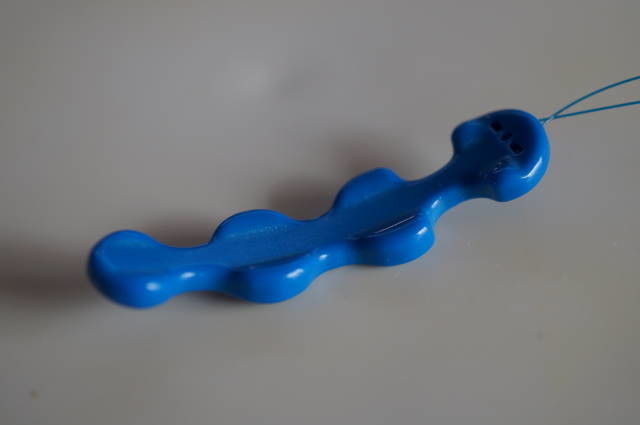
A longer flat curve chip reportedly stayed clean for one customer
In an entry published in May 2023, a customer wanted to keep using the flat shape despite hard deposits on M. The customer reports deposits after 3 days with M, but a clean surface after 10 days with L. The same account describes an initial delay in urine flow with M and smoother flow with L.
Mr. Okada discusses the customer's theory that the shorter chip left urine trapped around it. He suggests a chip shorter than the prostate might obstruct flow, without establishing that explanation as fact. Mr. Okada suggested that extra length might address this particular problem.
(Source: ok-lab's diary, published May 2023)
https://ok-lab.hatenablog.com/entry/2023/05/06/123024
If you see blood in your urine, even a small amount or for the first time, do not wait and see. See a urologist right away. If you suddenly cannot urinate, or the device cannot be removed, do not try to fix it yourself. Go to a medical facility, including emergency care, immediately.
How flat curve chip changed over time
| Published | What the diary said then |
|---|---|
| Nov 2021 | Curvature across the thinner dimension introduced a broad contact face. |
| Dec 2021 | S, M and L launched at ¥5,500 (about $35 at ¥156 = $1, rate as of 2026-09-04) excluding tax. |
| Jan 2022 | A recessed prototype was deferred to avoid selling similar designs together. |
| Aug 2022 | Investigation began; the manufacturer stopped its listing on Amazon, an online marketplace. |
| May 2023 | One customer's size comparison raised a possible urine-flow problem. |
| Jun 2023 | A flexible shaft allowed both curve orientations, with a bladder-retention warning. |
| Dec 2023 | Curved secondary chips were proposed with factory-fixed spacing. |
| Dec 2024 | Staff warned that turning a flat chip 90 degrees could worsen stability. |
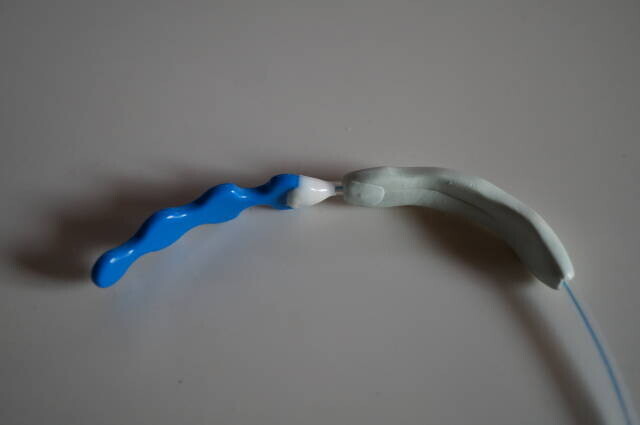
OK Prostate Chip products related to flat curve chip
The original resin flat-curve model is listed at ¥6,050 (about $39 at ¥156 = $1, rate as of 2026-09-04) including tax; related support options also appear below.
Products that appear in these entries
| Product (official name) | Price incl. tax | Relation to this topic |
|---|---|---|
| Flat-curve semi-long resin chip (OKプロステートチップ フラット面カーブ型 セミロングタイプ(生体適合樹脂)) | ¥6,050 (about $39 at ¥156 = $1, rate as of 2026-09-04) | The December 2021 launch described this shape; an August 2022 customer reported roughness and blood in urine. |
| Standard semi-long resin chip (OKプロステートチップ セミロングタイプ(生体適合樹脂)) | ¥5,500 (about $35 at ¥156 = $1, rate as of 2026-09-04) | The August 2022 customer reported no corresponding surface problem with their standard M model. |
The flat-curve semi-long resin chip is listed in the company's own online store.
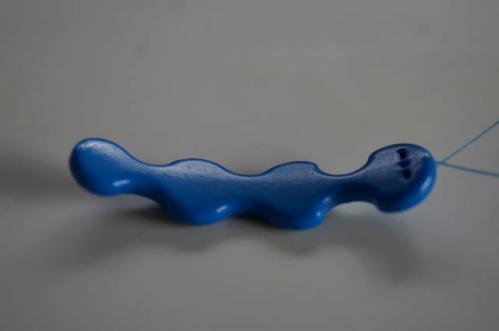
(Source: ok-lab's diary, published December 2021)
https://ok-lab.hatenablog.com/entry/2021/12/04/124140
(Source: ok-lab's diary, published August 2022)
https://ok-lab.hatenablog.com/entry/2022/08/20/122920
Products the diary mentioned as alternatives
| Product (official name) | Price incl. tax | Relation to this topic |
|---|---|---|
| Short ceramic chip (OKプロステートチップ 陶器素材ショートタイプ) | ¥3,300 (about $21 at ¥156 = $1, rate as of 2026-09-04) | In May 2024, Mr. Okada recommended this short ceramic chip as a flat support option alongside the curved resin model. |
| Short resin chip (OKプロステートチップ ショートタイプ(生体適合樹脂)) | ¥4,400 (about $28 at ¥156 = $1, rate as of 2026-09-04) | In May 2024, Mr. Okada also recommended this short resin chip for the same support role instead of a curved chip. |
(Source: ok-lab's diary, published May 2024)
https://ok-lab.hatenablog.com/entry/2024/05/04/122911
Titanium, recessed, bendable metal-shaft, curved support, arrowhead, paired and vibrating custom designs: No matching product can be confirmed on the current list.
Amazon listing: The diary does not say what the current state is.
Common worries about flat curve chip
The recorded questions concern drainage, surface changes and whether size labels transfer between designs.
"Could drainage holes keep a flat curve chip in place?"
In an entry published in January 2022, a customer proposed a hole through a large flat-curve chip to prevent displacement during urination. Mr. Okada replied that urine pressure could expel a tube with an internal diameter around 3mm. He thought the proposed chip would need a substantially larger opening.
He warned that urine passing the inner sphincter might escape despite closure of the outer sphincter, potentially causing leakage. The diary does not record whether the proposed custom chip was made. Mr. Okada's reply cautions that the hole could compromise urine control.
(Source: ok-lab's diary, published January 2022)
https://ok-lab.hatenablog.com/entry/2022/01/08/123729
"Does a rough flat curve chip mean the resin deteriorated?"
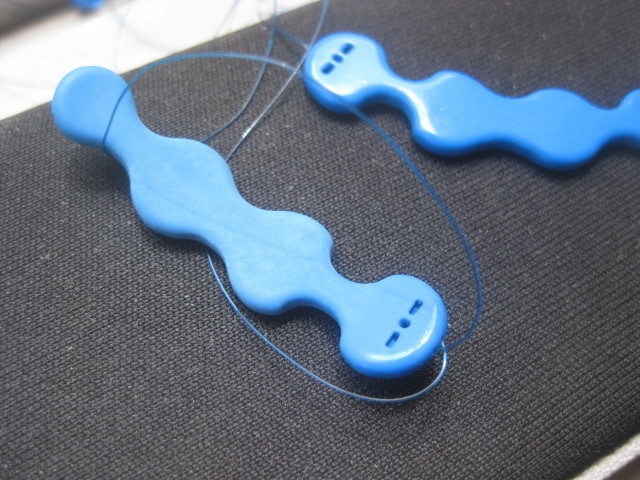
In an entry published in August 2022, a customer reported blood in urine and a dull, rough tip-side surface after 3 days. The customer wanted continued use; OK Lab considered a defect, requested its return, and offered a replacement after investigation. The manufacturer stopped its Amazon listing as a precaution, and OK Lab later confirmed sending a replacement.
Removable, sparkling material yielded white powder; the manufacturer concluded that deposits, rather than erosion, accounted for the altered surface. The deposit's composition was untested, and no later replacement result or confirmation of safe reuse appears. Mr. Okada suggested medical examination and possible analysis of the returned chip.
(Source: ok-lab's diary, published August 2022)
https://ok-lab.hatenablog.com/entry/2022/08/20/122920
"Does flat curve chip sizing carry across different models?"
In an entry published in December 2024, a customer compared a proposed vibrating custom chip with a medium flat-curve model that had felt tight. Staff explained that S, M and L were relative labels within each design, not interchangeable measurements. They also warned that rotating a flat chip 90 degrees relative to its wire curve could reduce stability.
The customer withdrew the requested textured shape, chose a screw-shaped M section, and asked for a revised quote. Mr. Okada considered the revised design better balanced, although the diary does not record completion or use. Staff advised considering the difference in curve direction when comparing shapes.
(Source: ok-lab's diary, published December 2024)
https://ok-lab.hatenablog.com/entry/2024/12/28/122907
Buying from outside Japan

OK Lab ships internationally to countries covered by Japan Post's EMS courier service. Overseas orders are paid in advance by PayPal. Each order carries a ¥400 (about $3 at ¥156 = $1, rate as of 2026-09-04) handling fee, and EMS shipping is charged on top. These terms come from OK Lab's official sales-terms page (written here as plain text, not a link: ok-lab.net/docs/law), checked on September 7, 2026; confirm them on the official store before you order, because they can change.
Summary of this article
| What you wanted to know | The answer |
|---|---|
| What is the short answer? | The broad face changed the design, but the diary records differing fit and surface problems. |
| What is the product? | A urethral device made and sold by OK Lab in Japan. |
| What does flat curve mean? | The chip bends across its thinner direction, presenting a broad face. |
| What happened in the reported cases? | Mr. Okada described easier positioning, size difficulties and removal hazards with later designs. |
| What did the maker propose? | He favored the flat shape, deferred a recessed version, and considered individual length differences. |
| What changed over time? | A fixed curved chip was followed by flexible shafts and connected support designs. |
| What does the listed flat-curve model cost? | ¥6,050 (about $39 at ¥156 = $1, rate as of 2026-09-04) including tax in the supplied current product list. |
| What questions did customers raise? | Drainage holes, rough surfaces and comparisons between differently shaped chips. |
| How do overseas orders work? | Advance PayPal payment, a ¥400 (about $3 at ¥156 = $1, rate as of 2026-09-04) handling fee and separate EMS shipping charges. |
Source: ok-lab's diary (Okada Comfortable Life Laboratory). The original entries are in Japanese; quotations on this page are translated. Photos and videos are on the original entries.
This article is a summary of the maker's development diary. The product is not a medical device and no result is guaranteed. If anything feels wrong or worries you, see a doctor. Prices, specifications and cautions change, so confirm the latest information on the official blog and the official site. Questions about ordering and shipping go to the seller.