![Will the chip's tip make peeing harder? | Some tested shapes blocked urine flow [OK Prostate Chip]](/img/a/T0547/eyecatch.svg)
This page is based on entries from "ok-lab's diary" (https://ok-lab.hatenablog.com/), the Japanese development diary
written by Mr. Okada, founder of OK Lab, a small company in Japan (Okada Comfortable Life Laboratory). Only the entries about "chip tip shape and difficulty peeing or passing the chip"
are summarized here, in order of publication. Past prices and sizes are as written at the time. Current prices come from
the official product list (retrieved September 4, 2026). Quotations are translated from Japanese.
Note: This page is a personal reading log by someone with no connection to the maker or the seller. It reflects the source entries as of their publication dates and makes no guarantee of accuracy or safety. The product is not a medical device; talk to a doctor about any health decision. Check the official site for current information. This page contains advertising.
In short
Some tested tip shapes let urine pass, while others caused blockage or difficult removal.
Mr. Okada explored open channels and drainage holes, with several unresolved design concerns.
A flat-faced curved semi-long resin chip appears on the current list; the diary also describes prototypes.
If you see blood in your urine, even a small amount or for the first time, do not wait and see. See a urologist right away. If you suddenly cannot urinate, or the device cannot be removed, do not try to fix it yourself. Go to a medical facility, including emergency care, immediately.
About this product
The OK Prostate Chip is a small device that is placed in the urethra (the urine passage) so that it acts on the prostate; the maker sells it in several shapes, sizes and materials. It is made and sold by OK Lab (Okada Comfortable Life Laboratory), a small company in Japan, through its own online store, and prices are in Japanese yen (JPY). The maker's development diary, "ok-lab's diary", is written in Japanese. This page is an English summary of it, and every quotation is translated. OK Lab ships internationally, so readers outside Japan can order (see "Buying from outside Japan" below). Product names on this page are plain-English descriptions. The official Japanese product name is shown once in the product table so you can find the same item in the store.
Before you read: key terms
| Term | Plain-English meaning |
|---|---|
| Urethra | The urine passage; it carries urine out and is where the chip is placed. |
| Retrieval thread | A thin cord attached to the chip, intended for pulling it out. |
| Catheter | A tube for draining urine; the February 2018 entry compares its openings with a hollow chip. |
| Internal urethral sphincter | The muscle at the bladder outlet; Mr. Okada discusses its role in holding urine back. |
| External urethral sphincter | A muscle tightened voluntarily to control urine; Mr. Okada questions whether it can stop leakage around a hollow chip. |
| Half-pipe and full-pipe | Open-channel and closed-tube shapes; the March 2018 design combined them to preserve strength around the sphincter. |
What happens: peeing with a prostate chip
The OK Prostate Chip is a small device placed in the urethra (the urine passage) to act on the prostate. Its tip is the leading end, which reached into the bladder in several prototypes discussed here. Mr. Okada explored holes, channels, curves, and rounded ends to change urine flow or help the chip stay in place. His reports also describe blockage and difficulty getting some shapes back out.
A hollow chip stayed put during urination but became difficult to remove
In an entry published in February 2018, Mr. Okada described testing a resin prototype with two hollow chip sections. During a half-day trial, he reported that a slow urine flow passed through the hollow sections without washing the chip out. Later, removal became so difficult that he feared the retrieval thread (the cord intended for pulling it out) would detach.
He eventually removed it and suspected that its dry outer surface had stuck to the urethral wall. He reported a normal examination afterward, but his urologist explicitly rejected the claim that this proved the chip safe. Mr. Okada said sales would wait until the surface-drying problem was overcome.
(Source: ok-lab's diary, published February 2018)
https://ok-lab.hatenablog.com/entry/20180228/1519809422
A central hole did not explain urine flow in the hollow prototype
In an entry published in February 2018, Mr. Okada also asked his urologist why the hollow prototype did not drain urine automatically. Its tip reached the bladder, yet urine did not simply emerge through its central opening.
The entry does not report a successful automatic-drainage test for this chip. The diary reports the urologist's explanation: 1 central hole was insufficient, while a catheter (a urine-drainage tube) had 2 side holes.
(Source: ok-lab's diary, published February 2018)
https://ok-lab.hatenablog.com/entry/20180228/1519809422
Factory pricing left the hollow chip as an unresolved proposal
In an entry published in February 2018, Mr. Okada explained that a factory's proposed chip design included a hollow passage. He made prototypes to assess that proposal before deciding whether to proceed. A minimum production run of 4,000 pieces would have cost more per piece than the handmade method.
The estimate suggested roughly 40,000 pieces could allow a selling price around ¥1,000 (about $6 at ¥156 = $1, rate as of 2026-09-04), as published in February 2018. The diary does not record whether factory production went ahead. Mr. Okada also identified cleaning the internal passage as an unresolved difficulty.
(Source: ok-lab's diary, published February 2018)
https://ok-lab.hatenablog.com/entry/20180228/1519809422
A titanium proposal aimed to leave more room for urine flow
In an entry published in July 2021, a titanium maker proposed a chip shaped like a Phillips screwdriver tip. Mr. Okada thought its form could act on the prostate from 4 directions while allowing urine to pass.
The diary does not record how this proposed design performed in use. Mr. Okada's reservation was its industrial appearance, which he felt lacked the appeal of more sculpted designs.
(Source: ok-lab's diary, published July 2021)
https://ok-lab.hatenablog.com/entry/2021/07/03/125851
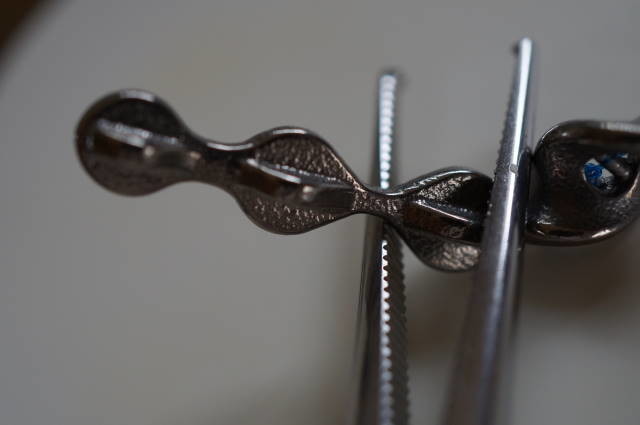
A spherical chip tip blocked urine despite feeling easier to remove
In an entry published in February 2024, Mr. Okada described replacing a hook-like bladder section after finding removal too stressful. He reported substantial strain on the internal urethral sphincter (the muscle controlling the bladder outlet), so he first softened the shape.
A later spherical tip became a plug: he reported that no urine passed while it occupied the bladder outlet. Urination became possible only after the chip was no longer lodged there.
He described removal of the spherical form as easier and painless, despite its failure to allow urination while in place. For his intended use, Mr. Okada considered that blockage unacceptable.
(Source: ok-lab's diary, published February 2024)
https://ok-lab.hatenablog.com/entry/2024/02/17/123013
The maker's answer to peeing with a prostate chip
Mr. Okada explored open channels and extra drainage holes, while shelving designs he could not yet justify selling.
The half-pipe chip kept a closed section for strength
In an entry published in March 2018, Mr. Okada introduced a half-pipe design (an open channel along part of the chip). Only the narrow recess at the sphincter retained a full-pipe shape (a closed tube section), because he considered a fully open version too weak. He also thought this change would be gentler on the muscle.
The new design had not yet been tested, and he planned to report results later. He did report a good feel from a separate prototype combining a glass first chip with a hollow second chip. Mr. Okada planned to compare that earlier prototype with the half-pipe design before judging the new shape.
(Source: ok-lab's diary, published March 2018)
https://ok-lab.hatenablog.com/entry/20180304/1520151387
A recessed chip face was shelved despite possible urine flow benefits
In an entry published in January 2022, Mr. Okada described receiving a curved, flat-faced prototype with a shallow recess. He thought this surface shape might let urine flow slightly better than the flat-faced curved model already being sold. The prototype arrived just after that existing model's launch.
Mr. Okada said he might have chosen it if both designs had been offered before the launch. He declined to adopt it for the time being because he did not want to sell two similar designs.
(Source: ok-lab's diary, published January 2022)
https://ok-lab.hatenablog.com/entry/2022/01/08/123729
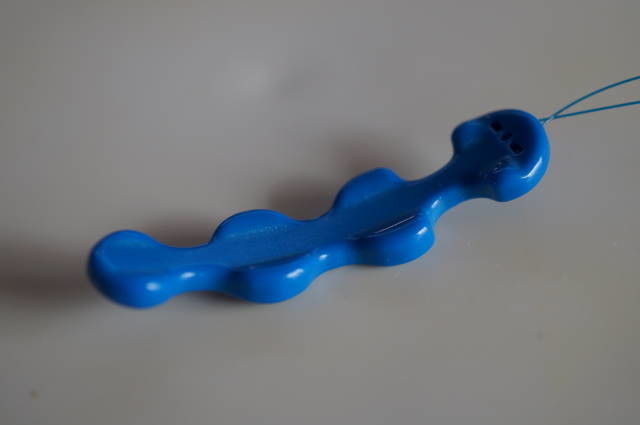
The spherical chip tip gained holes after one opening drained poorly
In an entry published in February 2024, Mr. Okada described a further prototype with drainage holes in the rounded bladder section. He found urine flow poor with 1 opening and specified at least 2. The resulting form had a rounded head and a narrow neck beside the internal urethral sphincter.
He thought that thinner neck reduced strain compared with the flatter chip shape. In his test, a head about 7 mm thick and 9 mm wide showed no sign of being expelled during urination. Mr. Okada cautioned that larger heads would place more strain on the muscle, while smaller ones might come out more easily.
(Source: ok-lab's diary, published February 2024)
https://ok-lab.hatenablog.com/entry/2024/02/17/123013
If you see blood in your urine, even a small amount or for the first time, do not wait and see. See a urologist right away. If you suddenly cannot urinate, or the device cannot be removed, do not try to fix it yourself. Go to a medical facility, including emergency care, immediately.
How peeing with a prostate chip changed over time
| Published | What the diary said then |
|---|---|
| Feb 2018 | Hollow prototypes stayed in place but raised drying and removal concerns. |
| Mar 2018 | An open-channel design retained a closed section for strength. |
| Jan 2019 | Mr. Okada questioned whether a thicker cone would make urination harder. |
| Apr 2019 | A customer linked difficult expulsion to a broad tip missing the bladder outlet. |
| Jul 2021 | A titanium design proposal aimed to preserve space for urine. |
| Jan 2022 | A recessed-face prototype was declined to avoid selling two similar models. |
| Feb 2024 | A spherical prototype blocked flow; later versions added multiple drainage holes. |
The diary does not say what the current state is.
OK Prostate Chip products related to peeing with a prostate chip
The current list includes the flat-faced curved semi-long model discussed in January 2022; the hollow version was a custom proposal.
Products that appear in these entries
| Product (official name) | Price incl. tax | Relation to this topic |
|---|---|---|
| Flat-faced curved semi-long resin chip (OKプロステートチップ フラット面カーブ型 セミロングタイプ(生体適合樹脂)) | ¥6,050 (about $39 at ¥156 = $1, rate as of 2026-09-04) | January 2022: the existing flat-faced curved semi-long model was the starting point for a customer's proposed hollow version. |
The flat-faced curved semi-long resin chip is listed in OK Lab's own online store.
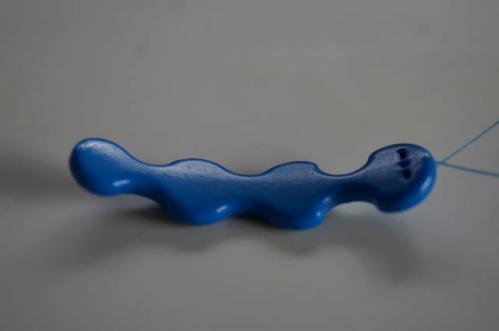
(Source: ok-lab's diary, published January 2022)
https://ok-lab.hatenablog.com/entry/2022/01/08/123729
Products the diary mentioned as alternatives
The diary names no alternative.
Prototype and custom designs in these entries: No matching product can be confirmed on the current list.
Common worries about peeing with a prostate chip
The reader concerns involved thicker tips, difficult expulsion, and whether a hollow chip could remain in place without leakage.
"Would a cone-shaped chip tip make peeing harder?"
In an entry published in January 2019, a customer proposed making the existing flat chip thicker, with a cone-like form. They hoped the muscle would grip the thicker shape more closely.
The diary does not record whether that cone-shaped version was made or how it felt in use. Mr. Okada's reply cautioned that he suspected this thicker shape would make urination more difficult.
(Source: ok-lab's diary, published January 2019)
https://ok-lab.hatenablog.com/entry/20190112/1547275441
"Could a narrower chip tip make expulsion easier?"
In an entry published in April 2019, a customer described trouble getting a broad-tipped chip out of the bladder. They felt its tip had turned away from the urine passage and was meeting resistance across a broad surface. Although a stronger curve seemed more stable to them, they also considered it harder to expel after the chip entered the bladder.
They favored a bladder section no larger than about 8 mm, believing a slimmer tip would be likelier to face the outlet. The diary does not record whether the chip was removed during that episode. Mr. Okada interpreted the report as support for a stronger curve rather than the chip's single bulge.
(Source: ok-lab's diary, published April 2019)
https://ok-lab.hatenablog.com/entry/2019/04/20/144337
"Would a hollow chip stay in place without causing leaks?"
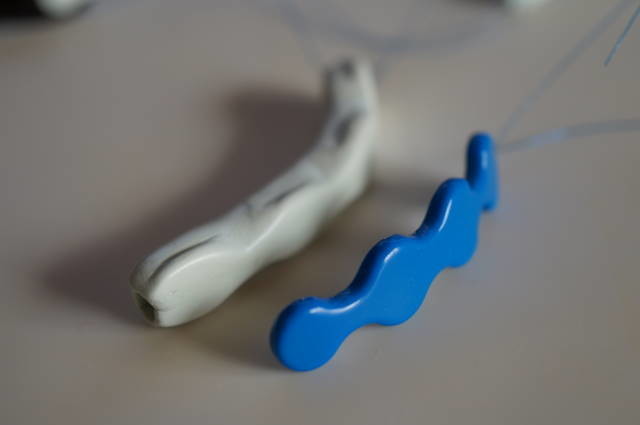
In an entry published in January 2022, a customer requested a hollow version of a blue, flat-faced curved semi-long chip. They wanted urine to pass through without washing the device out. Mr. Okada replied that, in an earlier urine-collection project, natural urination had expelled tubing with an internal diameter around 3 mm.
He thought the proposed chip needed at least the large opening shown in his photograph. He also expected leakage: the external urethral sphincter (the muscle tightened voluntarily to control urine) could not stop urine already past the internal sphincter. The diary does not record whether this custom order was completed; Mr. Okada's reply warned about the potential leakage.
(Source: ok-lab's diary, published January 2022)
https://ok-lab.hatenablog.com/entry/2022/01/08/123729
Buying from outside Japan
OK Lab ships internationally to countries covered by Japan Post's EMS courier service. Overseas orders are paid in advance by PayPal. Each order carries a ¥400 (about $3 at ¥156 = $1, rate as of 2026-09-04) handling fee, and EMS shipping is charged on top. These terms come from OK Lab's official sales-terms page (written here as plain text, not a link: ok-lab.net/docs/law), checked on September 7, 2026; confirm them on the official store before you order, because they can change.
Summary of this article
| What you wanted to know | The answer |
|---|---|
| What is the short answer about tip shape? | The diary reports both improved urine passage and problems with blockage or removal. |
| What is this product? | A urethral device made by OK Lab in Japan, sold through its own online store. |
| Which terms matter here? | The thread concerns retrieval; channels and holes concern urine passage; sphincters concern urine control. |
| What happened in the tests? | Staying in place during urination did not prevent difficult removal or blockage in the reported prototypes. |
| What changes did Mr. Okada explore? | Open channels, a recessed face, and extra holes in a rounded head. |
| What changed over time? | The entries move from hollow resin prototypes in 2018 to spherical drainage-hole designs in 2024. |
| Which current product is connected? | The listed flat-faced curved semi-long resin chip costs ¥6,050 (about $39 at ¥156 = $1, rate as of 2026-09-04) incl. tax; the customer's hollow design was a proposal. |
| What worried customers? | Thicker tips, a chip failing to come out, and possible leakage through a hollow design. |
| How can someone order outside Japan? | The stated terms use advance PayPal payment, Japan Post's EMS courier service, and a ¥400 (about $3 at ¥156 = $1, rate as of 2026-09-04) handling fee plus shipping. |
Source: ok-lab's diary (Okada Comfortable Life Laboratory). The original entries are in Japanese; quotations on this page are translated. Photos and videos are on the original entries.
This article is a summary of the maker's development diary. The product is not a medical device and no result is guaranteed. If anything feels wrong or worries you, see a doctor. Prices, specifications and cautions change, so confirm the latest information on the official blog and the official site. Questions about ordering and shipping go to the seller.