![Would a stronger chip curve help it stay put? | It can also make removal harder [OK Prostate Chip]](/img/a/T0538/eyecatch.svg)
This page is based on entries from "ok-lab's diary" (https://ok-lab.hatenablog.com/), the Japanese development diary written by Mr. Okada, founder of OK Lab, a small company in Japan (Okada Comfortable Life Laboratory). Only the entries about "stronger curves and sharply bent shapes" are summarized here, in order of publication. Past prices and sizes are as written at the time. Current prices come from the official product list (retrieved September 4, 2026). Quotations are translated from Japanese.
This article is about stronger chip curves, and summarizes the maker's testing, problems, and design changes. It also includes customer concerns, current products, and buying from outside Japan.
Note: This page is a personal reading log by someone with no connection to the maker or the seller. It reflects the source entries as of their publication dates and makes no guarantee of accuracy or safety. The product is not a medical device; talk to a doctor about any health decision. Check the official site for current information. This page contains advertising.
In short
- The diary connects stronger curves with better holding, difficult removal, unexpected movement, and broken joints.
- Mr. Okada explored gentler bends, flexible connections, and factory-shaped wire as responses.
- Today's list includes the long vibrating ceramic chip at ¥8,800 (about $56 at ¥156 = $1, rate as of 2026-09-04) including tax.
If you see blood in your urine, even a small amount or for the first time, do not wait and see. See a urologist right away.
If you suddenly cannot urinate, or the device cannot be removed, do not try to fix it yourself. Go to a medical facility, including emergency care, immediately.
About this product

The OK Prostate Chip is a small device that is placed in the urethra (the urine passage) so that it acts on the prostate; the maker sells it in several shapes, sizes and materials. It is made and sold by OK Lab (Okada Comfortable Life Laboratory), a small company in Japan, through its own online store, and prices are in Japanese yen (JPY).
The maker's development diary, "ok-lab's diary", is written in Japanese. This page is an English summary of it, and every quotation is translated.
OK Lab ships internationally, so readers outside Japan can order (see "Buying from outside Japan" below). Product names on this page are plain-English descriptions. The official Japanese product name is shown once in the product table so you can find the same item in the store.
Before you read: key terms
| Term | Plain-English meaning |
|---|---|
| Urethra | The urine passage; it carries urine and is where the diary describes placing the device. |
| Sphincter | A muscle around the urine passage; its grip helps hold certain designs in place, according to Mr. Okada. |
| Urethral sound | A rod-shaped device inside the urine passage; these entries discuss versions supporting a connected chip. |
| Shape-memory wire | Wire that returns toward a preset shape; it connects or supports parts while allowing them to bend. |
| Flexible joint | A bendable connection between chip sections; later designs combine rubber and wire to allow changes in angle. |
What happens: a stronger chip curve
The OK Prostate Chip is a small device placed in the urethra, the urine passage, to act on the prostate. In these entries, a stronger curve means a more sharply bent chip body, connecting joint, or supporting wire. Mr. Okada explores these shapes to help the device stay near the prostate and follow bends in the urine passage. His accounts also describe unwanted movement, bleeding, and difficulty getting sharply curved designs back out.
An early curved chip prototype caused bleeding and remained under review
In an entry published in January 2018, Mr. Okada described a paired prototype with a sharply curved tip intended to anchor inside the bladder. He reported that reliable anchoring had not been achieved. A tester experienced slight bleeding.
Mr. Okada attributed this to excessive strain on the sphincter (a muscle around the urine passage) when the curved tip faced incorrectly. He left the decision to begin selling this prototype pending further testing.
(Source: ok-lab's diary, published January 2018)
https://ok-lab.hatenablog.com/entry/20180111/1515662782
A customer's sharper curve raised concerns about getting the chip out
An April 2019 entry described a customer's request for an arched long chip. The customer believed curvature and the wider base contributed more to stability than the tip. However, the customer also identified stronger curvature as an obstacle if a chip entered the bladder.
The same message suggested that a large tip had missed the urinary outlet during an earlier removal difficulty. The diary does not record how the newly requested custom chip performed.
(Source: ok-lab's diary, published April 2019)
https://ok-lab.hatenablog.com/entry/2019/04/20/144337
A stronger curve moved the chip deeper during an external-pressure test
In June 2023, Mr. Okada compared curves in an S-shaped urethral sound (a rod-shaped support inside the urine passage). His setup also included an external support rod pressing against the body near the prostate. With the stronger curve, he reported that the sound itself reached the prostate and the connected chip entered the bladder.
He believed the external pressure had pushed the assembly farther inward than expected. His conclusion was that differences in anatomy prevented a single S-shaped curve from suiting everyone.
(Source: ok-lab's diary, published June 2023)
https://ok-lab.hatenablog.com/entry/2023/06/03/121955

A bendable chip's sharper curve came with a hospital-removal warning
A June 2023 entry introduced the bendable metal-bead chip (Cool Beads). Mr. Okada reported that curves of about 90–110 degrees barely moved during urination in his own tests. He also reported making approximately 8 cm versions, beyond the roughly 6 cm limit of earlier fixed-shape designs.
He warned that an extremely curved version entering the bladder might resist both its retrieval thread and urination. His caution was that hospital removal could become necessary.
(Source: ok-lab's diary, published June 2023)
https://ok-lab.hatenablog.com/entry/2023/06/24/123110
An elastic curved chip prototype moved inward, then later slipped outward
In March 2024, Mr. Okada tested ceramic chips connected by shape-memory wire (wire that returns toward a preset shape). The pair could straighten or bend close to 90 degrees. He reported movement exceeding 3 cm toward the bladder with very little force.
A follow-up published that month described the same prototype reaching the urethral opening after about 1 day. He suspected its smooth ceramic surfaces and changing shape made it unsuitable for staying in one position. His later assessment was that he could not particularly recommend it.
(Source: ok-lab's diary, published March 2024)
https://ok-lab.hatenablog.com/entry/2024/03/16/123023
(Source: ok-lab's diary, published March 2024)
https://ok-lab.hatenablog.com/entry/2024/03/23/122837
A flexible chip curve brought separate processing charges in January 2026
In January 2026, Mr. Okada introduced a flexible-joint ceramic design (Movable), with rubber and wire joining separated chip sections. It had a 15 mm gap, including approximately 5 mm of bendable rubber. Standard angles were 30–45 degrees, with approximately 90 degrees possible on request.
Published processing charges were ¥4,000 (about $26 at ¥156 = $1, rate as of 2026-09-04) for short and medium-length chips, excluding tax. Long, pronounced-curve, and double-twist types carried ¥5,000 (about $32 at ¥156 = $1, rate as of 2026-09-04) processing charges, excluding tax. Mr. Okada limited the general conversion offer to versions without raised bumps.
(Source: ok-lab's diary, published January 2026)
https://ok-lab.hatenablog.com/entry/2026/01/17/122907
The maker's answer to a stronger chip curve
Mr. Okada changed both bend angles and connection designs after problems with holding, movement, and breakage.
Gentler chip curves followed advice about pressure on the prostate
In November 2019, Mr. Okada discussed an early linked ceramic design (Rei) with someone he described as a urethral specialist. That person considered its curve excessive because of possible strain on the prostate. Mr. Okada initially questioned the concern, then adopted a gentler curve.
He also suspended plans for regular sales because testing was incomplete. He restricted the design to custom orders while further testing remained necessary.
(Source: ok-lab's diary, published November 2019)
https://ok-lab.hatenablog.com/entry/2019/11/02/132358
Stronger chip curves prompted a different connection after rubber breakages
In December 2023, Mr. Okada reported broken rubber connections in the paired ceramic design (Umiushi 5) when the joining angle was extreme. He had consequently been making gentler versions. He then proposed a curved helper mounted on a connecting tube, intended to accommodate a stronger curve.
Published helper lengths were 40 mm, 45 mm, and 50 mm, with widths of 8 mm, 9 mm, and 10 mm. He expected spacing from the neighboring chip to be fixed before shipping because the curved helper was difficult to slide.
(Source: ok-lab's diary, published December 2023)
https://ok-lab.hatenablog.com/entry/2023/12/30/122243
For a wire-supported chip curve, the maker considered 90 degrees sufficient
In November 2024, Mr. Okada described a silicone-covered shape-memory loop intended to stabilize a connected chip. He considered 90 degrees sufficiently stable and 60 degrees easier to position. He estimated a maximum of approximately 130 degrees.
The published addition to the chip price was ¥4,000 (about $26 at ¥156 = $1, rate as of 2026-09-04), excluding tax, with approximately 10 degrees of possible angle error. He cautioned that greater curvature also made insertion and positioning harder.
(Source: ok-lab's diary, published November 2024)
https://ok-lab.hatenablog.com/entry/2024/11/16/122924
Finished chip curve options included different wire thicknesses by February 2025
A February 2025 entry announced wire-loop devices without solid chips, using 0.3 mm or 0.4 mm wire. Announced finished angles were approximately 75, 90, 105, and 130 degrees. Tube covering affected the finished angle compared with the bare wire.
Mr. Okada treated 90 degrees as standard, with 75 degrees milder and 105 degrees stronger. Full manufacturer deliveries were still pending, and he acknowledged that preferences could change after further finished examples arrived. He favored 0.3 mm for beginners because he expected 0.4 mm to exert stronger pressure.
(Source: ok-lab's diary, published February 2025)
https://ok-lab.hatenablog.com/entry/2025/02/22/122939
A revised chip curve used a new joint after earlier failures
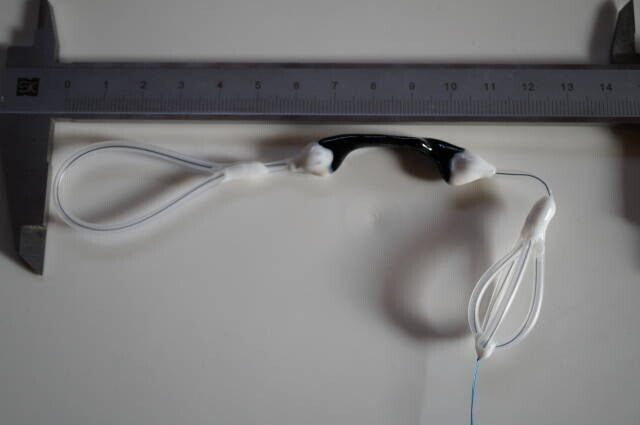
Another January 2026 entry returned to the rubber-linked ceramic pair. Mr. Okada said he now limited the older design to about 45 degrees, after which connection-trouble reports had stopped. He proposed a flexible-joint version accommodating 90 degrees, with shape-memory wire replacing the internal cord.
The new standard included reinforcement intended to keep ceramic pieces connected if they broke. He explained that potential breakage was why he had kept the older design's curve limited.
(Source: ok-lab's diary, published January 2026)
https://ok-lab.hatenablog.com/entry/2026/01/31/122917
If you see blood in your urine, even a small amount or for the first time, do not wait and see. See a urologist right away.
If you suddenly cannot urinate, or the device cannot be removed, do not try to fix it yourself. Go to a medical facility, including emergency care, immediately.
How a stronger chip curve changed over time

| Published | What the diary said then |
|---|---|
| Jan 2018 | Bladder-anchor prototype sales remained undecided after unreliable anchoring and bleeding. |
| Nov 2019 | Gentler linked ceramic curves replaced earlier shapes; regular sales remained on hold. |
| Jun 2023 | Bendable beads reached 4 mm thickness and 8 mm width. |
| Dec 2023 | Curved helpers cost ¥5,000 (about $32 at ¥156 = $1, rate as of 2026-09-04) plain/flat or ¥6,000 (about $38 at ¥156 = $1, rate as of 2026-09-04) twisted, excluding tax. |
| Mar 2024 | The elastic ceramic pair's outward movement weakened the maker's recommendation. |
| Nov 2024 | The maker considered 90 degrees sufficient for the wire-supported loop design. |
| Feb 2025 | Finished wire-loop angles and wire thickness became specified choices. |
| Jan 2026 | A new flexible connection addressed the older paired design's restricted bend. |
| Feb 2026 | A more flexible prototype bent beyond 180 degrees and also backward. |
| Feb 2026 | A 150-degree double-wire prototype had no sales planned at publication. |
OK Prostate Chip products related to a stronger chip curve
The current list prices the long vibrating ceramic chip at ¥8,800 (about $56 at ¥156 = $1, rate as of 2026-09-04) including tax.
Products that appear in these entries
| Product (official name) | Price incl. tax | Relation to this topic |
|---|---|---|
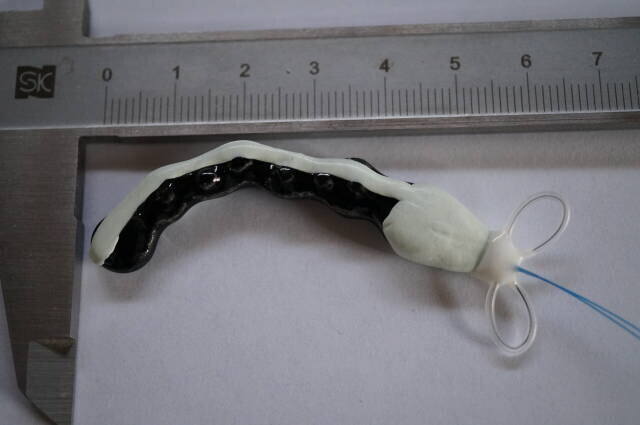
| Long vibrating ceramic chip (OKプロステート核振チップ 陶器素材ロングタイプ) | ¥8,800 (about $56 at ¥156 = $1, rate as of 2026-09-04) | A February 2026 custom quote paired this base chip with a 60-degree joint and separate ¥5,500 (about $35 at ¥156 = $1, rate as of 2026-09-04) processing. |
(Source: ok-lab's diary, published February 2026)
https://ok-lab.hatenablog.com/entry/2026/02/21/122935
The long vibrating ceramic chip is listed in OK Lab's own online store.
Products the diary mentioned as alternatives
The diary names no alternative.
For the historical custom builds, prototypes, bendable-bead designs, wire-loop designs, and flexible-joint conversions discussed here:
No matching product can be confirmed on the current list.
Common worries about a stronger chip curve

Readers asked about slipping, difficult entry, and whether a rigid curved design would work better.
"Will a sharper chip curve stop it slipping out?"
In May 2019, a customer wanted steeper and gentler designs to compare because an existing curved chip kept slipping out. Mr. Okada replied that the arched long design had almost the same curve as the customer's existing chip. He could not identify the cause and thought length might also matter.
The diary does not record whether the comparison order was completed. Mr. Okada said work on holding methods was continuing. He cautioned that an extreme curve might make removal impossible.
(Source: ok-lab's diary, published May 2019)
https://ok-lab.hatenablog.com/entry/2019/05/25/144939
"Can a strongly curved chip still be too difficult?"
In August 2020, a customer asked about a double-twist ceramic chip. Mr. Okada suggested a twin custom version because the single version's approximately 50 mm length might not satisfy that customer. After making it, he worried that the severe curve could prevent insertion, even for this experienced customer.
The diary does not record whether the customer could use the finished twin version. Mr. Okada also stated that inability to insert it would not qualify for a return.
(Source: ok-lab's diary, published August 2020)
https://ok-lab.hatenablog.com/entry/2020/08/08/130037
"Can a curved chip stay rigid instead of flexing?"
A May 2021 customer described differing results with glass and ceramic chips and requested a rigid, curved steel-ring design. Mr. Okada said fixed curved connections were possible. The diary does not record a completed rigid version or its performance for that customer. His preferred alternative was a wire-supported cord that combined flexibility with the ability to hold a chosen bend firmly.
(Source: ok-lab's diary, published May 2021)
https://ok-lab.hatenablog.com/entry/2021/05/01/130245
Buying from outside Japan

OK Lab ships internationally to countries covered by Japan Post's EMS courier service. Overseas orders are paid in advance by PayPal. Each order carries a ¥400 (about $3 at ¥156 = $1, rate as of 2026-09-04) handling fee, and EMS shipping is charged on top. These terms come from OK Lab's official sales-terms page (written here as plain text, not a link: ok-lab.net/docs/law), checked on September 7, 2026; confirm them on the official store before you order, because they can change.
Summary of this article
| What you wanted to know | The answer |
|---|---|
| What is the short answer? | Stronger curves sometimes improved holding, but the diary also records serious problems. |
| What is this product? | A urethral device made and sold by OK Lab in Japan. |
| What do the terms mean? | Curvature can involve the chip body, its joint, or a supporting wire. |
| What happened in testing? | Reports included bleeding, inward movement, outward slipping, and possible hospital removal. |
| What did the maker change? | He tried gentler angles, different connections, and flexible wire supports. |
| How did designs develop? | Fixed curves were followed by bendable beads, preset wire, and flexible joints. |
| What current product is confirmed? | The long vibrating ceramic base chip is listed at ¥8,800 (about $56 at ¥156 = $1, rate as of 2026-09-04) including tax. |
| Does more curvature solve slipping? | Mr. Okada could not identify curvature as the sole cause in the customer's case. |
| How do overseas orders work? | Advance PayPal payment, a ¥400 (about $3 at ¥156 = $1, rate as of 2026-09-04) handling fee, and additional EMS shipping charges. |
Source: ok-lab's diary (Okada Comfortable Life Laboratory). The original entries are in Japanese; quotations on this page are translated. Photos and videos are on the original entries.
This article is a summary of the maker's development diary. The product is not a medical device and no result is guaranteed. If anything feels wrong or worries you, see a doctor. Prices, specifications and cautions change, so confirm the latest information on the official blog and the official site. Questions about ordering and shipping go to the seller.