![Could my chip slip into the bladder? | Shape cannot guarantee prevention [OK Prostate Chip]](/img/a/T0386/eyecatch.svg)
This page is based on entries from "ok-lab's diary" (https://ok-lab.hatenablog.com/), the Japanese development diary written by Mr. Okada, founder of OK Lab, a small company in Japan (Okada Comfortable Life Laboratory). Only entries about designs intended to reduce bladder migration are summarized here, in order of publication. Past prices and sizes are as written at the time. Current prices come from the official product list (retrieved September 4, 2026). Quotations are translated from Japanese.
Note: This page is a personal reading log by someone with no connection to the maker or the seller. It reflects the source entries as of their publication dates and makes no guarantee of accuracy or safety. The product is not a medical device; talk to a doctor about any health decision. Check the official site for current information. This page contains advertising.
In short
- Enlarged ends and curved connections did not prevent every reported case of a chip entering the bladder.
- Mr. Okada explored larger stops, stiffer links, and loops, while acknowledging limits and retrieval risks.
- His August 2026 preference for an adjustable loop remained theoretical, without a recorded customer result.
If you see blood in your urine, even a small amount or for the first time, do not wait and see. See a urologist right away.
If you suddenly cannot urinate, or the device cannot be removed, do not try to fix it yourself. Go to a medical facility, including emergency care, immediately.
About this product

The OK Prostate Chip is a small device that is placed in the urethra (the urine passage) so that it acts on the prostate; the maker sells it in several shapes, sizes and materials. It is made and sold by OK Lab (Okada Comfortable Life Laboratory), a small company in Japan, through its own online store, and prices are in Japanese yen (JPY).
The maker's development diary, "ok-lab's diary", is written in Japanese. This page is an English summary of it, and every quotation is translated. OK Lab ships internationally, so readers outside Japan can order (see "Buying from outside Japan" below).
Product names on this page are plain-English descriptions. The official Japanese product name is shown once in the product table so you can find the same item in the store.
Before you read: key terms
| Term | Plain-English meaning |
|---|---|
| Urethra | The urine passage, where the device sits to act on the prostate. |
| Bladder migration | Movement of the device inward into the bladder; this names the problem these designs address. |
| Sphincter | A muscle described as gripping the chip; proposed shapes aim to resist movement past it. |
| Stopper | An added part intended to limit inward movement; customer reports show that it can also pass inward. |
| Auxiliary chip | An extra chip behind the main device, proposed to help hold its position. |
| Shape-memory wire | Wire that returns toward a set shape; it supports the curves and loops discussed here. |
| Endoscope / bladder scope | Internal viewing instruments used during the reported hospital removals. |
| CT | A scan included in a reported hospital visit. Its particular purpose: The diary does not explain this. |
What happens: chip slipping into the bladder
The OK Prostate Chip is a small device placed in the urethra to act on the prostate. Bladder migration (movement inward into the bladder) is the problem described in these customer reports. The diary explores enlarged rear ends, curved connections, and loops intended to keep the device near the prostate. These features sit on or behind the chip, near the sphincter (muscle that grips it), with the aim of resisting further inward movement.
A larger rear end avoided bladder migration but bleeding occurred
In an entry published in March 2022, a customer reported 2 uses of a pointed custom chip without bladder migration. However, it sometimes moved outward, and both uses involved pain and bleeding near the pointed end.
The customer wanted a longer version and asked about enlarging another resin design. Mr. Okada said custom enlargement was possible, while acknowledging concerns about combining the materials. He warned that the pointed design was dangerous and said future versions should have a softer tip.
(Source: ok-lab's diary, published March 2022)
https://ok-lab.hatenablog.com/entry/2022/03/05/123200
An enlarged custom end prevented bladder migration during three reported uses
In an entry published in April 2022, a customer reported 3 uses of a long resin chip with an enlarged rear end. They described stable positioning, without either bladder migration or movement back toward the urethral opening. Mr. Okada thought the enlargement might explain that result. He cautioned that the same large shape could make retrieval harder if it entered the bladder.
(Source: ok-lab's diary, published April 2022)
https://ok-lab.hatenablog.com/entry/2022/04/02/123050

Strong curves may resist bladder migration while making retrieval harder
In an entry published in June 2023, Mr. Okada described trials of a beaded-wire chip with a pronounced curve. At approximately 90 degrees to 110 degrees, he reported almost no movement during urination. He thought the shape might also resist complete passage into the bladder. However, he warned that a forcibly displaced chip might resist thread retrieval and natural expulsion, potentially requiring hospital treatment.
(Source: ok-lab's diary, published June 2023)
https://ok-lab.hatenablog.com/entry/2023/06/24/123110
A standard stopper failed to prevent bladder migration requiring hospital removal
In an entry published in March 2024, a customer reported bladder migration involving an L long ceramic four-point twist chip, approximately 60mm long. Its L six-hole stopper also entered the bladder, and a clinic removed the assembly with an endoscope (an internal viewing instrument). The customer then asked whether a custom stopper was necessary.
Mr. Okada said a standard L stopper would offer little resistance for someone able to accommodate a 15mm screw-shaped piece. The diary does not record a later custom-stopper result for this customer. Mr. Okada offered a larger custom stopper and suggested that a larger auxiliary chip (an extra chip behind the main device) might help.
(Source: ok-lab's diary, published March 2024)
https://ok-lab.hatenablog.com/entry/2024/03/02/123027
Bladder migration left broken ceramic inside until hospital treatment succeeded
A separate entry published in March 2024 described a ceramic chip that had broken in half, leaving a piece inside the bladder. A university hospital reportedly judged removal with grasping instruments impossible and considered a special operation or open abdominal surgery. The entry ultimately records successful removal, without identifying the final method. Mr. Okada cautioned that the retrieval tools he had improvised did not appear safe.
(Source: ok-lab's diary, published March 2024)
https://ok-lab.hatenablog.com/entry/2024/03/23/122837
Long curved chips raised bladder migration concerns for fully internal wear
In an entry published in August 2024, a customer asked about a fully internal version of the long curved version 5 chip. Mr. Okada advised against that arrangement. He said development work had shown that its long arc could keep advancing once sufficiently deep inside the bladder. He instead favored a loop-shaped rear connection, while explaining that the S-shaped design reversed the front curve to address this concern.
(Source: ok-lab's diary, published August 2024)
https://ok-lab.hatenablog.com/entry/2024/08/17/122842
Bladder migration carried a wire-loop device and its thread inside
In an entry published in May 2025, a customer could no longer retrieve a wire-loop device. OK Lab initially answered on the assumption that it remained in its expected position. When further messages revealed that the attached thread had also disappeared, the company advised urological care.
The customer reported CT (a hospital scan), urine testing, and removal with a bladder scope (an internal viewing instrument). The visit took about 5 hours, including waiting, and cost ¥34,000 (about $218 at ¥156 = $1, rate as of 2026-09-04). Mr. Okada warned that shape-memory wire (wire that returns toward a set shape) could deform under force and travel beyond its intended position.
(Source: ok-lab's diary, published May 2025)
https://ok-lab.hatenablog.com/entry/2025/05/03/122907
The maker's answer to chip slipping into the bladder
Mr. Okada proposed resistance through shape, but his accounts also identify discomfort, retrieval difficulties, and uncertain results.
Enlarged ends and deep grooves became an early bladder migration proposal
In an entry published in May 2018, a customer requested a glass chip with more pronounced bumps and grooves. One prototype measured 41mm, with an 11mm prostate-side bump and a 12mm rear bump. Mr. Okada thought an enlarged terminal section and deep grooves might resist the whole device crossing the sphincter. He nevertheless described an additional stopper as his preferred measure against inward movement.
(Source: ok-lab's diary, published May 2018)
https://ok-lab.hatenablog.com/entry/20180505/1525509161
Stiffer connections addressed bladder migration but introduced discomfort and durability concerns
In an entry published in January 2021, Mr. Okada described a steel-wire connection spanning 3cm between chips. He thought its resistance to folding would prevent the collapse associated with thread-linked devices entering the bladder. However, his bladder-directed prototype still shifted during urination, leaving a ring painfully caught at the inner sphincter.
A parallel nylon thread was included because the wire could eventually break. Mr. Okada cautioned that long-term durability remained unknown.
(Source: ok-lab's diary, published January 2021)
https://ok-lab.hatenablog.com/entry/2021/01/23/130107
An enlarged titanium end was proposed for repeated bladder migration
In an entry published in August 2021, a customer wanted an alternative after small chips failed to stay in position. Mr. Okada admitted that he could not confidently explain the reported inward movement. He proposed a 44mm titanium twist chip whose enlarged rear end might resist crossing the sphincter.
No subsequent experience with that proposal is recorded in the entry. Mr. Okada cautioned that an external stopper might be the only effective option if additional internal pieces also kept moving inward.
(Source: ok-lab's diary, published August 2021)
https://ok-lab.hatenablog.com/entry/2021/08/07/125807
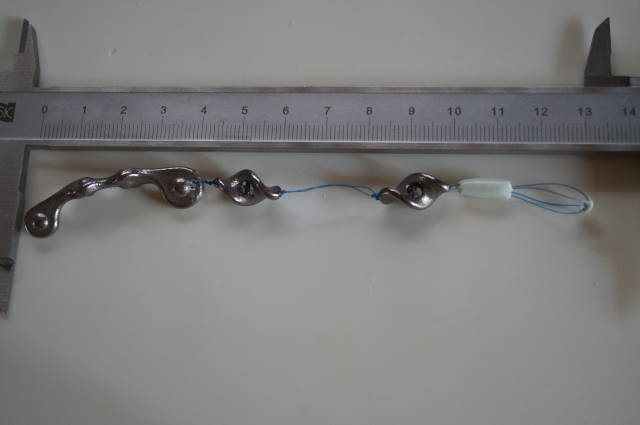
An S-shaped design sought to limit bladder migration through opposing curves
In an entry published in May 2024, Mr. Okada described an S-shaped device with its bladder section curved toward the back. He believed contact with the bladder wall limited further inward travel, while the hooked shape resisted outward movement. Shape-memory connections allowed the sections to return toward their intended curves.
The published standard price was ¥13,000 (about $83 at ¥156 = $1, rate as of 2026-09-04) excluding tax, covering three chips, their connection, and a tube cover. Mr. Okada recommended the cover because he considered exposed wire uncomfortable around the inner sphincter.
(Source: ok-lab's diary, published May 2024)
https://ok-lab.hatenablog.com/entry/2024/05/18/122913
A dedicated front loop led Mr. Okada to rule out bladder migration
In an entry published in March 2025, Mr. Okada discussed a wire-loop device with an additional bladder loop. He claimed that the front loop provided a stopping point and that a length approaching 20cm physically ruled out bladder migration. The paragraph does not record a customer outcome demonstrating that claim. For people worried about inward movement, he proposed this particular configuration while acknowledging that other wire-loop arrangements could still enter the bladder.
(Source: ok-lab's diary, published March 2025)
https://ok-lab.hatenablog.com/entry/2025/03/29/122912
If you see blood in your urine, even a small amount or for the first time, do not wait and see. See a urologist right away.
If you suddenly cannot urinate, or the device cannot be removed, do not try to fix it yourself. Go to a medical facility, including emergency care, immediately.
How chip slipping into the bladder changed over time
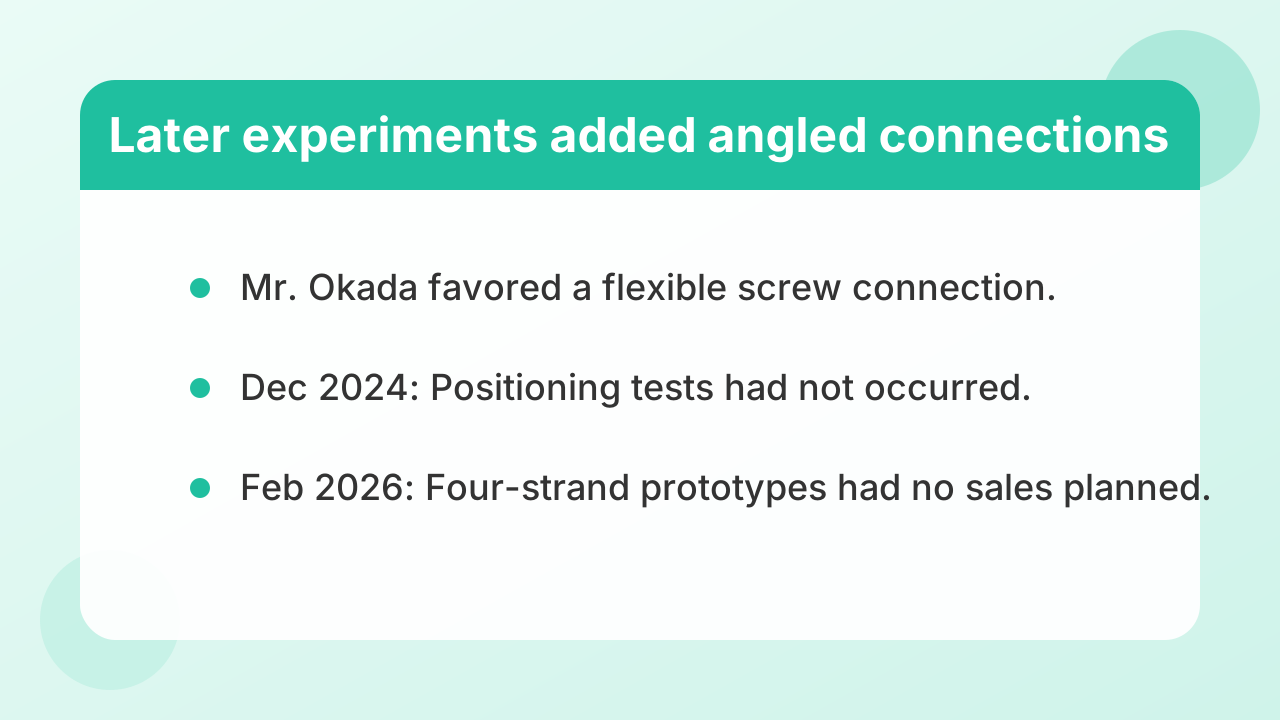
| Published | What the diary said then |
|---|---|
| May 2018 | Mr. Okada found his smaller glass prototype more comfortable than deeply grooved resin. |
| Mar 2020 | Mr. Okada favored a flexible screw connection over simply lengthening a rigid chip. |
| Aug 2024 | Mr. Okada reported stable positioning across a week of daytime loop-connector trials. |
| Sep 2024 | Unequal cable lengths produced an angled bulge of approximately 8mm. |
| Dec 2024 | A screw beside the loop junction was proposed; positioning tests had not occurred. |
| May 2025 | A separate custom tail paired 5cm of 0.3mm wire with 5cm of 0.2mm wire. |
| Nov 2025 | A loop-and-screw prototype resisted outward movement in Mr. Okada's tests. |
| Feb 2026 | Four-strand prototypes had no sales planned at publication. |
OK Prostate Chip products related to chip slipping into the bladder
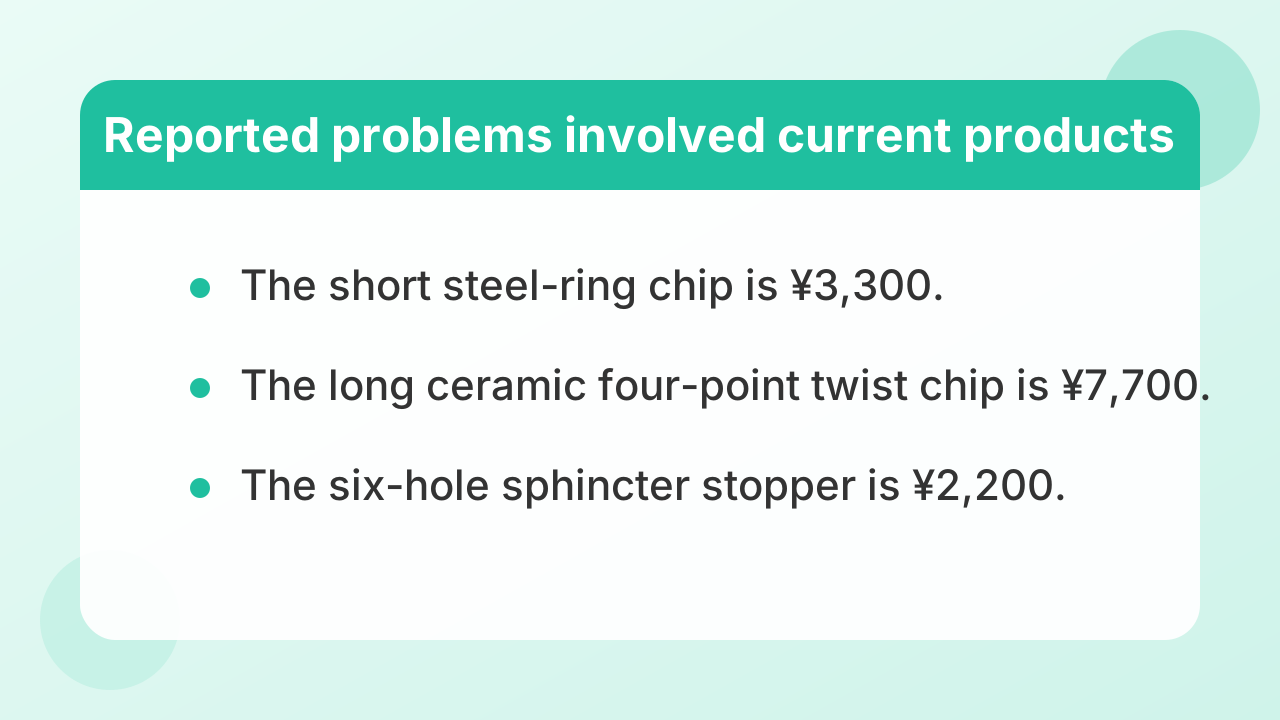
The current list includes products discussed in customer reports, including devices involved in problems.
Products that appear in these entries
| Product (official name) | Price incl. tax | Relation to this topic |
|---|---|---|
| Short steel-ring chip (OKプロステートチップ ステンレスリング ショートタイプ) | ¥3,300 (about $21 at ¥156 = $1, rate as of 2026-09-04) | January 2021: a customer reported outward movement during urination and asked about better retention. |
| Long ceramic four-point twist chip (OKプロステートチップ 陶器素材ロングタイプ 4点ツイスト) | ¥7,700 (about $49 at ¥156 = $1, rate as of 2026-09-04) | March 2024: the customer's L model entered the bladder despite an attached stopper. |
| Six-hole sphincter stopper (六穴方式オプションチップ(括約筋ストッパーチップ)) | ¥2,200 (about $14 at ¥156 = $1, rate as of 2026-09-04) | March 2024: an L stopper accompanied the ceramic chip into the bladder in the same hospital case. |
(Source: ok-lab's diary, published January 2021)
https://ok-lab.hatenablog.com/entry/2021/01/23/130107
(Source: ok-lab's diary, published March 2024)
https://ok-lab.hatenablog.com/entry/2024/03/02/123027
Products the diary mentioned as alternatives
The diary names no alternative.
Custom glass, enlarged-end resin and steel-wire builds; pointed resin, titanium twist, beaded-wire, S-shaped and long curved version 5 designs; wire-loop devices and adjustable connectors; four-strand prototypes:
No matching product can be confirmed on the current list.
Common worries about chip slipping into the bladder
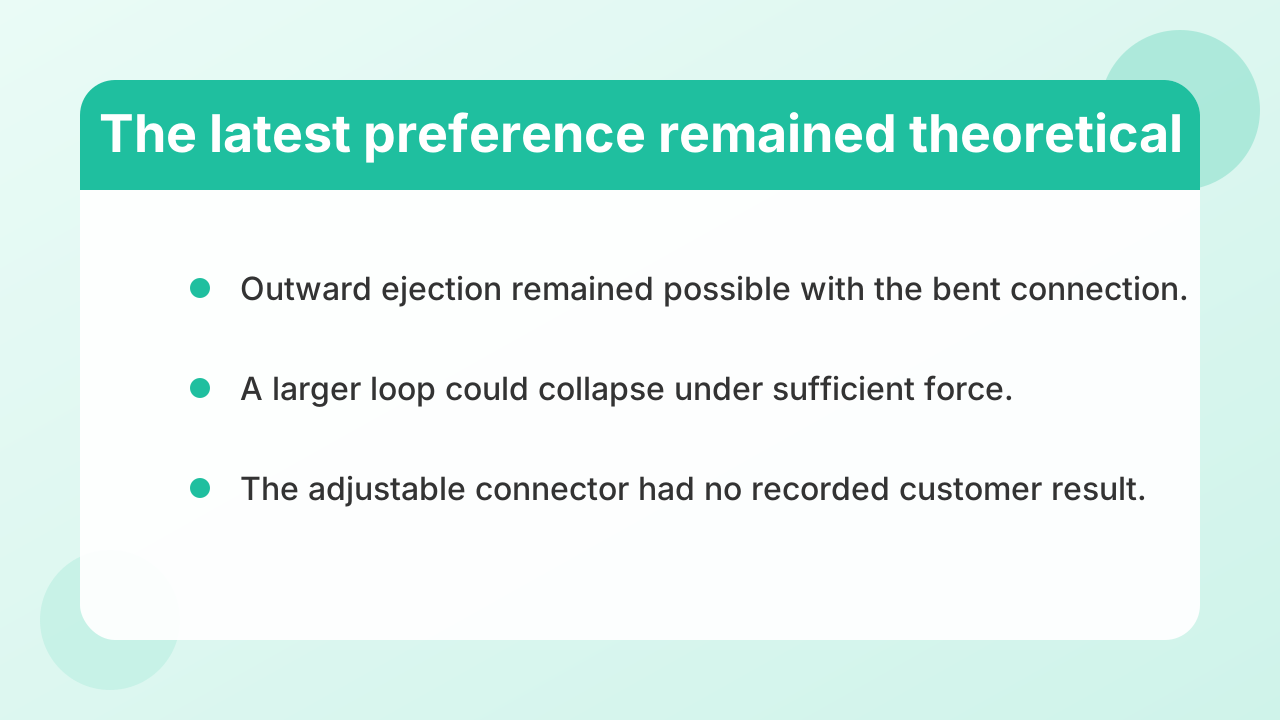
The replies distinguish resistance from certainty, and the latest comparison remains a theoretical judgment.
"Can a bent connector stop my chip slipping out?"
In an entry published in January 2021, a short steel-ring chip customer wanted better positioning during urination. Mr. Okada said a rubber-coated bent connection offered somewhat better retention. He explained that the leading chip could still move toward the auxiliary piece, so supporting one part did not necessarily stabilize the other. His caution was that this connection provided no complete protection against outward ejection.
(Source: ok-lab's diary, published January 2021)
https://ok-lab.hatenablog.com/entry/2021/01/23/130107
"Can a curved loop guarantee bladder migration prevention?"
In an entry published in August 2024, a customer asked whether the curved loop on a requested connector would prevent excessive inward movement. OK Lab's reply said its uneven curve might resist passage better than an ordinary screw-shaped piece. The customer then requested a slightly larger loop, which the company agreed to make.
Mr. Okada also changed all such connectors so the retrieval thread emerged from the loop's tip. The company's caution remained that this shape could not be guaranteed to work for someone whose devices tended to move inward.
(Source: ok-lab's diary, published August 2024)
https://ok-lab.hatenablog.com/entry/2024/08/31/122909
"Which design did Mr. Okada favor for bladder migration?"
In an entry published in August 2026, a customer asked about shapes after inward movement continued despite a stopper. Mr. Okada thought a flexible-jointed design offered little resistance because it readily changed shape. He thought a larger wire loop might help, but could still collapse under sufficient force.
He favored an adjustable connector with a loop between 2 stoppers, sized larger than the customer's sphincter could accommodate. The diary does not record a result for that customer. Mr. Okada stressed that his preference was theoretical and might not work for the person's anatomy.
(Source: ok-lab's diary, published August 2026)
https://ok-lab.hatenablog.com/entry/2026/08/01/122916
Buying from outside Japan

OK Lab ships internationally to countries covered by Japan Post's EMS courier service. Overseas orders are paid in advance by PayPal. Each order carries a ¥400 (about $3 at ¥156 = $1, rate as of 2026-09-04) handling fee, and EMS shipping is charged on top. These terms come from OK Lab's official sales-terms page (written here as plain text, not a link: ok-lab.net/docs/law), checked on September 7, 2026; confirm them on the official store before you order, because they can change.
Summary of this article
| What you wanted to know | The answer |
|---|---|
| What is the short answer? | Shape can offer resistance, but the diary records failures. |
| What is this product? | A urethral device made and sold by a small Japanese company. |
| What do the terms mean? | Migration describes inward movement; stoppers and loops are intended to resist it. |
| What happened in reported cases? | Some designs stayed positioned; others caused bleeding or required hospital removal. |
| What did the maker propose? | Enlarged ends, stiffer connections, opposing curves, and loops. |
| How did development change? | Later experiments added angled connections, additional supports, and reinforced structures. |
| Which current products appear? | A steel-ring chip, ceramic four-point twist chip, and six-hole stopper. |
| What remains uncertain? | The latest adjustable-loop proposal had no recorded customer outcome. |
| How are overseas orders handled? | Advance PayPal payment, EMS shipping, and a separate handling fee. |
| What does the article establish overall? | The diary records development experience, including limits to the maker's proposed safeguards. |
Source: ok-lab's diary (Okada Comfortable Life Laboratory). The original entries are in Japanese; quotations on this page are translated. Photos and videos are on the original entries.
This article is a summary of the maker's development diary. The product is not a medical device and no result is guaranteed. If anything feels wrong or worries you, see a doctor. Prices, specifications and cautions change, so confirm the latest information on the official blog and the official site. Questions about ordering and shipping go to the seller.