![Are risky chips taken off sale? | Some were withdrawn; restrictions changed [OK Prostate Chip]](/img/a/T0384/eyecatch.svg)
This page is based on entries from "ok-lab's diary" (https://ok-lab.hatenablog.com/), the Japanese development diary written by Mr. Okada, founder of OK Lab, a small company in Japan (Okada Comfortable Life Laboratory). Only the entries about "stopping sales or development over safety concerns" are summarized here, in order of publication. Past prices and sizes are as written at the time. Current prices come from the official product list (retrieved September 4, 2026). Quotations are translated from Japanese.
Note: This page is a personal reading log by someone with no connection to the maker or the seller. It reflects the source entries as of their publication dates and makes no guarantee of accuracy or safety. The product is not a medical device; talk to a doctor about any health decision. Check the official site for current information. This page contains advertising.
In short
- Reported injuries prompted several withdrawals and redesigns.
- Mr. Okada sometimes stopped sales, cancelled orders, or abandoned prototypes after safety concerns.
- The September 2026 product list cannot confirm every old custom build or changed specification.
If you see blood in your urine, even a small amount or for the first time, do not wait and see. See a urologist right away.
If you suddenly cannot urinate, or the device cannot be removed, do not try to fix it yourself. Go to a medical facility, including emergency care, immediately.
About this product
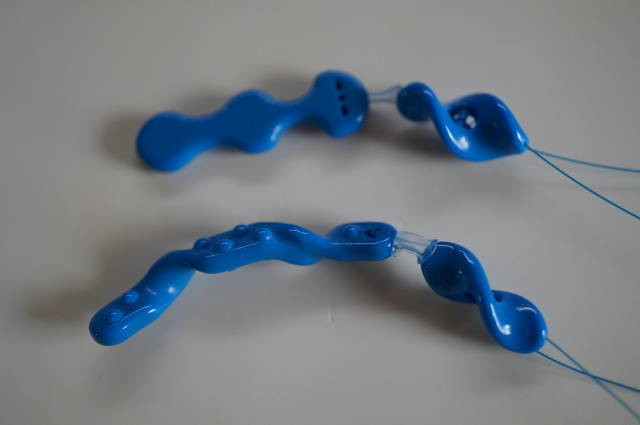
The OK Prostate Chip is a small device that is placed in the urethra (the urine passage) so that it acts on the prostate; the maker sells it in several shapes, sizes and materials. It is made and sold by OK Lab (Okada Comfortable Life Laboratory), a small company in Japan, through its own online store, and prices are in Japanese yen (JPY). The maker's development diary, "ok-lab's diary", is written in Japanese. This page is an English summary of it, and every quotation is translated. OK Lab ships internationally, so readers outside Japan can order (see "Buying from outside Japan" below). Product names on this page are plain-English descriptions. The official Japanese product name is shown once in the product table so you can find the same item in the store.
Before you read: key terms
| Term | Plain-English meaning |
|---|---|
| Urethra | The urine passage; urethral chips sit inside it to act on the prostate. |
| Retrieval thread | A line attached to a chip for retrieval. |
| Resin | Material used for chip bodies and protective coverings over connections. |
| 6-wire connection | Bundled wires, held together by resin, forming a connection for chips. |
| Auxiliary chip | An extra chip attached to limit unwanted movement. |
| Sphincter | A muscle described as gripping chips; designs account for its pressure. |
| Wire-and-tube support | A wire inside a tube, connected to a chip to support it. |
| Nitinol | A nickel–titanium alloy proposed for retrieval threads. |
| Silicone coating | A wire covering intended to prevent direct metal contact. |
| Urethral sound | An internal instrument discussed as a component of a penis-concealment device. |
What happens: OK Prostate Chip safety
The OK Prostate Chip is a small device placed in the urethra (urine passage) to act on the prostate. Sales restrictions include withholding designs, pausing sales, changing parts, or abandoning development after a reported problem. The reports cover chips inside the urine passage, retrieval threads (attached lines for removal), and separate anal devices. Mr. Okada describes responses to injury risks, breakage, and difficult removal.
Chip safety concerns ruled out designs with injury risks
In an entry published in October 2017, Mr. Okada said certain designs he had made and tested would not be offered. He considered their urethral and bladder injury risks unacceptable. He warned readers against trying the experimental ideas discussed afterward.
(Source: ok-lab's diary, published October 2017)
https://ok-lab.hatenablog.com/entry/20171022/1508644866
Chip safety testing paused both long and double models
In an entry published in May 2018, Mr. Okada temporarily stopped sales of long chips and linked 2-chip designs. He suspected these designs could put excessive force on their retrieval threads.
He wanted comparative tests to establish whether longer drying of resin (the connection material) prevented thread detachment. He asked customers to accept the temporary restrictions.
(Source: ok-lab's diary, published May 2018)
https://ok-lab.hatenablog.com/entry/20180510/1525959878
Chip safety warnings accompanied the launch of custom screws
In an entry published in July 2018, a customer requested a custom screw chip with alternating raised sections. Mr. Okada offered custom sales but withheld regular sales because he considered the design dangerous. The entry initially quoted glass at ¥9,000 (about $58 at ¥156 = $1, rate as of 2026-09-04) and resin at ¥6,000 (about $38 at ¥156 = $1, rate as of 2026-09-04), excluding tax.
A July 21 revision changed those prices to glass ¥5,000 (about $32 at ¥156 = $1, rate as of 2026-09-04) and resin ¥4,000 (about $26 at ¥156 = $1, rate as of 2026-09-04), excluding tax. The diary does not record whether that custom order was completed. Mr. Okada said he could not recommend these chips and would not make curved long or semi-long screw versions.
(Source: ok-lab's diary, published July 2018)
https://ok-lab.hatenablog.com/entry/20180707/1530947332
A delayed glass crack changed decisions about chip safety
In an entry published in September 2018, Mr. Okada reported finding a crack in a glass anal prototype about a week after use. He said it had seemed intact during testing; he abandoned glass for anal devices.
He acknowledged that he had no reliable answer to delayed cracking. Mr. Okada advised against using any glass chip with a crack.
(Source: ok-lab's diary, published September 2018)
https://ok-lab.hatenablog.com/entry/20180922/1537592180
Unexplained bleeding prompted chip safety restrictions on anal devices
In an entry published in October 2018, Mr. Okada reported bleeding during his anal-chip testing. Medical assessment did not establish the cause.
He suspended development and postponed sales indefinitely until the cause and safety could be established. He asked prospective buyers to accept the delay.
(Source: ok-lab's diary, published October 2018)
https://ok-lab.hatenablog.com/entry/20181013/1539409481
Possible metal reactions prompted chip safety restrictions on motors
In an entry published in February 2020, Mr. Okada reported nausea and headaches beginning around day 5 of testing a partly exposed motor. He suspected a reaction to the metal, but did not report a medical diagnosis.
He reported feeling better with a fully covered version. He stopped offering the exposed-motor design and rejected products with uncovered motor metal.
(Source: ok-lab's diary, published February 2020)
https://ok-lab.hatenablog.com/entry/2020/02/22/145216
Exposed wire tips prompted chip safety cancellations and withdrawals
In an entry published in September 2021, Mr. Okada attributed urethral bleeding to a tiny wire tip protruding through thin resin. He also attributed an earlier anal-device bleeding episode to a similarly small projection.
He stopped sales of that wire connector and cancelled pending orders. Mr. Okada said sales would remain stopped until its safety could be established.
(Source: ok-lab's diary, published September 2021)
https://ok-lab.hatenablog.com/entry/2021/09/11/125735
A small linked design still raised serious chip safety concerns
In an entry published in August 2022, a customer reported a short resin chip becoming stuck with its auxiliary chip (an attached extra chip). Hospital removal occurred on day 5; the customer reported that the pieces had folded against each other.
The reported treatment cost was approximately ¥8,000 (about $51 at ¥156 = $1, rate as of 2026-09-04), with insurance applied. Mr. Okada warned about linked-chip dangers and said no absolute solution involving thread had been found.
(Source: ok-lab's diary, published August 2022)
https://ok-lab.hatenablog.com/entry/2022/08/20/122920
An experienced customer's emergency exposed unresolved chip safety problems
A separate entry published in August 2022 described an experienced customer whose small sculpted chip (Zoro, S size) and screw auxiliary became stuck. The customer reported bleeding and a doctor's finding that the main chip had turned 180 degrees inside the urethra.
A camera-guided procedure at an emergency department removed it in 20 minutes, and the customer subsequently stopped using chips. Mr. Okada considered ending screw-auxiliary sales, but instead stated an intention to develop a safer connection. He endorsed the customer's prompt decision to seek emergency care.
(Source: ok-lab's diary, published August 2022)
https://ok-lab.hatenablog.com/entry/2022/08/27/123001
Chip safety concerns excluded urethral sounds from standard sets
In an entry published in March 2023, Mr. Okada announced a 3-part external penis-concealment set without a urethral sound (an instrument within the urine passage). He said his testing suggested the concealment device could function without that internal component.
He excluded the sound from the standard offering because he considered its handling difficult and its potential for urethral injury substantial. Mr. Okada said further consideration of sounds would require caution.
(Source: ok-lab's diary, published March 2023)
https://ok-lab.hatenablog.com/entry/2023/03/25/122614
An unfinished retrieval prototype fell short of chip safety expectations
In an entry published in May 2026, Mr. Okada abandoned an experimental retrieval tool. Its original shaft could not pass the sphincter (the muscle described as gripping chips); reinforcement increased the possibility of pushing the chip farther inward.
In another entry published in May 2026, he reported that a doctor had located that person's chip in the bladder. The diary does not record whether medical removal was completed. Mr. Okada concluded that his tool would not have helped and that supplying an unfinished device instead of medical care was inappropriate.
(Source: ok-lab's diary, published May 2026)
https://ok-lab.hatenablog.com/entry/2026/05/02/122917
(Source: ok-lab's diary, published May 2026)
https://ok-lab.hatenablog.com/entry/2026/05/09/122904
The maker's answer to OK Prostate Chip safety
His responses included stronger designs, refunds, protective coverings, and sales stops.
A thicker ceramic design followed reports about chip safety
In an entry published in July 2019, Mr. Okada suspended online sales of ceramic semi-long chips after 2 reports of breakage. He planned 50% greater thickness and prepared new molds.
One customer reported a chip breaking during washing, and was offered a thicker replacement. The diary does not record whether the replacement arrived. Mr. Okada asked buyers to wait for the revised chips to be finished.
(Source: ok-lab's diary, published July 2019)
https://ok-lab.hatenablog.com/entry/2019/07/27/130537
Chip safety complaints prompted refunds and suspended wire-product sales
In an October 2022 entry, Mr. Okada temporarily suspended 6-wire connections (bundled wires held by resin) and wire-and-tube supports (wire-containing tubes attached to chips). He reported early resin peeling on the former and a detached wire end on the latter.
The support customer declined free repair and requested a different chip, fearing further use. Mr. Okada declined that exchange and offered a refund. He also offered refunds to purchasers who objected to these products' risks.
(Source: ok-lab's diary, published October 2022)
https://ok-lab.hatenablog.com/entry/2022/10/01/122944
Chip safety policy required silicone coating over nitinol thread
In an entry published in September 2025, Mr. Okada stopped offering nitinol (a nickel–titanium alloy) products with wire directly contacting the body. Citing the supplier's warning about nickel release from cut sections, he adopted silicone coating (a covering over the metal).
A thin coating over the entire thread carried no additional charge; thicker coating cost ¥500 (about $3 at ¥156 = $1, rate as of 2026-09-04) excluding tax per 5cm, as published that month. He noted that thicker sections would not pass through auxiliary-chip holes. Mr. Okada advised people seeking a more finished product to wait while specifications settled.
(Source: ok-lab's diary, published September 2025)
https://ok-lab.hatenablog.com/entry/2025/09/06/122911

If you see blood in your urine, even a small amount or for the first time, do not wait and see. See a urologist right away.
If you suddenly cannot urinate, or the device cannot be removed, do not try to fix it yourself. Go to a medical facility, including emergency care, immediately.
How OK Prostate Chip safety changed over time
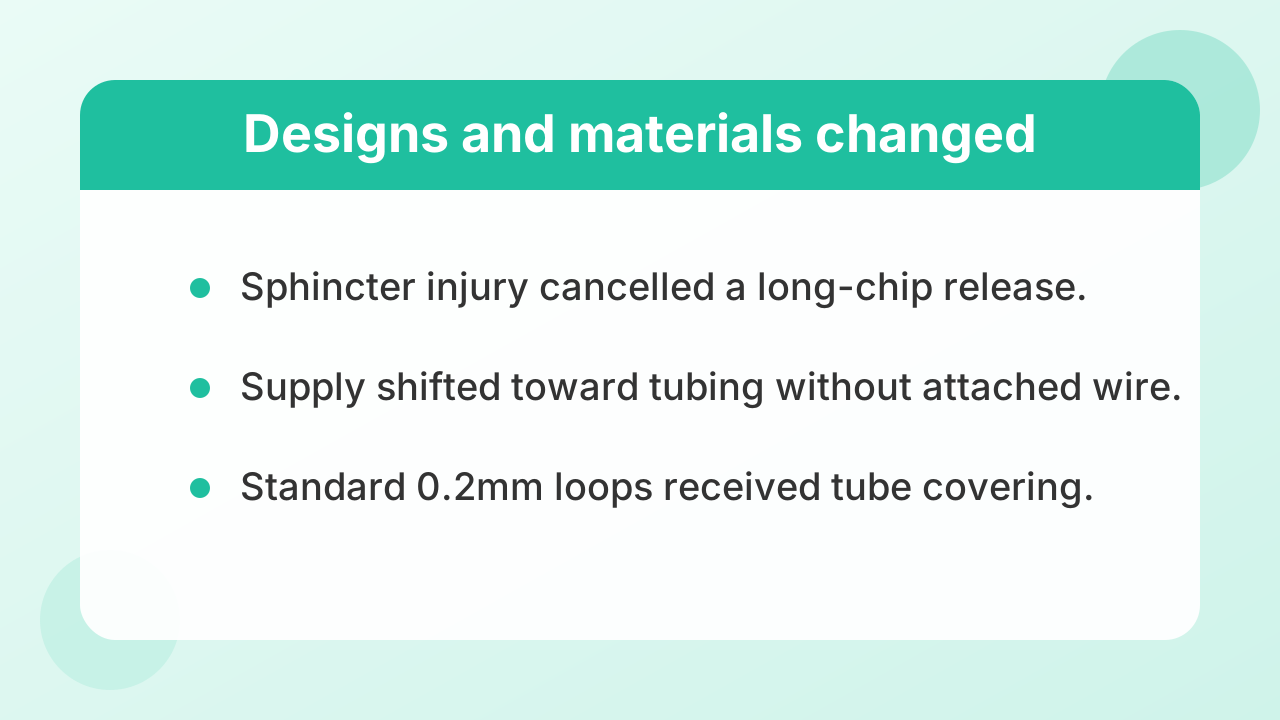
| Published | What the diary said then |
|---|---|
| Jan 2018 | Sphincter injury cancelled a long-chip release; linked designs were proposed instead. |
| Dec 2018 | A hooked prototype was withheld after the maker found removal unsettling. |
| Feb 2020 | Older controllers might have shipped with reversed wiring; correction was offered. |
| Oct 2020 | A metal-spring prototype awaited further personal safety testing. |
| Jun 2021 | A designer opposed reversible-chip sales over removal problems following thread breakage. |
| Sep 2022 | Stainless-steel support orders ended after wire breakage on the third use. |
| Jan 2023 | Supply shifted toward tubing without attached wire, assuming eventual wire breakage. |
| Oct 2024 | Discomfort with bare 0.3mm wire prompted standard 2mm tube covering. |
| Aug 2025 | Standard 0.2mm loops received tube covering after painful sensations during testing. |
| May 2026 | Mr. Okada rejected thicker wire prototypes over suspected strain on the lining. |
The diary does not say what the current state is.
OK Prostate Chip products related to OK Prostate Chip safety
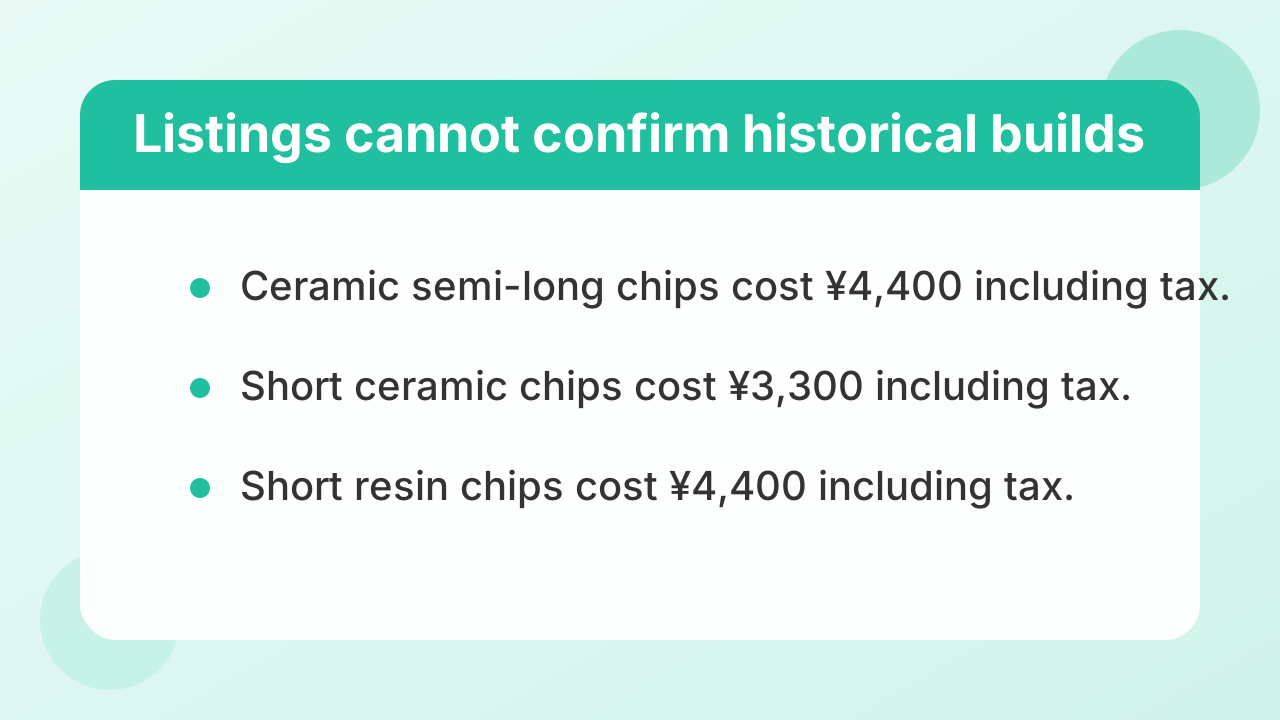
Current listings do not confirm historical sizes, connections, or redesigns.
Products that appear in these entries
| Product (official name) | Price incl. tax | Relation to this topic |
|---|---|---|
| Ceramic semi-long chip (OKプロステートチップ 陶器素材セミロングタイプ) | ¥4,400 (about $28 at ¥156 = $1, rate as of 2026-09-04) | July 2019: strength complaints prompted a sales pause and plans for greater thickness. |
| Short ceramic chip (OKプロステートチップ 陶器素材ショートタイプ) | ¥3,300 (about $21 at ¥156 = $1, rate as of 2026-09-04) | February 2020: a customer chose this after a narrower ceramic custom was refused. |
| Short resin chip (OKプロステートチップ ショートタイプ(生体適合樹脂)) | ¥4,400 (about $28 at ¥156 = $1, rate as of 2026-09-04) | August 2022: a chip with an auxiliary piece became stuck and required hospital removal. |
(Source: ok-lab's diary, published July 2019)
https://ok-lab.hatenablog.com/entry/2019/07/27/130537
(Source: ok-lab's diary, published February 2020)
https://ok-lab.hatenablog.com/entry/2020/02/22/145216
(Source: ok-lab's diary, published August 2022)
https://ok-lab.hatenablog.com/entry/2022/08/20/122920
Products the diary mentioned as alternatives
| Product (official name) | Price incl. tax | Relation to this topic |
|---|---|---|
| External penis-concealment set (エイン・デ・フラット3点セット) | ¥16,500 (about $106 at ¥156 = $1, rate as of 2026-09-04) | March 2023: Mr. Okada offered this without the urethral sound he considered harder and riskier to handle. |
(Source: ok-lab's diary, published March 2023)
https://ok-lab.hatenablog.com/entry/2023/03/25/122614
Historical builds include old long and linked chips, screw customs, glass anal prototypes, hooked designs, spring prototypes, and reversible chips. They also include the jointed ceramic chip, exposed-motor version, Zoro variant, old wire connections, and retrieval tool. No matching product can be confirmed on the current list.
Common worries about OK Prostate Chip safety
New problems sometimes changed the maker's replies.
"Do repair reports establish resin chip safety or lifespan?"
In an entry published in March 2019, a reader asked about resin-chip lifespan and thread detachment. Mr. Okada had no lifespan statistics; most repair requests concerned glass.
A separate repair note describes an old double chip's spacing changing from 0mm to about 3mm. He also reported no thread-detachment complaints for products improved by that date. Mr. Okada said gentler handling could help a chip last longer.
(Source: ok-lab's diary, published March 2019)
https://ok-lab.hatenablog.com/entry/2019/03/23/173222
"Can chip safety concerns change an offer after a reply?"
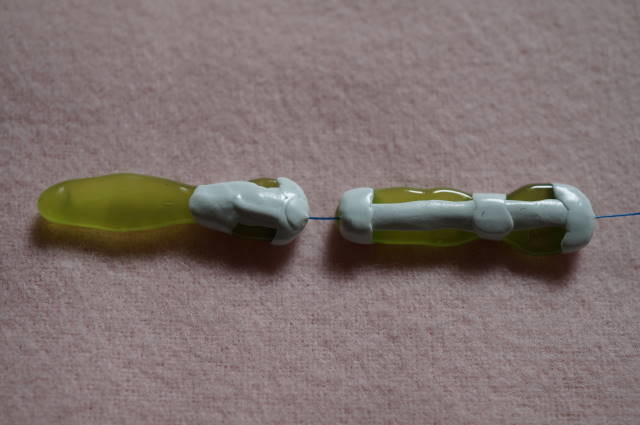
In an entry published in January 2020, a reader asked about dimensions for a jointed ceramic chip. Mr. Okada initially provided the requested length estimates.
A separate customer's report of cracking at a larger chip's joint then changed his response. He attributed the problem to forces on the connection in longer designs, and suspended sales. His updated reply apologized to the inquirer for that change.
(Source: ok-lab's diary, published January 2020)
https://ok-lab.hatenablog.com/entry/2020/01/11/151714
"Can chip safety justify refusing a narrow ceramic custom?"
In an entry published in February 2020, a customer requested a custom ceramic shape narrowed to 8mm. Mr. Okada refused over strength concerns. He said ceramic lacked the internal thread reinforcement of some resin chips.
The customer then chose a standard short ceramic chip in M size, which Mr. Okada records completing. The diary does not describe the customer's later use. Mr. Okada warned that extremely thin ceramic designs were beyond what he could make.
(Source: ok-lab's diary, published February 2020)
https://ok-lab.hatenablog.com/entry/2020/02/22/145216
Buying from outside Japan
OK Lab ships internationally to countries covered by Japan Post's EMS courier service. Overseas orders are paid in advance by PayPal. Each order carries a ¥400 (about $3 at ¥156 = $1, rate as of 2026-09-04) handling fee, and EMS shipping is charged on top. These terms come from OK Lab's official sales-terms page (written here as plain text, not a link: ok-lab.net/docs/law), checked on September 7, 2026; confirm them on the official store before you order, because they can change.
Summary of this article
| What you wanted to know | The answer |
|---|---|
| Were sales stopped? | Several designs were withdrawn or delayed. |
| What is the product? | A urethral device from OK Lab in Japan. |
| What do the terms describe? | Devices, connections, and protective materials. |
| What happened? | Injuries and failures prompted restrictions. |
| What measures followed? | Thicker ceramic, refunds, and coated wire. |
| What changed over time? | Designs, materials, and sales conditions changed. |
| Which products relate? | Listed ceramic and resin chips, plus the external concealment set. |
| What did customers ask? | Lifespan, dimensions, and custom-design feasibility. |
| How do overseas purchases work? | Advance PayPal payment, a ¥400 (about $3 at ¥156 = $1, rate as of 2026-09-04) fee, and EMS shipping. |
Source: ok-lab's diary (Okada Comfortable Life Laboratory). The original entries are in Japanese; quotations on this page are translated. Photos and videos are on the original entries.
This article is a summary of the maker's development diary. The product is not a medical device and no result is guaranteed. If anything feels wrong or worries you, see a doctor. Prices, specifications and cautions change, so confirm the latest information on the official blog and the official site. Questions about ordering and shipping go to the seller.