![How thick can the chip wire be? | Limits depend on the design [OK Prostate Chip]](/img/a/T0382/eyecatch.svg)
This page is based on entries from "ok-lab's diary" (https://ok-lab.hatenablog.com/), the Japanese development diary written by Mr. Okada, founder of OK Lab, a small company in Japan (Okada Comfortable Life Laboratory). Only the entries about "wire thickness, bends and end loops" are summarized here, in order of publication. Past prices and sizes are as written at the time. Current prices come from the official product list (retrieved September 4, 2026). Quotations are translated from Japanese.
Note: This page is a personal reading log by someone with no connection to the maker or the seller. It reflects the source entries as of their publication dates and makes no guarantee of accuracy or safety. The product is not a medical device; talk to a doctor about any health decision. Check the official site for current information. This page contains advertising.
In short
The diary reports pain, bleeding and breakage involving chip wires with different thicknesses and bends.
Mr. Okada responded with separate thickness limits, covered wire and looped ends.
The current list includes stainless wire, but does not confirm historical custom sizes or angles.
If you see blood in your urine, even a small amount or for the first time, do not wait and see. See a urologist right away.
If you suddenly cannot urinate, or the device cannot be removed, do not try to fix it yourself. Go to a medical facility, including emergency care, immediately.
About this product
The OK Prostate Chip is a small device that is placed in the urethra (the urine passage) so that it acts on the prostate; the maker sells it in several shapes, sizes and materials. It is made and sold by OK Lab (Okada Comfortable Life Laboratory), a small company in Japan, through its own online store, and prices are in Japanese yen (JPY). The maker's development diary, "ok-lab's diary", is written in Japanese. This page is an English summary of it, and every quotation is translated. OK Lab ships internationally, so readers outside Japan can order (see "Buying from outside Japan" below). Product names on this page are plain-English descriptions. The official Japanese product name is shown once in the product table so you can find the same item in the store.
Before you read: key terms
| Term | Plain-English meaning |
|---|---|
| Stainless thread | Thin stainless steel wire used in place of a chip's nylon connecting thread. |
| Support wire | Wire intended to help move or support the chip. |
| Nitinol | Shape-memory alloy wire, used for connections and structures intended to recover their shape. |
| Silicone tube | A flexible covering around wire, used for cushioning and separating wire from the surrounding tissue. |
| End loop | A rounded return at a wire's end, intended to avoid an exposed sharp tip or secure the connection. |
| Chipless device | A wire-and-tube design using loops in place of solid chips. |
What happens: chip wire thickness and bends
The OK Prostate Chip is a small device placed in the urethra to act on the prostate. Its connecting thread and support wires serve different purposes: connecting parts, supporting the device, or helping it move. These entries describe wire inside the urine passage, sometimes within a silicone tube (a flexible protective covering). An end loop (a rounded return in the wire) became an important feature at the ends of several designs.
Stainless chip wire kept its price but added concerns about kinks
In an entry published in September 2019, Mr. Okada introduced stainless thread (thin steel wire replacing nylon thread) for ceramic chips. It cost the same as nylon thread, with availability initially limited to a single-thread ceramic configuration.
He reported no breakage during approximately 2,000 finger bends, while acknowledging possible damage from repeated bending. Mr. Okada cautioned that extreme bends were hard to reverse, calling for a nearly straight shape and regular checks.
(Source: ok-lab's diary, published September 2019)
https://ok-lab.hatenablog.com/entry/2019/09/14/143710
Thicker chip wire caused pain in Mr. Okada's support test
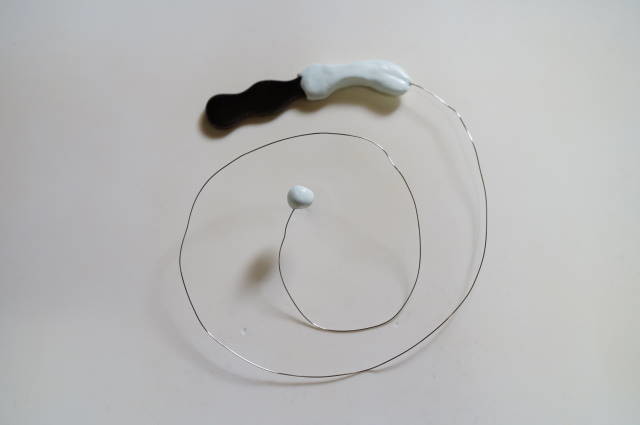
In an entry published in October 2021, Mr. Okada described pain from a single 0.7mm support wire (wire intended to help move the chip). He attributed this to poor bending around the muscle-controlled passage near the prostate; two parallel 0.5mm wires retained the thinner wire's flexibility. Mr. Okada said further testing was needed before offering the experiment to customers.
(Source: ok-lab's diary, published October 2021)
https://ok-lab.hatenablog.com/entry/2021/10/02/125825
Bleeding followed a customer's experiment with stainless chip wire
In an entry published in May 2022, a customer described trying to recognize sensations around the prostate. The customer reported urinating with stainless wire in place, then seeing a little blood after its removal.
Mr. Okada suspected that greater friction increased the likelihood of bleeding; the entry provides no confirmed diagnosis. His reply called for restraint.
(Source: ok-lab's diary, published May 2022)
https://ok-lab.hatenablog.com/entry/2022/05/14/123043
Sharp wire bends explained cable pain in Mr. Okada's account
In an entry published in May 2022, a customer reported that a 4-wire support cable felt painful. Mr. Okada attributed pain in his own experience to an extreme bend concentrated at one location inside the urethra. His proposed response focused on a shorter overall cable shape to reduce concentrated bending.
(Source: ok-lab's diary, published May 2022)
https://ok-lab.hatenablog.com/entry/2022/05/28/123218
Bare chip wire was dropped from the formal product design
In an entry published in October 2024, Mr. Okada described discomfort during his own nitinol (shape-memory alloy wire) experiment. He suspected the bare 0.3mm wire was pressing into the urethral lining and abandoned that version as a formal thread replacement.
The formal product's silicone covering changed from 1mm to 2mm, reflecting his concerns about strength and cushioning. Although he still fulfilled earlier bare-wire requests, Mr. Okada specified complete silicone coverage for the formal product.
(Source: ok-lab's diary, published October 2024)
https://ok-lab.hatenablog.com/entry/2024/10/19/122847
A 120° failure led Mr. Okada to limit wire bends
In an entry published in December 2024, a customer reported that a 120° chipless device broke after 2 days. The internal wire protruded, with slight pain but no reported bleeding. Mr. Okada apologized and offered a refund or replacement.
The customer chose replacement, but the diary does not record its subsequent performance. Mr. Okada said abnormally bending wire would be discarded as defective, with finished bends temporarily limited to 90°.
(Source: ok-lab's diary, published December 2024)
https://ok-lab.hatenablog.com/entry/2024/12/14/122948
Looped wire ends returned after concerns about sharp tips piercing rubber
In an entry published in April 2026, Mr. Okada revisited a retrieval-tool prototype after slight bleeding during an earlier personal test. He suspected a sharp wire tip could penetrate its rubber covering.
The shaft changed from one 0.4mm wire to two 0.15mm wires, with a looped tip. Mr. Okada therefore reinstated his principle that wire products needed looped ends.
(Source: ok-lab's diary, published April 2026)
https://ok-lab.hatenablog.com/entry/2026/04/25/122914
The maker's answer to chip wire thickness and bends
Mr. Okada changed attachments, coverings and loop designs as different problems emerged.
Chip wire breakage ended sales of several older cable designs
In an entry published in January 2023, Mr. Okada reviewed the discontinued 4-wire and 6-wire designs and an older wire-in-tube model. Reports of breakage or apparent impending breakage had prompted those withdrawals.
His replacement approach separated the wire from direct cable or chip attachments, using tubing that allowed customer replacement of the wire. Mr. Okada cautioned that these designs still needed to account for eventual wire breakage and replacement.
(Source: ok-lab's diary, published January 2023)
https://ok-lab.hatenablog.com/entry/2023/01/07/123115
Covered wire loops had minimum lengths and separate connection charges
In an entry published in October 2024, Mr. Okada required an end loop because he knew no reliable method of securing a straight end. The covered nitinol connection had a maximum wire length of 40cm.
Published surcharges were ¥4,000 (about $26 at ¥156 = $1, rate as of 2026-09-04) tax excluded through 30cm, and ¥5,000 (about $32 at ¥156 = $1, rate as of 2026-09-04) tax excluded through 40cm, added to the chip price. Mr. Okada specified a minimum loop length of 2-3cm, saying longer loops were easier to secure without excessive strain.
(Source: ok-lab's diary, published October 2024)
https://ok-lab.hatenablog.com/entry/2024/10/19/122847
Nitinol pushing wire carried its own thickness and price limits
A separate part of the entry published in October 2024 introduced a nitinol pushing wire intended to accompany the chip's thread. Its specified diameter was 0.4mm, with lengths of 20cm, 25cm or 30cm. The published price was ¥3,000 (about $19 at ¥156 = $1, rate as of 2026-09-04) tax excluded.
This was a separate accessory from the covered connection described above. Mr. Okada warned that severe bends could place breaking stress on the wire.
(Source: ok-lab's diary, published October 2024)
https://ok-lab.hatenablog.com/entry/2024/10/19/122847
Nitinol chip wire connections excluded the blue resin safety connector
In an entry published in August 2025, Mr. Okada began offering nitinol thread connections for ceramic, blue and stainless steel chips. He reported no problems during his own 3-day test, without guaranteeing that the wire could never break. Maximum length was 35cm, with a ¥2,000 (about $13 at ¥156 = $1, rate as of 2026-09-04) tax-excluded surcharge over the nylon specification.
The blue safety connector was excluded because its sharp connection bends would overstress the nitinol thread. Mr. Okada advised cautious buyers to wait or consider the older tube-covered nylon-and-nitinol connection, which he regarded as safer.
(Source: ok-lab's diary, published August 2025)
https://ok-lab.hatenablog.com/entry/2025/08/09/122924
Adjustable wire loops gained dedicated parts that limited excessive shrinking
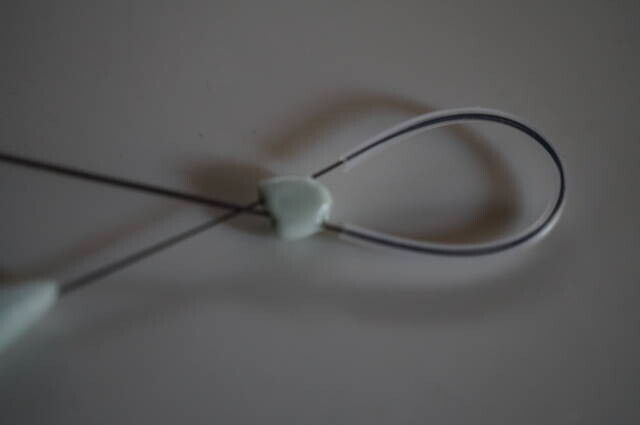
In an entry published in August 2025, the following week's update replaced the earlier adjustable-loop arrangement with a dedicated part. That part cost ¥1,000 (about $6 at ¥156 = $1, rate as of 2026-09-04) tax excluded, and roughly 40mm of tubing covered the loop to prevent excessive shrinking.
The revised loop section could no longer carry a stopper or safety connector. Mr. Okada made its protective covering mandatory because excessively small loops could stop the wire recovering its shape.
(Source: ok-lab's diary, published August 2025)
https://ok-lab.hatenablog.com/entry/2025/08/16/122934
If you see blood in your urine, even a small amount or for the first time, do not wait and see. See a urologist right away.
If you suddenly cannot urinate, or the device cannot be removed, do not try to fix it yourself. Go to a medical facility, including emergency care, immediately.
How chip wire thickness and bends changed over time
| Published | What the diary said then |
|---|---|
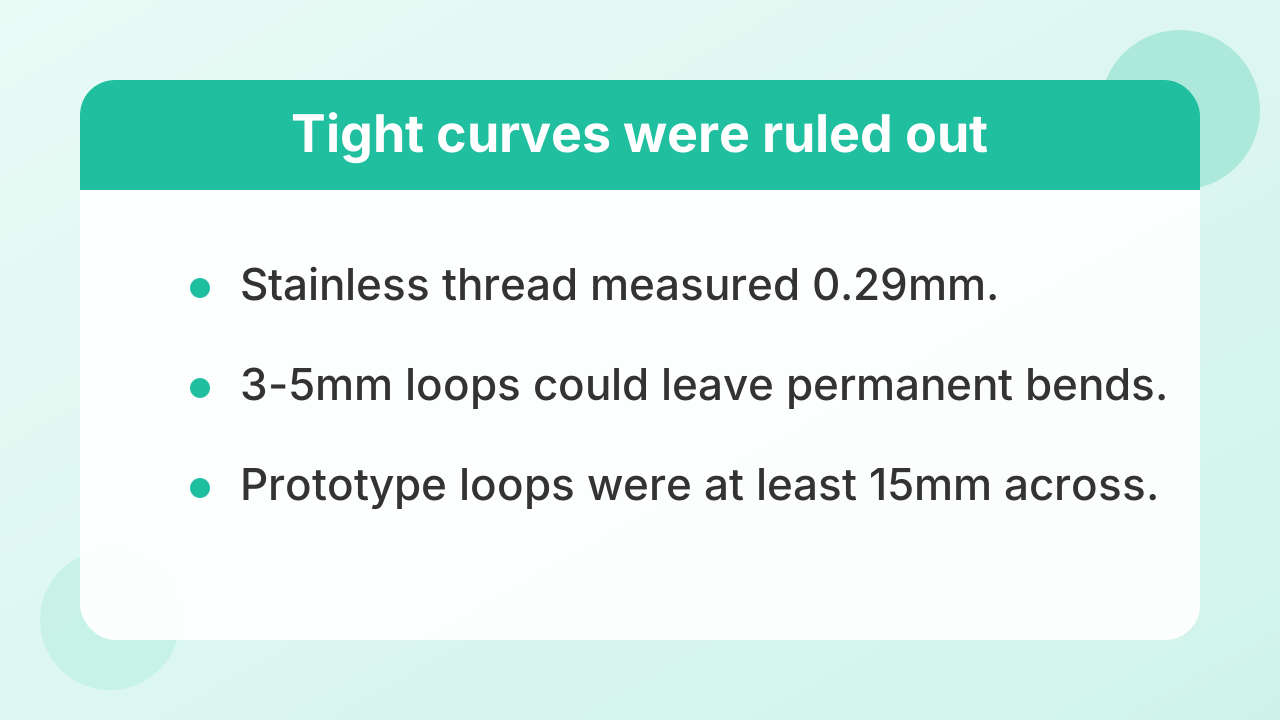
| Sep 2019 | Stainless thread measured 0.29mm; the nylon thread then used was approximately 0.25mm. |
| Oct 2021 | Mr. Okada reported stronger pushing support from paired 0.5mm wires than one 0.7mm wire. |
| Jan 2023 | Prototype tubing measured 2mm outside, 1mm inside, around doubled 0.3mm wire. |
| Sep 2023 | Flat wire supports required fully enclosed wire and a central U-shaped return. |
| Oct 2024 | Loops measuring 3-5mm could leave permanent bends; Mr. Okada ruled out such tight curves. |
| Nov 2025 | A continuous-wire prototype used loops at least 15mm across to preserve straightening ability. |
| Apr 2026 | Mr. Okada abandoned 0.03mm wire; 0.05mm retained the straightening ability he wanted. |
The diary does not say what the current state is.
OK Prostate Chip products related to chip wire thickness and bends
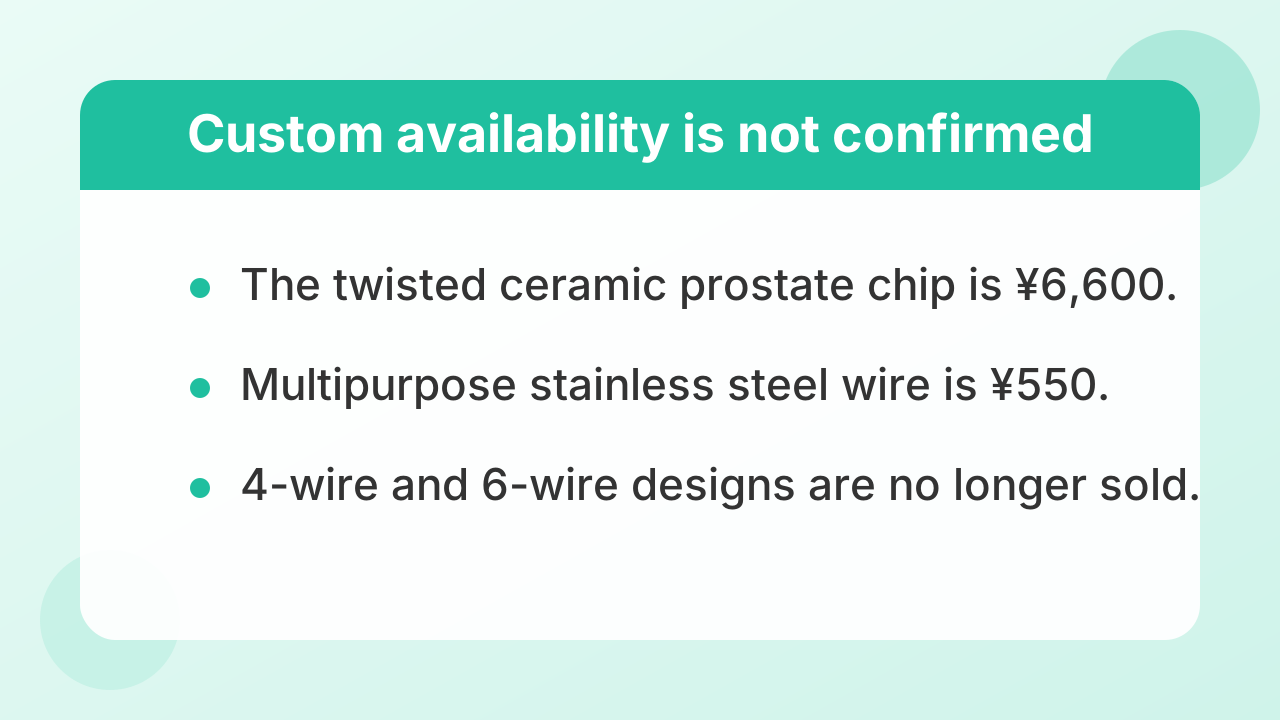
The current list confirms these products, but does not establish that their historical custom configurations remain available.
Products that appear in these entries
| Product (official name) | Price incl. tax | Relation to this topic |
|---|---|---|
| Twisted ceramic prostate chip (OKプロステートチップ 陶器素材覚醒タイプ コブラツイスト) | ¥6,600 (about $42 at ¥156 = $1, rate as of 2026-09-04) | February 2021: a wire-attachment request began with this model before the customer agreed to a different custom chip. |
| Multipurpose stainless steel wire (多目的ステンレスワイヤー) | ¥550 (about $4 at ¥156 = $1, rate as of 2026-09-04) | January 2022: a customization request led to a thickness limit and separate custom pricing. |
(Source: ok-lab's diary, published February 2021)
https://ok-lab.hatenablog.com/entry/2021/02/20/130830
(Source: ok-lab's diary, published January 2022)
https://ok-lab.hatenablog.com/entry/2022/01/29/123455
Products the diary mentioned as alternatives
The diary names no alternative.
No longer sold: the older 4-wire and 6-wire designs and the older wire-in-tube model, as reported in January 2023.
(Source: ok-lab's diary, published January 2023)
https://ok-lab.hatenablog.com/entry/2023/01/07/123115
Other historical custom builds, prototypes, covered-wire connections, chipless designs, adjustable-loop parts and the suggested nylon-and-nitinol alternative: No matching product can be confirmed on the current list.
Common worries about chip wire thickness and bends
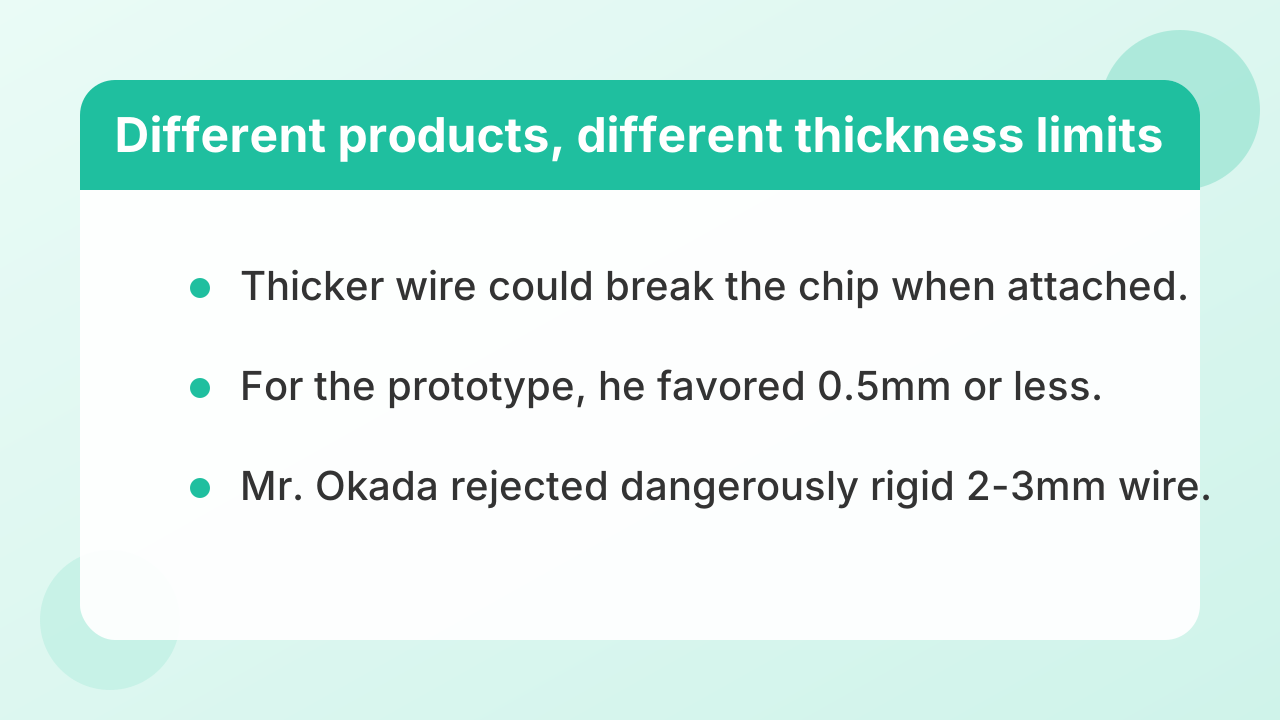
The maker's replies set different thickness limits for different products and attachments.
"Can thicker chip wire replace the original thread?"
In an entry published in February 2021, a customer requested 1mm stainless wire on a small twisted ceramic chip. Mr. Okada proposed 0.7mm instead, with ¥1,100 (about $7 at ¥156 = $1, rate as of 2026-09-04) extra for thread running alongside the wire. The requested raised bumps were unavailable on that model, so the customer agreed to a slim double-twist ceramic chip with bumps.
The diary does not record how the changed build felt in use. Mr. Okada limited the wire to 0.7mm because thicker wire could break the chip when attached.
(Source: ok-lab's diary, published February 2021)
https://ok-lab.hatenablog.com/entry/2021/02/20/130830
"Does a larger thread hole allow thicker chip wire?"
In an entry published in October 2021, Mr. Okada discussed an experimental device that transmitted vibration from an external motor through wire. Its roughly 1mm thread hole could accommodate approximately 0.7mm wire, but he considered that too stiff and favored 0.5mm or less. For that prototype, Mr. Okada advised wire replacement for every use because he expected eventual breakage.
(Source: ok-lab's diary, published October 2021)
https://ok-lab.hatenablog.com/entry/2021/10/09/125823
"Why was 2-3mm chip wire refused?"
In an entry published in January 2022, a customer wanted stiffer stainless wire and a larger pushing end. Mr. Okada corrected the customer's size assumption: the existing wire was 0.7mm. He offered custom work at ¥2,000 (about $13 at ¥156 = $1, rate as of 2026-09-04) tax excluded, matching the short resin chip price.
The diary does not record whether this proposed order was completed. Mr. Okada rejected 2-3mm wire as dangerously rigid and difficult to bend with fingers, setting 1mm as the maximum.
(Source: ok-lab's diary, published January 2022)
https://ok-lab.hatenablog.com/entry/2022/01/29/123455
Buying from outside Japan
OK Lab ships internationally to countries covered by Japan Post's EMS courier service. Overseas orders are paid in advance by PayPal. Each order carries a ¥400 (about $3 at ¥156 = $1, rate as of 2026-09-04) handling fee, and EMS shipping is charged on top. These terms come from OK Lab's official sales-terms page (written here as plain text, not a link: ok-lab.net/docs/law), checked on September 7, 2026; confirm them on the official store before you order, because they can change.
Summary of this article
| What you wanted to know | The answer |
|---|---|
| In short: is there one wire limit? | The diary gives different limits for different designs. |
| About the product: who makes it? | OK Lab in Japan; prices are in Japanese yen. |
| Key terms: what do coverings and loops do? | Their stated roles include cushioning, securing connections and avoiding sharp ends. |
| What happened? | Entries describe pain, bleeding, deformation and wire breakage. |
| What did the maker change? | Attachments, coverings, loop protection and permitted bends. |
| How did the designs develop? | Later entries introduced different materials and structures. |
| Which products are currently listed? | Stainless wire and the twisted ceramic chip appear on the supplied list. |
| What did customer replies establish? | Thickness limits depended on the wire's purpose and attachment. |
| How do overseas orders work? | Advance PayPal payment, a handling fee and additional EMS shipping. |
Source: ok-lab's diary (Okada Comfortable Life Laboratory). The original entries are in Japanese; quotations on this page are translated. Photos and videos are on the original entries.
This article is a summary of the maker's development diary. The product is not a medical device and no result is guaranteed. If anything feels wrong or worries you, see a doctor. Prices, specifications and cautions change, so confirm the latest information on the official blog and the official site. Questions about ordering and shipping go to the seller.