![What if the thread breaks? | A second thread is only a backup [OK Prostate Chip]](/img/a/T0380/eyecatch.svg)
This page is based on entries from "ok-lab's diary" (https://ok-lab.hatenablog.com/), the Japanese development diary written by Mr. Okada, founder of OK Lab, a small company in Japan (Okada Comfortable Life Laboratory). Only the entries about "two retrieval threads and backup wires" are summarized here, in order of publication. Past prices and sizes are as written at the time. Current prices come from the official product list (retrieved September 4, 2026). Quotations are translated from Japanese.
Note: This page is a personal reading log by someone with no connection to the maker or the seller. It reflects the source entries as of their publication dates and makes no guarantee of accuracy or safety. The product is not a medical device; talk to a doctor about any health decision. Check the official site for current information. This page contains advertising.
In short
A retrieval thread (a line attached for removal) can break, leaving a chip inside the body.
Mr. Okada favors backup connections, while acknowledging that both threads can fail.
The current list includes thread accessories; the diary describes further experimental connections through August 2026.
If you see blood in your urine, even a small amount or for the first time, do not wait and see. See a urologist right away. If you suddenly cannot urinate, or the device cannot be removed, do not try to fix it yourself. Go to a medical facility, including emergency care, immediately.
About this product

The OK Prostate Chip is a small device that is placed in the urethra (the urine passage) so that it acts on the prostate; the maker sells it in several shapes, sizes and materials. It is made and sold by OK Lab (Okada Comfortable Life Laboratory), a small company in Japan, through its own online store, and prices are in Japanese yen (JPY). The maker's development diary, "ok-lab's diary", is written in Japanese. This page is an English summary of it, and every quotation is translated. OK Lab ships internationally, so readers outside Japan can order (see "Buying from outside Japan" below). Product names on this page are plain-English descriptions. The official Japanese product name is shown once in the product table so you can find the same item in the store.
Before you read: key terms
| Term | Plain-English meaning |
|---|---|
| Retrieval thread | A line attached to a chip, intended to keep it connected for removal. |
| Backup connection | An additional thread or wire intended to preserve the connection if another breaks. |
| Paired cable | Two electrical wires joined side by side, also used to connect certain chips. |
| Safety accessory | A small fitting used to hold retrieval threads together. |
| Tail | A silicone tube containing nylon threads, used as a connection behind a chip. |
| Nitinol | A shape-memory metal used for flexible wires and thread-like connections. |
| Flexible extension | A tube containing nylon and shape-memory wire, proposed as a protected connection to the chip. |
What happens: retrieval thread breakage
The OK Prostate Chip is a small device placed in the urethra (the urine passage) to act on the prostate. Retrieval threads attach to the chip and extend toward the outside; linked models also have connections between their separate chips. A backup connection (an additional thread or wire) is intended to remain intact if another connection fails. Depending on the design, it runs beside the main connection or inside a protective tube.
A broken retrieval thread left the front chip inside for days
In an entry published in April 2019, a customer reported that a broken thread left the front chip of a linked resin device inside. Blood in the urine and difficulty urinating continued until the chip emerged after five and a half days. The customer requested repair and two threads; Mr. Okada made a separate replacement.
A follow-up published in May 2019 reported that the replacement had arrived and felt satisfactory. The diary does not record a medical assessment of the earlier symptoms. Mr. Okada favored two threads over a stronger single thread as his response to the breakage.
(Source: ok-lab's diary, published April 2019)
https://ok-lab.hatenablog.com/entry/2019/04/27/153239
(Source: ok-lab's diary, published May 2019)
https://ok-lab.hatenablog.com/entry/2019/05/11/152432
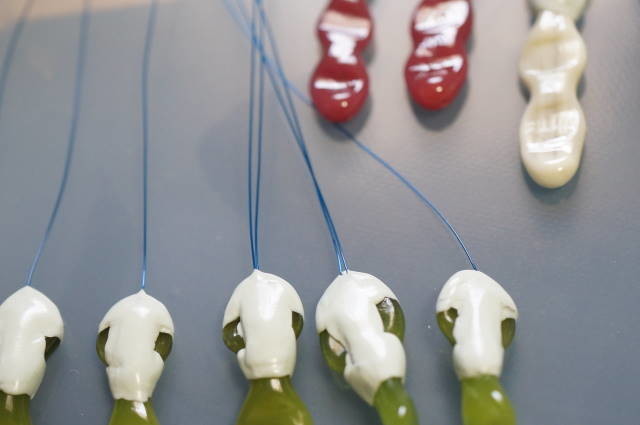
Backup threads accompanied ceramic links that Mr. Okada expected to break
In an entry published in September 2019, Mr. Okada described ceramic pairs connected by stainless wire with nylon backup. He expected the wire eventually to break and intended the nylon to keep the front chip connected. However, he warned that broken metal could damage that nylon. His advice was to request thread replacement whenever the wire broke.
(Source: ok-lab's diary, published September 2019)
https://ok-lab.hatenablog.com/entry/2019/09/28/140637
Stainless connectors failed testing despite the planned backup retrieval thread
An entry published in October 2019 abandoned stainless connections for the closely spaced ceramic pair. Mr. Okada reported failure after approximately three weeks of testing, attributing it to repeated bending at the same short section. He then tested thick fishing nylon, but still chose two strands despite its favorable durability result. His preferred direction became multiple strands of surgical nylon, which he judged gentler than fishing line.
(Source: ok-lab's diary, published October 2019)
https://ok-lab.hatenablog.com/entry/2019/10/12/125944
A second retrieval thread addressed the curved chip’s difficult pulling angle
In an entry published in September 2020, a customer sought help because a curved chip (Umiushi Ver.4) remained stuck the following day. The customer also reported bleeding. Mr. Okada suspected that the thread’s off-center attachment contributed to the difficulty.
The customer subsequently reported successful removal; the diary describes repeated attempts, without establishing that those attempts were safe. Mr. Okada then tested an independent thread attached on the opposite side and reported easier retrieval. He advised consulting a urologist when removal was unsuccessful.
(Source: ok-lab's diary, published September 2020)
https://ok-lab.hatenablog.com/entry/2020/09/05/095734
Backup threads remained inside replacement tails after rubber connections broke
In an entry published in December 2023, Mr. Okada reported broken rubber connections on sharply angled curved pairs (Umiushi 5). He said subsequent custom builds had used gentler angles. His new proposal used a tail (a silicone tube containing nylon threads), with two nylon threads intended to preserve the connection if the tube failed. Mr. Okada proposed this design for customers dissatisfied with the reduced curve of recent builds.
(Source: ok-lab's diary, published December 2023)
https://ok-lab.hatenablog.com/entry/2023/12/30/122243
Paired cable and backup threads replaced an earlier fragile electrode connection
An entry published in August 2024 recalled an earlier linked electrode device whose single connecting wire had failed relatively quickly. Mr. Okada’s new aluminum electrode pair used paired cable (two electrical wires joined side by side), alongside nylon thread. The illustrated connection also had a resin covering.
Its published starting price was ¥10,000 (about $64 at ¥156 = $1, rate as of 2026-09-04) excluding tax, before the optional covering. Mr. Okada’s proposed precaution was to retain the paired cable and the additional nylon connection.
(Source: ok-lab's diary, published August 2024)
https://ok-lab.hatenablog.com/entry/2024/08/10/122913
Double wire became the proposed answer after four customers reported breakage
An entry published in March 2025 recorded a customer requesting repair or replacement after wire protruded from a wire-loop device (Chipless). This brought the reported number of affected customers to four. Staff offered refunds for recently shipped items because the cause remained unknown and remaking them would not resolve it.
The diary does not record completion of this customer’s refund. Mr. Okada abandoned the assumption that a different source of bent wire would eliminate breakage. His proposed policy was double wire, with the product discarded as soon as either wire broke.
(Source: ok-lab's diary, published March 2025)
https://ok-lab.hatenablog.com/entry/2025/03/08/123016
Mr. Okada reported heart trouble during his double wire test
Another part of the entry published in March 2025 concerned a customer requesting two 0.4mm wires inside one tube. Staff initially postponed testing pending supplies and mentioned a different loop arrangement; Mr. Okada then tested the requested double-wire design. He reported stimulation that felt excessive and an episode he described as heart failure after about two hours, ending the test.
The diary does not record medical confirmation of that episode. Mr. Okada proposed 0.3mm double wire for himself, but that prototype had not yet undergone an in-body test.
(Source: ok-lab's diary, published March 2025)
https://ok-lab.hatenablog.com/entry/2025/03/08/123016
Nitinol retrieval threads launched with warnings about possible simultaneous failure
An entry published in August 2025 introduced nitinol threads (flexible connections made from shape-memory metal) for blue resin, stainless, and ceramic chips. The published additional charge was ¥2,000 (about $13 at ¥156 = $1, rate as of 2026-09-04) excluding tax, with a maximum length of 35cm. Two threads were initially standard, intended to leave one connection after a break.
The blue resin safety accessory could not be connected because its tight bends would burden the metal threads. Mr. Okada acknowledged that both threads could fail together. He advised customers worried about breakage to wait before trying the new material.
(Source: ok-lab's diary, published August 2025)
https://ok-lab.hatenablog.com/entry/2025/08/09/122924
The maker's answer to retrieval thread breakage
Mr. Okada’s measures added backup connections, but their construction, cost, and limits differed between designs.
Two retrieval threads carried separate accessory costs from their April launch
An entry published in April 2019 opened two-thread requests for orders from April 27, 2019, excluding vibrating chips. Embedding two threads cost the same as one, but the usual safety accessory (a fitting holding the threads together) was omitted. Each 6-hole accessory cost ¥500 (about $3 at ¥156 = $1, rate as of 2026-09-04) excluding tax more than its 3-hole equivalent.
Orders already being made could not change; completed, unshipped products could change for the usual thread-repair charge. Mr. Okada recommended the separately sold six-hole safety accessory for keeping the two thread lengths aligned.
(Source: ok-lab's diary, published April 2019)
https://ok-lab.hatenablog.com/entry/2019/04/27/153239
Backup retrieval threads became standard where rubber connections lacked strength evidence
In an entry published in January 2021, Mr. Okada described a prototype combining three chips with electrical cable and rubber connections. He said those rubber connections lacked an established strength record. A continuous nylon thread therefore connected the entire assembly alongside the cable. Mr. Okada treated that full-length backup as standard equipment for this design.
(Source: ok-lab's diary, published January 2021)
https://ok-lab.hatenablog.com/entry/2021/01/02/123619
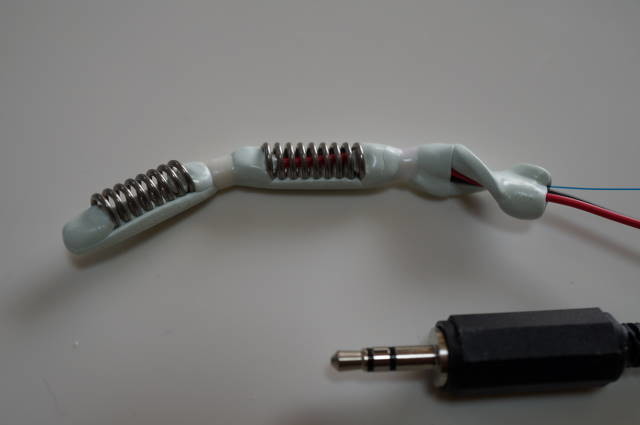
Four retrieval threads brought extra cost and limits on replacement services
An entry published in May 2023 introduced a four-thread specification as Mr. Okada anticipated heavier chips placing greater demands on their threads. The required blue resin safety accessory cost ¥1,500 (about $10 at ¥156 = $1, rate as of 2026-09-04), and the additional thread work cost ¥1,000 (about $6 at ¥156 = $1, rate as of 2026-09-04). The published combined charge was ¥2,500 (about $16 at ¥156 = $1, rate as of 2026-09-04), with all these amounts excluding tax.
The extra two threads served only as retrieval backups; the diary did not offer four-thread support for the other auxiliary fittings. Existing one-thread or two-thread products were excluded from conversion during ordinary thread replacement. Mr. Okada restricted four-thread replacement service to products originally purchased with that specification.
(Source: ok-lab's diary, published May 2023)
https://ok-lab.hatenablog.com/entry/2023/05/13/123004
If you see blood in your urine, even a small amount or for the first time, do not wait and see. See a urologist right away. If you suddenly cannot urinate, or the device cannot be removed, do not try to fix it yourself. Go to a medical facility, including emergency care, immediately.
How retrieval thread breakage changed over time
| Published | What the diary said then |
|---|---|
| Mar 2018 | Separate chips had independent threads, intended to reduce the force carried by each. |
| May 2019 | Adding nylon beside cable made the connecting gap about 2mm longer. |
| Jan 2020 | A linked ceramic design formally switched to paired cable with nylon backup. |
| Jun 2021 | A new titanium attachment was designed to remain fixed after one thread broke. |
| Sep 2022 | A silicone-covered cord enclosed two nylon threads within separate 10cm tube sections. |
| Aug 2025 | Mr. Okada proposed four 0.15mm nitinol strands as the new standard. |
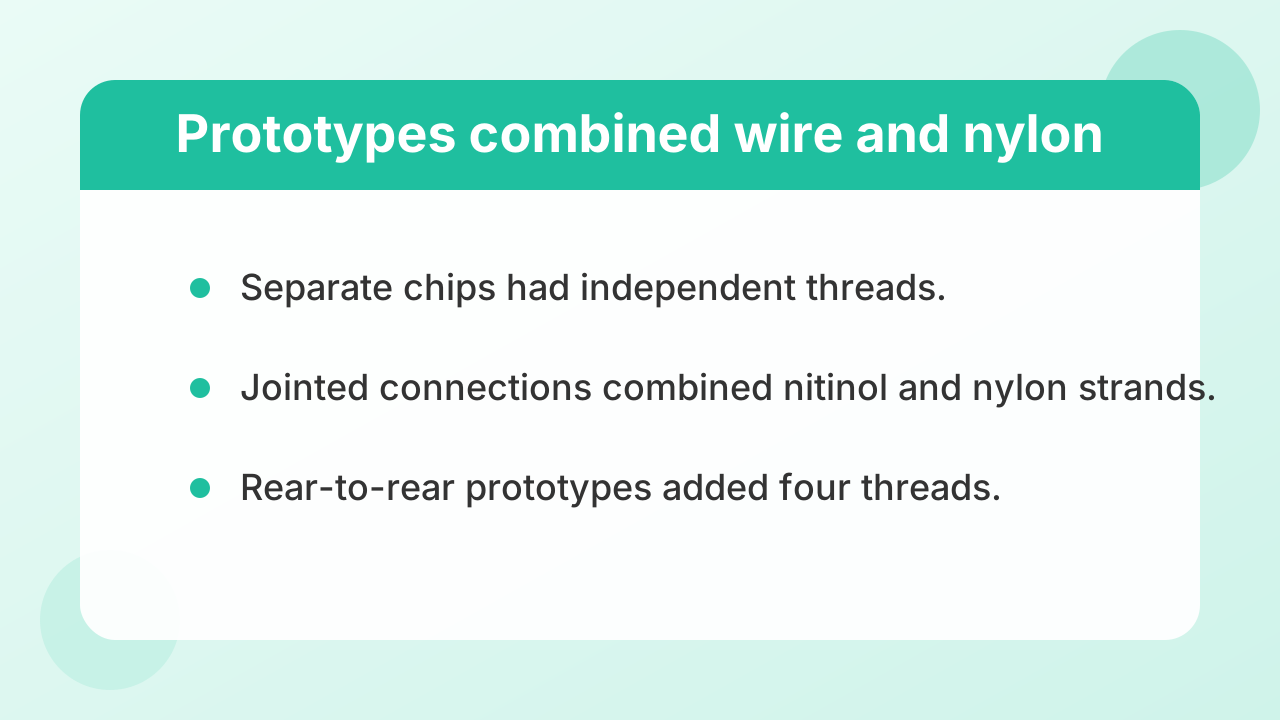
| Nov 2025 | Jointed connections combined two nitinol strands with two nylon strands inside resin-covered sections. |
| Feb 2026 | Ceramic and blue-resin prototypes combined double wire with double nylon; sales were not planned. |
| Aug 2026 | Rear-to-rear prototypes added four threads; Mr. Okada warned of overlapping chips after bladder entry. |
OK Prostate Chip products related to retrieval thread breakage
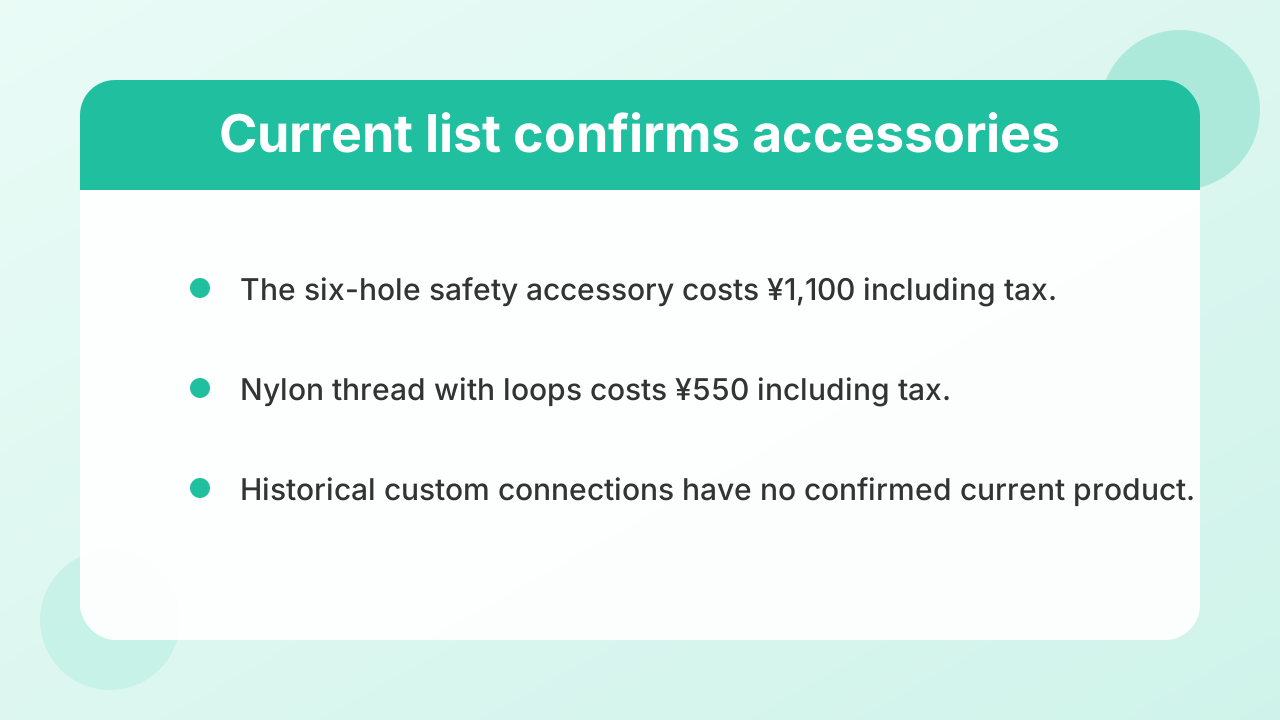
The current list confirms these accessories, without establishing availability of the historical custom connections.
Products that appear in these entries
| Product (official name) | Price incl. tax | Relation to this topic |
|---|---|---|
| Six-hole safety accessory (六穴方式オプションチップ(セーフティチップ)) | ¥1,100 (about $7 at ¥156 = $1, rate as of 2026-09-04) | In April 2019, this separately sold accessory accompanied the introduction of two-thread orders. |
The six-hole safety accessory is sold through OK Lab’s own online store.
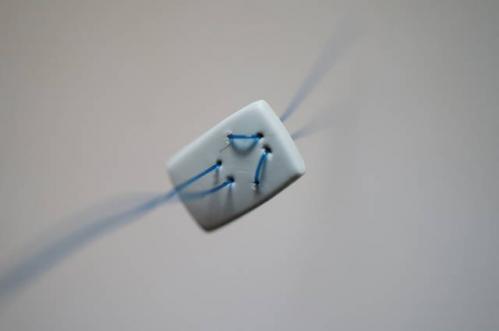
(Source: ok-lab's diary, published April 2019)
https://ok-lab.hatenablog.com/entry/2019/04/27/153239
Products the diary mentioned as alternatives
| Product (official name) | Price incl. tax | Relation to this topic |
|---|---|---|
| Nylon thread with loops at both ends (両端ループナイロン糸) | ¥550 (about $4 at ¥156 = $1, rate as of 2026-09-04) | In February 2021, Mr. Okada suggested two separate loop threads instead of joined loops for strength. |
The nylon thread with loops at both ends is sold through OK Lab’s own online store.
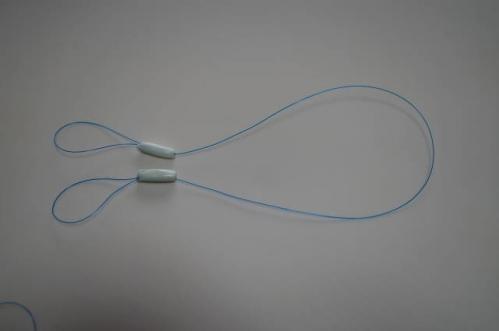
(Source: ok-lab's diary, published February 2021)
https://ok-lab.hatenablog.com/entry/2021/02/27/130152
Historical custom connections, curved-chip versions, wire-loop builds, titanium prototypes, and experimental thread assemblies
No matching product can be confirmed on the current list.
Common worries about retrieval thread breakage
The diary distinguishes a secure attachment from a thread that remains vulnerable to damage.
"Can two retrieval threads come loose from a ceramic chip?"
In an entry published in August 2020, a customer asked whether a ceramic chip’s thread depended on glue alone. Mr. Okada explained that its attachment included a knot through a hole, secured beneath resin. He considered that attachment secure, while acknowledging that damage could still cut the nylon itself.
At that time, approximately one in ten orders requested two threads. Mr. Okada advised the two-thread option for customers concerned about breakage.
(Source: ok-lab's diary, published August 2020)
https://ok-lab.hatenablog.com/entry/2020/08/01/124144
"Can double retrieval threads also form matching end loops?"
In an entry published in February 2021, a customer requested doubled loops with the strands held together. Mr. Okada produced a prototype but reported that the two strands were not exactly equal and could change shape differently. The terminal loop remained free, while doubling the separately sold loop-thread product added ¥500 (about $3 at ¥156 = $1, rate as of 2026-09-04) excluding tax.
He warned that the finish would not necessarily look neat. For strength, Mr. Okada suggested two separate loop threads might work better than joined loops.
(Source: ok-lab's diary, published February 2021)
https://ok-lab.hatenablog.com/entry/2021/02/27/130152
"Do two retrieval threads rule out losing the chip?"
In an entry published in July 2025, a customer feared that a thread could break or disappear inside the body. Mr. Okada replied that two threads improved the backup, but a sharp object could still cut both. His alternative was a flexible extension (a tube containing nylon and shape-memory wire), using a 1mm tube.
The diary does not record the customer’s eventual choice. Mr. Okada recommended that covered extension as the safer option in his judgment.
(Source: ok-lab's diary, published July 2025)
https://ok-lab.hatenablog.com/entry/2025/07/26/122909
Buying from outside Japan

OK Lab ships internationally to countries covered by Japan Post's EMS courier service. Overseas orders are paid in advance by PayPal. Each order carries a ¥400 (about $3 at ¥156 = $1, rate as of 2026-09-04) handling fee, and EMS shipping is charged on top. These terms come from OK Lab's official sales-terms page (written here as plain text, not a link: ok-lab.net/docs/law), checked on September 7, 2026; confirm them on the official store before you order, because they can change.
Summary of this article
| What you wanted to know | The answer |
|---|---|
| What is the short answer? | A second connection is a backup; Mr. Okada acknowledges that both can fail. |
| What is the product? | A urethral device made by OK Lab in Japan, with prices in Japanese yen. |
| What do the connection terms mean? | Threads, wires, cables, and covered extensions provide different forms of attachment or backup. |
| What has happened? | The diary records broken connections, retained chips, and problems during prototype testing. |
| What did the maker change? | He introduced additional threads, continuous backups, and four-thread specifications with separate costs and limits. |
| How did development continue? | Later entries explored mixed materials and new connections, including experimental designs in 2026. |
| What has a confirmed current price? | The listed six-hole safety accessory costs ¥1,100 (about $7 at ¥156 = $1, rate as of 2026-09-04); the loop thread costs ¥550, (about $4 at ¥156 = $1, rate as of 2026-09-04) both including tax. |
| What remained uncertain for customers? | Secure attachments did not eliminate thread damage or guarantee retrieval. |
| How do overseas purchases work? | Advance PayPal payment, a ¥400 (about $3 at ¥156 = $1, rate as of 2026-09-04) handling fee, and additional EMS shipping apply under the stated terms. |
Source: ok-lab's diary (Okada Comfortable Life Laboratory). The original entries are in Japanese; quotations on this page are translated. Photos and videos are on the original entries.
This article is a summary of the maker's development diary. The product is not a medical device and no result is guaranteed. If anything feels wrong or worries you, see a doctor. Prices, specifications and cautions change, so confirm the latest information on the official blog and the official site. Questions about ordering and shipping go to the seller.