![Urine leakage or can't pee after a chip? | Some cases needed hospital treatment [OK Prostate Chip]](/img/a/T0347/eyecatch.svg)
This page is based on entries from "ok-lab's diary" (https://ok-lab.hatenablog.com/), the Japanese development diary written by Mr. Okada, founder of OK Lab, a small company in Japan (Okada Comfortable Life Laboratory). Only the entries about "urine leakage, trouble urinating and unusual urges" are summarized here, in order of publication. Past prices and sizes are as written at the time. Current prices come from the official product list (retrieved September 4, 2026). Quotations are translated from Japanese.
Note: This page is a personal reading log by someone with no connection to the maker or the seller. It reflects the source entries as of their publication dates and makes no guarantee of accuracy or safety. The product is not a medical device; talk to a doctor about any health decision. Check the official site for current information. This page contains advertising.
In short
The diary records urine leakage, sudden urges and difficulty urinating, including cases that required hospital treatment.
Mr. Okada warns about design limitations and stopper failures, and says the chip alone cannot resolve overactive bladder.
The current list includes products involved in earlier incidents; older custom builds cannot all be matched.
If you see blood in your urine, even a small amount or for the first time, do not wait and see. See a urologist right away. If you suddenly cannot urinate, or the device cannot be removed, do not try to fix it yourself. Go to a medical facility, including emergency care, immediately.
About this product

The OK Prostate Chip is a small device that is placed in the urethra (the urine passage) so that it acts on the prostate; the maker sells it in several shapes, sizes and materials. It is made and sold by OK Lab (Okada Comfortable Life Laboratory), a small company in Japan, through its own online store, and prices are in Japanese yen (JPY).
The maker's development diary, "ok-lab's diary", is written in Japanese. This page is an English summary of it, and every quotation is translated. OK Lab ships internationally, so readers outside Japan can order (see "Buying from outside Japan" below).
Product names on this page are plain-English descriptions. The official Japanese product name is shown once in the product table so you can find the same item in the store.
Before you read: key terms
| Term | Plain-English meaning |
|---|---|
| Urethra | The urine passage; it carries urine and is where the chip is placed. |
| Urinary sphincter | A muscle described in the diary as closing the urine passage to help control urine. |
| Sphincter stopper | An auxiliary piece intended to limit a chip's movement toward the bladder. |
| Retrieval thread | A line attached to the chip, intended to help retrieve it. |
| Endoscope and forceps | A viewing instrument and gripping instruments used by hospital staff during the reported removals. |
| Overactive bladder | The condition name Mr. Okada uses when discussing urgent, hard-to-control urination. |
| Urethritis | Inflammation of the urine passage; Mr. Okada mentions it as a possible explanation for frequent urination. |
What happens: urine leakage and trouble peeing
The OK Prostate Chip is a small device placed in the urethra to stimulate the prostate. This topic concerns unwanted urine leakage, unusually urgent toilet needs and difficulty passing urine during or after chip use. The entries discuss urinary sphincters (muscles that help control urine), device shapes and chips that moved into the bladder. They also describe a sphincter stopper (an auxiliary piece intended to limit inward movement), including cases where it failed.
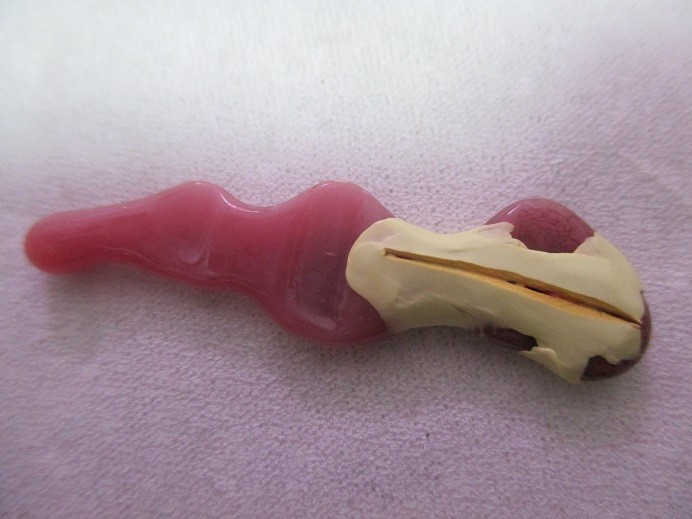
Frequent urination preceded hospital removal after the retrieval thread detached
An entry published in May 2018 describes a customer who valued a custom semi-long chip's steady stimulation. After its retrieval thread (the line intended for removal) detached, the chip entered the bladder; frequent urination, dull pain and blood followed.
Hospital staff removed it using an endoscope (a viewing instrument) and forceps (gripping instruments). With a 30% patient share, the reported bill was about ¥29,000 (about $186 at ¥156 = $1, rate as of 2026-09-04), including ¥25,000 (about $160 at ¥156 = $1, rate as of 2026-09-04) for surgery. The customer reported recovery; Mr. Okada declined to add comments.
(Source: ok-lab's diary, published May 2018)
https://ok-lab.hatenablog.com/entry/20180511/1526036007
Sudden urges followed repeated use of a large motorized chip
In an entry published in June 2019, a customer reported using a chip with 3 motors about 10 times. They said an urge now left only 10–20 seconds to reach a toilet, affecting shopping and driving.
Mr. Okada suspected a bladder-control problem and discussed possible strain from prolonged widening of the muscles. The diary does not record whether the customer's bladder control recovered. Mr. Okada warned that a large, flattened bulge could prevent muscle closure, allowing leakage as soon as an urge appeared.
(Source: ok-lab's diary, published June 2019)
https://ok-lab.hatenablog.com/entry/2019/06/08/144200
A directly attached stopper preceded urine leakage lasting about one day
In an entry published in November 2020, Mr. Okada described testing a chip with a short connecting projection and directly attached stopper. He wrote that after about 10 hours, the muscle would not close properly and slight urine leakage continued for about a whole day. He suspected fatigue or injury, rather than reporting a medical diagnosis. Mr. Okada cautioned that this direct connection could place excessive strain on the muscle.
(Source: ok-lab's diary, published November 2020)
https://ok-lab.hatenablog.com/entry/2020/11/07/121125
A stopper failed to prevent urine leakage after inward movement
An entry published in April 2022 describes a customer whose double-twist chip (Labuca) entered the bladder during sleep despite a stopper. They reported uncontrollable urine leakage, blood and an intense feeling that urine remained after each toilet visit. Hospital treatment removed the device and cost about ¥8,000 (about $51 at ¥156 = $1, rate as of 2026-09-04).
The diary does not record when the remaining symptoms resolved. Mr. Okada said an internal stopper might be unsuitable when it easily crossed the muscle into the bladder. For that situation, he wrote that he trusted only a stopper outside the head of the penis.
(Source: ok-lab's diary, published April 2022)
https://ok-lab.hatenablog.com/entry/2022/04/02/123050
A stuck chip pair raised concerns about later trouble peeing
In an entry published in August 2022, a customer reported that a short resin chip, size M, and its auxiliary piece became trapped together. Hospital staff removed the folded pair using a viewing instrument and gripping instruments on the 5th day. Treatment cost about ¥8,000 (about $51 at ¥156 = $1, rate as of 2026-09-04), with insurance coverage.
The customer's doctor reportedly warned that injury from prolonged retention and extraction might later affect urine flow. The diary does not record whether that later problem developed. Mr. Okada acknowledged that thread entanglement had no absolute solution.
(Source: ok-lab's diary, published August 2022)
https://ok-lab.hatenablog.com/entry/2022/08/20/122920
A solid sphere stopped urine flow during the maker's prototype test
In an entry published in February 2024, Mr. Okada reported that a spherical prototype head acted like a plug inside the bladder. He reported urine flow stopped completely, and urination resumed only after the head was no longer inside the bladder. He then developed a head with drainage openings. Mr. Okada rejected the solid sphere for his intended continuous use.
(Source: ok-lab's diary, published February 2024)
https://ok-lab.hatenablog.com/entry/2024/02/17/123013
Crossed loops produced urine leakage in Mr. Okada's test
In an entry published in January 2025, Mr. Okada tested crossed wire-and-tube loops after a customer's request. He reported leakage whenever the muscle gripped the crossed loops, because their spring forces kept them from closing together. He also feared muscle injury during prolonged retention in that position.
He offered the custom construction at ¥2,000 (about $13 at ¥156 = $1, rate as of 2026-09-04) tax excluded for each loop location changed to crossed loops, as published in January 2025. Mr. Okada said he could not recommend this construction to everyone.
(Source: ok-lab's diary, published January 2025)
https://ok-lab.hatenablog.com/entry/2025/01/11/122910
An overnight accident outside Japan led to worsening trouble peeing
In an entry published in June 2025, a customer outside Japan reported an overnight accident with a chip (Sea Slug ver.4). The entire cord slipped into the urethra, and the chip entered the bladder during sleep. After 1 day, difficulty urinating and frequent toilet needs had worsened, and the customer underwent hospital surgery described as requiring no incision.
The customer had previously shortened the cord, but did not know why the later inward movement happened. Mr. Okada guessed that gripping instruments had been used; the customer did not identify the hospital's exact method. He thanked the customer for reporting the accident.
(Source: ok-lab's diary, published June 2025)
https://ok-lab.hatenablog.com/entry/2025/06/14/122936
The maker's answer to urine leakage and trouble peeing
Mr. Okada's replies acknowledge limits to the chip's benefits and to the protection offered by its parts.
Mr. Okada described reduced urine leakage as speculation with limits
In an entry published in October 2017, Mr. Okada discussed overactive bladder (urgent, hard-to-control urination). He thought a chip might strengthen urinary control, explicitly calling this speculation based on his experience. Even his own symptoms, he wrote, had not completely disappeared. He cautioned that the chip alone could not resolve the underlying condition and might only reduce the amount leaked.
(Source: ok-lab's diary, published October 2017)
https://ok-lab.hatenablog.com/entry/20171013/1507858434
Persistent urinary urgency prompted a change toward early medical care
In an entry published in May 2020, a first-time customer could not retrieve a short twisted ceramic chip with a screw-shaped auxiliary chip. They reported frequent urges, little time to reach a toilet and some pain during urination. Mr. Okada initially proposed home retrieval, then urged early urology care when the next morning brought no improvement.
A later follow-up reported that the chip came out, but was lost before inspection. Asked about alternatives, Mr. Okada favored a single chip with a sphincter stopper, while acknowledging that the stopper offered no guarantee.
(Source: ok-lab's diary, published May 2020)
https://ok-lab.hatenablog.com/entry/2020/05/02/131505
One stuck chip report prompted warnings about external vibration
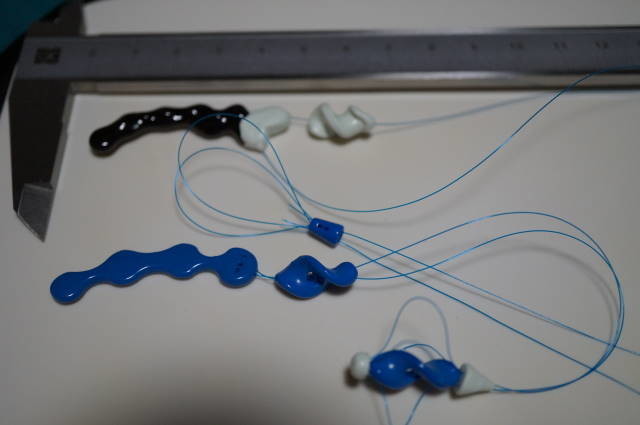
An entry published in December 2021 describes a customer seeking help after a narrow custom chip assembly disappeared inward. OK Lab staff initially thought its final component probably remained outside the bladder; the hospital found the whole assembly inside. The customer reported removal in about 10 minutes, with treatment costing more than ¥30,000 (about $192 at ¥156 = $1, rate as of 2026-09-04).
The customer later described strong external vibration during use. Mr. Okada warned against vibrator-assisted pressure with an entirely internal assembly; his stated minimum requirement was a retrieval thread extending outside the body.
(Source: ok-lab's diary, published December 2021)
https://ok-lab.hatenablog.com/entry/2021/12/25/123556
If you see blood in your urine, even a small amount or for the first time, do not wait and see. See a urologist right away. If you suddenly cannot urinate, or the device cannot be removed, do not try to fix it yourself. Go to a medical facility, including emergency care, immediately.
How urine leakage and trouble peeing changed over time
| Published | What the diary said then |
|---|---|
| Jan 2018 | A customer reported darker urine and bleeding after about 12 hours of use. |
| Apr 2019 | A broken-thread accident prompted a separately made replacement with two retrieval threads. |
| Nov 2020 | Revised connection: about 6mm spacing; Mr. Okada reported no problems after 10 hours. |
| Apr 2022 | Support made from 4 wires became chargeable; a 12cm version added ¥3,300 (about $21 at ¥156 = $1, rate as of 2026-09-04). |
| Dec 2022 | An 8-hole auxiliary device was announced for the following year. |
| Oct 2023 | Mr. Okada paused chip retention because of frequent urination and perceived reduced bladder capacity. |
| Dec 2024 | Mr. Okada announced a more flexible, single-wire connection for bladder loops. |
| Apr 2025 | A customer reported chills and ended a stiffer loop trial in under 30 minutes. |
| Apr 2026 | A prototype customer continued to report repeated small urine leaks. |
(Source: ok-lab's diary, published April 2022)
https://ok-lab.hatenablog.com/entry/2022/04/23/123121
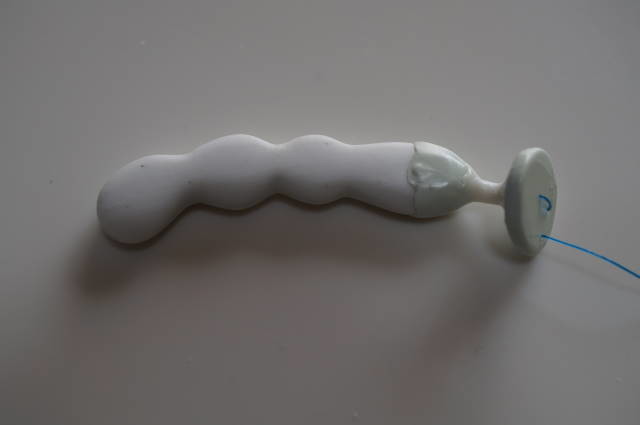
OK Prostate Chip products related to urine leakage and trouble peeing
The current list identifies the main chip and auxiliary part named in the May 2020 accident report.
Products that appear in these entries
| Product (official name) | Price incl. tax | Relation to this topic |
|---|---|---|
| Short twisted ceramic chip (OKプロステートチップ 陶器素材ショートタイプ ツイスト) | ¥4,400 (about $28 at ¥156 = $1, rate as of 2026-09-04) | May 2020: this was the named main chip in a report of failed retrieval and urgent urination. |
| Screw-shaped auxiliary chip (スクリュー型補助チップ追加オプション) | ¥3,300 (about $21 at ¥156 = $1, rate as of 2026-09-04) | May 2020: this was the auxiliary part involved; Mr. Okada said it did not reliably prevent inward movement for that customer. |
(Source: ok-lab's diary, published May 2020)
https://ok-lab.hatenablog.com/entry/2020/05/02/131505
Products the diary mentioned as alternatives
The diary names no alternative.
Historical custom builds, prototypes and nickname-only versions: No matching product can be confirmed on the current list.
Common worries about urine leakage and trouble peeing
The questions include increased toilet frequency, leakage from proposed designs and an inability to urinate despite wanting to.
"Why does the chip make me need to pee frequently?"
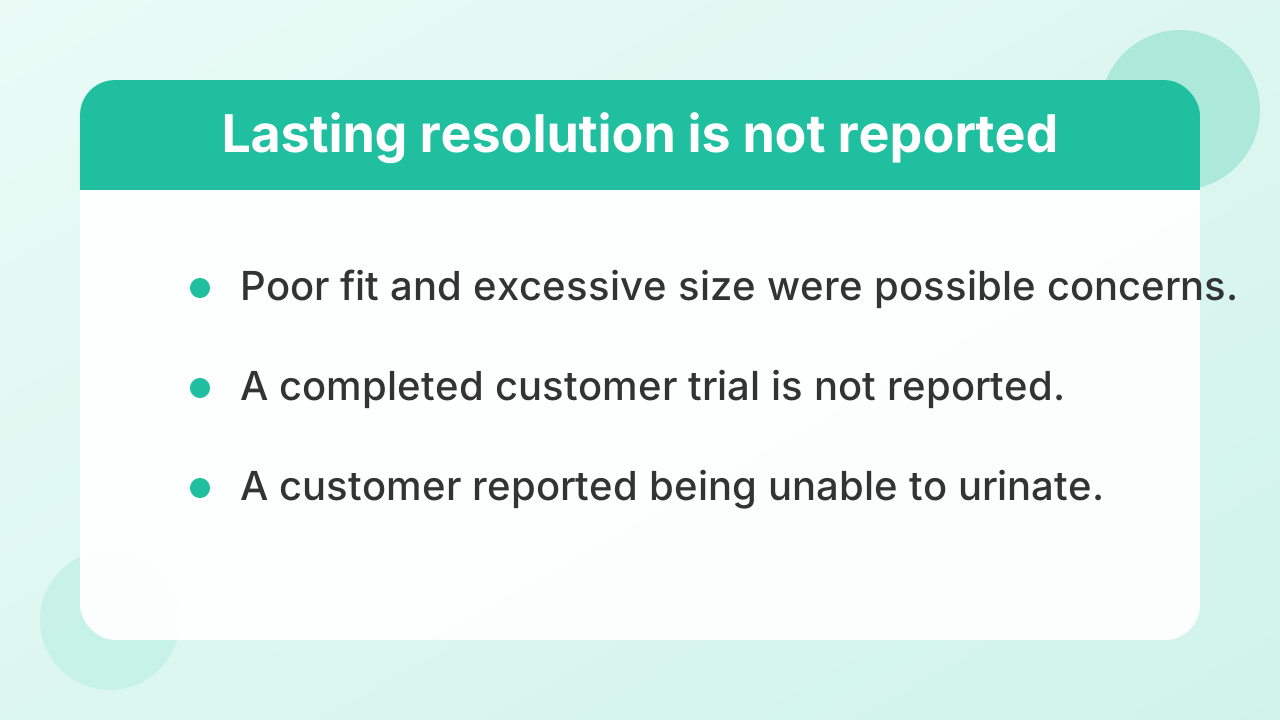
In an entry published in October 2019, a long-term customer asked whether more frequent toilet trips were unusual. Mr. Okada said some increase matched his experience, and that awareness of it could lessen with familiarity. The diary does not record whether this customer's symptoms improved. Mr. Okada also raised poor fit, excessive size and urethritis (inflammation of the urine passage) as possible concerns.
(Source: ok-lab's diary, published October 2019)
https://ok-lab.hatenablog.com/entry/2019/10/12/125944
"Would a hollow chip stay put without causing urine leakage?"
In an entry published in January 2022, a customer proposed a hollow chip to avoid displacement during urination. Mr. Okada replied that a tube with an internal diameter around 3mm could be overwhelmed by urine flow. The diary does not record a completed customer trial. He warned that a through-hole could also leave the muscle unable to stop urine that had passed beyond the bladder outlet.
(Source: ok-lab's diary, published January 2022)
https://ok-lab.hatenablog.com/entry/2022/01/08/123729
"Has anyone else been unable to pee after chip use?"
In an entry published in May 2022, a customer living in the United States reported being unable to urinate after repeated orgasms. After use of a chip identified by its nickname (Zoro), episodes lasted 3–4 hours at minimum and about 10 hours at maximum. The customer wanted to know whether similar reports existed and had avoided medical care because of cost and difficulty explaining the situation.
Mr. Okada said he had not experienced this, and asked whether the customer actually wanted to urinate. A follow-up published later in May 2022 confirmed a distressing need to urinate without being able to. The diary does not record a medical diagnosis or a lasting resolution.
(Source: ok-lab's diary, published May 2022)
https://ok-lab.hatenablog.com/entry/2022/05/21/124217
(Source: ok-lab's diary, published May 2022)
https://ok-lab.hatenablog.com/entry/2022/05/28/123218
Buying from outside Japan

OK Lab ships internationally to countries covered by Japan Post's EMS courier service. Overseas orders are paid in advance by PayPal. Each order carries a ¥400 (about $3 at ¥156 = $1, rate as of 2026-09-04) handling fee, and EMS shipping is charged on top. These terms come from OK Lab's official sales-terms page (written here as plain text, not a link: ok-lab.net/docs/law), checked on September 7, 2026; confirm them on the official store before you order, because they can change.
Summary of this article
| What you wanted to know | The answer |
|---|---|
| In short | Leakage, urgent toilet needs and difficulty urinating appear in reports, including hospital cases. |
| About this product | OK Lab in Japan makes the urethral device and sells it in Japanese yen. |
| Key terms | The sphincters control urine; threads and stoppers are device parts intended to aid retrieval or limit movement. |
| What happens | Reported problems include inward movement, trapped connected chips, poor muscle closure and blocked urine flow. |
| The maker's answer | His replies acknowledge limitations and include an escalation toward medical care after failed retrieval. |
| Changes over time | Accidents and prototype problems prompted changes to threads, connections and support designs. |
| Related products | The named ceramic chip and auxiliary part are listed at ¥4,400 (about $28 at ¥156 = $1, rate as of 2026-09-04) and ¥3,300 (about $21 at ¥156 = $1, rate as of 2026-09-04) incl. tax. |
| Common worries | The diary records questions about frequency, hollow designs and inability to urinate after use. |
| Buying from outside Japan | The stated terms are advance PayPal payment, a ¥400 (about $3 at ¥156 = $1, rate as of 2026-09-04) handling fee and additional EMS shipping. |
Source: ok-lab's diary (Okada Comfortable Life Laboratory). The original entries are in Japanese; quotations on this page are translated. Photos and videos are on the original entries.
This article is a summary of the maker's development diary. The product is not a medical device and no result is guaranteed. If anything feels wrong or worries you, see a doctor. Prices, specifications and cautions change, so confirm the latest information on the official blog and the official site. Questions about ordering and shipping go to the seller.