![Can a tight penis ring cause blisters or tissue damage? | The maker reports serious pressure problems [OK Prostate Chip]](/img/a/T0344/eyecatch.svg)
This page is based on entries from "ok-lab's diary" (https://ok-lab.hatenablog.com/), the Japanese development diary written by Mr. Okada, founder of OK Lab, a small company in Japan (Okada Comfortable Life Laboratory). Only the entries about "tight penis rings, blisters, and tissue damage" are summarized here, in order of publication. Past prices and sizes are as written at the time. Current prices come from the official product list (retrieved September 4, 2026). Quotations are translated from Japanese.
Note: This page is a personal reading log by someone with no connection to the maker or the seller. It reflects the source entries as of their publication dates and makes no guarantee of accuracy or safety. The product is not a medical device; talk to a doctor about any health decision. Check the official site for current information. This page contains advertising.
In short
Mr. Okada reports purple discoloration, blisters, and difficult removal in experiments involving rings and plates.
He warns against strong pressure and later rejects some binding proposals.
The current list includes an older cushion alternative, but the latest supplied ring report still describes unresolved pressure problems.
If you see blood in your urine, even a small amount or for the first time, do not wait and see. See a urologist right away.
If you suddenly cannot urinate, or the device cannot be removed, do not try to fix it yourself. Go to a medical facility, including emergency care, immediately.
About this product

The OK Prostate Chip is a small device that is placed in the urethra (the urine passage) so that it acts on the prostate; the maker sells it in several shapes, sizes and materials. It is made and sold by OK Lab (Okada Comfortable Life Laboratory), a small company in Japan, through its own online store, and prices are in Japanese yen (JPY).
The maker's development diary, "ok-lab's diary", is written in Japanese. This page is an English summary of it, and every quotation is translated. OK Lab ships internationally, so readers outside Japan can order (see "Buying from outside Japan" below).
Product names on this page are plain-English descriptions. The official Japanese product name is shown once in the product table so you can find the same item in the store.
Before you read: key terms
| Term | Plain-English meaning |
|---|---|
| Urethra | The urine passage; the chip is intended to remain inside it. |
| Gatekeeper | The maker’s name for an accessory intended to limit chip movement at the urethral opening. |
| Base plate | An external support used in experiments intended to keep the penis pressed inward. |
| Stopper | An additional chip component intended to limit movement along the urine passage. |
| Silicone–nylon cord | Silicone tubing containing nylon, proposed as material for an external ring. |
What happens: tight penis rings
The OK Prostate Chip is a small device placed in the urethra to act on the prostate. These entries discuss pressure from external rings, cords, and plates intended to hold a chip or related equipment in position. The rings and cords surround the penis, while some plate experiments involve an opening around its head. The concern is whether pressure becomes excessive, causes blistering or discoloration, or makes an attachment difficult to remove.
Mr. Okada reported his penis turning purple during ring testing
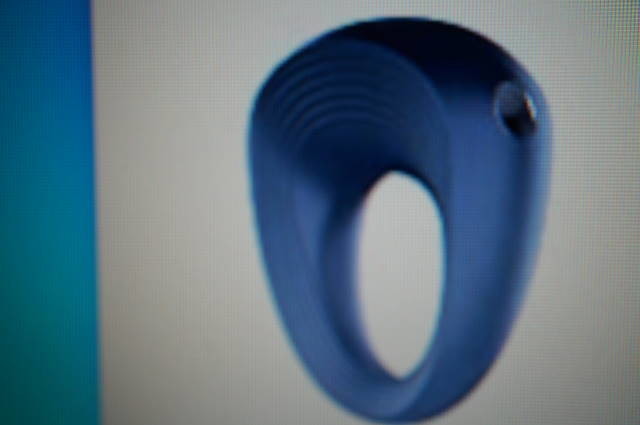
In an entry published in October 2021, Mr. Okada describes testing a German-made silicone ring while looking for a suitable chip accessory. He reports that the ring became excessively tight and his penis turned purple. His account connects this problem to stretching the ring beyond its intended arrangement. He favored developing an adjustable alternative after finding the commercial rings unsuitable.
(Source: ok-lab's diary, published October 2021)
https://ok-lab.hatenablog.com/entry/2021/10/23/125707
Tight penis rings created a tradeoff between pressure and slipping
In an entry published in January 2022, Mr. Okada describes adapting a ring-shaped controller for a wearable vibrating chip. He writes that stretched silicone could exert excessive pressure and impede blood flow, while a larger ring could slip off when the penis shrank. His prototype therefore combined silicone with adjustable stocking fabric. Mr. Okada advised against tolerating an uncomfortably tight controller ring.
(Source: ok-lab's diary, published January 2022)
https://ok-lab.hatenablog.com/entry/2022/01/01/124134
Mr. Okada linked penis blisters to pressure during gatekeeper development
In an entry published in April 2022, Mr. Okada discusses a gatekeeper (an accessory intended to limit chip movement at the urethral opening). He intended it to prevent chips moving outward or too far inward, including toward the bladder. He writes that strongly compressed penile skin could quickly blister, although he believed the head and narrower area behind it tolerated pressure better. He cautioned about trapped foreskin when describing that claimed difference.
(Source: ok-lab's diary, published April 2022)
https://ok-lab.hatenablog.com/entry/2022/04/16/123037
Rubber band pressure prompted a warning after one customer’s favorable report
In an entry published in May 2022, a customer describes a customized ceramic chip assembly and a rubber-band attachment intended to stabilize it. The customer reported steadier positioning and less concern about the chip moving toward the bladder. Mr. Okada replied that the idea might work with moderate pressure. He also warned that excessive tightening with a rubber band was dangerous.
(Source: ok-lab's diary, published May 2022)
https://ok-lab.hatenablog.com/entry/2022/05/07/123013
Mr. Okada described repeated episodes of his penis turning purple
In an entry published in October 2022, Mr. Okada reports repeatedly forgetting a silicone ring because it felt pleasant. He writes that his penis became purple, which he described as approaching tissue death. The diary does not record whether a clinician assessed these episodes. Mr. Okada warned about prolonged pressure from elastic rings.
(Source: ok-lab's diary, published October 2022)
https://ok-lab.hatenablog.com/entry/2022/10/01/122944
Penis trapped in a plate raised concerns about erections during sleep
In an entry published in May 2023, Mr. Okada describes a base plate (an external support intended to keep the penis pressed inward). He reports that an opening of about 2 cm left the plate difficult to remove once the penis head was beyond it. He worried about pressure during an erection while asleep, although he reported no such episode in that entry. Mr. Okada cautioned against this arrangement where an erection could prevent removal.
(Source: ok-lab's diary, published May 2023)
https://ok-lab.hatenablog.com/entry/2023/05/06/123024
Penis blisters and difficult removal appeared in a ceramic plate test
In another entry published in May 2023, Mr. Okada describes a 20mm-15mm ceramic opening and reports experiencing heart failure. He places this about 1 hour after falling asleep, without penile pain, discoloration, or coldness, and says removal took about 30 minutes. The diary does not record a confirmed cause for the reported heart failure.
He also reports slight blister-like swelling after more than 1 day in a position that partly compressed the penis head. According to him, the swelling quickly subsided after that position ended. Mr. Okada judged prolonged use of the smaller opening unsuitable with the whole head exposed.
(Source: ok-lab's diary, published May 2023)
https://ok-lab.hatenablog.com/entry/2023/05/20/123034
The maker's answer to tight penis rings
Mr. Okada explored different materials and adjustable designs, while warning that pressure could still cause serious problems.
An older cushion suggestion accompanied warnings about tight penis rings
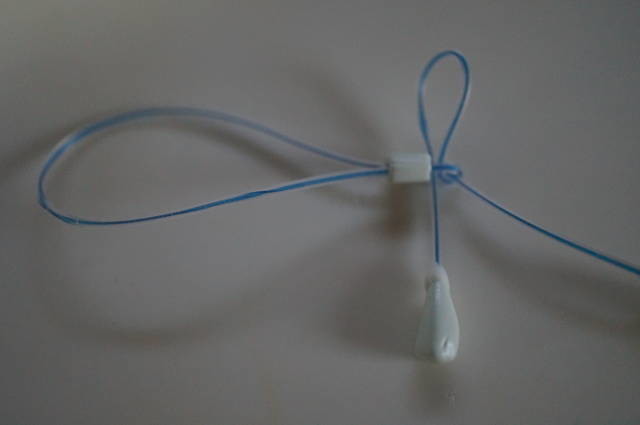
In an entry published in June 2019, Mr. Okada warns that prolonged tightening could lead to tissue death. He names a stocking-fabric cushion as a possible alternative to a ring for stabilizing a curved ceramic chip. He describes a cushion that could contract to half its size and then return naturally. Mr. Okada emphasized avoiding strong pressure during prolonged fixation.
(Source: ok-lab's diary, published June 2019)
https://ok-lab.hatenablog.com/entry/2019/06/01/155432
A silicone–nylon cord was offered as an alternative to tight penis rings
In an entry published in October 2022, Mr. Okada presents a silicone–nylon cord (silicone tubing containing nylon) with a loop component. The published price for the 20 cm version was ¥2,000, (about $13 at ¥156 = $1, rate as of 2026-09-04) tax excluded. He writes that the nylon limited stretching and that the combined materials resisted forming tight knots. Mr. Okada proposed this cord as an alternative to conventional silicone rings.
(Source: ok-lab's diary, published October 2022)
https://ok-lab.hatenablog.com/entry/2022/10/01/122944
Rubber band pressure was rejected for an experimental urine collector
In an entry published in April 2023, Mr. Okada discusses a urine collector involving a condom and external tubing. He warns that rubber bands could deform the tubing and potentially stop blood flow in the penis. His experiment instead used silicone tubing with an outside diameter of 1 mm, which he considered gentler. Mr. Okada warned against rubber bands for penile restraint.
(Source: ok-lab's diary, published April 2023)
https://ok-lab.hatenablog.com/entry/2023/04/01/122841
A softer adjustable loop addressed ring pressure in another urine collector
In a later entry published in April 2023, Mr. Okada describes bead-adjusted silicone loops associated with the three-piece external plate set. These doubled loops used tubing with an outside diameter of 1 mm; the published price was ¥500, (about $3 at ¥156 = $1, rate as of 2026-09-04) tax excluded, for 2 loops. He believed their softness limited excessive pressure, but also described urine backing up when the seal was too loose. Mr. Okada cautioned that his standard sample might not fit larger users.
(Source: ok-lab's diary, published April 2023)
https://ok-lab.hatenablog.com/entry/2023/04/08/122508
If you see blood in your urine, even a small amount or for the first time, do not wait and see. See a urologist right away.
If you suddenly cannot urinate, or the device cannot be removed, do not try to fix it yourself. Go to a medical facility, including emergency care, immediately.
How tight penis rings changed over time
| Published | What the diary said then |
|---|---|
| Jun 2019 | A fabric cushion was suggested alongside warnings about prolonged tightening. |
| Oct 2021 | Mr. Okada found a 42 mm ring unremovable during erections. |
| Jan 2022 | A controller prototype combined adjustable stocking fabric with silicone. |
| Oct 2022 | A nylon-reinforced silicone cord was offered as an alternative material. |
| Nov 2022 | Mr. Okada rejected a proposal involving pressure on the testicles. |
| Apr 2023 | Rubber bands were rejected for connections in an experimental urine collector. |
| May 2023 | A ceramic plate test involved difficult removal and a separate blistering observation. |
| Jan 2024 | Earlier small openings were excluded from the list intended for full-head exposure. |
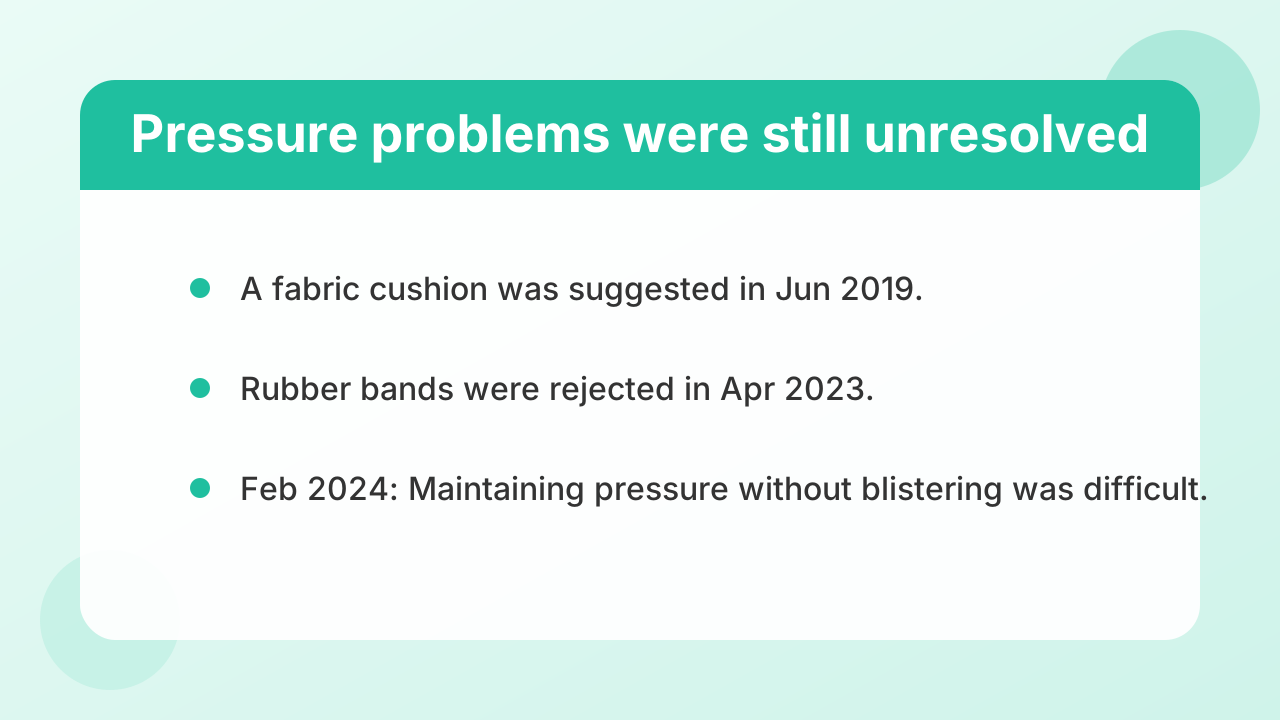
| Feb 2024 | Mr. Okada reported difficulty maintaining pressure that prevented movement without blistering. |
The diary does not say what the current state is.
OK Prostate Chip products related to tight penis rings
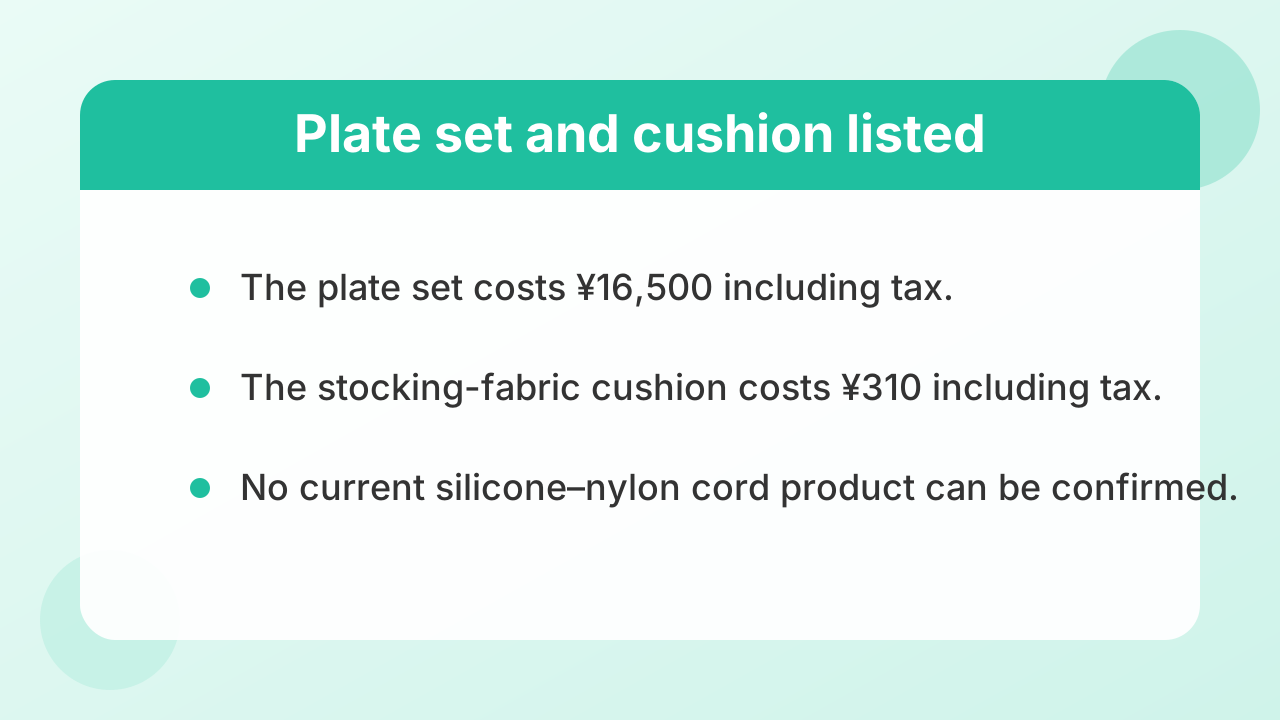
The current list includes an experimental setup’s plate set and the cushion named in the older ring discussion.
Products that appear in these entries
| Product (official name) | Price incl. tax | Relation to this topic |
|---|---|---|
| Three-piece external plate set (エイン・デ・フラット3点セット) | ¥16,500 (about $106 at ¥156 = $1, rate as of 2026-09-04) | In April 2023, this set appeared in the urine-collector experiment involving adjustable loops and concerns about pressure and leakage. |
(Source: ok-lab's diary, published April 2023)
https://ok-lab.hatenablog.com/entry/2023/04/08/122508
Products the diary mentioned as alternatives
| Product (official name) | Price incl. tax | Relation to this topic |
|---|---|---|
| Stocking-fabric cushion (亀頭淵クッション) | ¥310 (about $2 at ¥156 = $1, rate as of 2026-09-04) | In June 2019, Mr. Okada named this cushion as a ring substitute while warning about prolonged tightening. |
(Source: ok-lab's diary, published June 2019)
https://ok-lab.hatenablog.com/entry/2019/06/01/155432
Earlier gatekeeper, silicone–nylon cord, experimental silicone loops, wearable controller, and custom plate or chip assemblies: No matching product can be confirmed on the current list.
Common worries about tight penis rings
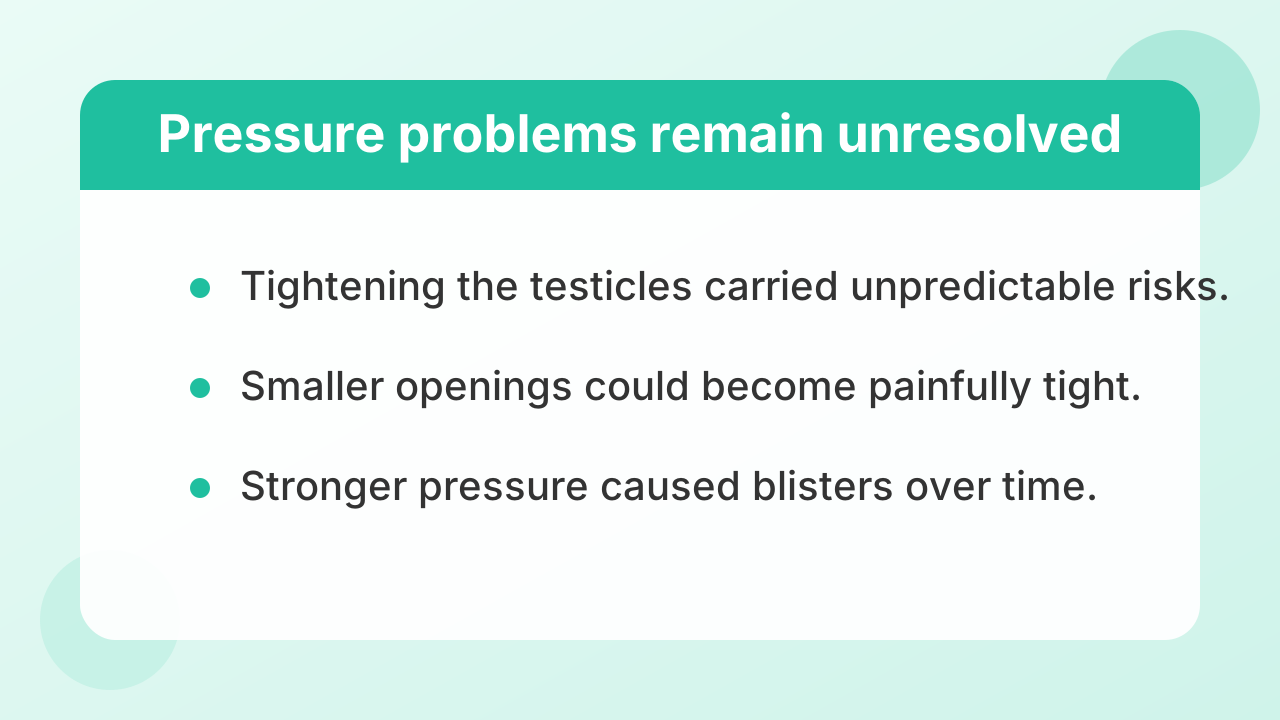
The reader questions concern whether experience, sizing, or extra supports could make pressure-based designs workable.
"Could experienced chip users avoid the dangers of testicle binding?"
In an entry published in November 2022, a customer asks whether a binding design could be offered as a custom product for experienced users. Mr. Okada explains that he had explored binding when he thought pressure was necessary to keep the penis pressed inward.
By then, he believed that goal might be possible without binding, and he rejected the proposal because tightening the testicles carried unpredictable risks. Mr. Okada favored the approach that avoided this tightening.
(Source: ok-lab's diary, published November 2022)
https://ok-lab.hatenablog.com/entry/2022/11/26/122622
"Could a tight plate trap my penis during an erection?"
In an entry published in January 2024, a customer seeking a ceramic replacement for a broken resin plate asks about sizing when relaxed. Mr. Okada warns that an opening much smaller than the area behind the erect penis head could become painfully tight. He listed 8 opening sizes: 26-24, 28-26, 30-28, 32-30, 34-32, 36-34, 40-34, and 45-34.
Earlier, smaller openings were excluded because they had not been designed for full-head exposure. The diary does not record which size the customer received or how it felt. Mr. Okada advised avoiding use when it caused pain.
(Source: ok-lab's diary, published January 2024)
https://ok-lab.hatenablog.com/entry/2024/01/13/123155
"Could tight penis rings hold an internal stopper securely?"
In an entry published in February 2024, a customer proposes external rings around a stopper (an additional component intended to limit chip movement). Mr. Okada thought the concept might work if the external rings stayed in place, but he had not tested the proposed stationery rings. In his own silicone and stocking-ring experiments, stronger pressure caused blisters over time, while gentler pressure allowed the internal stopper to pass.
The diary does not record whether the customer commissioned or tested the proposed assembly. Mr. Okada offered a custom design for consideration while explaining that he could not maintain suitable pressure in his own tests.
(Source: ok-lab's diary, published February 2024)
https://ok-lab.hatenablog.com/entry/2024/02/10/123023
Buying from outside Japan

OK Lab ships internationally to countries covered by Japan Post's EMS courier service. Overseas orders are paid in advance by PayPal. Each order carries a ¥400 (about $3 at ¥156 = $1, rate as of 2026-09-04) handling fee, and EMS shipping is charged on top. These terms come from OK Lab's official sales-terms page (written here as plain text, not a link: ok-lab.net/docs/law), checked on September 7, 2026; confirm them on the official store before you order, because they can change.
Summary of this article
| What you wanted to know | The answer |
|---|---|
| What is the short answer? | Mr. Okada reports pressure problems, including purple discoloration, blisters, and difficult removal. |
| What is this product? | A urethral device made by OK Lab in Japan. |
| What do the terms mean? | Rings, gatekeepers, plates, and stoppers serve different positioning roles. |
| What happened in these entries? | Customer reports and Mr. Okada’s experiments describe both apparent success and serious difficulties. |
| What did the maker suggest? | Different materials and adjustable designs, with warnings about excessive pressure. |
| What changed over time? | Later entries include rejected binding proposals and unresolved pressure problems. |
| What is on the current list? | The plate set costs ¥16,500 (about $106 at ¥156 = $1, rate as of 2026-09-04); the cushion costs ¥310, (about $2 at ¥156 = $1, rate as of 2026-09-04) both including tax. |
| What did customers ask? | Whether experience, plate sizing, or external rings could address their concerns. |
| How can overseas readers buy? | Advance PayPal payment, a ¥400 (about $3 at ¥156 = $1, rate as of 2026-09-04) handling fee, and additional Japan Post EMS shipping. |
Source: ok-lab's diary (Okada Comfortable Life Laboratory). The original entries are in Japanese; quotations on this page are translated. Photos and videos are on the original entries.
This article is a summary of the maker's development diary. The product is not a medical device and no result is guaranteed. If anything feels wrong or worries you, see a doctor. Prices, specifications and cautions change, so confirm the latest information on the official blog and the official site. Questions about ordering and shipping go to the seller.