![Could this device cause a metal allergy? | The diary reports suspected reactions and changing precautions [OK Prostate Chip]](/img/a/T0346/eyecatch.svg)
This page is based on entries from "ok-lab's diary" (https://ok-lab.hatenablog.com/), the Japanese development diary written by Mr. Okada, founder of OK Lab, a small company in Japan (Okada Comfortable Life Laboratory). Only the entries about "metal allergy and leaving metal inside the body" are summarized here, in order of publication. Past prices and sizes are as written at the time. Current prices come from the official product list (retrieved September 4, 2026). Quotations are translated from Japanese.
Note: This page is a personal reading log by someone with no connection to the maker or the seller. It reflects the source entries as of their publication dates and makes no guarantee of accuracy or safety. The product is not a medical device; talk to a doctor about any health decision. Check the official site for current information. This page contains advertising.
In short
The diary reports suspected reactions to exposed metal, without recorded confirmation of metal allergy.
Mr. Okada favored covers and coatings but later allowed bare wire in specific designs.
The February 2026 entry still excludes people with metal allergies from its uncovered twin-wire design.
About this product
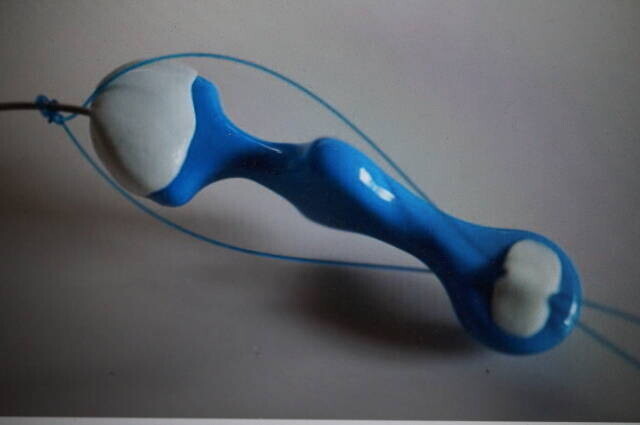
The OK Prostate Chip is a small device that is placed in the urethra (the urine passage) so that it acts on the prostate; the maker sells it in several shapes, sizes and materials. It is made and sold by OK Lab (Okada Comfortable Life Laboratory), a small company in Japan, through its own online store, and prices are in Japanese yen (JPY). The maker's development diary, "ok-lab's diary", is written in Japanese. This page is an English summary of it, and every quotation is translated. OK Lab ships internationally, so readers outside Japan can order (see "Buying from outside Japan" below). Product names on this page are plain-English descriptions. The official Japanese product name is shown once in the product table so you can find the same item in the store.
Before you read: key terms
| Term | Plain-English meaning |
|---|---|
| Urethra | The urine passage, where the chip is placed to act on the prostate. |
| Tube cover | A sleeve around wire, intended to separate metal from the body. |
| Sterling silver | Silver used for jewelry casting; discussed as a possible material for making the silver chip. |
| Heart failure | The diary does not explain this. |
| Nitinol | A nickel-titanium alloy used for wires connecting chip parts or replacing nylon thread. |
| Silicone | Rubber used for covers and coatings, intended to separate metal from tissue. |
| Screw-shaped auxiliary chips | Additional chip pieces intended, in the multi-piece design, to keep wire away from the urethral lining. |
| Resin | Material forming covers or outer segments, intended to separate metal from the body. |
| 316 stainless steel | The diary does not explain this. |
What happens: metal allergy from urethral devices
The OK Prostate Chip is a small device placed in the urethra, the urine passage, to act on the prostate. The metal in these entries appears in chip bodies, motor casings, and wires connecting parts or replacing thread. Metal allergy is Mr. Okada's proposed explanation for several reactions during contact inside the body. Tube covers (sleeves around wire) and coatings were explored to keep exposed metal away from the urethral lining.
Aluminum allergy remained uncertain after a short personal prototype test
In an entry published in March 2019, Mr. Okada described an aluminum-foil prototype intended to explore possible reactions to aluminum. He wrote that aluminum could cause allergic reactions in some people, despite its reputation as a comparatively safe metal.
Mr. Okada reported no problems during his 1-day personal test. No matching product can be confirmed on the current list. His caution was that water soaked into the prototype, creating a possible place for bacteria to grow during prolonged use.
(Source: ok-lab's diary, published March 2019)
https://ok-lab.hatenablog.com/entry/2019/03/09/150813
Suspected metal allergy led Mr. Okada to reject exposed motors
In an entry published in February 2020, Mr. Okada reported nausea and headaches beginning around day 5 with exposed motor metal. His symptoms gradually worsened, although he said his temperature stayed normal. He suspected metal allergy or mild poisoning from dissolved metal.
After changing to a fully covered chip, he reported no fever, nausea, or headache about 6 hours later. The diary does not record a confirmed diagnosis explaining those symptoms. Because he suspected harm, Mr. Okada decided against selling vibrating chips with any exposed motor metal.
(Source: ok-lab's diary, published February 2020)
https://ok-lab.hatenablog.com/entry/2020/02/22/145216
Silver allergy ruled out the newly cast chip for some users
In an entry published in April 2021, Mr. Okada described a newly cast short silver twist chip weighing about 9 grams. His estimate for a proposed long version was about 25 grams. No matching product can be confirmed on the current list. Mr. Okada warned that people with silver allergies from jewelry could not use the silver chip.
(Source: ok-lab's diary, published April 2021)
https://ok-lab.hatenablog.com/entry/2021/04/24/125721

Silver allergy concerns led to pure silver, which still scratched
In an entry published in May 2021, Mr. Okada said his pure-silver chip came out during urination in 1 second. It struck the toilet rim, and he later found scratches on its surface. He reported that the supplier had used pure silver instead of sterling silver (silver commonly used for casting jewelry).
According to that supplier, sterling silver could cause allergic reactions. The diary does not record allergy testing of the finished chip. The supplier also cautioned that pure silver was soft and easily scratched.
(Source: ok-lab's diary, published May 2021)
https://ok-lab.hatenablog.com/entry/2021/05/01/130245
Possible metal allergy became Mr. Okada's explanation for delayed symptoms
In an entry published in September 2023, Mr. Okada reported symptoms he described as heart failure (not explained in the diary). He said they began about half a day after stainless-steel placement and eased after the chip was out. He later noticed the same problem with a single small stainless-steel chip.
Mr. Okada suspected that repeated exposure had gradually strengthened an allergic reaction. The diary does not record a medical diagnosis connecting his heart symptoms to metal allergy. He suggested considering metal allergy when stainless-steel chips coincided with symptoms different from a person's usual experience.
(Source: ok-lab's diary, published September 2023)
https://ok-lab.hatenablog.com/entry/2023/09/02/122918
Nickel allergy concerns led to a policy against direct wire contact
In an entry published in September 2025, Mr. Okada described concern about recognizing reactions inside the body. His concern was that symptoms deep inside the urethra might be mistaken for another problem. He reported the wire manufacturer's warning that some people react to nitinol (a nickel-titanium alloy used for chip wires).
The manufacturer also warned that nickel might dissolve out at cut surfaces. Mr. Okada announced that OK Lab would not supply products allowing nitinol wire to touch skin directly. He favored a barrier between the metal and the body.
(Source: ok-lab's diary, published September 2025)
https://ok-lab.hatenablog.com/entry/2025/09/06/122911
The uncovered twin-wire vibrating design remained unsuitable for metal allergy
In an entry published in February 2026, Mr. Okada described a twin-wire vibrating ceramic chip with all tube covers omitted. The design used parallel 0.3mm or 0.4mm wires, with lengths up to 20cm. Published additions to the ordinary vibrating-chip price were ¥5,000 (about $32 at ¥156 = $1, rate as of 2026-09-04) up to 10cm, ¥6,000 (about $38 at ¥156 = $1, rate as of 2026-09-04) up to 15cm, and ¥8,000 (about $51 at ¥156 = $1, rate as of 2026-09-04) up to 20cm, all tax excluded.
No matching product can be confirmed on the current list. Mr. Okada said the design avoided silicone (the rubber used for covers), leaving bare wires against the urethral lining. He explicitly described it as unsuitable for people with metal allergies.
(Source: ok-lab's diary, published February 2026)
https://ok-lab.hatenablog.com/entry/2026/02/21/122935
The maker's answer to metal allergy from urethral devices
The maker explored barriers between metal and tissue, while retaining allergy cautions for uncovered designs.
Silicone coating addressed nickel allergy concerns without an added basic charge
In an entry published in September 2025, Mr. Okada described thin silicone coatings intended to keep nitinol away from the urethral lining. He reported that coated 0.1mm and 0.15mm wires could remain 0.3mm or less in overall thickness. Mr. Okada said the coating adhered firmly and seemed unlikely to come off with ordinary friction.
Thin coating over the whole thread carried no additional charge; thicker coating cost ¥500 (about $3 at ¥156 = $1, rate as of 2026-09-04) per 5cm, tax excluded, as published then. He noted that thick coating would not fit through the small holes in additional chip parts. Mr. Okada suggested thicker coating for areas where he was concerned about the wire pressing into tissue.
(Source: ok-lab's diary, published September 2025)
https://ok-lab.hatenablog.com/entry/2025/09/06/122911
Metal allergy concerns still favored covers when bare wire became optional
In an entry published in November 2025, Mr. Okada allowed uncovered nitinol in a design with several screw-shaped auxiliary chips (extra chip pieces). His miniature screw pieces were approximately 10mm long and 7–8mm wide, priced at ¥1,000 (about $6 at ¥156 = $1, rate as of 2026-09-04) each, tax excluded. He believed the extra pieces reduced the wire's contact with the lining.
No matching product can be confirmed on the current list. For anyone worried about metal allergy, Mr. Okada still recommended tube covers.
(Source: ok-lab's diary, published November 2025)
https://ok-lab.hatenablog.com/entry/2025/11/01/122937
A jointed prototype addressed metal allergy by shielding wire with resin
In an entry published in November 2025, Mr. Okada described a jointed nitinol prototype with nylon thread running alongside the wire. Resin (the material forming the outer segments) covered the wire except at narrow joints. Mr. Okada wrote that any broken wire end would stay between those segments, while nylon thread kept the structure connected.
He reported that only resin would touch skin, which he believed addressed metal allergy concerns. No matching product can be confirmed on the current list. Mr. Okada stressed that the design still required further investigation.
(Source: ok-lab's diary, published November 2025)
https://ok-lab.hatenablog.com/entry/2025/11/22/122910
How metal allergy from urethral devices changed over time
| Published | What the diary said then |
|---|---|
| Mar 2019 | Water entered an aluminum-foil prototype; Mr. Okada raised concerns about bacteria during prolonged use. |
| Feb 2020 | Suspected health effects led Mr. Okada to reject exposed-motor sales. |
| Apr 2021 | Mr. Okada excluded people with silver allergies from using the silver chip. |
| May 2021 | The supplier confirmed pure silver and explained its allergy-related material choice. |
| Sep 2023 | Mr. Okada suspected metal allergy after delayed symptoms with stainless-steel chips. |
| Nov 2024 | Wire tube covers were described as safer for allergy concerns, with an additional charge. |
| Sep 2025 | Mr. Okada announced a policy against nitinol wire touching skin directly. |
| Nov 2025 | Bare wire became optional in the multiple-screw design; allergy concerns still favored covers. |
| Feb 2026 | The uncovered twin-wire design was described as unsuitable for people with metal allergies. |
OK Prostate Chip products related to metal allergy from urethral devices
No current product is directly tied to this topic.
Common worries about metal allergy from urethral devices
Customer questions concerned covering dimensions, previous jewelry reactions, and the cost of covering wire.
"Can motor covering address metal allergy within my size limit?"
In an entry published in February 2020, a customer requested exposed motor edges to keep width 10mm and thickness 5mm. Mr. Okada answered that covering both faces could keep thickness within 5mm, with a width around 10.3mm. He said 10mm width was impossible because some resin was also needed around the edge.
The customer placed the custom order; the diary does not record how it felt in use. No matching product can be confirmed on the current list. Mr. Okada's final position was that he would make no product with exposed motor metal.
(Source: ok-lab's diary, published February 2020)
https://ok-lab.hatenablog.com/entry/2020/02/22/145216
"Does tolerating jewelry settle my metal allergy concern?"
In an entry published in December 2021, a customer said metal allergy was their main concern about stainless-steel chips. They reported no reaction to piercing jewelry labeled 316 stainless steel (the diary does not explain this grade). They had reacted to jewelry whose metal was uncertain.
Mr. Okada replied that stainless-steel development was moving forward and that a prototype had arrived. The diary does not record whether that customer later used a stainless-steel chip or experienced a reaction. Mr. Okada's guidance was that each person's experience would differ.
(Source: ok-lab's diary, published December 2021)
https://ok-lab.hatenablog.com/entry/2021/12/04/124140
"Do wire covers change comfort, cost, or nickel allergy concerns?"
In an entry published in November 2024, a customer asked whether a chip's wire cover changed comfort or price. Mr. Okada said his tests found little difference in how covered and uncovered wires felt. He attributed this to the short wire section and its thickness.
A tube cover made the chip connection thicker and the work harder, adding ¥1,000, (about $6 at ¥156 = $1, rate as of 2026-09-04) tax excluded, as published that month. He said the customer's requested thread hole could be accommodated with either version; the diary does not record a completed order. Because bare nickel-titanium wire might cause allergies in some people, Mr. Okada regarded a tube cover as the safer choice.
(Source: ok-lab's diary, published November 2024)
https://ok-lab.hatenablog.com/entry/2024/11/02/122858
Buying from outside Japan
OK Lab ships internationally to countries covered by Japan Post's EMS courier service. Overseas orders are paid in advance by PayPal. Each order carries a ¥400 (about $3 at ¥156 = $1, rate as of 2026-09-04) handling fee, and EMS shipping is charged on top. These terms come from OK Lab's official sales-terms page (written here as plain text, not a link: ok-lab.net/docs/law), checked on September 7, 2026; confirm them on the official store before you order, because they can change.
Summary of this article
| What you wanted to know | The answer |
|---|---|
| What is the short answer? | The diary reports suspected reactions and precautions; it does not establish a confirmed metal-allergy diagnosis. |
| What is this product? | A small urethral device made by OK Lab in Japan, with prices stated in Japanese yen. |
| What do the material terms mean? | Nitinol is nickel-titanium wire; silicone and resin appear as barriers intended to limit metal contact. |
| What problems were reported? | Mr. Okada described symptoms with exposed motor metal and stainless steel, plus a warning about silver allergy. |
| What measures did the maker explore? | Full motor covers, wire tubing, silicone coating, and resin-covered jointed structures. |
| How did the position change? | A September 2025 policy against direct wire contact was followed by particular designs allowing uncovered wire. |
| Which current product matches? | No current product is directly tied to this topic. |
| What did customer questions establish? | Covering could affect dimensions and price; one customer's jewelry experience had no recorded chip-use outcome. |
| How do overseas orders work? | Advance PayPal payment, a ¥400 (about $3 at ¥156 = $1, rate as of 2026-09-04) handling fee, and additional Japan Post EMS shipping charges. |
Source: ok-lab's diary (Okada Comfortable Life Laboratory). The original entries are in Japanese; quotations on this page are translated. Photos and videos are on the original entries.
This article is a summary of the maker's development diary. The product is not a medical device and no result is guaranteed. If anything feels wrong or worries you, see a doctor. Prices, specifications and cautions change, so confirm the latest information on the official blog and the official site. Questions about ordering and shipping go to the seller.