![Pain after using a prostate chip? | The diary records injuries and unresolved risks [OK Prostate Chip]](/img/a/T0341/eyecatch.svg)
This page is based on entries from "ok-lab's diary" (https://ok-lab.hatenablog.com/), the Japanese development diary written by Mr. Okada, founder of OK Lab (Okada Comfortable Life Laboratory). Only the entries about "sphincter injury and pain" are summarized here, in order of publication. Past prices and sizes are as written at the time. Current prices come from the official product list (retrieved September 4, 2026). Quotations are translated from Japanese.
Note: This page is a personal reading log by someone with no connection to the maker or the seller. It reflects the source entries as of their publication dates and makes no guarantee of accuracy or safety. The product is not a medical device; talk to a doctor about any health decision. Check the official site for current information. This page contains advertising.
In short
The diary records pain, bleeding, urine leakage, and devices that became stuck.
Mr. Okada of OK Lab, a small company in Japan, proposed flexible connections to reduce pressure.
In August 2026, proposed answers to painful inward movement remained theoretical.
If you see blood in your urine, even a small amount or for the first time, do not wait and see. See a urologist right away. If you suddenly cannot urinate, or the device cannot be removed, do not try to fix it yourself. Go to a medical facility, including emergency care, immediately.
About this product
The OK Prostate Chip is a small device that is placed in the urethra (the urine passage) so that it acts on the prostate; the maker sells it in several shapes, sizes and materials. It is made and sold by OK Lab (Okada Comfortable Life Laboratory), a small company in Japan, through its own online store, and prices are in Japanese yen (JPY).
The maker's development diary, "ok-lab's diary", is written in Japanese. This page is an English summary of it, and every quotation is translated. OK Lab ships internationally, so readers outside Japan can order (see "Buying from outside Japan" below).
Product names on this page are plain-English descriptions. The official Japanese product name is shown once in the product table so you can find the same item in the store.
Before you read: key terms
| Term | Plain-English meaning |
|---|---|
| Urethra | The urine passage; the chip occupies part of it to act on the prostate. |
| Prostate | The body part targeted by the chip. Its normal function: The diary does not explain this. |
| Urinary sphincters | Muscles involved in urine control; the diary discusses them gripping chips and connections. |
| Stopper | A component intended to limit inward chip movement; these entries report failures. |
| Retrieval thread | Thread attached to a chip for withdrawal; an early attachment failed. |
| Guide wire | An aid for positioning a device; a worn prototype features in this history. |
| Horn connector | A projecting connection between parts, intended to keep them separated. |
What happens: pain after using a prostate chip
The OK Prostate Chip is a small urethral device intended to stimulate the prostate, according to the maker's diary. These entries discuss urinary sphincters (muscles involved in controlling urine flow) and pain reported around them. The diary places an inner sphincter at the bladder boundary and an outer sphincter beyond the prostate. Some designs place narrow connections across these muscles, aiming to hold the device in place while reducing pressure.
A long-chip test raised sphincter injury concerns after continuous wear
In an entry published in December 2017, a tester reported sphincter injury after several days of 24-hour continuous wear. Mr. Okada suspected the long chip strained the muscle when its position shifted downward. His own testing had included overnight breaks, unlike the tester's experience. He initially proposed selling the long design only for short sessions.
(Source: ok-lab's diary, published December 2017)
https://ok-lab.hatenablog.com/entry/20171231/1514712104
Chip pain prompted a cancellation announcement reversed later in January 2018
In an entry published in January 2018, Mr. Okada announced cancellation of the rigid long version following the injury report. He proposed linked pieces with a 0 mm gap, explaining that their connection could bend. A later January 2018 entry reversed that decision and announced plans to sell the long version. His warning remained that prolonged wear could injure the sphincter.
(Source: ok-lab's diary, published January 2018)
https://ok-lab.hatenablog.com/entry/20180106/1515230584
(Source: ok-lab's diary, published January 2018)
https://ok-lab.hatenablog.com/entry/20180111/1515662782

Bleeding after use was reported during January 2018 bladder-anchored prototype testing
A separate tester's experience appears in an entry published in January 2018. Mr. Okada attributed bleeding to the curved prototype meeting the sphincter at an unsuitable angle. The tester reported that the slight bleeding had stopped by the next urination. Mr. Okada called this the most difficult design and deferred a sales decision pending further testing.
(Source: ok-lab's diary, published January 2018)
https://ok-lab.hatenablog.com/entry/20180111/1515662782
A failed thread attachment left Mr. Okada's long chip stuck twice
In an entry published in January 2018, Mr. Okada reported 2 occasions when he could not withdraw the long chip. He blamed failure of an older silicone attachment holding the retrieval thread (the thread used for withdrawal). He eventually recovered both devices and described a different adhesive connection in products made at that time. He explicitly discouraged beginners and intermediate users from buying the long version.
(Source: ok-lab's diary, published January 2018)
https://ok-lab.hatenablog.com/entry/20180111/1515662782
Sphincter pain appeared during extended wear of a resin test chip
In an entry published in March 2018, Mr. Okada described discomfort near the sphincter after about 10 days with a socketed resin chip. He reported 1 day without the device and no bleeding. He suggested that continuous wear of resin versions might require breaks.
(Source: ok-lab's diary, published March 2018)
https://ok-lab.hatenablog.com/entry/20180324/1521875816
Urine leakage followed suspected sphincter injury from a directly attached stopper
In an entry published in November 2020, Mr. Okada tested a stopper (a component intended to prevent inward movement). It was attached directly to a horn connector (a projecting link between the chip and stopper). After about 10 hours, he reported difficulty closing the sphincter and slight leakage lasting roughly 1 day. He suspected fatigue or injury and warned that this direct attachment was dangerous.
(Source: ok-lab's diary, published November 2020)
https://ok-lab.hatenablog.com/entry/2020/11/07/121125
Bleeding after use followed a flexible steel ring prototype test
In an entry published in February 2021, Mr. Okada tested a ring prototype measuring 12 cm long and 5.6 mm outside diameter. After 4 hours, it resisted withdrawal; forceful removal was followed by bleeding. He suspected injury near the outer sphincter and reported slight pain when urinating afterward. Mr. Okada said he planned a break from chip use.
(Source: ok-lab's diary, published February 2021)
https://ok-lab.hatenablog.com/entry/2021/02/27/130152
Exposed metal on a worn guide wire preceded bleeding after use
In an entry published in September 2021, Mr. Okada reported bleeding during a test with a guide wire (an aid for positioning chips). He attributed it to worn resin exposing a sharp steel tip, which he believed injured the inner sphincter. Although he reported the bleeding ending, pain during urination remained at publication. He urged readers to pause use after injury.
(Source: ok-lab's diary, published September 2021)
https://ok-lab.hatenablog.com/entry/2021/09/11/125735
A chip stuck inside the bladder required difficult hospital removal
In an entry published in April 2022, a customer reported a double-twist chip (Rabuka) trapped in the bladder despite a stopper. They described sphincter pain, leakage, blood in urine, and an intense feeling of incomplete emptying. Hospital imaging showed the chip displaced to the right rather than aligned with the urine passage.
A hospital attempt involving salt-water fluid failed; abdominal surgery was discussed before a doctor eventually removed the chip by force. The diary does not record the customer's recovery afterward. Mr. Okada cautioned against relying on internal stoppers that readily passed through a customer's sphincter.
(Source: ok-lab's diary, published April 2022)
https://ok-lab.hatenablog.com/entry/2022/04/02/123050
A double-loop prototype raised sphincter injury concerns after urine leakage
In an entry published in January 2025, Mr. Okada tested a customer's proposed double-loop device. He reported that opposing springy loops could not flatten together when gripped by the sphincter, allowing urine leakage. He also suspected prolonged pressure there could injure the muscle. Mr. Okada therefore said this configuration was unsuitable for a general recommendation.
(Source: ok-lab's diary, published January 2025)
https://ok-lab.hatenablog.com/entry/2025/01/11/122910
The maker's answer to pain after using a prostate chip
Mr. Okada's responses focused on reducing pressure, changing connections, and warning against force.
Stopper spacing became a design concern after suspected sphincter injury
In an entry published in November 2020, Mr. Okada described a different prototype with a straight connector and about 6 mm of clearance. He reported no problem during 10 hours of testing. His proposed spacing for this stopper connection was 5 mm or more, reflecting concern about pressure and restricted urine flow.
(Source: ok-lab's diary, published November 2020)
https://ok-lab.hatenablog.com/entry/2020/11/14/131426
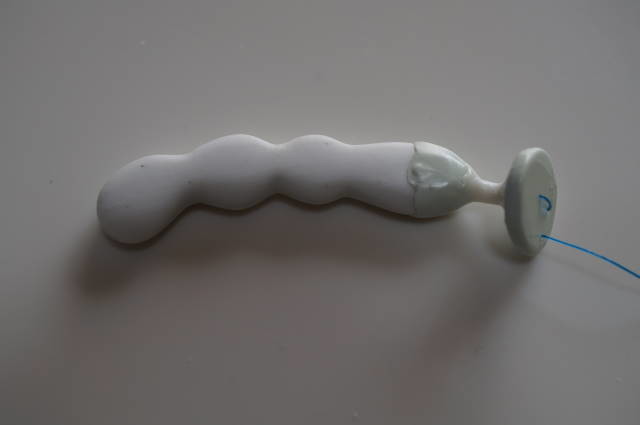
A painful stopper could fail when caught within the sphincter
In an entry published in December 2020, a customer asked why a stopper could move inward painfully despite changes in spacing. Mr. Okada's proposed configuration had a gap of about 8 mm or more, with the stopper outside the sphincter. The diary does not record whether this resolved the customer's problem. His warning concerned a stopper caught within the muscle, where he thought it could follow the chip inward.
(Source: ok-lab's diary, published December 2020)
https://ok-lab.hatenablog.com/entry/2020/12/12/124126
Bleeding after use during exercise led to advice about simpler shapes
In an entry published in July 2021, a customer reported bleeding with a stopper-equipped textured chip (sea-slug version 4) during vigorous exercise. Bleeding accompanied repeated urination, and the customer suspected injury to the sphincter or prostate. They reported suspending chip use; a medical diagnosis is not recorded. Mr. Okada advised against long or large chips during exercise, favoring a simple short shape.
(Source: ok-lab's diary, published July 2021)
https://ok-lab.hatenablog.com/entry/2021/07/03/125851
A stuck chip prompted Mr. Okada's warning about force and dryness
In an entry published in September 2022, a customer described another episode involving overlapping chips after an earlier hospital incident. The customer reported eventual recovery of the devices after 3 hours. Mr. Okada accepted the customer's explanation that the pieces had overlapped rather than reversed. He warned that force against resistance, especially with dryness, would cause injury.
(Source: ok-lab's diary, published September 2022)
https://ok-lab.hatenablog.com/entry/2022/09/17/123057
If you see blood in your urine, even a small amount or for the first time, do not wait and see. See a urologist right away. If you suddenly cannot urinate, or the device cannot be removed, do not try to fix it yourself. Go to a medical facility, including emergency care, immediately.
How pain after using a prostate chip changed over time
| Published | What the diary said then |
|---|---|
| Dec 2017 | Linked chips used roughly 10 mm of thread across the sphincter to reduce strain. |
| Mar 2019 | A customer reported blood and dull urinary pain, absent the following morning. |
| Sep 2020 | Mr. Okada defined his own long wear as daytime use, ending before sleep. |
| Jun 2021 | Mr. Okada associated sudden leakage with possible sphincter trouble or urethral inflammation. |
| Dec 2022 | Silicone covered a nylon connection to address Mr. Okada's concerns about sphincter strain. |
| Aug 2026 | Mr. Okada said the flexible-joint design offered little resistance to inward movement. |
OK Prostate Chip products related to pain after using a prostate chip
The current list includes the twisted ceramic chip and auxiliary component involved in a September 2020 pain report.
Products that appear in these entries
| Product (official name) | Price incl. tax | Relation to this topic |
|---|---|---|
| Short twisted ceramic chip (OKプロステートチップ 陶器素材ショートタイプ ツイスト) | ¥4,400 (about $28 at ¥156 = $1, rate as of 2026-09-04) | In September 2020, a customer reported severe urinary pain with this chip and a screw-shaped auxiliary chip. |
| Screw-shaped auxiliary chip option (スクリュー型補助チップ追加オプション) | ¥3,300 (about $21 at ¥156 = $1, rate as of 2026-09-04) | In September 2020, the same customer reported blood on this component after painful use. |
(Source: ok-lab's diary, published September 2020)
https://ok-lab.hatenablog.com/entry/2020/09/19/123115
Products the diary mentioned as alternatives
The diary names no alternative.
The long chip, bladder-anchored chip, socketed resin chip, horn-linked builds, steel ring, and guide wire appear here as historical test versions. No matching product can be confirmed on the current list.
Other historical descriptions include the double-twist nickname, sea-slug version 4, double-loop prototype, paired custom chips, flexible-joint design, wire-loop device, and adjustable loop restraint. No matching product can be confirmed on the current list.
Common worries about pain after using a prostate chip
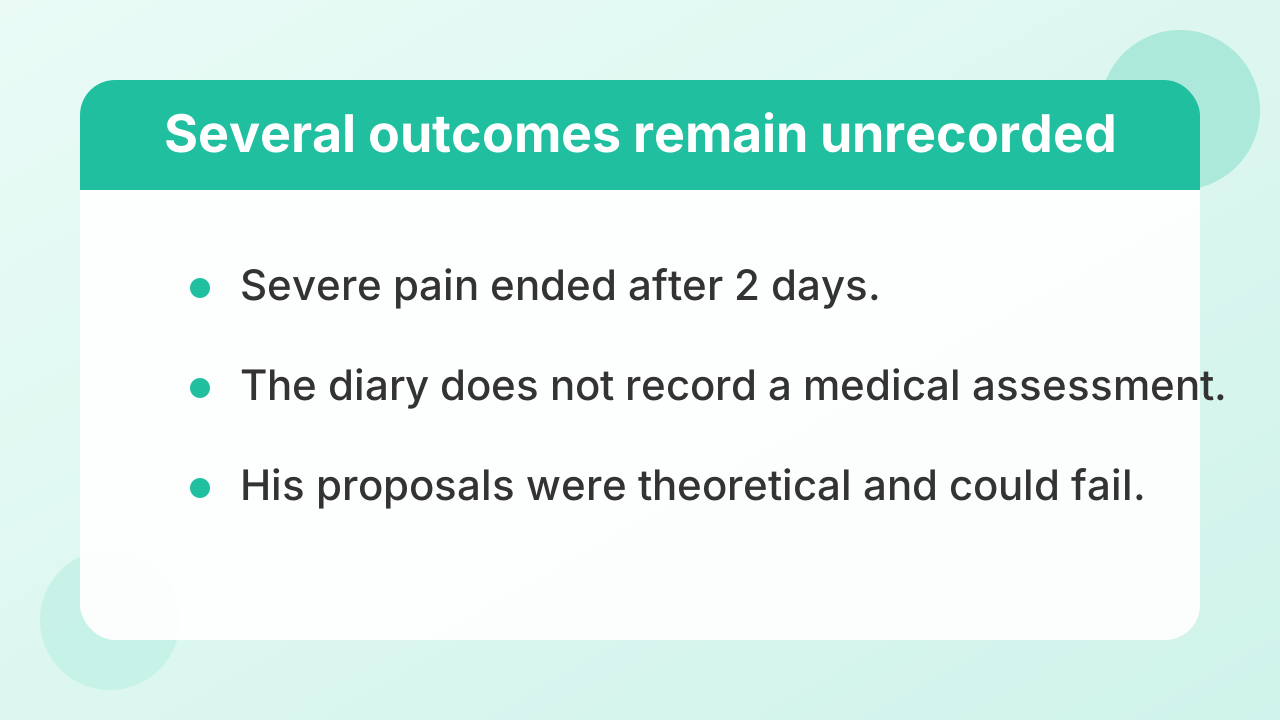
The diary contains replies to pain and stopper questions, but several outcomes remain unrecorded.
"Is pain when peeing expected after using a prostate chip?"
In an entry published in September 2020, a customer asked whether painful urination also happened to people using larger chips. Their own report concerned the short twisted ceramic chip with a screw-shaped auxiliary chip. They described severe urinary pain, a sharp sensation when tightening the sphincter, and blood on the auxiliary piece.
The customer reported that the severe pain ended after 2 days. The diary does not record a medical assessment. Mr. Okada's caution was that painful urination could reflect damage to the urethral lining from excessive friction.
(Source: ok-lab's diary, published September 2020)
https://ok-lab.hatenablog.com/entry/2020/09/19/123115
"Could a simpler chip avoid the same sphincter pain?"
In an entry published in December 2020, a beginner asked about switching from a twisted ceramic chip after 4 unsuccessful attempts. They described strong prickling and pain in the skin over the area they had been pressing. Mr. Okada said he could not identify the cause from their description.
He also said the remaining thread length could not establish the chip's position because people differed. The diary does not record whether the customer later succeeded. His reply favored a simpler shape over the larger twisted chip for lower resistance at the sphincter.
(Source: ok-lab's diary, published December 2020)
https://ok-lab.hatenablog.com/entry/2020/12/12/124126
"Can an adjustable stopper prevent painful inward chip movement?"
In an entry published in August 2026, a customer asked about painful inward movement despite a stopper. A follow-up published later that month clarified that the movement occurred without deliberate pushing, which the customer attributed to natural muscle activity. They described the stopper turning sideways and passing painfully through the sphincter.
Mr. Okada proposed a wire-loop device or adjustable loop restraint, while acknowledging that neither proposal established a reliable result for this customer. The diary records a request for custom builds, but not how they felt afterward. Mr. Okada cautioned that his proposals were theoretical and could fail with the customer's anatomy.
(Source: ok-lab's diary, published August 2026)
https://ok-lab.hatenablog.com/entry/2026/08/01/122916
(Source: ok-lab's diary, published August 2026)
https://ok-lab.hatenablog.com/entry/2026/08/08/122906
Buying from outside Japan
OK Lab ships internationally to countries covered by Japan Post's EMS courier service. Overseas orders are paid in advance by PayPal. Each order carries a ¥400 (about $3 at ¥156 = $1, rate as of 2026-09-04) handling fee, and EMS shipping is charged on top. These terms come from OK Lab's official sales-terms page (written here as plain text, not a link: ok-lab.net/docs/law), checked on September 7, 2026; confirm them on the official store before you order, because they can change.
Summary of this article
| What you wanted to know | The answer |
|---|---|
| What is the short answer? | The diary reports injuries and continuing uncertainty about prevention. |
| What is the product? | A urethral device made by OK Lab in Japan. |
| Which terms matter? | Sphincters control urine; stoppers aim to limit chip movement. |
| What happened in the reports? | Pain, bleeding, leakage, attachment failure, and difficult hospital removal appear. |
| What did the maker propose? | Different connections and spacing, simpler shapes, and caution about force. |
| What changed over time? | Later replies still questioned whether designs could reliably prevent inward movement. |
| Which current products appear? | The twisted ceramic chip and screw-shaped auxiliary option appear in a pain report. |
| Were readers' worries resolved? | Some replies have no recorded outcome; the August 2026 proposals remained theoretical. |
| How does overseas buying work? | Advance PayPal payment, a ¥400 (about $3 at ¥156 = $1, rate as of 2026-09-04) handling fee, and additional EMS shipping. |
Source: ok-lab's diary (Okada Comfortable Life Laboratory). The original entries are in Japanese; quotations on this page are translated. Photos and videos are on the original entries.
This article is a summary of the maker's development diary. The product is not a medical device and no result is guaranteed. If anything feels wrong or worries you, see a doctor. Prices, specifications and cautions change, so confirm the latest information on the official blog and the official site. Questions about ordering and shipping go to the seller.