![Can the thread hurt my urethra? | Pain and bleeding appear in the diary [OK Prostate Chip]](/img/a/T0340/eyecatch.svg)
This page is based on entries from "ok-lab's diary" (https://ok-lab.hatenablog.com/), the Japanese development diary written by Mr. Okada, founder of OK Lab, a small company in Japan (Okada Comfortable Life Laboratory).
Only the entries about "threads or wires digging into the urethral lining" are summarized here, in order of publication. Past prices and sizes are as written at the time. Current prices come from the official product list (retrieved September 4, 2026). Quotations are translated from Japanese.
Note: This page is a personal reading log by someone with no connection to the maker or the seller. It reflects the source entries as of their publication dates and makes no guarantee of accuracy or safety. The product is not a medical device; talk to a doctor about any health decision. Check the official site for current information. This page contains advertising.
In short
- Customers reported pain and bleeding; thread digging in was a suspected cause.
- Mr. Okada developed covered connectors and withdrew some designs after problems.
- The current list still includes a ceramic chip discussed in a bleeding report.
If you see blood in your urine, even a small amount or for the first time, do not wait and see. See a urologist right away.
If you suddenly cannot urinate, or the device cannot be removed, do not try to fix it yourself. Go to a medical facility, including emergency care, immediately.
About this product
The OK Prostate Chip is a small device that is placed in the urethra (the urine passage) so that it acts on the prostate; the maker sells it in several shapes, sizes and materials. It is made and sold by OK Lab (Okada Comfortable Life Laboratory), a small company in Japan, through its own online store, and prices are in Japanese yen (JPY).
The maker's development diary, "ok-lab's diary", is written in Japanese. This page is an English summary of it, and every quotation is translated.
OK Lab ships internationally, so readers outside Japan can order (see "Buying from outside Japan" below). Product names on this page are plain-English descriptions. The official Japanese product name is shown once in the product table so you can find the same item in the store.
Before you read: key terms
| Term | Plain-English meaning |
|---|---|
| Urethra | The urine passage; it carries urine out and is where the chip is placed. |
| Retrieval thread | An attached cord kept as a backup for retrieval; some threads also connect chip parts. |
| Support cable | A connector reinforced with wires, intended to support the chip and its position. |
| Covered tail | A tube covering part of the attached thread, intended to soften contact inside the urine passage. |
| Screw-shaped support | An extra chip behind the main chip, intended to help limit movement toward the bladder. |
| Nitinol | A nickel-titanium alloy used for springy connectors and thread replacements. |
What happens: urethral thread pain
The OK Prostate Chip is a small device placed in the urethra (the urine passage) to act on the prostate. An attached retrieval thread (a backup cord) runs from the chip through the urine passage. Wire connectors can link chip parts and help hold them in place. The diary records concerns about these narrow parts pressing into the lining, especially at bends, and experiments with softer coverings.
Thread pain and bleeding followed prolonged use: January 2018
In an entry published in January 2018, a customer described problems with a custom extended short chip. After about 12 hours, urine looked darker; repeated use brought visible blood clots, pain, and blood clots at the next ejaculation. The customer suspected that pulling tightened the thread against a right-angle bend in the urethral wall, and Mr. Okada agreed this was possible.
The diary does not record whether his proposed alternative resolved this customer's pain. Mr. Okada suggested a pair of linked chips with a 0mm gap.
(Source: ok-lab's diary, published January 2018)
https://ok-lab.hatenablog.com/entry/20180118/1516263011
Thread digging in remained a concern despite strong attachments: May 2018
An entry published in May 2018 reports attachment-strength tests after a customer's thread detached. Threads released above 2kg on a chip bought 7 months earlier, and above 1.5kg on a newer medium-length chip.
The report warned that thread tension above 1kg could tear the urinary passage and treated stretching as a warning against further force. Mr. Okada directed attention to preventing excessive pulling.
(Source: ok-lab's diary, published May 2018)
https://ok-lab.hatenablog.com/entry/20180515/1526348315
Wire pain was linked to concentrated cable bends: May 2022
In an entry published in May 2022, a customer reported pain from a 4-line support cable (a connector reinforced with wires). Mr. Okada attributed every painful episode in his own tests to extreme bending concentrated at one point.
He believed this happened when the urine passage shortened and left the cable with nowhere to go. Mr. Okada proposed reducing the cable's effective length.
(Source: ok-lab's diary, published May 2022)
https://ok-lab.hatenablog.com/entry/2022/05/28/123218
Wire pain revealed protruding metal from a support cable: July 2022
In an entry published in July 2022, a customer reported pain and found wire protruding from a 4-line support cable. They had stopped using it and asked about replacement with a reinforced 6-line cable. Mr. Okada said the line itself could not be repaired, although replacement was possible.
He warned that 6-line and reinforced 6-line designs could also expose wire under extreme use. The diary does not record whether this replacement was completed. Mr. Okada advised against forcing a device that would not advance.
(Source: ok-lab's diary, published July 2022)
https://ok-lab.hatenablog.com/entry/2022/07/09/123142
Thread digging in complicated arrowhead chip retrieval: February 2024
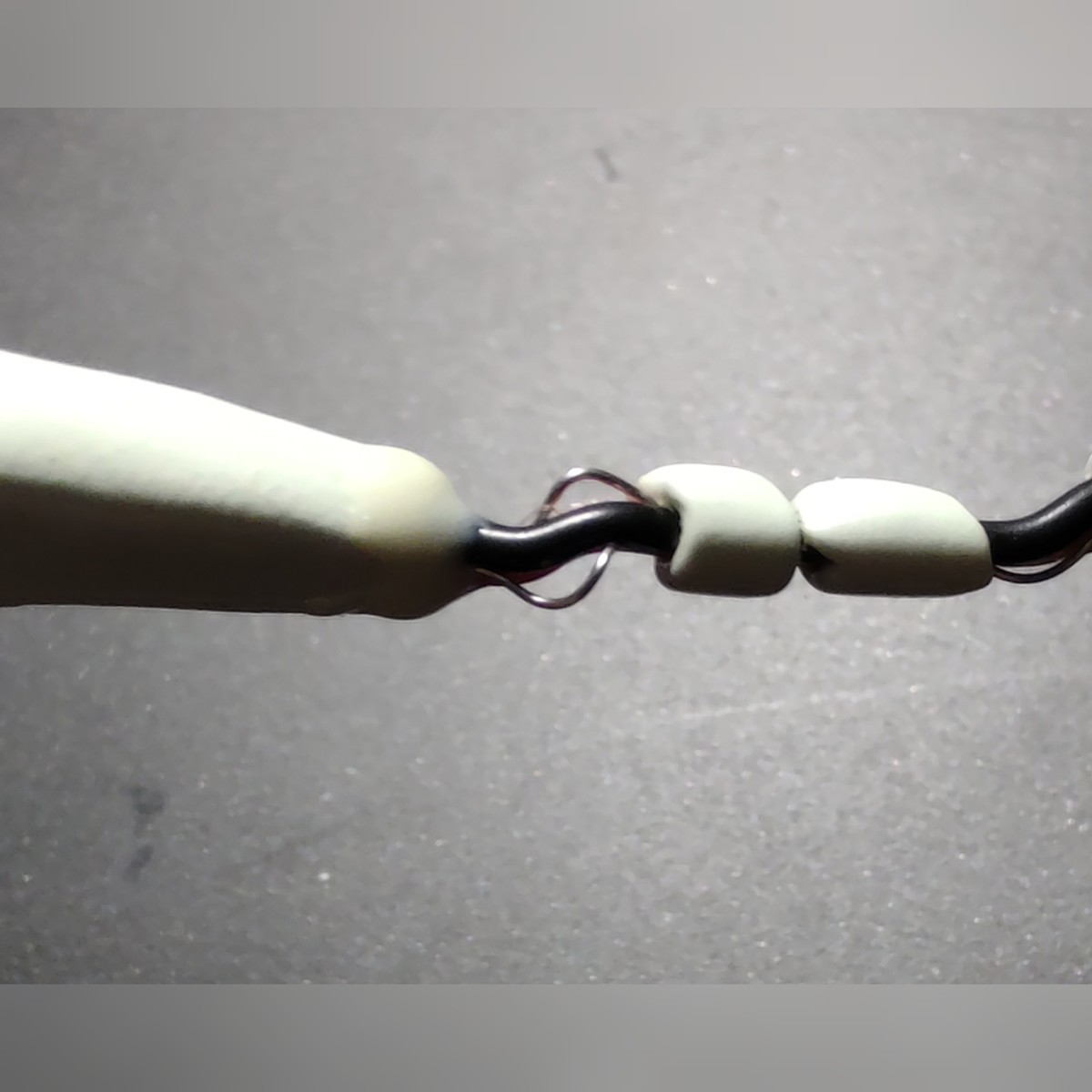
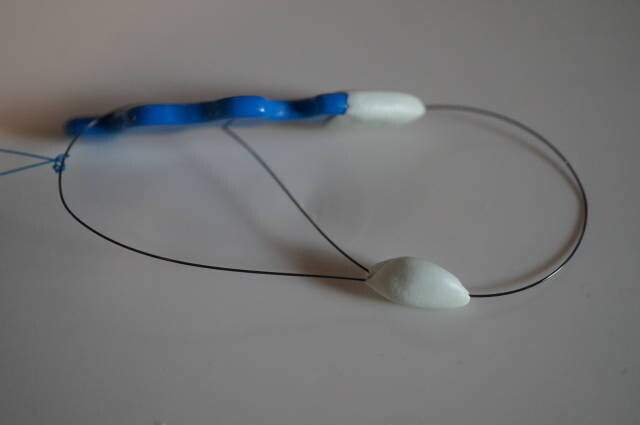
In an entry published in February 2024, Mr. Okada described an arrowhead-shaped prototype intended to resist slipping out. He reported difficult removal and feared that an exposed thread would dig hard into the urine passage. Although he reported no bleeding, he described pain during urination afterward.
He chose a covered tail (a tube covering part of the attached thread) to soften contact. Mr. Okada warned that the arrowhead design was dangerous and unsuitable without detailed knowledge of individual fit.
(Source: ok-lab's diary, published February 2024)
https://ok-lab.hatenablog.com/entry/2024/02/10/123023
The maker's answer to urethral thread pain
Mr. Okada's measures focused on covering narrow connectors, limiting sharp bends, and abandoning designs he judged unsuitable.
Wire pain prompted public withdrawal of the original cable: June 2022
An entry published in June 2022 announced that the plain 4-line cable was discontinued from public sale after pain reports. Its replacement was a 6-line support cable, offered at the previous design's price.
Mr. Okada still allowed exceptional custom requests for the original design, while warning that repeated extreme bending would eventually break it. He asked customers to consider the new 6-line and reinforced 6-line choices.
(Source: ok-lab's diary, published June 2022)
https://ok-lab.hatenablog.com/entry/2022/06/11/123420
A covered connector addressed thread digging in: August 2022
In an entry published in August 2022, Mr. Okada tested a 2mm tube around the thread between connected chips. A screw-shaped support (an extra chip intended to help hold position) sat behind the main chip. After about 3 days, he reported gentler contact and suspected less damage from thin thread.
The trial option carried no extra charge and covered gaps of 2–6mm; standard fitting remained a future intention. Mr. Okada favored this spring-like covered connection for the thread-contact problem.
(Source: ok-lab's diary, published August 2022)
https://ok-lab.hatenablog.com/entry/2022/08/27/123001
Wire pain prompted fully covered standard connectors: October 2024
An entry published in October 2024 describes pain when part of a bare 0.3mm wire loop emerged at the urethral opening. Mr. Okada abandoned bare wire as the standard thread replacement because he feared tissue cuts. The formal specification became complete coverage with a 2mm silicone tube, replacing the earlier 1mm trial covering.
Previously requested bare-wire custom builds were still supplied, so experimental exceptions remained. Mr. Okada selected the fully covered version for the formal product.
(Source: ok-lab's diary, published October 2024)
https://ok-lab.hatenablog.com/entry/2024/10/19/122847
Coated metal threads addressed wire digging in: September 2025
In an entry published in September 2025, Mr. Okada chose silicone coating for nitinol (a nickel-titanium alloy) used as thread. He said general products would no longer place bare nitinol directly against skin; thin coating over the entire thread carried no extra charge.
Thicker coating cost ¥500 (about $3 at ¥156 = $1, rate as of 2026-09-04) excluding tax per 5cm, and he believed it reduced digging in further. He noted uneven surfaces and that thicker sections would not pass through accessory holes. Mr. Okada advised allowing more development time for anyone wanting a more finished design.
(Source: ok-lab's diary, published September 2025)
https://ok-lab.hatenablog.com/entry/2025/09/06/122911
A proposed retrieval tool was abandoned after thread pain: May 2026
In an entry published in May 2026, Mr. Okada abandoned development of a retrieval tool. He concluded that its reinforced shaft could push the chip farther inward.
The intended recipient was due to have a doctor remove the chip; the diary does not record that medical outcome. Mr. Okada concluded that supplying an unfinished retrieval device would be wrong.
(Source: ok-lab's diary, published May 2026)
https://ok-lab.hatenablog.com/entry/2026/05/02/122917
If you see blood in your urine, even a small amount or for the first time, do not wait and see. See a urologist right away.
If you suddenly cannot urinate, or the device cannot be removed, do not try to fix it yourself. Go to a medical facility, including emergency care, immediately.
How urethral thread pain changed over time
| Published | What the diary said then |
|---|---|
| Apr 2018 | Polyester sewing thread felt gentler to Mr. Okada but broke under strong pulling. |
| May 2020 | Mr. Okada reported pain despite 8 resin covers on a roughly 9.5mm wire coil. |
| Jun 2021 | A wider thread-exit hole allowed movement; Mr. Okada reported no sharp feeling. |
| Sep 2022 | A prototype enclosed two 0.25mm nylon threads inside a tube with 1mm outer diameter. |
| Aug 2023 | Mr. Okada proposed softer nylon-reinforced cable, approximately 1mm across, for thread discomfort. |
| Dec 2023 | Covered tails cost ¥2,000 (about $13 at ¥156 = $1, rate as of 2026-09-04) through 15cm, or ¥3,000 (about $19 at ¥156 = $1, rate as of 2026-09-04) for 16–25cm, excluding tax. |
| Nov 2025 | Mr. Okada abandoned bare double-loop tests because he feared cuts at the urethral opening. |
| Aug 2026 | Rear-to-rear connection aimed to reduce thread injury; Mr. Okada warned of folding during retrieval. |
OK Prostate Chip products related to urethral thread pain
The current list includes the long ceramic four-point twist chip and a resin screw-shaped support.
Products that appear in these entries
| Product (official name) | Price incl. tax | Relation to this topic |
|---|---|---|
| Long ceramic four-point twist chip (OKプロステートチップ 陶器素材ロングタイプ 4点ツイスト) | ¥7,700 (about $49 at ¥156 = $1, rate as of 2026-09-04) | A February 2020 customer questioned bleeding after use; Mr. Okada suspected friction, and later recovery was unrecorded. |
| Resin screw-shaped support (スクリュー型補助チップ追加オプション(生体適合樹脂)) | ¥3,300 (about $21 at ¥156 = $1, rate as of 2026-09-04) | In March 2025, staff accepted this accessory as part of a customer's requested changes following repeated bleeding. |
The long ceramic four-point twist chip is listed in OK Lab's own online store.
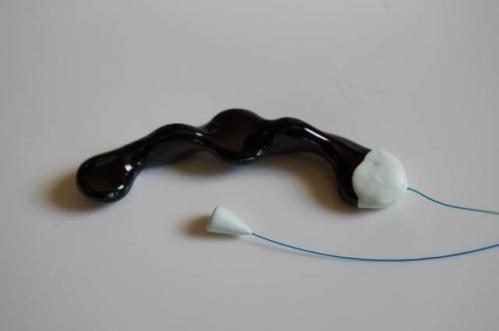
(Source: ok-lab's diary, published February 2020)
https://ok-lab.hatenablog.com/entry/2020/02/22/145216
(Source: ok-lab's diary, published March 2025)
https://ok-lab.hatenablog.com/entry/2025/03/22/122906
Products the diary mentioned as alternatives
The diary names no alternative.
Historical custom builds, covered connectors, and prototypes described here:
No matching product can be confirmed on the current list.
Common worries about urethral thread pain
The reader questions concern keeping a backup thread, attachment discomfort, and unsuccessful retrieval.
"Could a chip alone prevent urethral thread pain?"
In an entry published in April 2018, a customer asked about a custom trial chip after blaming nylon for injury. They had begun using the glass piece alone. Mr. Okada accepted customization but opposed threadless use because the thread was an emergency backup.
The customer then planned a different thread material; the diary does not record how that arrangement felt. Mr. Okada's advice emphasized preserving the backup, reducing reliance on thread traction, and limiting friction through adequate moisture.
(Source: ok-lab's diary, published April 2018)
https://ok-lab.hatenablog.com/entry/20180414/1523697398
"Could the rubber cover cause urethral thread pain?"
In an entry published in March 2025, a customer reported bleeding every time they used a custom ceramic chip (Sea Slug, version 4). Its 2 threads emerged separately; the customer requested a shared exit and questioned the rubber around the attachment. Staff explained that the cover cushioned the pointed rear shape, which they suspected could itself cause discomfort.
Staff received the returned chip, and the customer left the cover decision pending. The diary does not record comfort after the requested changes. Mr. Okada favored retaining rubber protection and cautioned that separate exits could be troublesome when the fit was tight.
(Source: ok-lab's diary, published March 2025)
https://ok-lab.hatenablog.com/entry/2025/03/22/122906
"Can a retrieval tool resolve urethral thread pain?"
In an entry published in April 2026, a customer said a chip remained inside 1 week after its thread broke. They reported pain during urination and asked about a wire tool. Staff doubted that the tool could grip reliably and warned that manipulation might push the chip into the bladder.
Staff considered a lubrication-based approach less risky, without recording successful removal. Mr. Okada outlined an experimental retrieval concept but cautioned that it was not a reliable solution.
(Source: ok-lab's diary, published April 2026)
https://ok-lab.hatenablog.com/entry/2026/04/04/122916
Buying from outside Japan
OK Lab ships internationally to countries covered by Japan Post's EMS courier service. Overseas orders are paid in advance by PayPal.
Each order carries a ¥400 (about $3 at ¥156 = $1, rate as of 2026-09-04) handling fee, and EMS shipping is charged on top. These terms come from OK Lab's official sales-terms page (written here as plain text, not a link: ok-lab.net/docs/law), checked on September 7, 2026; confirm them on the official store before you order, because they can change.
Summary of this article
| What you wanted to know | The answer |
|---|---|
| Can the thread hurt? | Customers reported pain and bleeding, with suspected thread contact. |
| What is the product? | A Japan-made urethral device intended to act on the prostate. |
| What are the attached parts for? | Retrieval, connection, support, and softer contact. |
| What problems appeared? | Painful traction, concentrated bends, exposed wire, and difficult retrieval. |
| What did the maker change? | Coverings, cable designs, and decisions to abandon unsuitable prototypes. |
| Did development continue? | The August 2026 entry proposed another connection arrangement. |
| What appears on the current list? | The listed ceramic chip and resin support accessory. |
| What remains unknown? | Several customer exchanges lack later recovery or repair outcomes. |
| How do overseas orders work? | PayPal prepayment, a handling fee, and EMS shipping charges. |
| What does the article establish? | Dated customer reports and the maker's responses to them. |
Source: ok-lab's diary (Okada Comfortable Life Laboratory). The original entries are in Japanese; quotations on this page are translated. Photos and videos are on the original entries.
This article is a summary of the maker's development diary. The product is not a medical device and no result is guaranteed. If anything feels wrong or worries you, see a doctor. Prices, specifications and cautions change, so confirm the latest information on the official blog and the official site. Questions about ordering and shipping go to the seller.