![Could a rough chip edge cause injury? | The diary records injuries and design changes [OK Prostate Chip]](/img/a/T0339/eyecatch.svg)
This page is based on entries from "ok-lab's diary" (https://ok-lab.hatenablog.com/), the Japanese development diary written by Mr. Okada, founder of OK Lab (Okada Comfortable Life Laboratory). Only the entries about "rough chip edges" are summarized here, in order of publication. Past prices and sizes are as written at the time. Current prices come from the official product list (retrieved September 4, 2026). Quotations are translated from Japanese.
Note: This page is a personal reading log by someone with no connection to the maker or the seller. It reflects the source entries as of their publication dates and makes no guarantee of accuracy or safety. The product is not a medical device; talk to a doctor about any health decision. Check the official site for current information. This page contains advertising.
In short
Customers reported scratches and bleeding around rough surfaces, sharp thread joints, cracks, and exposed wire.
OK Lab, a small company in Japan, changed connections and coverings after complaints.
The latest supplied entry, from May 2026, describes rubber coverings on fine wire tips.
If you see blood in your urine, even a small amount or for the first time, do not wait and see. See a urologist right away.
If you suddenly cannot urinate, or the device cannot be removed, do not try to fix it yourself. Go to a medical facility, including emergency care, immediately.
About this product

The OK Prostate Chip is a small device that is placed in the urethra (the urine passage) so that it acts on the prostate; the maker sells it in several shapes, sizes and materials. It is made and sold by OK Lab (Okada Comfortable Life Laboratory), a small company in Japan, through its own online store, and prices are in Japanese yen (JPY). The maker's development diary, "ok-lab's diary", is written in Japanese. This page is an English summary of it, and every quotation is translated. OK Lab ships internationally, so readers outside Japan can order (see "Buying from outside Japan" below). Product names on this page are plain-English descriptions. The official Japanese product name is shown once in the product table so you can find the same item in the store.
Before you read: key terms
| Term | Plain-English meaning |
|---|---|
| Urethra | The urine passage; the chip occupies this passage to act on the prostate. |
| Burr | An unwanted rough projection on a part; it has no intended function in the reported designs. |
| Thread | A line attached to a chip, intended for retrieval. |
| Stopper | An attached part intended to limit movement, including movement toward the bladder. |
| Epoxy | A resin used to bond or cover components, including thread connections. |
| Silicone rubber | A soft material used to cushion joints and cover potentially irritating ends. |
What happens: rough chip edges
The OK Prostate Chip is a small device placed in the urethra (the urine passage) to act on the prostate. A thread (retrieval line) attaches to the chip, while a stopper is intended to restrict movement toward the bladder. The concern is an unwanted edge on the device or its connections. Burrs (rough projections), cracks, hardened thread joints, and exposed wires appear in the diary's accounts of pain or injury.
A custom long chip prompted competing explanations for rough chip edges
In an entry published in April 2018, a customer requested repair after an epoxy connection caught during removal, followed by bleeding and stinging urination. Epoxy is a resin used for bonding and covering parts. Mr. Okada requested the chip for inspection and offered free repair if a manufacturing defect was confirmed.
He also reported repeated bleeding complaints involving prolonged use of long chips, including a separate account of blood coating a chip after 10 days. He suspected sustained friction and size could contribute; the customer's repair outcome is not recorded. Mr. Okada cautioned against casually ordering custom long chips.
(Source: ok-lab's diary, published April 2018)
https://ok-lab.hatenablog.com/entry/20180421/1524299808
Suspected sharp thread joints preceded hospital removal of a custom chip
In an entry published in May 2018, a customer described bleeding during use of a custom medium-length chip. The customer suspected insertion damage or the raised thread connection, but neither explanation was confirmed. The thread detached, and the chip reached the bladder.
Hospital clinicians removed it using a viewing instrument and grasping tools. The customer subsequently reported feeling well. Mr. Okada published the account without adding advice.
(Source: ok-lab's diary, published May 2018)
https://ok-lab.hatenablog.com/entry/20180511/1526036007
A cracked glass chip developed rough edges during continuous use
In an entry published in September 2018, a customer reported a crack in a glass awakening chip. The initial account described about a week of continuous use and a surface step of approximately 0.2mm. The customer believed this edge had repeatedly scratched the passage lengthwise, without visible bleeding.
Mr. Okada said he had no certain way to prevent delayed glass cracks. He advised checking for cracks before each use and not using a cracked chip.
(Source: ok-lab's diary, published September 2018)
https://ok-lab.hatenablog.com/entry/20180922/1537592180
Resin damage offered another explanation for exposed wire on a prototype
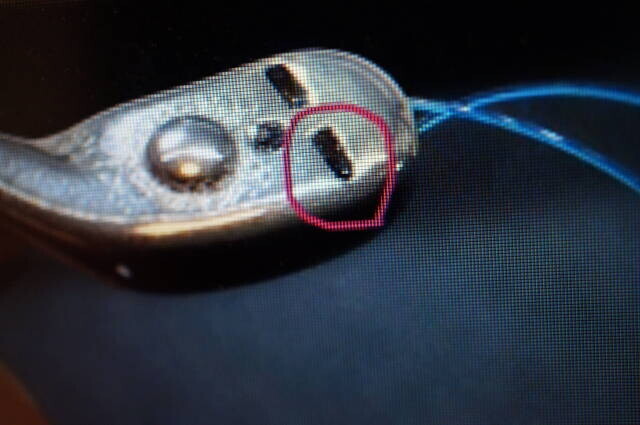
An entry published in October 2018 concerned Mr. Okada's rectal prototype, rather than a urethral chip. He attributed bleeding during testing to protruding wire. He also reported resin damage after approximately 5 days in bleach at a 20-fold dilution. He therefore raised dissolved resin as a possible explanation for the exposure, rather than treating poor initial construction as certain.
(Source: ok-lab's diary, published October 2018)
https://ok-lab.hatenablog.com/entry/20181020/1540018080
Rough ceramic surfaces led Mr. Okada to seek medical care
In an entry published in June 2019, Mr. Okada described fever and a urology visit following tests of a deliberately roughened ceramic chip. According to his account, the consultation confirmed a urethral injury. He wrote that the doctor told him to stop using the roughened device. Mr. Okada also warned against copying that experiment because of the injury risk.
(Source: ok-lab's diary, published June 2019)
https://ok-lab.hatenablog.com/entry/2019/06/15/144142
Tiny exposed wire prompted a sales suspension after bleeding
In an entry published in September 2021, Mr. Okada attributed bleeding to a tiny exposed wire tip beneath insufficient resin covering. He reported that an initial fingertip check had missed it. Sales of the experimental wire attachment (Miko wire) stopped until safety could be established, and pending orders were cancelled. The supplied material does not establish whether that suspension later ended.
(Source: ok-lab's diary, published September 2021)
https://ok-lab.hatenablog.com/entry/2021/09/11/125735
Exposed wire on an integrated stopper prompted a revised attachment
In an entry published in November 2025, a customer reported bleeding and later discovered wire protruding from an integrated stopper. Mr. Okada initially offered a refund because rebuilding could reproduce the problem. He said further similar reports could lead to a sales stop; this was a possibility, not an announced discontinuation.
Later in the same entry, he described a revised attachment bonded along the ceramic body, with additional treatment intended to resist breakage. He also reported measures against slipping in current figure-eight loop orders. Mr. Okada asked customers to report any further slipping.
(Source: ok-lab's diary, published November 2025)
https://ok-lab.hatenablog.com/entry/2025/11/29/122908
A slipping double loop exposed wire and triggered broader connection changes
In an entry published in December 2025, a customer reported pain and bleeding from a chipless wire device. Mr. Okada identified an apparently slipped, doubled 0.4mm wire loop, although the photograph did not establish which loop. He acknowledged previously dropping a retention feature to keep those connections smaller.
He announced retention measures for every connection on future shipments, accepting larger resin joints. He offered a refund or remake, which the customer declined. The customer wanted the report to inform future production.
(Source: ok-lab's diary, published December 2025)
https://ok-lab.hatenablog.com/entry/2025/12/27/122915
A stainless chip burr led to replacement and a reproduced manufacturing fault
In an entry published in January 2026, a buyer reported a burr at the thread hole of a small stainless steel Zoro chip. The buyer requested closer inspection before shipping. OK Lab offered a new replacement after receiving the already altered chip and expressing concern about its changed surface.
A follow-up published later in January 2026 reported that factory finishing wire could damage the unusually thin rim beside that model's hole. Mr. Okada said reproduction tests confirmed the problem when the wire contacted the rim. OK Lab advised reporting defects for assessment and exchange.
(Source: ok-lab's diary, published January 2026)
https://ok-lab.hatenablog.com/entry/2026/01/24/122909
(Source: ok-lab's diary, published January 2026)
https://ok-lab.hatenablog.com/entry/2026/01/31/122917
The maker's answer to rough chip edges
Mr. Okada changed spacing, finishing, shapes, and wire connections, while later entries continued to record problems.
A shorter connection addressed sharp thread joints in the resin design
In an entry published in January 2018, Mr. Okada introduced a linked resin-chip design with a 2mm gap only. Its thread emerged centrally, and he thought a longer exposed section could irritate the lining. Manufacturing constraints also ruled out a zero-length gap. He suggested the resin design for customers concerned about glass breakage, particularly for short-term use.
(Source: ok-lab's diary, published January 2018)
https://ok-lab.hatenablog.com/entry/20180121/1516504265
Separate finishing addressed rough chip edges on an early stopper
In an entry published in June 2018, a stopper tester reported bleeding after prolonged use and discovered a burr. Mr. Okada attributed the defect to additional resin applied after the original construction. The revised design used a separately finished stopper with rounded edges and a sliding connection that allowed adjustable spacing. He said further development meant release would be July at the earliest.
(Source: ok-lab's diary, published June 2018)
https://ok-lab.hatenablog.com/entry/20180609/1528523953
Rubber treatment relieved sharp thread joints, followed by a rounder rear
In an entry published in July 2019, a customer reported that rubber treatment had eliminated weak, prickling pain on a medium-length curved ceramic chip. The customer still disliked its pointed rear and preferred a rounded shape. Silicone rubber, a soft covering material, had been used at the connection.
Mr. Okada accepted that the pointed rear served no necessary function. He changed newly made curved chips to rounded rear ends that month.
(Source: ok-lab's diary, published July 2019)
https://ok-lab.hatenablog.com/entry/2019/07/27/130537
A revised petal loop addressed exposed wire after repeated failures
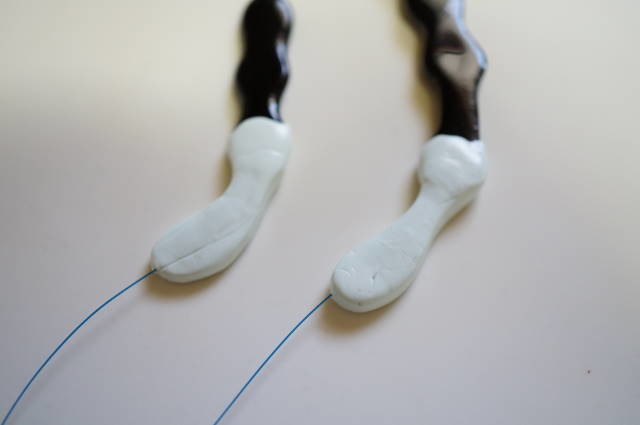
In an entry published in August 2025, a customer described repeated petal-loop failures, including an exposed internal wire that cut the lining. Mr. Okada initially proposed thicker rubber repairs and considered ending sales if failures continued. He then presented a revised design using straight wire held open by rubber, without permanent bending.
He said this required extra manufacturing work and larger joints. The customer confirmed receiving a repair, but the revised design's long-term result is not recorded. Mr. Okada offered further maker repairs for the reported failures.
(Source: ok-lab's diary, published August 2025)
https://ok-lab.hatenablog.com/entry/2025/08/30/122943
If you see blood in your urine, even a small amount or for the first time, do not wait and see. See a urologist right away.
If you suddenly cannot urinate, or the device cannot be removed, do not try to fix it yourself. Go to a medical facility, including emergency care, immediately.
How rough chip edges changed over time
| Published | What the diary said then |
|---|---|
| Oct 2017 | An early prototype covered an exposed thread knot with silicone. |
| Aug 2019 | Aluminum reinforcement became the planned standard; exposed metal prompted a repair offer. |
| Aug 2020 | Rubber joint covers became standard for the fourth sea-slug design and two-thread chips. |
| Jun 2021 | Wider connection holes allowed thread movement, which Mr. Okada described as eliminating pointedness. |
| Aug 2022 | Wire covers used 3mm outer/2mm inner tubing; connections up to 20cm cost ¥1,000 (about $6 at ¥156 = $1, rate as of 2026-09-04) excluding tax. |
| Nov 2022 | A silicone-tube connection eliminated the step at its ceramic-chip joint. |
| Jun 2023 | The earlier four-wire cable support was discontinued because wire-strength problems remained unresolved. |
| Nov 2024 | A 1mm thread hole raised irritation concerns; a wire sleeve added ¥1,000 (about $6 at ¥156 = $1, rate as of 2026-09-04) excluding tax. |
| Feb 2025 | A revised locking prototype covered its painful hardened thread connection with rubber. |
| May 2026 | The fine-wire prototype covered every 0.04mm wire tip with silicone rubber. |
OK Prostate Chip products related to rough chip edges
The supplied current list includes models discussed in these injury and repair reports.
Products that appear in these entries
| Product (official name) | Price incl. tax | Relation to this topic |
|---|---|---|
| Glass awakening chip (OKプロステート覚醒チップ) | ¥5,500 (about $35 at ¥156 = $1, rate as of 2026-09-04) | A September 2018 customer reported a crack with a raised edge. |
| Ceramic awakening chip (OKプロステートチップ 陶器素材覚醒タイプ) | ¥5,500 (about $35 at ¥156 = $1, rate as of 2026-09-04) | A June 2019 customer reported a painful thread connection. |
| Short curved ceramic chip (OKプロステートチップ 陶器素材ショート勾玉タイプ) | ¥4,400 (about $28 at ¥156 = $1, rate as of 2026-09-04) | The same June 2019 complaint identified a painful connection on this model. |
| Medium-length curved ceramic chip (OKプロステートチップ 陶器素材セミロング勾玉タイプ) | ¥5,500 (about $35 at ¥156 = $1, rate as of 2026-09-04) | A July 2019 customer reported relief from prickling after rubber treatment. |
| Stainless steel Zoro chip (OKプロステートチップ 凶悪ゾロ(サージカルステンレス)) | ¥9,900 (about $63 at ¥156 = $1, rate as of 2026-09-04) | A January 2026 complaint concerned a burr on the historical S-size model. |
(Source: ok-lab's diary, published September 2018)
https://ok-lab.hatenablog.com/entry/20180922/1537592180
(Source: ok-lab's diary, published June 2019)
https://ok-lab.hatenablog.com/entry/2019/06/29/143536
(Source: ok-lab's diary, published July 2019)
https://ok-lab.hatenablog.com/entry/2019/07/06/152113
(Source: ok-lab's diary, published July 2019)
https://ok-lab.hatenablog.com/entry/2019/07/27/130537
(Source: ok-lab's diary, published January 2026)
https://ok-lab.hatenablog.com/entry/2026/01/24/122909
Products the diary mentioned as alternatives
The diary names no alternative.
For the historical custom long chips, roughened ceramic test piece, early stopper prototypes, and later custom wire-loop assemblies: No matching product can be confirmed on the current list.
Common worries about rough chip edges
Customers asked about repairs, refunds, and whether protective rubber itself caused pain.
"Can painful thread joints be repaired after use?"
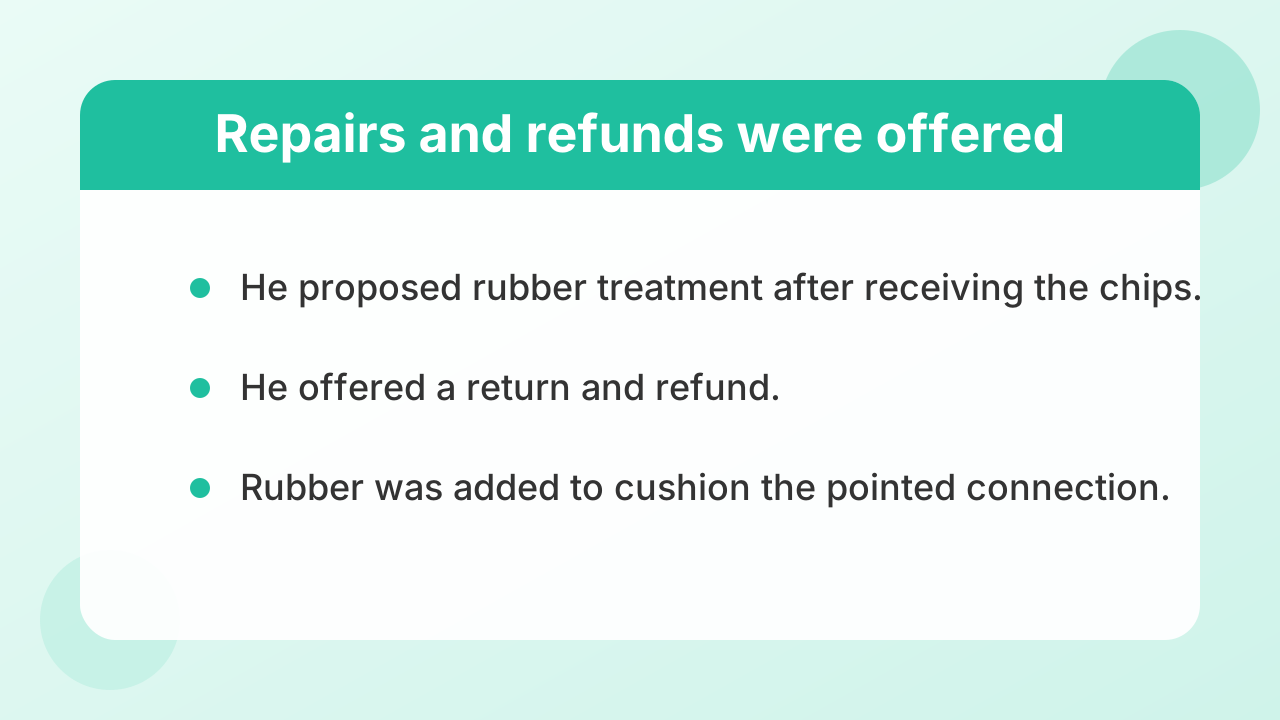
In an entry published in June 2019, a customer reported painful connections on both an awakening ceramic chip and a short curved ceramic chip. The customer worried that prior use prevented an exchange. Mr. Okada acknowledged recognizing the pointed connection during development but previously judging it acceptable.
He offered rounding work, then proposed rubber treatment after receiving the chips. That entry does not record how the returned products felt afterward. Mr. Okada asked the customer to return them for repair.
(Source: ok-lab's diary, published June 2019)
https://ok-lab.hatenablog.com/entry/2019/06/29/143536
"Can rough chip edges qualify for a refund?"
In an entry published in February 2020, a customer requested an exchange because the white resin connection caught against a finger. Mr. Okada initially offered replacement for a manufacturing fault, or a refund if the finish matched standard production. After inspection, he judged the returned glass chip typical of his products.
He explained that more resin had been adopted to strengthen the connection, making its outline less even. He acknowledged that his confidence in the finish could not settle the customer's concern. He offered a return and refund because another build would have a similar finish.
(Source: ok-lab's diary, published February 2020)
https://ok-lab.hatenablog.com/entry/2020/02/15/144151
"Could protective rubber cause pain around sharp thread joints?"
In an entry published in March 2025, a customer reported repeated bleeding with a custom sea-slug chip whose threads emerged separately. The customer requested a shared exit and questioned the rubber covering. OK Lab explained that the rubber had been added to cushion the pointed connection, and the customer deferred a decision on the rubber protection.
Mr. Okada thought two separated threads could strongly irritate a narrow passage. He favored keeping the rubber on this shape and advised against separately emerging threads when the fit was already tight.
(Source: ok-lab's diary, published March 2025)
https://ok-lab.hatenablog.com/entry/2025/03/22/122906
Buying from outside Japan

OK Lab ships internationally to countries covered by Japan Post's EMS courier service. Overseas orders are paid in advance by PayPal. Each order carries a ¥400 (about $3 at ¥156 = $1, rate as of 2026-09-04) handling fee, and EMS shipping is charged on top. These terms come from OK Lab's official sales-terms page (written here as plain text, not a link: ok-lab.net/docs/law), checked on September 7, 2026; confirm them on the official store before you order, because they can change.
Summary of this article
| What you wanted to know | The answer |
|---|---|
| In short: has injury been reported? | Yes; the diary records scratches, bleeding, and changes following complaints. |
| About this product: what is it? | A urethral device made and sold by OK Lab in Japan. |
| Key terms: which parts matter here? | Surfaces, retrieval threads, stopper connections, resin coverings, and wire ends. |
| What happens around rough edges? | Reported problems include cracks, raised connections, and exposed metal; suspected causes are not always confirmed. |
| What did the maker change? | Spacing, finishing, rear shapes, rubber coverings, and connection retention. |
| How did the issue develop? | The supplied entries trace different defects and responses from October 2017 through May 2026. |
| Which current products appear? | The table identifies listed models and current tax-inclusive yen prices. |
| What did customers ask? | Whether painful joints could be repaired, refunded, or changed without removing useful protection. |
| How does overseas buying work? | Advance PayPal payment, a ¥400 (about $3 at ¥156 = $1, rate as of 2026-09-04) handling fee, and additional EMS shipping charges. |
Source: ok-lab's diary (Okada Comfortable Life Laboratory). The original entries are in Japanese; quotations on this page are translated. Photos and videos are on the original entries.
This article is a summary of the maker's development diary. The product is not a medical device and no result is guaranteed. If anything feels wrong or worries you, see a doctor. Prices, specifications and cautions change, so confirm the latest information on the official blog and the official site. Questions about ordering and shipping go to the seller.